
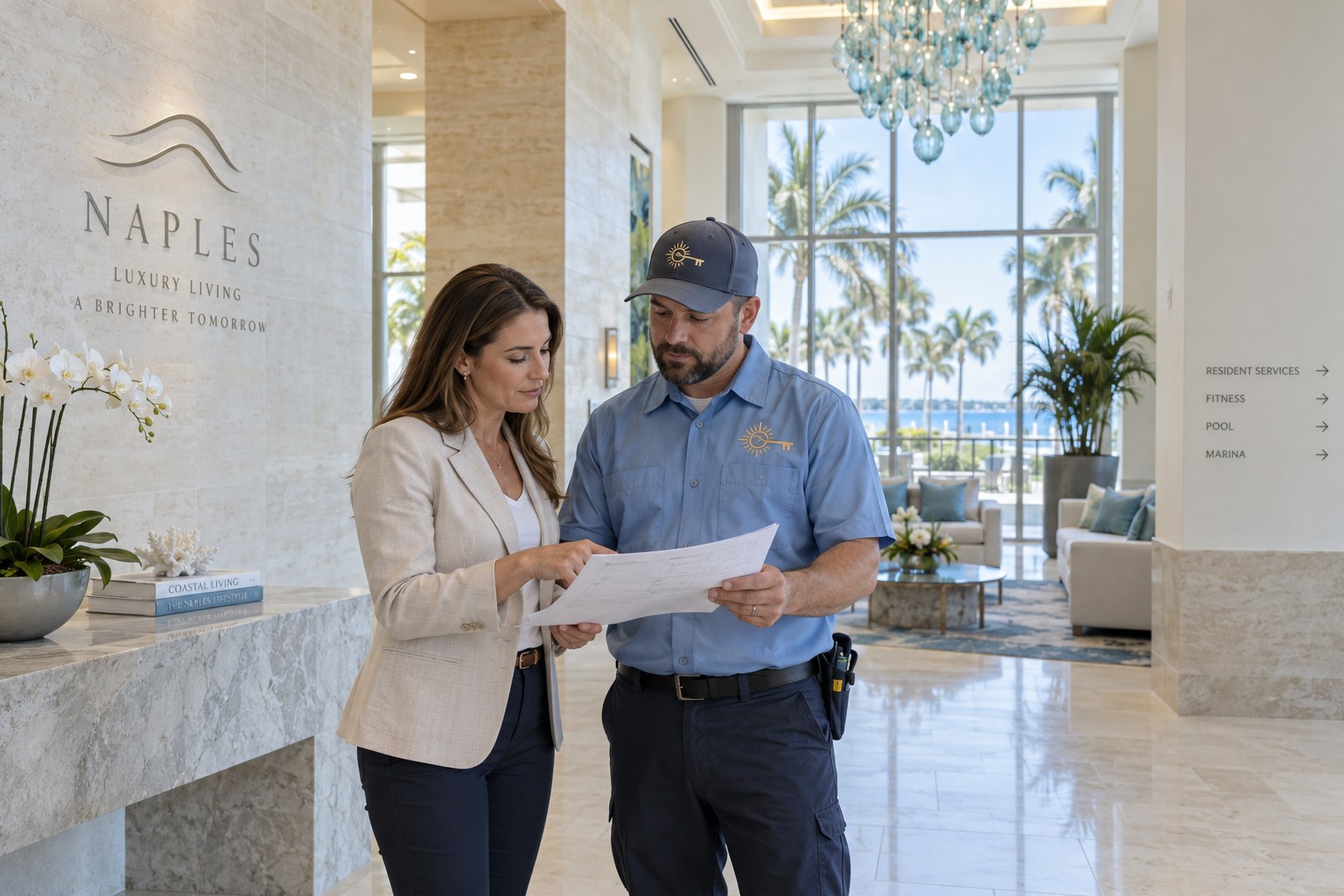
Why a business door is never just a bigger home door
A business lock serves many people with different reasons to be there. Staff arrive early and leave late, customers come and go, cleaners and vendors need access at odd hours, and in many buildings tenants share corridors and entrances. That mix changes every decision about hardware, keys and records. The pages in this group are arranged by type of place and type of problem, from offices and restaurants to clubhouses, plazas and marinas, so you can find the one that looks most like your building before reading the details. Choosing by building type first saves time, because the hardware and the risks tend to follow the use of the space.
Life safety adds a layer that rarely applies at home. Exit doors have to open easily from the inside for the people using them, fire-rated doors have rules about how they close and latch, and public areas have expectations around hardware that homeowners never think about. A responsible locksmith respects those constraints, and several pages here explain how security and safe exit are balanced. If a question touches on codes or inspections, the building authority and the property's own advisers have the final say, and the locksmith will tell you plainly where that line is.
Naples brings local texture to all this: condo towers with service corridors, gated communities with common buildings, shopping plazas full of small tenants, marinas with salt-exposed gates, and farm offices on rural land. Humidity, salt air and the seasonal rhythm of occupancy affect hardware wherever you look. As you read, notice which pages describe your kind of building and which describe a neighbor type, because the lessons often carry over from one setting to another. Those details are part of the reason a visit to look first is sometimes wiser than guessing from a description over the phone, especially for older or larger buildings.
Choosing between a single fix and a system
Small businesses often begin with one lock and a few keys, and for a long time that works. Then a key goes missing, an employee leaves, a second tenant moves in, or the hours expand, and suddenly the question is no longer how to fix a lock but how to manage access. The pages on master key systems, keyed-alike confusion and badge access are written for that moment. They explain in plain terms what a system adds, what it costs in planning effort, and when a simpler arrangement is perfectly adequate. Having that conversation before a crisis makes every later decision calmer.
A useful test is to count the people and the doors. If a handful of people use a few doors, good rekeying and a clear key log may be enough. If several tenants share a building, or many staff need different levels of access, a structured approach with levels of keys or electronic credentials begins to make sense. Electronic access removes the need to chase down physical keys but brings its own concerns, including power, software and what happens if the reader fails. The pages discuss those tradeoffs without pushing any one direction. Take your time with this part, since it is the decision that shapes daily habits for years afterward.
Whichever route you choose, think about growth. A system built for the business you have today may feel cramped in two years, and a system built for ten locations may be wasteful for two. A locksmith can talk through phasing, starting with the doors that matter most and leaving room to add the rest. That conversation begins by phone, and when the layout is complicated, a technician visits to look at the building before anything is proposed, with the service call charge explained before dispatch. Planning in phases also spreads the effort so no single week feels overwhelming for the people who run the place.
Preparing a building for a locksmith visit
Authority comes first in a commercial setting. Before a technician opens, rekeys or replaces anything, they confirm that you have the right to approve the work. For a tenant that may mean a lease and a note from the landlord, for a condo association it may mean a board decision, and for a property manager it may mean a management agreement. Having that paperwork ready, or knowing who can provide it quickly, turns a long delay into a short one. This applies to everything from storage units to church halls, and the individual pages note any variations.
Next, prepare the facts of the building. Know how many doors are involved, which ones matter most, what kinds of locks are on them and whether any of them are fire-rated or part of an exit path. Know who holds keys today, including cleaners, contractors and past employees. If there is a key list, find it, and if there is not, start one on the day of the visit. Take photos of the door, the frame and the hardware, which helps the technician bring the right parts and gives you a record of the starting point.
Finally, think about timing and access. A business may not be able to close for a repair, so tell the technician about busy hours and any quiet window. Call to confirm availability and ask that someone with authority be present or reachable. If the work affects a shared space, let neighbors, tenants or the association know in advance. A well-prepared visit often finishes sooner and leaves the building in better shape than a rushed one, and it gives your staff a clear picture of how the new arrangement works. A short written note of what was agreed helps the next person who inherits the property.
Mistakes that quietly weaken a building's security
The most common mistake in commercial properties is the key that nobody tracks. A former employee, a retired contractor or a vendor who changed jobs still holds a key to the back door, and nobody remembers. Because nothing visibly goes wrong, the problem sits unnoticed until it matters. The pages on staff turnover, office suites and storage describe how to rekey on a sensible schedule and how to keep a simple record that survives a change in management. It is not glamorous work, but it is the foundation of a secure space. A yearly check of this kind takes little time and prevents a great deal of guesswork.
A second mistake is patching hardware that has reached the end of its life. A panic bar that sticks, double doors that no longer line up, or a keypad that forgets its code are not cosmetic nuisances. They are signs that the hardware is wearing out or that the door has shifted. Repeated temporary fixes cost attention and sometimes leave an exit unreliable. The pages on these topics explain when a repair is reasonable and when replacement is the more honest answer, always in the context of the building's particular use. Reliable hardware is part of how a business earns the quiet confidence of its staff and visitors.
A third mistake is treating shared codes as private. A clubhouse keypad, a pool gate or a lockbox can keep the same code for years, and by then half the community knows it. The better habit is to change codes on a schedule and after any known exposure, and to tell the people who need them. Those pages show how to do that without causing confusion. In every case, ownership and authority are checked before codes or keys are changed, since shared spaces involve many stakeholders. Treat the code like a key and the habit follows naturally, including who is told and when.
Storms, salt air and the seasonal rhythm of property use
Many commercial and common-area locks in the Naples area live in the open or near it. Gates at marinas, doors at clubhouses, storage units, roll-up doors and farm sheds all face humidity, salt air and sun. Hardware that looks fine in spring can seize by late summer. The pages on hurricane preparation and seasonal turnover explain what to check before the season begins: whether gates close and latch properly, whether padlocks turn, whether hinges and strikes have corroded, and whether a spare key and a record of codes exist in a safe place. The advice is simple: look before the season starts, not after the first storm warning.
Seasonal occupancy matters as well. Condos and rental communities are busiest at some times and quiet at others, and a quiet stretch is the right moment to service locks, change codes and replace worn hardware. Associations that wait until peak season to fix a broken gate or a stuck mailbox lock often find the repair is harder to schedule and more disruptive to residents. The group pages for HOA, condo and rental properties offer a calendar-minded way of thinking that is less about rules and more about steady, modest maintenance. Quiet months are a gift to anyone responsible for a building, so use them well.
After a storm, doors may have shifted or filled with debris, and electronic access may have lost power. A careful walk-through, looking for latches that no longer catch and readers that no longer respond, is wise before relying on the building again. If something is off, call and describe it. The technician can often tell by phone whether the issue is a simple adjustment or a repair that deserves a visit, and the explanation includes what the visit involves and how the service call charge works. Document what you find, even briefly, so the next walk-through starts with a record.
Using the pages together as a planning guide
Though each page speaks about a particular place or problem, together they make a planning guide. Start with the page nearest your building type to understand the usual hardware and risks. Then read the page about the situation you are in, such as a lost key, a departing employee or a stuck exit. Then glance at the pages on key control and access systems, since almost every problem here eventually leads back to the question of who holds what. Reading in that order moves from picture to problem to prevention. Each page stands on its own, yet they are meant to be read as a set that supports one another.
Property managers and board members can use the same pages as a checklist for a yearly review. Walk the property, door by door, and ask the questions the pages raise: does it latch, does it open from inside, who has keys, when did we last change codes, and does the hardware show signs of corrosion. Even a short walk-through often finds two or three items that are easy to address today and expensive to ignore. A locksmith can join the walk when the property is large or the situation is unusual. Make it a routine, perhaps once a year, and the property stays in a more dependable condition.
When in doubt, call and describe the building. Explain what it is used for, how many people rely on it and what has changed. The answer might be a simple phone quote, or it might be that a technician should come look first. Either way you will hear the process explained before anything is done, and no work starts without your approval. That clarity is the point of this whole group: to help you make a calm, informed decision about a space that many people depend on. Informed decisions are calmer decisions, and calm is what a busy building needs most.