
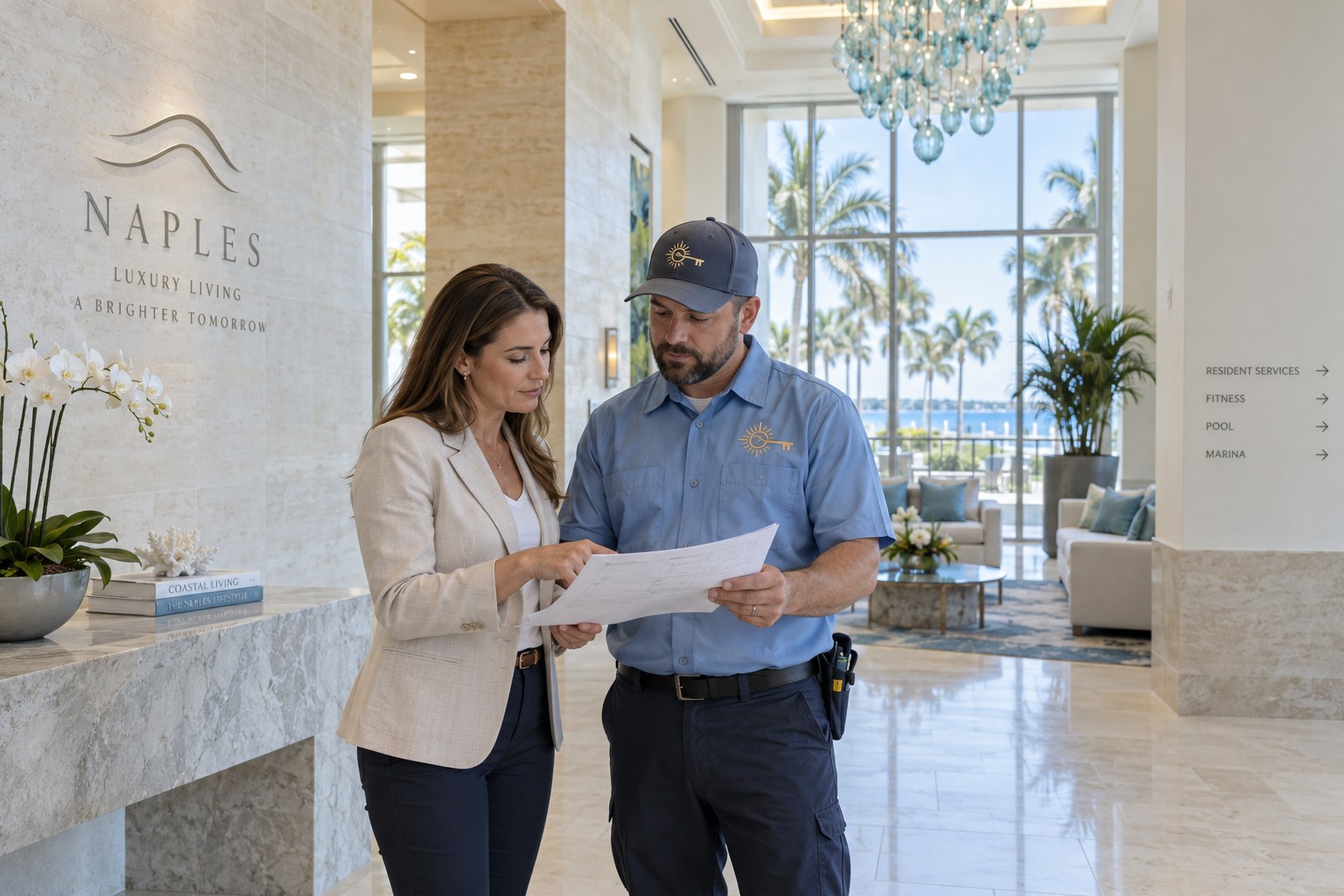
A small office in Naples has a bookkeeper who has resigned, and she still carries a key to the suite. Nothing is wrong, yet nothing feels settled. This page walks through the situation as a locksmith sees it: what is worth changing, what can be left alone, how rekeying compares with replacing cylinders, and how to keep control of keys from this point onward.
The quiet problem of a key nobody collected
Most departures are friendly. The employee hands back a laptop, a badge and perhaps a parking pass, and the office key either comes back in an envelope or goes home in a pocket by mistake. Weeks later someone wonders whether it was returned, and nobody is sure. That uncertainty is the real problem, because an office cannot confidently say who can enter.
It is rarely about suspicion. People forget keys in coat pockets, move house, or keep a spare on a ring they never think about. But a key that is unaccounted for is a standing opening into your records, equipment and client files, and it stays that way for years unless something is done.
The practical question is not whether the person is trustworthy but whether you can show who holds access. If you cannot, the solution is usually to change what the key does, not to chase the key. That is the heart of the decision between collecting, rekeying and replacing, and it is worth walking through before you call anyone.
Rekeying versus replacing the cylinders
Rekeying changes the internal pins of an existing cylinder so that it works with a new key and no longer works with the old one. The cylinder stays in the door, the lock body is untouched, and the cost and time are modest. For most small office suites with sound hardware, rekeying is the sensible first choice.
Replacing the cylinder means removing the old one and installing a new unit. That makes sense when the existing cylinder is worn, corroded, damaged, or of a type that can be copied freely at any hardware counter and you want to move to a restricted keyway. In Naples, humidity and salt air can leave cylinders gritty, which is a good reason to replace rather than rekey.
A third option is replacing the entire lockset. That is rarely needed just because of a departure, but it may be worthwhile if the door is old, the handle is loose or the latch binds. A technician can examine the door and tell you plainly whether rekeying will do the job or whether you would be putting a fresh key into tired hardware.
- Rekey: lowest disruption, works when hardware is sound
- Cylinder replacement: for worn parts or a move to restricted keys
- Full lockset replacement: when the lock body itself is failing
Who is allowed to ask for the change
Before a technician rekeys a suite, they confirm that the person asking has authority over it. In a small office, that is typically the owner or the manager named on the lease. If the building is leased, there may also be a landlord who controls the door, and sometimes the lock is part of the building's master system.
This matters more than it sounds. An employee who calls a locksmith on their own to change the locks on a shared suite is not necessarily entitled to do so, and a locksmith who helps without checking could create a serious conflict. Expect to show identification and some evidence of your role, such as a lease, business registration or a note from the owner.
If you are the owner, bring that information along and the process is quick. If you are the office manager acting for the owner, a short message from the owner confirming your authority is enough. If authority is unclear, the technician will explain what is missing and wait, which may be frustrating but is exactly the discipline that protects your office.
Checking the building before deciding
Many suites in Naples sit within a larger office park, plaza or professional building. The suite door may be controlled by the landlord's master key system, which means changing it without permission could lock out the property manager or violate your lease. A quick check of the lease or a call to the manager saves headaches.
Some buildings allow tenants to rekey their own suites as long as they provide a copy of the new key. Others require the landlord's locksmith to do it. A technician can tell you quickly which cylinder type is installed, but the rules come from the landlord. Asking early prevents a return visit.
Other doors may also deserve attention. A suite often has a front door, a back door, a supply closet, a file cabinet and perhaps a server room. Walking through the whole space with the technician reveals which ones the departing employee could open, and the list of doors to change often turns out longer than expected.
Setting up key control going forward
A one-time rekey fixes this departure. A simple key control habit prevents the next one from causing worry. Start with a short sheet listing every key, its stamp or number, who holds it and the date it was issued. Update it whenever someone joins or leaves.
Consider limiting who holds a full key. Many offices give a part-time employee a keypad code instead, which can be changed in seconds with no need to collect anything. Keypad deadbolts work well on a suite door when staff change frequently, provided the door closes squarely and the batteries are checked.
Use restricted keys if you are concerned about copies. With a restricted keyway, only the owner or an authorized contact can order duplicates, which prevents a key from being quietly copied at a hardware counter. A technician can set this up during the rekey and explain how to request additional keys later.
Offboarding as a routine, not a crisis
Offices that handle departures well do not treat them as events. They have a short checklist that includes returning keys, deactivating accounts, collecting equipment and changing any shared codes. Adding a line for keys, with a signature on a return form, takes seconds and creates a record.
When a key is returned, check that it is the right one and not a copy. A key stamped with a number that matches your sheet is easy to verify. If a key is missing and the employee says it was lost, treat it as unaccounted for and decide whether the risk justifies a rekey. In most offices, it does.
For sudden or uncomfortable departures, move faster. Arrange for the locks to be changed the same day if possible, ideally before the person returns. Please call us to confirm availability. A technician can often rekey several doors in a single visit, which is much less disruptive than people expect.
Salt air, old cylinders and the condition of the hardware
Hardware age matters when you rekey. Cylinders that have lived through years of Gulf humidity may feel rough, and rekeying a cylinder that is already failing wastes effort. A technician will test the lock by turning it several times, check for play in the cylinder and look for corrosion on the keyhole and bolt.
If the cylinder is in good shape, rekeying is straightforward. If not, replacing it is a better investment, particularly for exterior-facing doors that get salt spray. Brass or stainless cylinders hold up well, and a dry lubricant keeps them smooth.
Hinges and strikes also tell a story. A suite door that sags or scrapes can make a new key feel just as bad as the old one. Adjusting the door during the visit often removes complaints that staff had long attributed to the lock. It is a small extra that improves daily use.
What happens on the day
When you call, describe the doors, the type of locks if you know them, and how many keys you want. Explain whether you rent the space and who controls the building. Quotes are given by phone for straightforward rekeying. If the situation is complicated, such as unknown lock types or a master system, a technician visits first and the service call charge is explained before dispatch.
On arrival, the technician confirms authority, inspects each door and tests the existing locks. Rekeying usually involves removing the cylinder, changing the pins, cutting new keys and refitting the cylinder. Each door is tested with the new keys, and the old keys should no longer work.
Before leaving, the technician hands over the new keys and tells you how many were cut. Add them to your key sheet and decide who receives which. If you need more keys later, call and the technician will confirm who is authorized to order them, which keeps your key control intact.
Letting staff know without creating drama
Employees notice when locks change. A short, neutral explanation helps: the office is updating its keys as part of regular practice, and everyone will receive a new one. Presenting it as routine avoids implying anything about the person who left.
Hand out new keys in person, record who received them and ask each person to return the old key. Some offices do this at a short staff meeting. Others place each key in an envelope and ask the employee to sign. The method matters less than having a clear record.
Finally, consider setting a reminder to review the key sheet once a year. Offices change faster than anyone expects, and a ten-minute annual check keeps the list accurate. When the next person leaves, you will already know exactly who holds what and whether any rekey is needed.
Cabinets, safes, desks and the locks inside the suite
The suite door is only part of the picture. Inside, there may be a filing cabinet with client records, a desk drawer holding checks, a small safe, a supply closet and a back office. A departing employee may have had keys to several of these, and each one has its own separate lock that the door rekey will not touch. Walk the office with a pen and list every lock that uses a key.
Furniture locks are often cheap and use a small number of key patterns shared across thousands of desks, which means a stray key from another office could open yours. Replacing those cylinders with unique ones is a quick, inexpensive job for a locksmith with the right stock. Cabinets can usually be rekeyed on site, and the keys are small enough to keep on a single ring.
If there is a safe, remember that the key is only one element. Combinations should be changed when a trusted employee leaves, and a technician can do that for common models. Ask about it at the same visit. Keeping the safe, the cabinets and the suite doors on a single schedule makes the whole office easier to manage.
Shared offices, executive suites and seasonal staff
Naples has many small professional offices, shared suites and seasonal operations that staff up for the winter months and wind down in summer. These arrangements generate departures at predictable times, which makes planning easier. A short rekey at the end of each season, as a routine task, is far simpler than reacting to each individual departure.
In shared suites, keep a clear boundary between private offices and common areas. A shared front door might use one key held by several tenants, while each private office has its own. When a tenant leaves, only their office and perhaps the shared door need attention. A technician can map this arrangement and propose a sensible plan.
Seasonal staff are best handled with keypad codes or temporary keys that are logged and returned. If someone works only from January to April, having a defined return date written on the key sheet means the question of the missing key never arises. It is a modest bit of discipline that pays back every year.
Common mistakes after a departure
The most common mistake is doing nothing because the departure was friendly. The second is changing only the front door and forgetting the back door, the storage closet and the cabinets. The third is asking an employee to arrange the lock change, which puts someone with an interest in the outcome in charge of the access list. Ownership of that decision should stay with the person responsible for the business.
Another mistake is buying a lock at a hardware store and installing it without checking how it fits the door. A lock that is slightly off can bind, and a bolt that does not reach the strike fully offers little protection. A technician can evaluate the door in minutes and avoid the false sense of safety a poorly fitted lock provides.
Finally, many offices fail to record what they did. Without notes, the next departure begins from scratch. A single page stating the date, the doors changed, the number of keys cut and who received them is enough. It becomes the first line of your key log and removes most of the guesswork from future decisions.
When the departure is not friendly
Some departures are abrupt, tense or involve a dispute. In those cases the question of keys becomes urgent and emotional. The calm approach is to treat it as a procedure: decide what must be secured, call a locksmith to change those locks, and keep a written record of what was done and when. Avoid confrontations at the door, and avoid asking the locksmith to take sides.
A technician cannot decide who is right in a dispute. What the technician can do is confirm that the person authorizing the work has legitimate authority over the space. If two people both claim authority, the locksmith may decline until the matter is clarified, which protects everyone. Having your lease and business documents ready makes this smooth.
If the former employee has property in the office, arrange a time for them to collect it with a trusted person present, rather than leaving the key in their hands. Many offices box personal items and hand them over at the door. That keeps the relationship civil, the office secure and the record clean for any later conversation.
A simple one-page procedure to keep on file
Once the dust settles, write the whole sequence on one page and keep it where the person responsible can find it. It should list the steps in order: collect keys and badges, check them against the key sheet, decide which doors and cabinets need rekeying, confirm who has authority, call the locksmith, receive and log the new keys, and brief the staff. Having it written means the next departure will not depend on anyone's memory.
Add the practical details that tend to get lost. Include the name of whoever holds authority under your lease, the landlord's contact for questions about master keys, and the date of the last rekey. Include a note about which doors in the suite have hardware that can be rekeyed on site and which would need parts ordered, which a technician can tell you during the visit.
Frequently asked questions
Do I have to rekey if the employee says they returned the key?
Not always. If the key is verified against your sheet and you are confident no copies exist, you may choose to keep the locks as they are. If you cannot confirm that, rekeying is a modest step that removes the uncertainty. A technician can talk through the tradeoff with you.
Can a manager call for a rekey without the owner knowing?
The locksmith checks that the person asking has authority over the suite. A manager may have it, but we may ask for written confirmation from the owner or a lease. If the landlord controls the door, they may need to approve it as well.
What if the building uses a master key?
Changing a cylinder that is part of a building master system without permission can create problems with your lease and with building access. Check with the landlord first. A technician can identify the cylinder type and suggest options that fit the building rules.
Is a keypad better than keys for an office with frequent turnover?
It can be. Codes can be changed quickly and do not need to be physically collected. Keypads need battery checks and a door that closes properly. A technician can look at your door and tell you whether it suits a keypad.
How long does an office rekey take?
It depends on the number of doors and the condition of the hardware. A technician can estimate after you describe the suite. Please call us to confirm availability, and we will explain what the visit involves and how quotes work.