
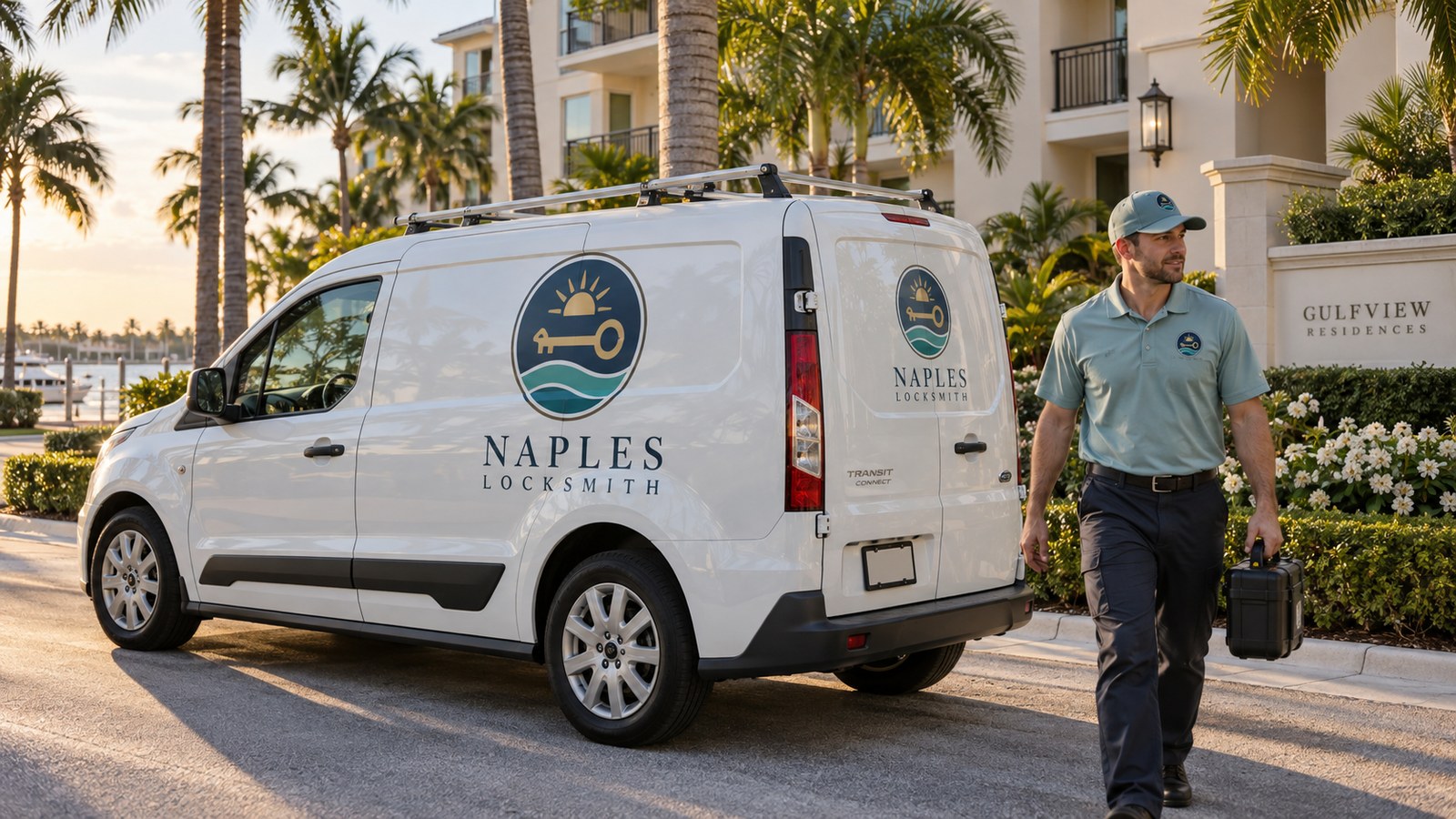
You step into the hallway for the newspaper, the door swings shut, and your key is on the kitchen counter. In a condominium, the situation has an extra layer: the association may hold an emergency key, the door may be fire rated, and building rules decide who can do what. This page walks through how a lockout in a Naples condo is handled calmly, from the first phone call to the final test of the lock.
The first few minutes in the hallway
The moment the door clicks shut, most people feel a small jolt, then a quick rehearsal of what is inside: the phone, the wallet, the stove, perhaps a pet. Take a breath and check the basics. Try the door handle once more. Check whether a balcony or lanai door might be unlocked, though going over a railing is never a good idea. Look in your pockets, because a key is sometimes hiding in a jacket.
Next, decide how urgent the situation is. If a pet is inside in the heat, a stove is on, or someone vulnerable is trapped behind the door, contact emergency services first. For an ordinary lockout, where nobody is in danger, you have time to choose the cleanest route. The hallway of a condo is usually a calm place, and a few quiet minutes of planning save trouble later.
Keep your phone handy if you have it. Many lockouts happen with the phone inside as well, in which case a neighbor's phone or the lobby desk becomes your tool. Memorizing one number, such as a family member or the management office, is surprisingly useful. Write it on a card in your wallet and you will never be stuck in a hallway without a way to reach someone who can help.
Think about who might help. Do you have a spare key with a neighbor, a relative or a property manager? Is the front desk staffed? Does the association keep a key on file? Answering those questions tells you whether you need a locksmith at all. In many buildings, the office can open the door for a verified owner in minutes. In others, the key is locked away or the office is closed, and a locksmith becomes the practical answer.
Why the association may hold a key
Many condominium associations keep a key, a code or a lockbox for each unit. The purpose is practical: in a water leak, a fire alarm, a medical emergency or a pest treatment, staff or responders need to reach a unit when the owner is away. The arrangement is usually written into the building's rules, and owners agree to it when they buy. It is a safety net rather than a convenience.
These keys are guarded carefully. A cabinet in the office, a safe or a sealed envelope system tracks who takes a key and why. Most associations do not hand a key to a resident on request without checking identity and recording the event. That caution protects every owner in the building, including you. It can feel slow when you are standing in a hallway, but it exists for good reasons.
If the association holds your key, calling the office or the manager is often the first step. Ask about the procedure: what identification is needed, who must accompany you and whether there is an after-hours contact. If the key is available and the process is quick, use it. If the key cannot be found, the cabinet is locked or the person who holds it is unreachable, a locksmith can step in with the association's knowledge.
How we verify ownership before opening
Opening a door is a serious act, and we do not do it on a claim alone. Before a technician opens a unit, we ask for proof that you live there or own the unit. A photo ID with an address matching the unit is the simplest. Mail addressed to the unit, a utility bill, a lease agreement or an association record can also help. The goal is to be sure the person asking has the right to enter.
If your ID does not show the address, other evidence may serve. A neighbor who knows you, a building staff member who recognizes you or a call to the manager can confirm that the unit is yours. Occasionally, an owner has left their wallet inside as well. In that case, we may need building staff to confirm identity, or we may wait while someone brings documents. It takes more time but protects the people involved.
We also consider the case where the person at the door is a guest, a tenant or a family member. Tenants usually have a lease, and the landlord can verify it. Guests and family members need the owner or tenant to authorize entry. We do not open a unit for someone who cannot show a connection to it. If we decline, we explain why and suggest the next step, such as contacting the owner or the association.
Telling building management before we begin
In a managed condo, it is good practice to let the office know that a locksmith is coming. Some associations require it. Staff may need to open the building entrance, hold an elevator or meet us in the hallway. They may want to record the event, and they may ask us to follow certain procedures. A call to the office at the start avoids misunderstandings and keeps the building running smoothly.
Management can also tell us about the door. Is it fire rated? Does the association restrict hardware? Is there a special lock or an extra bolt installed by a previous owner? Have recent changes been made to the key system? Knowing these things lets the technician plan the approach and bring the right tools. It also helps if the association has a preferred contractor list we should follow.
If the office is closed, we still try to follow the building's rules. We may leave a note or a message, and we document what we did. Some buildings have security staff on duty overnight who can help. Where nobody is available, we proceed as carefully as possible, keep the work minimal and report the event to management afterward. We never override a building rule we know about without the proper authority.
Opening a fire-rated door without harming it
Most condo unit doors are fire rated, meaning the door, the frame and the hardware work together as a tested assembly. Damage to the door can affect that rating, and repair can be costly and slow. That is why we favor non-destructive methods whenever possible. The aim is to open the door so that it closes, latches and looks exactly as it did before.
The best technique depends on the lock. Many entry locks can be opened by manipulating the latch or the cylinder. Deadbolts that are not thrown can often be bypassed through the latch. Deadbolts that are thrown and secured require more skill, and each situation is different. A technician evaluates the door and explains the likely approach, including any chance that the lock itself might need replacement.
Drilling is a last resort on a rated door. If we must drill a lock, we explain the consequences first, including that the lock will be destroyed and the door may need repair. The association may need to be told, and the owner is responsible for restoring the door's integrity under building rules. We would much rather spend extra time on a careful opening than hand you a damaged door.
What happens once the door is open
After the door is open, the technician checks that it still closes, latches and locks properly. A lock that has just been opened may behave differently, and a small adjustment can prevent a repeat lockout. If something was disturbed during the opening, we fix it before leaving. We also check the strike plate and the door edge, because those are the places a mark would show.
Now is a good moment to think about why the lockout happened. Was the door a self-locking type, where the latch catches every time it shuts? Are you carrying a key that is too bulky or fiddly? Would a keypad, a spare key in a trusted place or a smart lock make daily life easier? A technician can talk through the choices, though there is no obligation to change anything.
If you want a spare made, or the lock rekeyed because you are unsure where the missing key is, say so. Rekeying changes the lock so the lost key no longer works. If the key was lost in a public place, rekeying is a sensible precaution. Check your association's rules first, because some require that any change to the unit lock be reported, with a new emergency key supplied to the office.
Records, receipts and keeping the board informed
A lockout in a condominium leaves a small paper trail, and that is a good thing. The association may log the event so there is a record of who entered a unit and when. We keep our own notes too: the unit, the time, who was present and what was done. If a question arises later about a scratch on a door or a changed lock, those notes answer it plainly.
If the work involved replacing a cylinder or rekeying, ask the technician to write down what was changed. Pass a short note to management so the file for your unit stays accurate, particularly if the building holds an emergency key. An out-of-date key on file is worse than none, because staff will waste precious time discovering that it no longer fits during a real emergency.
Finally, keep your own copy of the details. Photograph the finished lock and note the date. If your unit is covered by an insurance policy, the paperwork may ask about lock changes, and a clear record makes that easier. None of this is difficult, and all of it helps the next time you, or the next owner, need to know how the door has been handled over the years.
Self-locking doors, keypads and lockout prevention
Many condo doors lock automatically when they close. That feature is a safety benefit, but it is also the reason so many lockouts happen. A moment of distraction, a delivery at the door, a quick trip to the mailroom, and you are outside without a key. The best prevention is a habit: touch your pocket or bag for the key every time the door closes behind you.
Keypad deadbolts remove the key from the equation. You enter a code instead, and you can change the code at any time. They suit people who forget keys, who host guests or who share a unit with family. The tradeoffs are batteries and the need to protect the code. Most also have a key override, and the association may want a copy kept with the emergency keys.
A spare key kept somewhere trusted is simple and reliable. A neighbor you know, a relative nearby or a small lockbox inside the building where rules allow are all options. Avoid hiding keys outside the door in a plant or under a mat, since those are the first places a stranger looks. Whatever you choose, tell the association if the rules require it.
Snowbirds, vacation rentals and absent owners
Naples condos have many owners who live elsewhere for part of the year. A lockout can be more complicated when the owner is not in town. A property manager, a cleaning service or a relative may need to enter the unit, and the question of authority becomes important. We do not open a unit for a third party without authorization from the owner, and that authorization needs to be clear.
If you are out of state and need to arrange access, contact the association first. Provide a written authorization naming the person who will meet the locksmith, along with a copy of your ID, and ask the office to confirm. We may speak with you by phone as well. It takes some coordination, but it protects your home and avoids the risk of a stranger getting in.
Owners who rent through vacation platforms often have guests who lock themselves out. Planning ahead makes this easier. A keypad lock, a lockbox that the association allows, or a local contact with a spare key reduces calls at inconvenient moments. Tell guests the building's rules in advance, including who to call, and note that they should not ask a locksmith to open a unit unless the owner has authorized it.
Dealing with a damaged lock or a lost key afterwards
Sometimes the lockout reveals a worn lock. A latch that sticks, a cylinder that turns hard or a deadbolt that no longer retracts fully are signs the hardware is near the end of its life. In a coastal building, salt and humidity accelerate that wear. If the technician sees these signs, we point them out honestly, and you decide whether to replace the lock now or later.
If the lock does need replacement, remember the building's rules. The association may require a specific brand, finish or function so that doors look consistent and the emergency key still works. We can match those requirements if you tell us, and we can help you request approval if needed. Replacement hardware should fit the existing door preparation, so the fire rating is not disturbed.
If a key was lost, consider the risk. A key that disappeared at the beach is less worrying than one that fell out of a bag in a busy parking lot. Because the key can be linked to your address through the building, rekeying is a prudent step if you are unsure. It is a modest job, and it gives you the comfort of knowing that the old key no longer opens your door.
Calling us for a condo lockout
When you call, tell us the building name and location, the unit and floor, and whether anyone or anything inside is at risk. Describe the door: a standard entry lock, a deadbolt, a keypad. Mention whether the association holds a key and whether you have contacted the office. Have your photo ID ready, along with any proof that connects you to the unit.
Quotes are given by phone, based on what you describe. If the door is unusual or the situation is complicated, a technician visits and the service call charge is explained before dispatch. Please call to confirm availability, since we want to give you an honest answer about timing and not make promises we cannot keep. We will tell you what to expect on arrival.
Our goal is a quiet, clean opening that leaves your door as it was. We verify ownership, respect the building's rules, take care of the door and test the lock before we go. Afterward, we are happy to talk through ways to avoid a repeat. Lockouts happen to careful people, and a calm, practical response turns an irritating moment into a short interruption. If you are unsure whether your situation needs a locksmith or just a call to the office, ask us, and we will give you an honest opinion before anyone is dispatched.
Frequently asked questions
Should I call the association before a locksmith?
Often yes. If the association holds a key, the office may open the door for a verified owner quickly. If the key is unavailable or the office is closed, a locksmith can help, usually with the building informed. We can talk through the best route when you call.
What ID will you need?
A photo ID with an address matching the unit is simplest. Mail, a utility bill, a lease or confirmation from building staff can also help. We confirm ownership or authority before opening, and we explain what we need so you can find it.
Will opening the door damage the fire rating?
We use non-destructive methods whenever possible, so the door closes, latches and looks as before. Drilling is a last resort and we explain the consequences first. The goal is to keep the door assembly intact.
Can someone else request the opening for me?
Only with clear authorization from the owner, ideally written, plus identification and confirmation from the association. We do not open a unit for a third party who cannot show a connection to it.
Should I rekey after a lockout?
Only if the key was lost and you are unsure where it went. Rekeying makes the old key useless. Check your association's rules first, since some require reporting lock changes and supplying a new emergency key.