
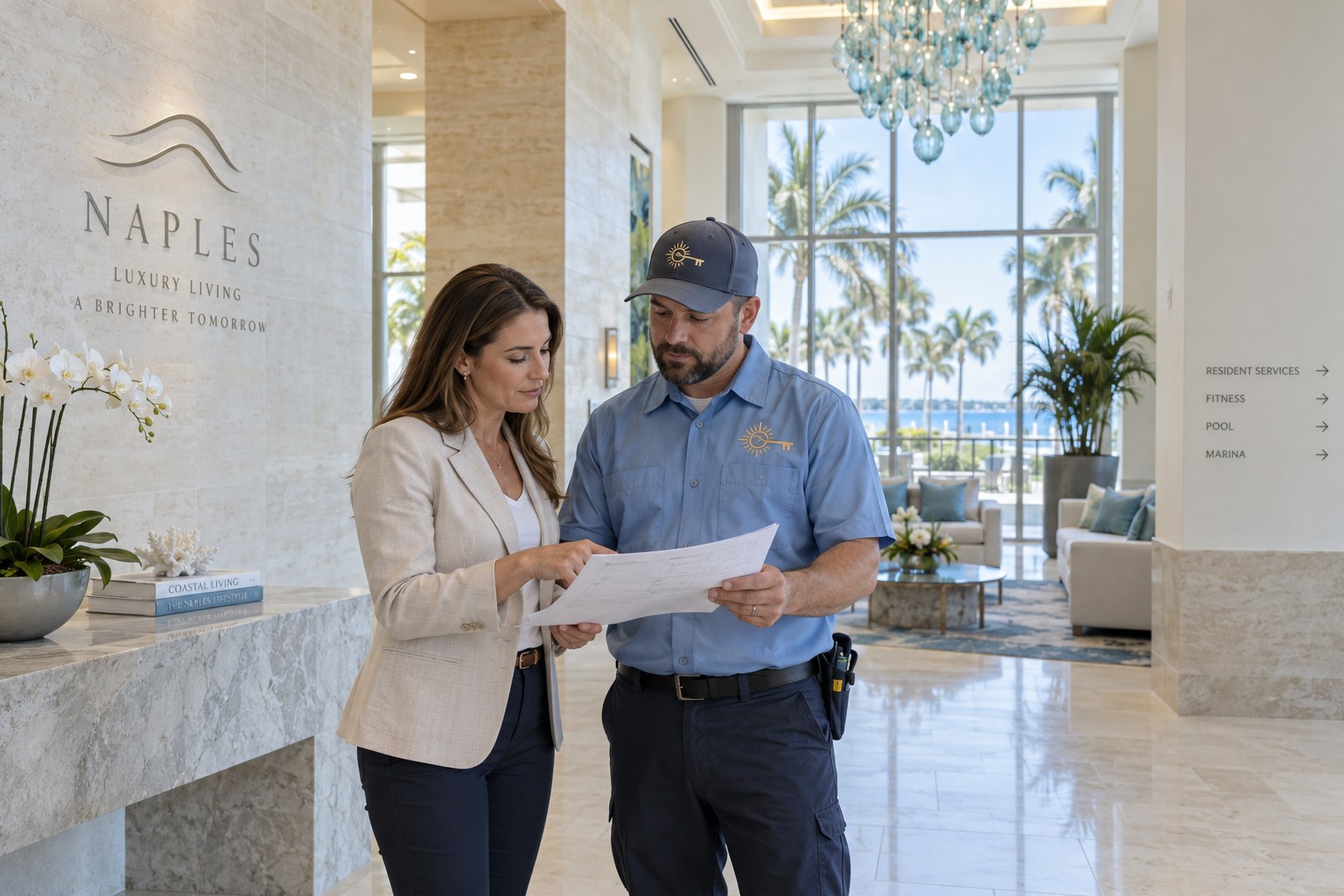
A fellowship hall tends to collect keys the way a church kitchen collects casserole dishes: quietly, over many years, with nobody quite sure where they all went. When one key disappears, the worry is real but the answer does not have to be dramatic. This page explains how a mobile locksmith in Naples helps a congregation sort out who needs access, rekey at a calm pace and build a habit that keeps it from happening again.
Why one missing key feels bigger in a church
In a house, a lost key usually belongs to one person. In a church hall, a lost key might have passed through a dozen hands: the pastor, a deacon, the choir director, the woman who has opened the kitchen every Wednesday for as long as anyone remembers. Nobody wants to accuse a volunteer of carelessness, so the question of who last held the key gets awkward quickly. That awkwardness is often what delays the fix, and the delay is usually worse than the loss itself.
The practical risk is also different. A fellowship hall often holds a commercial kitchen, a sound system, folding tables, a piano, children's program supplies and sometimes a small office with donation records. None of that is dramatic, but it is all worth protecting. The hall is also used at odd hours, which means an open door can go unnoticed through a quiet weekend.
The good news is that a missing key is a solvable problem with a clear sequence. You decide what is at stake, decide who truly needs access, and then change the lock so the missing key stops working. A locksmith does the mechanical part. The congregation, usually through a trustee or building committee, makes the human decisions that go with it.
First steps before anyone calls a locksmith
Before you call, spend ten unhurried minutes looking. Check the usual suspects: the coat closet, the lost and found box, the glove compartment of the van used for outreach, the pocket of the jacket worn at the last potluck. Ask the last two or three people known to have locked up. Many missing keys turn up within an hour once someone asks a friendly question rather than a pointed one.
If the key does not turn up, write down what you know. Which door does it open? Does it open only the hall, or also the sanctuary, the nursery, or a storage room? Is it a standard key, a stamped do-not-duplicate key, or an older key that has probably been copied at a hardware counter more than once? That last answer matters, because a copied key means the real count of keys in circulation is unknown.
Then decide who speaks for the church. A locksmith needs someone with authority to approve work on the building, such as a trustee, a church administrator or a council member. When you call us, have that person's name ready. Quotes are given by phone, and if the job turns out to be more complicated than it sounds, a technician visits and the service call charge is explained before anyone is dispatched.
Mapping who actually needs access
The most valuable hour of this whole process is spent with a pencil, not a screwdriver. Sit down with a list of every door and ask who needs to enter it, and when. The Sunday school coordinator needs the classrooms. The kitchen team needs the kitchen. The treasurer may need the office but has no reason to enter the boiler room. Congregations are often surprised at how many people carry a master key simply because it was easier to hand out one key than three.
Group the people by role rather than by name, because volunteers change. Roles such as clergy, building steward, kitchen lead, youth leader, music leader and cleaning crew make a lasting structure. A person who holds a role holds the key; when the role changes hands, so does the key. This turns a messy pile of favors into a short, readable list that a new trustee can understand in five minutes.
Bring this map when the technician arrives. It lets the locksmith suggest a sensible arrangement, such as one key for the kitchen team that does not open the office, and one key for clergy that opens everything. It also tells us how many keys to cut, which saves a second visit. A key plan that fits on one sheet of paper is a gift to whoever serves on the property committee next year.
Rekeying versus replacing the locks
When a key goes missing, the cleanest answer is usually rekeying, not replacing hardware. Rekeying changes the internal pins of the lock cylinder so that the old key no longer turns it, while the door hardware stays exactly where it is. For a hall with sturdy, attractive commercial hardware, this keeps the look of the building intact and avoids drilling or refinishing the door.
Replacement makes sense when the hardware itself is tired. In Naples, salt air and humidity are hard on exterior locks, and a hall near the coast may have latches that stick, handles that have pitted, or deadbolts that need two tries to throw. If the hardware is failing anyway, replacing it during the same visit can be more sensible than rekeying parts that will soon need attention. The technician looks at the condition of each lock and tells you plainly which path makes sense.
There is also a middle road: rekeying the doors that matter most right now and scheduling the rest. A congregation on a tight budget may start with the exterior doors and the kitchen, then return to interior rooms later. Quotes are given by phone, and we can describe the options in order of priority so the building committee can choose what fits the season.
Keeping the building usable during the work
A church hall is rarely empty for long, so timing matters. If the hall hosts a weekday food pantry, an evening support group or a Saturday wedding reception, the work should not collide with them. When you call us, mention the calendar. Ask about the availability that fits your schedule, and remember that we ask you to call to confirm availability rather than assuming a particular hour.
Rekeying one door usually takes a modest part of a visit, and a technician working through several doors can often leave the building usable the whole time. The usual approach is to work door by door, test each new key before moving on, and never leave a door unlocked and unattended. If there is a gap while a cylinder is out, someone from the congregation should stay nearby or the door should be secured another way.
Plan for the handover. When the work is finished, a trustee should receive the new keys directly, test each one on its door, and sign for them. It feels formal for a church, but the formality is the point: from that moment the key list is accurate, and anyone who still carries an old key is carrying a piece of metal that no longer opens anything.
Dealing with copies nobody remembers making
Many halls have a history of informal duplication. A volunteer needed a spare, a hardware counter cut one, and the copy went home with a different volunteer. Nobody meant harm, but the result is a key population no one can count. This is exactly why we suggest rekeying over simply cutting another key: a new key cut from the same pattern keeps every old copy alive.
A restricted key system can help going forward. These systems use key blanks that ordinary hardware counters will not copy without authorization, so duplicates require a signature from someone the church has named. It is not an unbreakable defense, and we would never describe it that way, but it adds a pause that stops casual copying. Whether it suits your congregation depends on how many doors you have and how often keys change hands.
Be honest with the congregation about why the change is happening. A short note in the bulletin explaining that locks were updated as routine housekeeping, with no blame placed on anyone, usually lands well. People who had keys can be asked to return them in exchange for the new ones. Most people are relieved to hand back a key they were quietly worrying about.
A simple sign-out habit that actually lasts
Elaborate systems fail in churches because volunteers are busy and goodwill is limited. The habit that works is the simplest one: a single sheet or small notebook kept in the office, listing each key by number or tag, who holds it, the date it was issued and the date it came back. It takes thirty seconds to fill in, and it answers the question that caused the original trouble.
Tag every key with a number rather than a label such as fellowship hall main door. A tag that tells a stranger exactly what it opens is a small gift to whoever finds a dropped key in the parking lot. A number means something only to the person holding the sheet. If a key is lost, you can look up the number, and the building steward knows immediately which cylinder needs attention.
Review the sheet twice a year, perhaps at the start of the program year and after the winter season when many seasonal residents return or depart. Naples congregations often swell and shrink with the seasons, and a volunteer who spent the winter in town may head north in spring. A quick look at who is away, and who still holds a key, prevents the slow drift back into a pile of unknown copies.
Keypads, fobs and when they make sense
Some congregations decide to move away from metal keys for at least some doors. A keypad lock lets the church give each group its own code and change codes on a schedule, with no key to lose. It can be a good fit for a kitchen door used by a rotating crew, or a side entrance for a weekday program. The tradeoff is that codes can be shared as easily as keys can be copied.
That is why a code needs the same discipline as a key. Decide who gets which code, change the code when a leader steps down, and avoid obvious combinations such as the year the church was founded. Keypad hardware also needs fresh batteries and a plan for what happens when they fail, which is why most installations keep a mechanical key override that is stored with the trustees.
We will tell you plainly when a keypad is not the right answer. A sanctuary door with historic character may be better served by a quality rekey and a tidy key list. A kitchen door that sees constant use, in a humid coastal climate, might deserve a weather-rated keypad. Each door gets a recommendation based on how it is used, not a one-size-fits-all pitch.
Checking authority before we start work
Whenever we rekey or open a building, we confirm that the person asking has authority over it. For a church that usually means a trustee, an administrator, a pastor with building responsibility or a member of the property committee. It is not an insult to anyone; it protects the congregation from a stranger who walks in and asks for a change. We may ask you to name your role and, where it is unclear, to reach another officer by phone.
This matters even more when a church building is owned by a larger body or held in trust. Some congregations rent space from other organizations, and some share a campus with a school or a daycare. In those cases, the person who can approve changes may not be the person standing at the door. Sorting that out before the technician arrives avoids a wasted visit and keeps relationships friendly.
If a dispute exists, for example two committees disagree about who should hold keys, we ask the congregation to settle it internally first. A locksmith should never be the one picking sides. Once the decision is clear, we carry it out cleanly, document which doors were changed, and give the trustee a simple record of what was done.
Preparing for storms, seasons and shared use
Southwest Florida has a hurricane season, and church halls often serve as places where neighbors gather, sometimes even as informal shelter or supply points. Before the season starts, it is worth confirming that every exterior door latches firmly, that the swollen-door problem has been addressed, and that two trusted people can reach the hall if the usual keyholder is away. Humid air makes wood doors expand and metal parts corrode.
Shared use also deserves a plan. Many halls host outside groups: a recovery meeting, a scout troop, an exercise class. Giving every group its own key quickly spreads access wide. A better habit is for a named member of the church to open and close the building for outside groups, or to issue a temporary code that is changed afterward. The extra step is small compared with the problem it prevents.
Finally, keep a short emergency page in the office. It lists who has authority to call a locksmith, which doors are the most important, and how to reach the trustees. When a key goes missing on a Saturday afternoon before an important gathering, that page turns a stressful scramble into a quiet phone call. Call us to talk it through, and we will help you plan from there.
What the trustee should keep after the visit
When the technician leaves, the building should be in better shape on paper as well as in metal. Ask for a short list of the doors that were rekeyed, the number of keys cut for each, and any hardware that was repaired or replaced. Tuck that list into the same folder as the sign-out sheet. A year from now, when someone wonders whether the side door was ever changed, the answer will be a quick lookup instead of a guessing game among longtime members.
Keep the spare keys somewhere deliberate. A small lockable cabinet in the office, or with a trustee who has agreed to hold them, works far better than a desk drawer or a hook by the kitchen. Spares should be few. Every spare is another key that can wander, so the rule of thumb is to keep only what you would genuinely need if the primary holder were unreachable for a weekend.
Finally, pick a date on the calendar to review the arrangement. Many congregations choose the start of the fall program year, when leadership roles are refreshed. At that review, check the list, return keys from anyone who has stepped down, and rekey a door if a key has gone astray again. Small, regular attention keeps the whole system quiet, which is exactly what a church hall should be.
Frequently asked questions
Do we have to change every lock if one key is missing?
Not necessarily. We start by finding out which doors the missing key opens, then rekey those doors so the lost key no longer works. Doors it never opened can stay as they are. If the key was a master or opened many doors, a larger change makes sense, and we explain the options by phone.
Who at the church can authorize the work?
Usually a trustee, church administrator, pastor with building duties or a property committee member. We ask you to name your role before work begins and may ask to confirm with another officer. This protects the congregation and keeps the job clear for everyone involved.
Can the old keys be reused after rekeying?
No, and that is the point. Rekeying changes the lock so the old key stops working. The congregation receives a new set, and old keys, including forgotten copies, become useless. Returned old keys can simply be discarded or kept as a harmless reminder.
Will the work disturb our weekday programs?
We try to plan around them. Tell us about your calendar when you call, and we will work with it. Please call to confirm availability. Rekeying is done door by door, so the building usually stays usable, and a technician will not leave a door unsecured.
What if the job turns out to be bigger than expected?
Quotes are given by phone based on what you describe. If the job looks complicated, such as failing hardware or an unclear key system, a technician visits first, and the service call charge is explained before anyone is dispatched. You approve the plan before we proceed.