
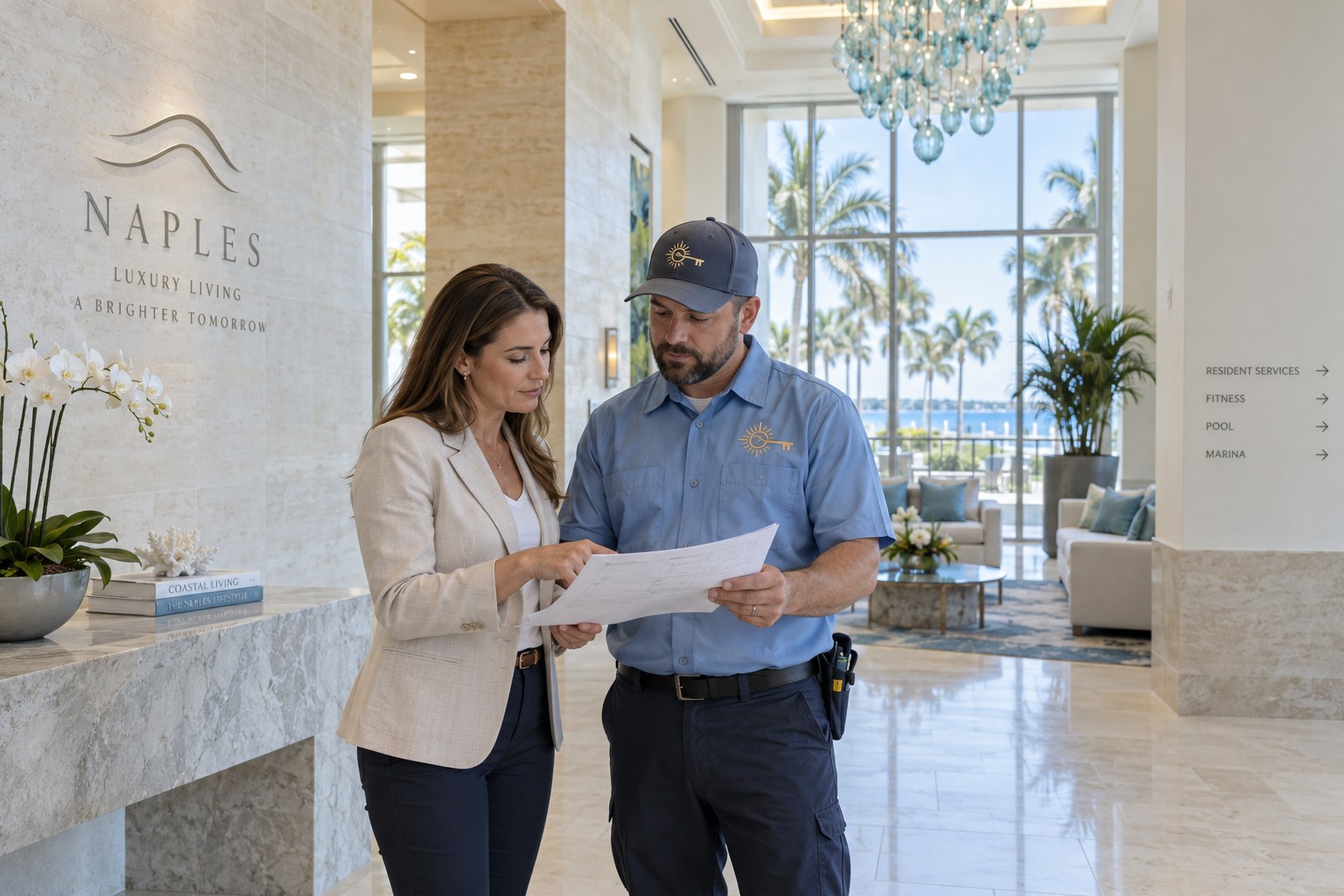
Managing many doors means managing many keys, many people and many deadlines. This page describes how a mobile locksmith can fit into a property manager's routine in Naples and Collier County: turnover rekeys, key logs, confirming who may authorize work, and keeping owners, tenants and vendors on the same page without creating more paperwork than the work is worth.
The real job behind a turnover
When a tenant moves out of a Naples rental, a manager has a short list of things that must happen before the next person arrives: cleaning, repairs, inspection and keys. Locks are easy to push to the bottom of that list, yet they decide whether the next resident can trust the home they have just rented. Rekeying is the step that makes every old key, copied or lost, stop working.
A mobile locksmith can come to the unit and rekey in place, which means pulling each cylinder, changing the pins to match a new key, and putting it back. The hardware stays on the door, the paint is untouched, and the whole process for a typical apartment or small house is far less disruptive than replacing locksets. Managers value that predictability when a schedule is tight.
It also helps to decide in advance what a turnover standard looks like. Some managers rekey every door, some also change the mailbox lock, and some replace anything worn. Writing that standard down once and sharing it with your locksmith means each visit starts from a known checklist rather than a conversation.
Seasonal residents and the rhythm of Naples rentals
Naples has a strong seasonal pattern. Many owners live here for the winter and return north in spring, and a lot of homes and condos are rented by the month or the season. That produces bursts of turnover when schedules cluster, and it also means some units sit empty for weeks with only a manager holding the keys.
For empty units, access control matters more than convenience. A lockbox or a keypad deadbolt can let cleaners, inspectors and contractors in without handing out physical keys, and the code can be changed after each visit. A technician can set up the hardware and explain how to change the code so you do not have to call back every time.
For vacation rentals with frequent guest changes, keypad or smart locks reduce the burden of key handoffs, but they bring their own tasks: batteries, resetting codes and checking the unit's door alignment. A short walk-through with your locksmith during installation usually answers the questions managers would otherwise discover on a busy changeover day.
Building a key log that actually gets used
A key log is a simple record of which keys exist, who holds them, and when they were issued or returned. Many managers know they should keep one and struggle to keep it up. The difference between a log that works and one that gathers dust is usually how little effort each entry takes.
A workable log has four columns: the unit or door, the key stamp or number, the person holding it, and the date. When a locksmith cuts keys, they can note how many were made and hand the managers a small tag set so each one is identifiable without writing the unit number on it, which would be unsafe if the key were lost.
Logs pay off at the worst moments. When a tenant says they only received two keys and the file says three, or when a contractor claims to have returned a key that is missing, the record settles it. Over time it also shows patterns, such as particular doors that lose keys often, which can point to a hardware or habit problem worth fixing.
- Unit or door identifier
- Key stamp or number, never the address on the key itself
- Name of holder and role, such as tenant, cleaner or vendor
- Date issued and date returned
Who is allowed to say yes
Property management involves layers of authority. An owner owns the property, a tenant occupies it, and a manager acts on the owner's behalf under an agreement. A locksmith needs to know which of those layers is asking before changing anything. The rule is simple: only someone with real authority over the door can authorize opening, rekeying or replacing the lock.
In practice, this means a manager will usually be asked to show a management agreement or a signed authorization from the owner, along with their own identification. For a tenant lockout, the locksmith will typically ask for proof the person lives there, such as identification matching the lease or mail addressed to the unit.
Having these documents ready in a shared folder or on a phone makes the process quick. It also protects you: a locksmith who is careful about who they let in is exactly the kind of vendor a property manager wants working in their buildings. If something does not add up, the technician will explain what is needed and wait for you to sort it out.
Lockouts, after-hours calls and handling them calmly
Property managers get lockout calls at inconvenient times: a resident home from a late flight, a cleaner arriving before dawn, a guest who left a key inside. Having a plan for who answers, who verifies identity and who calls the locksmith removes the guesswork. Please call us to confirm availability, and have the unit address and the caller's relationship to the unit ready.
A technician can often open a standard door without damage using non-destructive methods. Where a lock is damaged, corroded or a high-security type, opening may take longer or require replacing the cylinder. The tradeoff is explained on the phone and again on site, so you know whether the door can be saved.
After any opening, it is worth asking whether the lockout points to a larger problem. A resident who keeps losing keys might benefit from a keypad. A vacation guest who keeps locking themselves out might be confused by a thumb-turn that is too stiff. Fixing the cause is usually better than repeating the call.
Hardware that suits a managed portfolio
Managers who handle many units benefit from consistency. When all units in a building use the same brand and keyway, replacement parts are easier to find, technicians learn the building quickly, and a single master key can serve the maintenance team. Mixed hardware makes every visit slower and every repair more guesswork.
Salt air shapes choices here. Coastal buildings and waterfront homes see accelerated corrosion on exteriors, so stainless or marine-grade finishes on entry doors, patio doors and gates often last longer. Interior hardware can be a more basic grade without much penalty, which lets a manager spend where it matters.
Think too about what happens when a resident leaves a key in the lock, jams it, or forces it. Residential-grade hardware with a decent bolt and a solid strike plate tolerates this better than the most basic options. A technician can walk a sample unit with you and suggest a standard that balances cost, durability and ease of rekeying.
Coordinating with vendors, cleaners and contractors
Every vendor who enters a unit is another key, another code and another risk of loss. A clear policy on who gets what access, for how long, and how it is retrieved keeps that risk small. Temporary codes on keypad locks are especially useful because they can expire automatically or be erased after the job.
When physical keys are necessary, consider issuing a dedicated set to the vendor, tagged and logged, and rekeying if the set is lost. Some managers use a lockbox on the property, which holds a key for the vendor and can have its combination changed as needed. A locksmith can install the box and show how to change the code.
Communicate with residents too. Tenants appreciate knowing when a vendor is expected and how their entry is controlled. A short notice about a rekey or a lock replacement, including how and when they will receive new keys, prevents confusion and unnecessary calls to your office.
Condo, HOA and gated community considerations
Many Naples properties sit inside condominium associations or gated communities with their own rules. A manager might control the unit door but not the building's common areas, and the association may control gates, mailroom locks and garage doors. Knowing who owns each lock prevents tangled conversations and blocked work.
Before any lock work, confirm whether the association has requirements about hardware, keying or notification. Some buildings require that unit entry locks remain keyed to a master system for emergency access, in which case changing them without approval can cause real trouble. A technician can work within those rules if you tell them up front.
For gated communities, ask how vendor access is handled. The locksmith may need to be added to a guest list or given a gate code, and the gate attendant may need a name and company. Providing those details early avoids standing at the entrance while the schedule slips.
How quotes, visits and follow-up work
For routine work such as rekeying a set number of doors, a quote is given over the phone after you describe the hardware. Photos help, as does telling the technician how many keys you want. For complicated situations, a technician visits first and the service call charge is explained before dispatch.
When multiple units are involved, it often makes sense to batch them on a single day, so the technician moves from door to door with the right tools. Planning that day together lets you coordinate resident notices and access, and the work tends to feel smoother for everyone concerned.
At the end of the visit, you should receive the keys, a clear count of how many were cut, and a note of what was changed. Keep that with your records. If something does not work later, you have a starting point for the follow-up call, and the technician can see exactly what was done.
Mailbox, garage and utility locks that get forgotten
When managers think about keys, they picture the front door. Residents think about more: the mailbox, the storage closet, the garage opener, the pool gate, the laundry room. Each of these has its own lock, and each is a place where a former tenant can still hold a working key long after the lease ends. A complete turnover checklist lists them all by name so nothing is skipped.
Mailbox locks are a good example. They are usually controlled by a separate system, sometimes by the postal service and sometimes by the association, so a locksmith may not be allowed to change them. Knowing who has authority saves a wasted trip. When the association controls the lock, a short email from you to them is the correct first step, and the technician can handle the rest.
Utility closets and storage cages deserve attention too. They often hold water shutoffs, electrical panels and spare supplies, and a vendor or former resident wandering in can cause damage. Rekeying them to a manager-only key, and noting who holds it in your log, keeps the building running smoothly without drama when something breaks.
Handling damaged and forced locks after a move-out
Sometimes a move-out leaves surprises: a deadbolt that will not turn, a handle that has been pulled loose, or a door frame split by someone forcing it. A technician inspects the damage before any decision is made, because the visible problem may be hiding a second one. A stripped screw hole in a frame, for instance, will undermine any new lock until it is repaired.
Documentation matters here. Take photos before the technician starts and after the repair is done, and keep the invoice with the tenant file. If the cost is to be deducted from a deposit, the paper trail is what supports that conversation. The technician can also describe the damage in plain language on the invoice, which helps when you explain it to an owner.
Where a frame is damaged, the repair might involve a carpenter or a door specialist before the lock is fitted. A locksmith can tell you what is needed and often coordinate timing so you are not paying for a second visit just to finish the job. Being honest about the sequence prevents an awkward return trip.
Planning a lock standard across several properties
Managers with more than a handful of doors benefit from stepping back and writing a lock standard once. It can be a single page: the preferred brand and grade for entry locks, whether deadbolts are required, how many keys are cut per unit, and which doors get keypads. Having it written down turns each future purchase and each future visit into a quick decision.
A standard also helps when you take on a new building. A technician can survey the doors, tell you what is in place, and estimate what bringing it up to your standard would involve. You may choose to do it gradually, upgrading doors only as they fail or at turnover, which spreads the work across time and avoids a large single disruption.
Do not forget to review the standard now and then. Hardware improves, buildings change, and a standard written years ago may no longer fit your portfolio. A short conversation with your locksmith at the end of each season is usually enough to confirm that what you are installing still makes sense for Naples conditions.
After a storm: checking doors across a portfolio
Hurricane season is part of every Collier County manager's calendar. After a significant storm, the first priority is safety and structure, but doors are close behind. Water pushed against a door can swell the slab, bend a strike, or leave a deadbolt that no longer reaches its keeper. Walking each unit's entry and patio doors after the weather clears reveals problems before residents report them.
A locksmith can help with that walk. Prioritize units where doors will not close, where glass has been disturbed, or where a lock turns without the bolt moving. These are security problems as well as comfort problems. A technician can secure an opening temporarily, then return when carpenters or glass companies have finished their part of the repair.
Keep a record of what was found and fixed, with photos. Insurance conversations after a storm go more smoothly when you can show the condition of each opening and when it was repaired. It also helps owners, who may be out of state, feel confident that someone is caring for their property while they cannot be there.
Training staff to spot lock trouble early
Maintenance staff and cleaners see doors more often than a manager does. A short conversation about what to report can save emergency calls later: a key that needs jiggling, a handle that wobbles, a door that no longer latches without a push. These are early warnings, and a small adjustment now prevents a lockout next month.
Give staff a simple way to report. A shared note, a text thread or a line on the work order form works. Include the unit, the door and a short description. A technician can then group several small items into one visit, which saves time for everyone concerned and keeps your schedule predictable.
Remind staff never to force a stuck lock, spray heavy oil into a cylinder, or file a key to make it fit. Those habits turn a minor issue into a replacement. A locksmith can give a ten-minute talk to your team about what helps and what harms, and the effect on service calls is usually noticeable.
Frequently asked questions
Do I need to rekey every time a tenant leaves?
It is a good practice, because you cannot know how many copies of the old key exist. Rekeying makes all earlier keys useless without replacing the hardware. Some managers also rekey after a long vendor engagement ends. A technician can help you set a standard that fits your portfolio.
What does a locksmith need from me before opening a unit?
The technician will check that you have authority over the unit, usually through a management agreement or owner authorization and your identification. For a tenant lockout, proof of residence is typically requested. If anything is unclear, we explain what is missing before work begins.
Can you rekey several units on the same day?
Yes, batching is common and usually works well. Tell us the number of units, doors per unit and how many keys you need. Please call us to confirm availability for the day you want, and we will describe how the visit will be organized.
Are keypad locks a good idea for vacation rentals?
They can reduce key handoffs and let you change codes between guests. They also require battery checks and attention to how the door closes and latches. A technician can install one, explain how to manage codes and tell you whether the existing door is suitable.
How are quotes handled for larger jobs?
Straightforward jobs are quoted by phone once you describe them. For complicated work, a technician visits and the service call charge is explained before dispatch. You will understand the options and the scope before anything is started.