
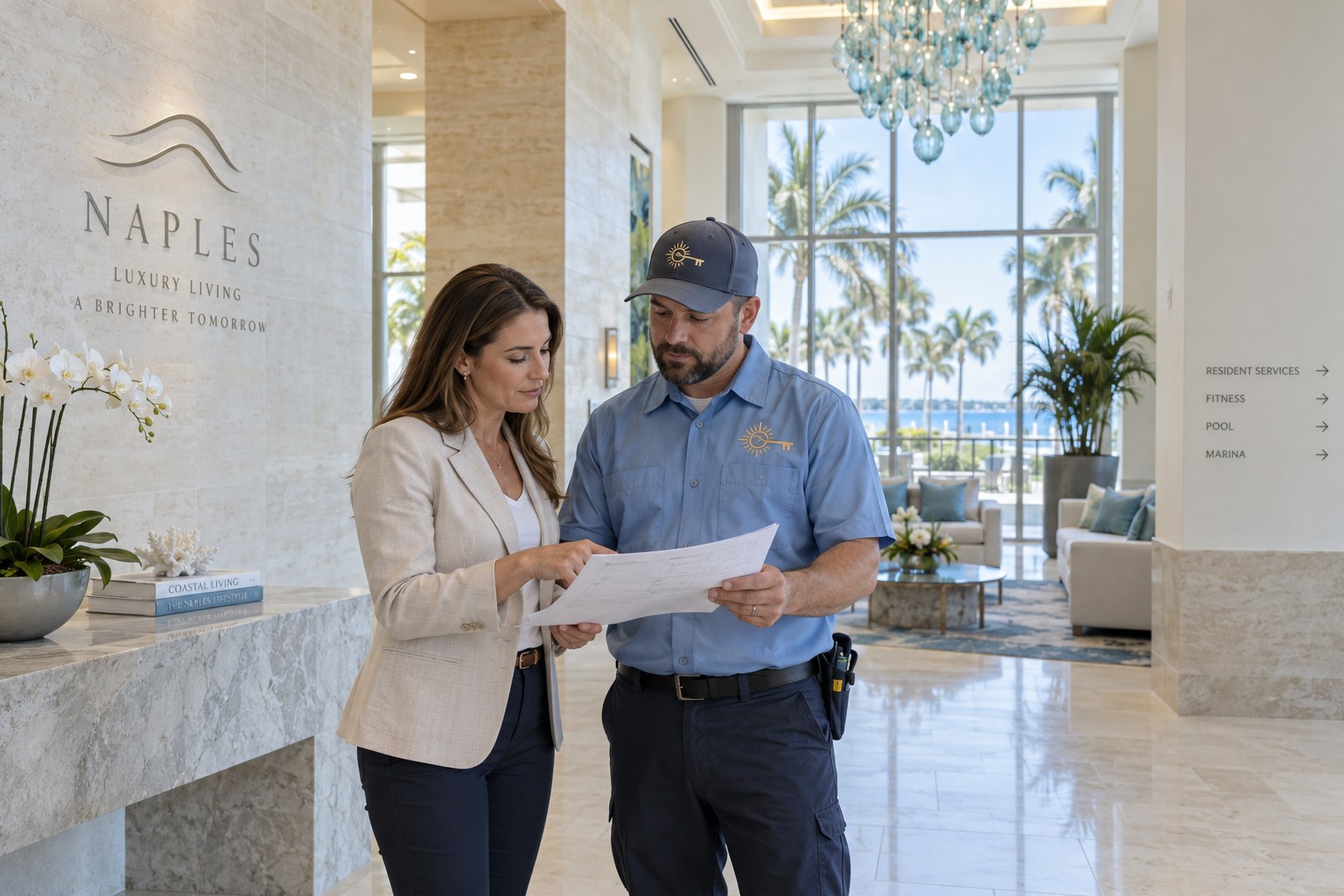
A coastal tower is a small vertical town with its own rules. The lobby, the mail room, the trash chutes, the stairwells and the service corridors all have doors, and most of them belong to the association rather than to any single resident. This page explains how a mobile locksmith approaches those doors, why fire ratings change what we can do, and why talking to building management always comes first.
A tower is many buildings stacked together
From the street, a condo tower looks like one structure. Inside, it is a layered set of spaces with different owners, different rules and different risks. The lobby is a public-facing area managed by the association. The floors above hold private units that belong to individual owners. Between them lie service corridors, stairwells, utility rooms, garages and amenity decks, each with a door that has its own purpose and its own authority behind it.
That layering matters to a locksmith because the right to authorize work follows the layers. A unit owner can ask for work on their own front door, within the association's rules. The association, acting through its board and its manager, authorizes work on common elements such as lobby doors, corridor doors and stairwell doors. Mixing these up causes delays, so the first question on any tower call is simply: whose door is this?
Many towers along the Gulf coast also serve seasonal owners and vacation renters. A building may be half empty in summer and full in winter, with staff and residents changing frequently. Doors in that kind of building get heavy use, and hardware wears accordingly. Understanding the rhythm of the building helps us plan work for quiet periods and avoid disturbing residents who are trying to enjoy their stay.
Why building management is the first call
Before any technician touches a common-area door in a tower, building management should know. The manager keeps records of the key system, the fire alarm connections, the access control setup and the contracts with other vendors. They know which doors are tied into other systems and which are not. A change that seems simple, like swapping a lobby lock, can set off alarms or disable an access panel if no one has been warned.
Management also controls the schedule. Elevators may need to be reserved for contractors, loading areas may be restricted and some work must be done outside of quiet hours. In many buildings, a contractor must be on a list approved by the association and must provide the paperwork the board requires. We are used to this and will work with it. Please call to confirm availability early, since coordination takes time.
Finally, management is the keeper of authority. The board decides who may approve work, and the manager communicates that to us. We confirm ownership or authority before we rekey, replace or open anything in a tower. If a resident calls us about a common-area door, we politely point them to the office. It can feel slower than a quick fix, but it protects residents and avoids costly mistakes.
Lobby doors: where security meets first impressions
The lobby is the face of the building, and its doors carry the double burden of looking good and keeping the building secure. Entry doors are often glass or aluminum storefront-style doors with panic hardware, magnetic locks or electric strikes tied to an access system. They may have a key override for emergencies and for times when the electronics are down.
Common lobby problems are practical ones. A door that does not latch because the closer has loosened. A strike plate that no longer lines up after years of settling. A key cylinder that sticks in salt-laden air. A magnetic lock that releases too easily or fails to hold. Each of these has a different fix, and some involve the access control vendor rather than the locksmith. We can tell you which category the problem belongs to.
Appearance matters in a lobby. Hardware finishes should match what is already there, and repairs should be tidy. Residents notice a mismatched handle or a cheap replacement. We aim to match finish and style where possible, and to be honest when a perfect match is not available. In a coastal tower, finishes that resist salt and humidity are worth the thought, because lobby doors near the pool deck or garage face harsher conditions than interior ones.
Service corridors, back-of-house doors and why they matter
Behind the polished lobby, a tower has a working side. Service corridors connect the loading area to the trash rooms, the maintenance shop, the mechanical rooms and the freight elevator. The doors there are less glamorous, but they protect equipment, supplies and the staff who work there. They are also the doors most likely to be propped open, which defeats any lock.
Security in these areas depends on access control that fits the work. Maintenance staff need quick access to many rooms. Delivery people need a path to the freight elevator but not to the mechanical room. Cleaning crews need certain closets. A well-planned key system, or an access system with different permissions, matches access to the role. We help the association think through that structure and put hardware in place.
Many service doors are heavy steel in hollow metal frames. They take a beating from carts, pallets and hurried hands. Hinges sag, closers fail and latches wear. Regular maintenance prevents small issues from becoming failures. A brief periodic inspection of the doors in the back of the building, noting which ones do not latch or are held open, gives the board a clear picture and a basis for a repair plan.
Fire-rated doors and what we do and do not touch
Many doors in a tower are part of the fire protection system. Stairwell doors, corridor doors and doors to mechanical rooms often carry a label from a testing agency showing that the door and frame form a rated assembly. The label tells us not to modify the door casually. Extra holes, wrong hardware or removed closers can affect how the door performs in a fire, and may cause trouble in inspections.
Because of that, we stay within the existing preparation of rated doors. If a lock needs replacement, we look for hardware designed to fit the same cutouts and carrying the right listing. If a requested change would require new drilling, cutting or a different type of hardware, we stop and explain. The association and its fire safety consultant can decide how to proceed, with the right approvals in place.
Rated doors must also close and latch by themselves. A door held open with a wedge or a bungee cord defeats its purpose. Part of our inspection is to notice closers that are too weak, latches that do not catch and doors that rub on the frame. We report these to management, since correcting them is as much a safety matter as it is a lock matter. We do not make claims about code compliance for any specific building.
Unit entry doors and the association's role
Unit doors in a tower usually meet fire-rating requirements as well, and many associations set rules about what hardware owners may install. Some require that all unit locks be keyed to a master or that a key be left with management for emergencies. Others limit finishes or lock types so corridors look uniform. Before an owner changes a unit lock, checking the rules is wise.
From a locksmith's view, rekeying a unit door is usually simple and does not alter the rated assembly. Replacing the lockset with the same type is also straightforward. Adding extra locks, changing the door or modifying the frame is more involved and may need association approval. We ask owners about the rules, and we confirm ownership of the unit before working on the door.
Owners who rent their units through vacation platforms face another wrinkle. Rental turnover means many people handle keys or codes, and the owner may want to change them often. A keypad lock approved by the association may be a good fit. We can help with setup and code changes, while the owner remains responsible for compliance with the building's rules about rentals and access.
Master keys, emergency access and responsible handling
A tower often has some form of emergency access. The association may keep a key or code for each unit in a secure place, so staff and emergency responders can enter if needed. These master keys are the most sensitive items in the building. Where they are stored, who can sign them out and how their use is recorded are decisions for the board and manager, not for a locksmith.
What we can contribute is mechanical care. A key cabinet should be sturdy, locked and placed out of public view. The key tags should not carry unit numbers in plain sight, so a lost tag reveals little. Duplicate keys should be controlled, and old keys that are no longer needed should be accounted for. We can set up a restricted key system so extra copies cannot be cut at a hardware counter.
When a unit changes hands, the key stored for emergencies should be updated. New owners often change the unit lock and forget to give the new key to management. That leaves the building with a key that no longer works. A simple notice to new owners explaining the practice, and a regular check of the key cabinet, keep the emergency system useful.
Stairwells, roof access and amenity decks
Stairwell doors in a tower carry a special balancing act. People inside a stairwell during an emergency must be able to leave, and in many buildings the doors must also allow re-entry at certain floors. Which doors lock from the stair side, and which stay unlocked, is a matter of the building's design and approved plan. A locksmith does not decide that; we maintain the hardware the building already has and ask before changing how any stair door behaves.
Roof access doors and mechanical penthouse doors are usually restricted to staff and vendors. They are exposed to wind, sun and rain, which punish hardware. A roof door that sticks can become a safety concern if someone needs to get through it in a hurry. We look at weather seals, closers and cylinders on these doors and recommend finishes made for hard outdoor use. Keys to these doors should be few and well recorded.
Amenity decks hold pools, fitness rooms, grilling areas and sometimes a clubroom. Their doors take guests as well as residents, which means more key and fob activity. Pool gates in particular need to latch every time, and we treat them as a safety item. Door hardware on a deck is subject to sun, spray and sand, so a regular wipe-down and lubrication schedule helps a great deal.
Locked out of a unit when the board holds the key
Residents sometimes lock themselves out and then find the office is closed. If the association holds a key, the manager or security can provide access, subject to their policy. If not, or if the situation is urgent, a locksmith can help, with conditions. We confirm that the person is the owner or authorized occupant, and we notify building staff where required by the association's rules.
Opening a unit door in a tower is done carefully to protect the rated door. We aim for non-destructive entry wherever possible. Drilling a fire-rated door is a last resort and is avoided, because it affects the door's integrity and would need repair. The technician explains the approach and the likely outcome before starting. Quotes are given by phone, and for complicated cases a technician visits and the service call charge is explained before dispatch.
Ask for the building's lockout procedure ahead of time. Some towers have rules such as requiring ID at the front desk, notifying the manager or using a specific entry. Knowing the steps before you need them avoids stress. If you spend part of the year away, make sure someone you trust has a way to reach the building and a copy of the instructions.
Coastal wear: salt, humidity and storm season
Towers by the Gulf deal with a harsher environment than inland buildings. Salt air creeps into lobby doors, balcony hardware, garage gates and exterior stairwell doors. Over time it corrodes metal parts, stiffens latches and seizes cylinders. A building that looked fine in spring can have doors that stick by the end of summer, and the problem often shows first on doors that face the water.
Preventive care helps. Regular cleaning of exterior hardware, suitable lubricant, and prompt attention to doors that rub or stick all extend the life of locks. Specifying corrosion-resistant finishes when replacing hardware pays off. We can recommend options for exterior and near-water doors, and point out which interior doors do not need premium finishes, so the association spends where it matters.
Storm season adds planning. Before a hurricane threatens, buildings secure doors, shut down certain systems and sometimes evacuate. Afterward, doors may have shifted or taken water. A plan that lists responsible people, key locations and the order for checking doors makes recovery smoother. We can help the association walk its doors before and after a storm, and note any that need repair.
How to work with us on a tower project
Start with a conversation. Tell us the building, the doors in question and what is wrong or desired. Share the contact for the manager, since coordination is part of every job. We will explain what we can do from the description and what would need a visit. Quotes are given by phone for straightforward items, and complicated jobs begin with a technician visit, with the service call charge explained before dispatch.
Expect paperwork. Many associations ask contractors to provide documents before entering the building, and to follow rules about hours, elevators and noise. We work within those requirements. Please call to confirm availability early enough to allow for approval. Last-minute requests are possible in an emergency, but planned work goes more smoothly with a little lead time.
Think about timing around the seasons. Naples towers are busiest in winter, when seasonal owners return and the lobby, elevators and corridors see steady traffic. Larger door projects are often easier in the quieter summer months, though that overlaps with storm season, so flexibility helps. A short list of planned hardware work, shared with the manager in spring, lets the board choose a window that disturbs the fewest residents and fits the building's calendar.
Keep records. After any work, ask for a summary listing the doors touched, the hardware used and the keys issued. Store it with the building records so the next board has the history. A tower outlasts any single manager or board, and good documentation is a gift to the people who come after. Call us when you are ready to talk about your doors.
Frequently asked questions
Who can authorize work on lobby and corridor doors?
The association, usually through its board and building manager, authorizes work on common doors. We confirm authority before starting and may speak with the manager directly. Individual owners can authorize work on their own unit door, within the association's rules.
Can you drill a fire-rated door?
We avoid it. Rated doors form a tested assembly, and extra holes or the wrong hardware can affect it. We look for hardware that fits the existing preparation and explain the options if anything more is involved.
What if I am locked out and the office is closed?
Call us and we will talk it through. We confirm you are the owner or authorized occupant, follow the building's notification rules and aim for non-destructive entry. Please call to confirm availability.
Can an owner change the lock on a unit door?
Often yes, but many associations have rules about hardware and require a key for emergency access. We recommend checking the rules first. Rekeying or replacing with the same type is usually simple; larger changes may need approval.
How do you handle coastal corrosion on tower doors?
We inspect for sticking, rust and worn cylinders, clean and lubricate where suitable, and suggest corrosion-resistant hardware when replacement is needed. Doors facing the water usually need attention first.