
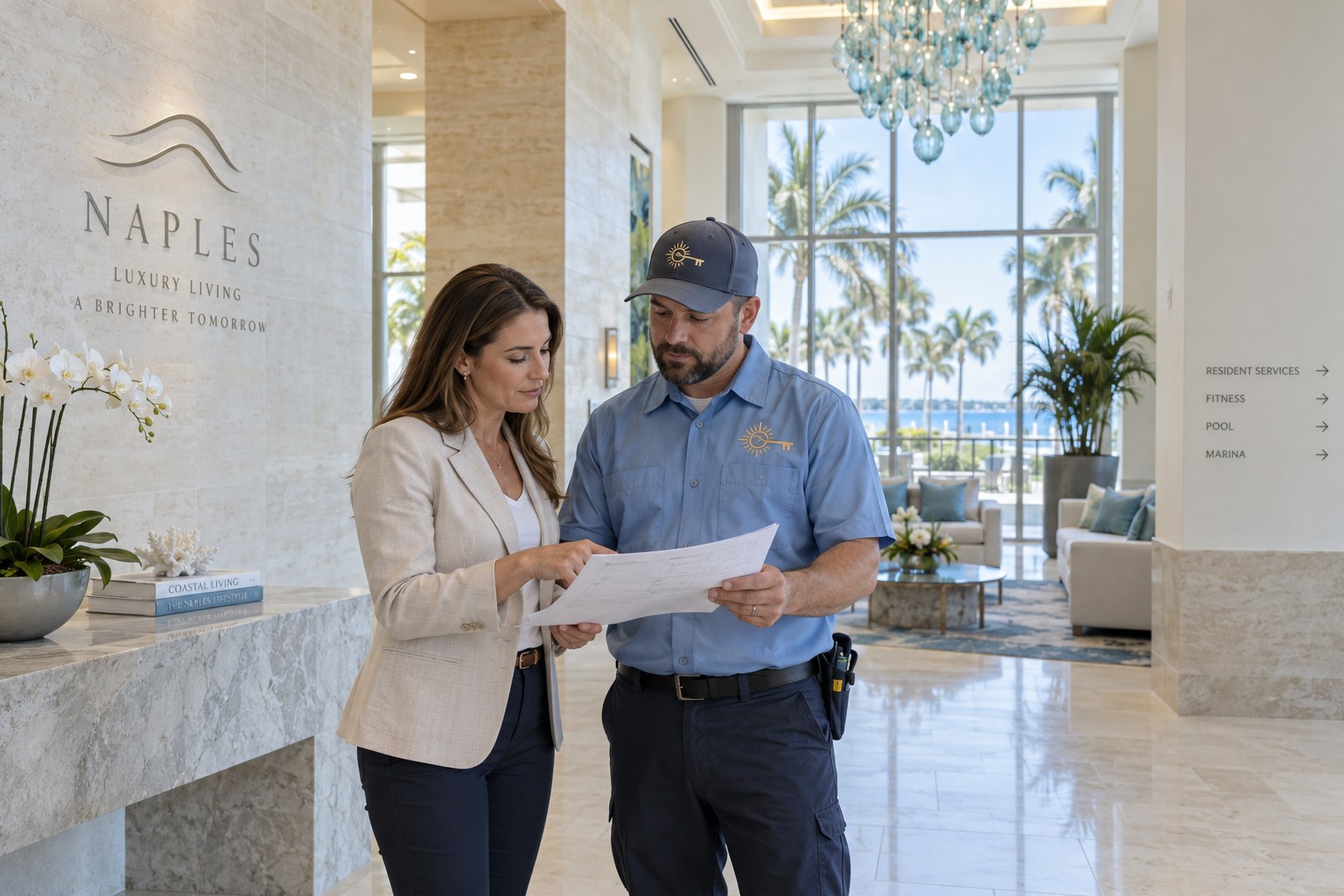
A tenant in a small plaza tries a spare key from the next unit and the door opens. Or the landlord's old master key still turns every back door. Situations like this are common in older strip centers around Collier County, and they make everyone uneasy. This page explains how the keying gets untangled, who decides what, and how each tenant ends up in control of their own space.
How a plaza ends up with doors that share keys
Most keyed-alike problems have ordinary origins. When a plaza was built, the developer or first landlord may have ordered all the storefront locks keyed alike to save effort, so one key opened every door during construction and early leasing. Years later, tenants have come and gone, each receiving copies of that same key, and nobody ever went back to separate the units. The shared key simply became part of how the place worked.
Another route is the landlord master system. A landlord keeps a master key for emergencies and maintenance, which is reasonable. The trouble starts when the system was never documented, the master was copied freely and former property managers, maintenance contractors and prior tenants retained copies. Years on, the landlord cannot say how many masters exist, and tenants cannot say who else might be able to open their door.
A third cause is plain neglect. Tenants who replaced their own locks sometimes bought the same popular brand and keyway as the unit next door, and a few turned out to share the same cut. The outcome is a plaza where keys cross over in ways nobody planned. Untangling it starts with finding out exactly what exists, rather than guessing from rumor, and that means a careful survey of every opening.
Why shared keys are a real risk for everyone
A key that opens several tenants' doors is more than a nuisance. A retail shop may keep inventory, a cash drawer and customer records behind its back door, and a medical or insurance office may hold sensitive files. If a former tenant, a cleaner or a contractor still has a key that opens the neighbor's door too, the business cannot claim to control who enters after hours.
There are also practical consequences. When a break-in or theft occurs, shared keys complicate every investigation, because nobody can say whether the door was forced or simply opened. Insurance conversations become harder when there is no clear control over entry. Tenants, quite fairly, will feel uneasy discovering that the unit next door can walk through their back entrance, even if the neighbor is a trustworthy business.
Landlords have their own exposure. If the landlord holds a master that opens every tenant space, tenants may expect the landlord to use it only for emergencies. Depending on the lease, entry rights are usually defined. Having an orderly system with a clear record of who may enter and when protects the landlord from complaints as much as it protects the tenants, and it makes the plaza a more attractive place to rent.
The first step: a survey of what is actually installed
Before anything is changed, a technician walks the plaza and records each opening. That includes front storefront doors, rear service doors, shared hallway doors, electrical or utility closets, roof access and any restroom locks. For each lock, the tech notes the brand, keyway, whether it is a deadbolt, a mortise cylinder or a rim cylinder, and its condition. Photographs help with later decisions and ordering.
Next comes testing, with permission. Keys held by tenants and the landlord are tried on the doors to map which key opens which lock. This reveals the real structure of the keying: perhaps all rear doors share one key, some storefronts match by accident, and the landlord's master fits everything. You cannot design a clean solution without this map, and rumors or assumptions often turn out wrong in surprising ways.
Because several parties are involved, ownership and authority must be clear before any work. We check that the person calling has the right to authorize changes for the doors in question: a tenant for their own suite, the landlord or manager for shared and building areas. We never open, rekey or change a tenant's lock at the landlord's request alone without the lease allowing it, and we do not alter a landlord's building hardware at a tenant's request.
Who controls which door: landlord, tenant and shared areas
The legal and practical question of control usually lives in the lease. Many leases say the tenant is responsible for locks on the leased premises and must provide the landlord with a key or code, while the landlord controls roof access, utility rooms and common areas. Others say the landlord retains control of all exterior doors. Our job is not to interpret the lease, but we ask what it says, because the answer shapes who can approve the work.
A workable principle is that each party controls what is theirs. The tenant owns the decision on their storefront and back door, within the lease. The landlord decides about the shared rooms and about any master or emergency access. Where the lease is silent or confusing, a short written agreement between the two sides, signed before work begins, avoids disputes. We can take direction from a written note naming who may authorize which doors.
For emergency access, a common compromise is a sealed key or lockbox arrangement. The landlord keeps a key to each tenant space in a controlled location, with a log of who opens it. Tenants know the key exists, and the landlord can still enter for a burst pipe or a fire alarm. This keeps the landlord's access visible and limited, which tenants generally prefer to an unknown number of loose masters.
Whatever the lease says, a courteous process helps. A notice to the tenant before the landlord enters, except in a true emergency, builds goodwill, and a short note afterward explaining why the door was opened shows respect. These habits cost nothing and prevent the sense of suspicion that so often grows in shared properties when entry rights are vague.
Separating the keying: the rekey that fixes it
The most common solution is rekeying each tenant's cylinders to a new, unique key. The technician removes the cylinders, changes the pin patterns and cuts keys, so that each suite has its own key that cannot open the neighbors. The doors and handles stay in place, which keeps the work quick and the storefronts looking unchanged. Done carefully, an entire small plaza can be separated in a short sequence of visits.
Sometimes rekeying is not enough. Older mortise cylinders may be worn, and some cheap locks cannot hold a new combination reliably. In those cases the technician will recommend replacing the cylinder or the lock body. For storefronts with aluminum frame doors, special narrow stile hardware is common, and it needs matching parts. The tech will explain these specifics, and if the job is complicated, a visit is arranged first and the service call charge explained before dispatch.
Choose the keyway thoughtfully. If each tenant gets a different keyway, copies need that specific blank, which makes casual duplication harder. Some plazas use a landlord-controlled restricted system so new keys are cut only with authorization. Others simply give each tenant their own standard key. We will describe the choices by phone, and the quote is given by phone, so you know what is involved before anyone drives out.
Keeping the landlord's emergency access without the old mess
Separating tenants does not mean the landlord has to give up emergency access. A tidy way is to build a small master system: each tenant has a change key, and the landlord holds a single master that opens all units. Unlike the old accidental master, this one is documented, limited in number and tied to a register. Tenants often accept it because they know exactly what it is and who holds it.
If tenants dislike any landlord master, a second option is a controlled key cabinet. The landlord stores an emergency key for each unit in a locked cabinet, and access is logged. Some plazas keep this cabinet with a property manager or in an office, and use of a key is reported to the tenant afterward. This offers the same emergency capacity without a permanent master circulating.
Whichever route is chosen, document it. A one-page summary should say how many master keys exist, who holds them, where the emergency keys are stored and what must happen when one is used. Have both sides sign it. This clarity reduces future complaints and gives a new property manager an easy starting point when management changes, which, in a busy commercial setting, it eventually will.
Handling tenants who come and go
The main reason keying decays in a plaza is turnover. When a tenant leaves, their keys go with them, and unless the lock is rekeyed, the former tenant, their staff and anyone they gave keys to can still enter. The best habit is to rekey every suite when a lease ends, before the next tenant moves in. It costs a modest visit and removes any lingering uncertainty about old keys.
New tenants often want to install their own locks or security hardware. That is generally fine if the lease allows it, but the landlord should be told and given a key or code for emergencies. A tenant who changes the lock without telling anyone creates the same kind of confusion the plaza is trying to escape. A short notice template in the lease packet keeps everyone on the same page.
Keep a simple turnover checklist for each suite: keys collected, count verified, lock rekeyed, new keys issued, register updated. If a tenant cannot account for all keys at move-out, treat the lock as compromised. Seasonal businesses in Naples, such as shops that open for winter visitors and close in summer, make this habit especially valuable, since shuttered units sit unobserved for months and should not have loose keys circulating.
Alarms, gates and the other things that tie into the locks
Plaza security is more than locks. Many units share an alarm company, a monitored panel, a rear delivery lane with a gate or an electronic lock on a shared corridor. When rekeying, it helps to know what else connects. An alarm code that is the same for every tenant has the same problem as a key that is the same for every tenant, and a good clean-up addresses both together.
Customer-facing doors have their own quirks. Aluminum storefront doors often use a thumb turn or a small cylinder at the bottom or side of the frame, and the latch can sag as the door drops on its hinges over the years. A tenant may blame the lock when the real cause is alignment. The technician checks the door itself, adjusts the closer and strike where possible and tells you honestly whether a lock change or a hinge repair is the better fix.
Rear service corridors deserve special mention. They often serve every tenant, carry deliveries and trash, and are used by cleaning crews at night. The doors off these corridors are frequent targets for tampering, and they are also where keyed-alike confusion is most likely to hide. Check that every rear door closes fully, latches without a slam and locks from the outside, because sticking doors in humid weather are a common cause of unsecured entries.
If the plaza has exit hardware on any door, such as push bars on a rear exit, those devices need to remain functional from the inside at all times. Rekeying a lock on the outside must never interfere with the ability to leave in an emergency. Our work respects fire and life safety requirements, and we will tell you if a change you request would affect an exit, so that nothing is done which could trap someone inside.
What a coordinated clean-up visit looks like
A well-run clean-up is scheduled in advance, with tenants told which day and what to expect. The landlord or manager walks the technician through the plaza, opening doors as needed, and each tenant is present when their suite is worked on. Starting early or late in the day, depending on the businesses, keeps customer disruption small. Retailers appreciate not being told to close during peak hours.
The technician works suite by suite, rekeying cylinders, cutting keys and testing each lock several times with the door open and closed. Keys are handed to the authorized person for each suite, counted and recorded. The landlord's master or emergency key set is delivered separately and logged. By the end of the day, each tenant should hold a key that opens their own space and nobody else's.
After the visit, the register and key chart go to the manager, and everyone discards the old keys. It is worth asking tenants to hand in old keys to be destroyed, rather than letting them drift. Call us to confirm availability and to discuss the layout of your plaza. If it is a large property, we may plan the work across more than one visit, with the plan explained over the phone first.
Preventing the confusion from coming back
Once the plaza is separated, keeping it that way takes a few simple habits. Appoint one person, usually the property manager, to keep the key register and approve new key requests. Make sure that anyone who needs keys cut knows to use a locksmith or a restricted process, not a casual kiosk. Include a clause in new leases requiring tenants to notify the landlord of any lock changes.
Schedule a quick annual review. Walk the plaza, test a sample of doors and compare the register with who actually holds keys. Salt air and humidity wear down locks, and a lock that starts to stick or loosen can be fixed before it fails. A modest yearly look often catches issues far sooner than a break-in or a lockout would reveal them.
Finally, keep communication open. Tenants who feel their space is secure are less likely to improvise with their own hardware, and the landlord who responds quickly to lock complaints earns trust. If a tenant reports a suspicious key or a door that has begun to feel loose, treat it seriously. Call us to talk through the situation, and we will explain the options clearly and without any pressure.
One last suggestion: keep a labeled photo of each suite door and its lock in the manager's file. When a new technician, a new manager or a new tenant arrives, those pictures save a surprising amount of time and prevent mistaken assumptions about what hardware is actually on the door.
Frequently asked questions
How do I find out whether my tenant door shares a key with another unit?
A technician can survey the plaza and test the keys held by tenants and the landlord, with permission, to map what opens what. Rumors are often wrong, so testing is the reliable way. Call us to describe the situation and we can explain how a survey visit works.
Can the landlord still have emergency access after the keying is separated?
Yes. Options include a documented master key held by the landlord, or a locked key cabinet with a log of use. Either approach keeps access visible and limited. We suggest putting the arrangement in writing so both sides understand it.
Who can authorize changes to a tenant door?
We check ownership or authority first. Usually the tenant authorizes their own suite within the lease, while the landlord or manager authorizes shared areas and building hardware. When the lease is unclear, a short signed note from both parties settles it before we begin.
Do old tenants still have working keys after they move out?
Unless the lock was rekeyed, yes. Former tenants and their staff may still hold working copies. The safest habit is to rekey every suite at turnover, before the new tenant moves in, and to count and log all keys returned.
Will rekeying affect exit hardware or fire safety?
It should not. Exit devices must always allow easy exit from the inside, and our work respects that. If a requested change could affect an exit door, we will explain this plainly before doing anything. Complicated jobs begin with a visit, and the service call charge is explained first.