
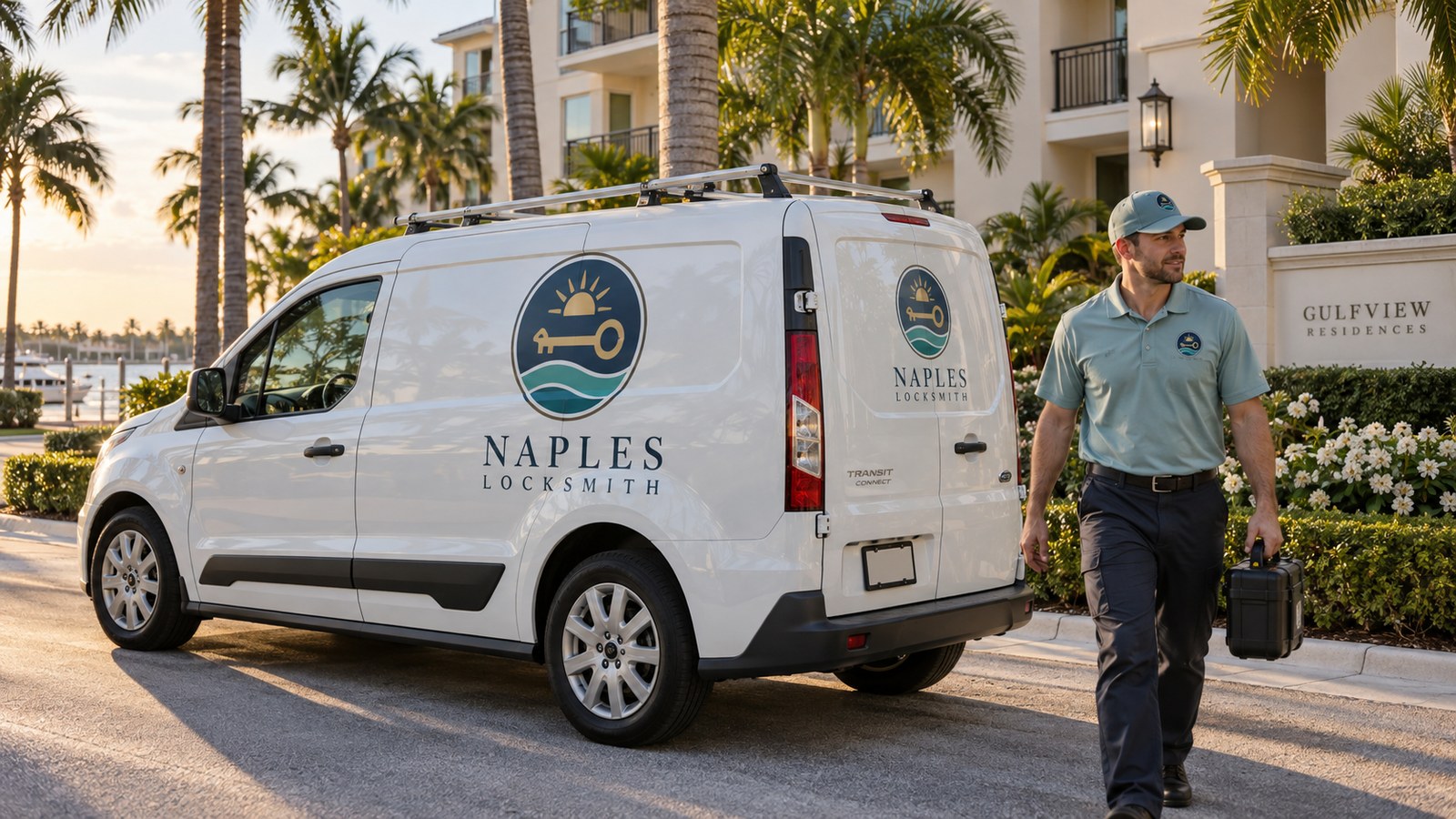
The last plates are washed, the staff is heading out, and the kitchen door will not catch. It bounces off the strike, hangs ajar, or only latches if somebody leans on it. This page explains why back doors in busy Naples restaurants fail this way, how a technician works through the possible causes at night, and what a kitchen can do to keep the door dependable.
Why the back door fails first
Of all the doors in a restaurant, the one behind the kitchen takes the most abuse. It opens for deliveries, trash runs, smoke breaks, staff arrivals and fire safety. Carts and boxes bump the edges, wet hands and grease coat the handle, and the door is often propped open with a mop bucket during prep. Every one of those habits shifts something a little out of place.
Humidity makes matters worse. Steam from the kitchen, damp air from the Gulf and the daily temperature swings between an air-conditioned interior and a warm alley cause metal to expand and contract and wooden or composite doors to swell. A latch that was perfect in the dry months can begin to catch in the wet season, especially if the door was hung with a very small clearance.
Because the door is out of public sight, problems often go unnoticed until the end of the night, when a manager discovers it will not lock. That is when a call goes out, and a technician who understands the usual causes can often fix the issue quickly instead of treating the whole door as broken.
The first questions a technician asks
On the phone, expect a few short questions. Is the door metal, wood or fiberglass? Does it open inward or outward? Is there a push bar on the inside or a simple knob or lever? Does the latch bolt move in and out freely when you operate the handle with the door open? Does the door close fully on its own, or does it stop short?
These answers narrow the problem. A latch that moves freely but does not catch usually points to alignment. A latch that sticks when the door is open suggests a problem inside the lock. A door that does not close fully on its own points toward the closer or the hinges. A dispatcher can pass these details to the technician so the right parts are in the van.
If safe, take a photo of the edge of the door and the strike side of the frame. Mention any recent changes, such as a new mat, a new cooler near the door, or a delivery that bumped the frame. Please call us to confirm availability, and tell us whether anyone is on site who can confirm ownership or authority.
Checking the latch bolt itself
With the door open, the technician works the handle or push bar and watches the latch bolt. It should slide out crisply and retract fully when the handle is operated. If it is slow, gritty or catches halfway, the spring or the internal mechanism may be gummed with grease and dust. Kitchens produce an airborne film that settles on every hardware surface and thickens over time.
Cleaning is often the first remedy. A careful technician removes the latch assembly where possible, cleans it with a suitable solvent and relubricates with a dry product that does not attract more grime. Oily sprays may loosen the latch for a night but will attract dirt, so they are avoided in kitchen environments.
If the latch is worn, bent or has a broken spring, replacement is the honest answer. Many commercial latches are standard sizes and can be swapped quickly. Exit devices have a latch that retracts when the bar is pushed, and the same logic applies: clean what can be cleaned, replace what is worn, and test before leaving.
The strike plate and the shifting frame
If the latch moves freely, the next suspect is the strike, the metal plate in the frame where the bolt lands. A strike that has drifted by even a few millimeters will keep the bolt from entering the hole. Vibration from slamming, a door frame that has settled, or a loose screw can all cause drift.
A technician tests alignment by applying a little marking material to the end of the bolt and closing the door. The mark transfers to the strike and shows where the bolt is landing. Small misalignments can be fixed by filing the strike opening or moving the plate. Larger ones may need the frame reinforced or the strike repositioned entirely.
Frames in older buildings can be softer than they look. Screws that no longer bite into wood or a hollow metal frame are common, and a longer screw or a repair of the screw hole may be needed. Without that, a perfect new latch would fail within weeks because the plate would loosen again.
Door closers and the way a door arrives at the frame
A closer controls the final inches of the door's swing. If it closes too gently, the door arrives at the frame with no momentum and may stop just short of the latch. If it closes too hard, the door slams and bounces back, sometimes opening a few inches again before the latch engages. Either pattern can be mistaken for a lock problem.
Closers have adjustment screws for the main sweep and the final latching speed. In a humid kitchen, the hydraulic fluid inside the closer can behave differently across the day, and a seal that is starting to leak will give inconsistent results. A technician checks for oil staining, tests the door repeatedly and adjusts the speed accordingly.
A frequent habit in restaurants is blocking the door open with a wedge or a bucket. Closers hate this, and the arm can bend over time. If the kitchen needs the door open for ventilation or deliveries, a proper hold-open device is a better solution, and a technician can discuss what suits the door and the local requirements.
Swollen doors, warped slabs and wet-season problems
Wooden and composite back doors can absorb moisture and expand, especially if the bottom edge was never sealed. A swollen door rubs on the frame, and the latch side may no longer line up. In the dry season the problem vanishes, and in summer it returns. Staff blame the lock, but the door slab is the cause.
A technician may relieve the problem by adjusting the hinges, trimming a small amount from the offending edge, or sealing the bottom and sides against moisture. Metal doors can also warp from heat and impacts, and a bent door can only be improved so far by adjustment. In that case, a door replacement through a carpenter or door company is the long-term answer.
Rain and pressure from storms can shift a door in its frame, so after any bad weather it is worth checking whether the back door still closes smoothly. If it does not, call before it fails completely. A small hinge adjustment now is easier than a security problem at the end of a busy night.
Securing the door for the night when a repair must wait
Sometimes the problem cannot be fully solved on the spot, for example when a replacement part is needed that is not on the truck. A technician will then make the door as secure as possible for the night. That might mean installing a temporary surface bolt, adjusting the strike to catch the latch partially, or fitting a hasp with a padlock on the interior.
Be honest with the technician about fire and exit requirements. An exit door must remain operable from the inside, and a temporary measure should never trap people. Anything the technician installs for the night should let staff leave quickly in an emergency, and it should be removed when the proper fix is made.
Make a note for the opening crew the next day so they know the door is in a temporary state. A small sign on the door and a line in the manager's log prevent confusion. Please call us to confirm availability for the follow-up visit, and we will confirm what parts are required before coming back.
Verifying who can authorize the work
A restaurant door call can come from a line cook, a dishwasher or a night manager. Before work begins, the technician asks who is authorized to approve it. In many restaurants, the owner or general manager decides. If that person is not present, a phone call or text confirmation may be enough for routine repair.
Where the building is leased, the landlord may own the door and frame. A repair that modifies the frame or changes the lock may need landlord approval. A technician cannot resolve a lease question but can describe what the work would involve so you can contact the right person.
This approach protects you. An unfamiliar person asking a locksmith to change locks on a restaurant at night is something every business owner would want a technician to question. The few minutes it takes to confirm authority are a small price for a vendor who takes security seriously.
Hardware choices that suit a kitchen environment
If a door has failed repeatedly, it may be time to think about better hardware. Stainless steel levers and push bars resist grease and cleaning chemicals better than plated finishes. Sealed latches and cylinders keep out moisture and food residue. Heavy-duty hinges prevent the sag that causes so many alignment problems.
Consider also the style of handle. Smooth levers are easier to wipe clean than knobs with crevices, and they work better for staff carrying trays or boxes. A push bar on the inside, with a lever or cylinder outside, keeps the door secure while allowing quick exit from the kitchen.
Finally, think about the weather exposure. A door that faces an alley with direct sun and rain will age faster than a sheltered one. Adding a drip edge, a sweep at the bottom and a proper threshold reduces moisture entry and extends the life of the hardware. A technician can point out these small additions during the visit.
Habits that keep the door dependable
The best repair is the one that lasts. Teach the team to close the door fully and listen for the latch. A quick daily test at closing, pulling the door after it is shut, takes seconds and prevents the unpleasant surprise of an unsecured building. Make it part of the closing checklist alongside turning off equipment and setting the alarm.
Keep the area around the door clear. Boxes stacked against the frame, mats that catch the bottom edge and trash bins placed too close all interfere with the swing. Wipe the handle and latch edge during regular cleaning, and report stiffness early rather than waiting for failure.
Schedule a seasonal check before the busy winter months. A technician can inspect the closer, lubricate the latch, tighten hinges and confirm the strike is aligned. Doing so before the dining season, when Naples restaurants are at their busiest, means the back door will not be the thing that goes wrong on a full night.
Deliveries, trash runs and the wear that builds up
Think about how many times the back door opens during a service. Produce arrives, dry goods are carried in, grease is carried out, bags go to the dumpster, and staff step out for air between rushes. A busy restaurant can cycle that door well over a hundred times in an evening. Each cycle works the latch, the hinges and the closer a little, and the wear is cumulative rather than sudden.
Deliveries add a particular hazard: hand trucks and carts that strike the lower part of the door and the frame. Over months, that bumping can bend the bottom corner, push the frame out of square and dent the kick plate. A technician looks at the bottom hinge and the strike side of the frame for dents, because those marks show where the damage began.
A simple change helps. Use a designated door stop or hold-open device rather than improvised wedges, and ask delivery drivers to avoid hitting the frame. A kick plate in stainless steel protects the door's lower edge and is easy to fit. These small habits and fittings reduce the number of times a latch problem appears in the first place.
Grease, cleaning chemicals and what they do to hardware
Kitchen air carries fine grease droplets that settle on everything, including door hardware. Mixed with dust, they form a sticky layer that traps grit and slows moving parts. Cleaning crews add strong degreasers and sanitizers, which are effective on counters but can strip finishes and attack the lubricants inside a latch if sprayed directly onto the hardware.
A technician will often recommend wiping the handle and latch edge with a mild cleaner and a cloth rather than spraying, and avoiding bleach-based products on metal finishes. If the latch has already gummed up, it can be removed, soaked, brushed and treated with a dry lubricant. Doing this once or twice a year keeps the mechanism running smoothly through the busy months.
Stainless steel hardware tolerates cleaning chemicals better than plated finishes, but even stainless can stain or pit if harsh products are left to sit. Rinse and dry after cleaning, especially on doors near the dish area. A locksmith can walk the kitchen with the manager and point out the doors most exposed, so the cleaning routine can be adjusted where it matters most.
Getting through a busy-season night without a locked door problem
Naples restaurants are at their busiest when seasonal residents and visitors fill the town, and a door failure in the middle of that period is costly in lost sleep and distraction. Planning ahead is easier than improvising. A pre-season inspection of every exterior door, including the back and any side exits, costs little and catches the problems that are most likely to surface under pressure.
Have a short written plan for what staff do if the back door will not latch. Who gets called? Who stays until it is secured? What is the fallback, such as a temporary surface bolt kept in the office? Having that plan prevents a late-night scramble. Please call us to confirm availability, and keep the number where the closing manager can find it.
Finally, consider keeping the door's make and model noted somewhere accessible. A photo of the lock, the closer and the strike on the manager's phone helps the technician arrive with the right parts. When the part is on hand, the repair is often completed in a single visit, and the restaurant can lock up and go home.
Frequently asked questions
Why does my kitchen door latch in the morning but not at night?
Temperature and humidity change through the day. Metal and wood expand when warm and damp, and a door that fits well in the cool morning may bind later. A closer that behaves differently as its fluid warms can also play a part. A technician can adjust the strike, hinges and closer to cope with those swings.
Can you fix a back door after the restaurant closes?
Please call us to confirm availability, since schedules vary. Many latch and strike repairs can be done on site in one visit. If a part is needed that the technician does not have, the door can be secured temporarily and finished at a follow-up visit.
Will you need to replace the whole lock?
Often not. Cleaning, adjusting the strike or setting the closer correctly solves many cases. Replacement is recommended when the latch is worn, bent or broken. The technician explains what was found and offers options before doing anything beyond the agreed work.
Do you check who I am before working on the door?
Yes. The locksmith checks that the person requesting work has authority over the business or building. An owner, a manager, or someone confirmed by them is typically enough. If the landlord controls the door, they may need to approve changes to the frame or lock.
How is the cost explained?
Straightforward repairs are quoted by phone once you describe the door. When the problem is unclear or complicated, a technician visits and the service call charge is explained before dispatch. You will know the scope before the work starts.