
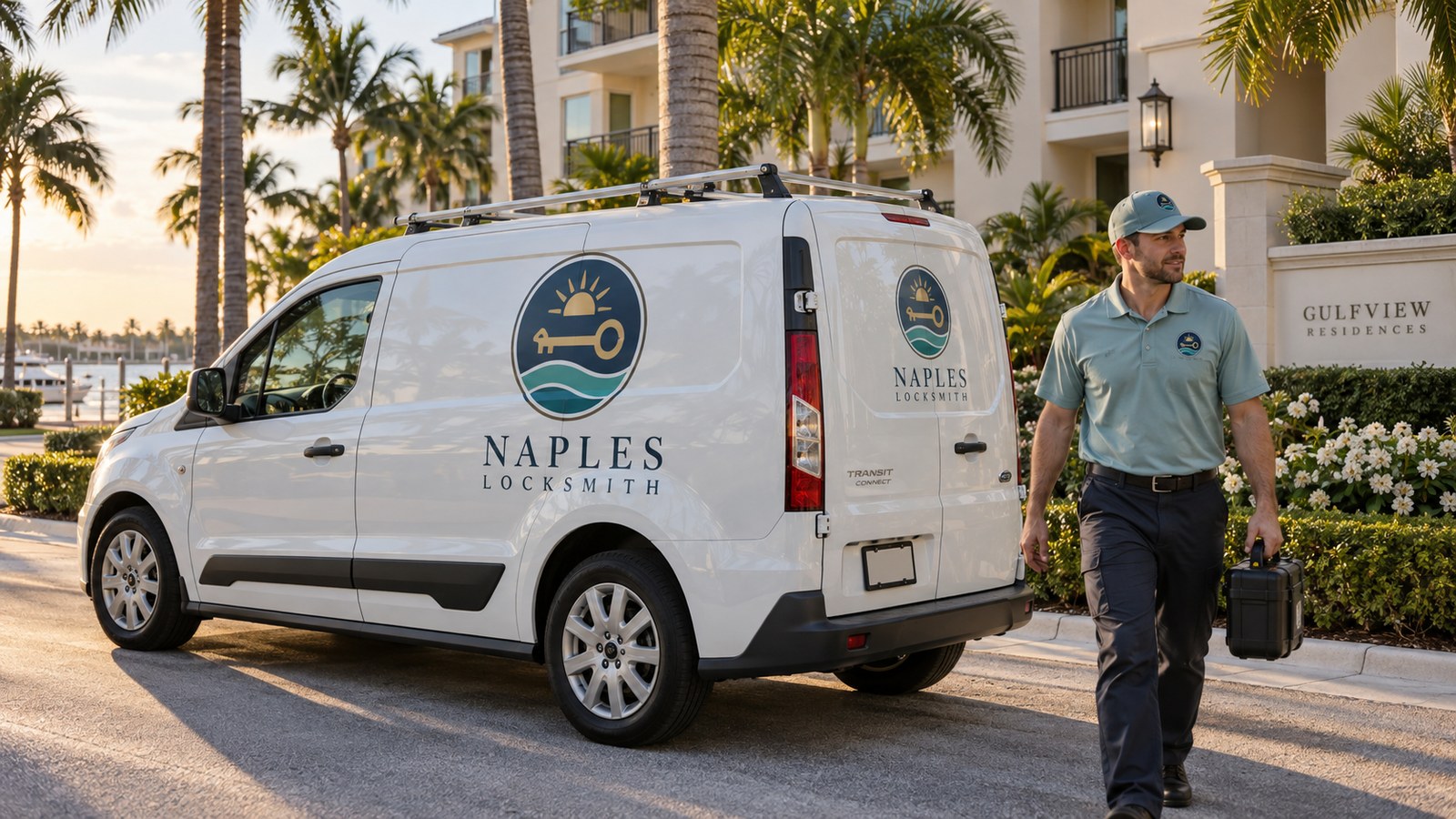
A small law office has two quiet problems. The file room holds confidential paper that should open for only a few people, and the partners want to come and go in the evening without fuss. This page explains how a mobile locksmith in Naples approaches layered keying, who should hold which key, and how to make after-hours entry smooth without creating a tangle of copies.
Two doors, two different jobs
The front door of a professional office and the door of the file room do different work, and treating them the same is the most common planning mistake. The front door has to welcome clients during the day and keep the suite secure at night. The file room door has to remain closed to nearly everyone, even people who work in the office all day.
Seeing them as separate problems makes the design easier. The suite entry can be keyed so every employee has a key, and a keypad or a second lock can be added for after-hours use. The file room can be keyed on its own system, with only a few holders. Clean separation means that losing a front door key does not expose the confidential files.
A technician will start by walking the office with you, noting each door, what lies behind it, and who needs to go through it during a normal week. Draw this on a sketch if you can. The sketch becomes the basis of the keying plan, and it keeps the discussion concrete rather than abstract.
Layered keying in plain language
Layered keying means one key can do more than another. A common arrangement has three levels. A change key opens a single door, such as an associate's office. A master key opens several doors, such as every private office. A grand master opens everything, held by the managing partner. Each key is cut to its place in the hierarchy.
The attraction is simplicity for the people using the keys. Each person carries one key that does what they need, and no more. The tradeoff is that master keys carry more risk if lost, so they should be few in number, tracked carefully and stored securely when not in use. A technician can sketch the structure so you can see exactly what each key opens.
Not every office needs a full master system. A two-partner firm with a suite and a file room may do perfectly well with two separate keys. The fuller design pays off when there are many doors and several levels of trust. A locksmith should be willing to suggest the simpler option when it is the better fit.
- Change key: one office or one cabinet
- Master key: a defined group of offices
- Grand master: held by the managing partner only
- Separate key for the file room, not included in the master
The file room as its own island
Confidential files deserve a lock that is outside the general system. Consider keying the file room on a separate, restricted keyway that is not covered by any master. Only the named holders have a key, and copies can be ordered only with written authorization. If an office master key is lost, the file room is not affected.
The door itself should be solid. A hollow-core interior door can be forced, so a solid-core or metal door with a reinforced frame is worth considering. A deadbolt with a long throw and a reinforced strike gives the lock something solid to push against. A technician checks the door, frame, hinges and gaps to see where the weak points are.
Inside, filing cabinets with their own locks add a second layer for the most sensitive matters. Cabinet locks are often easy to replace with unique cylinders. Set a simple rule that the file room door is always locked when unattended, and add a closer if the door tends to be left ajar. Habits support hardware, and hardware supports habits.
After-hours entry for partners
Partners often work late, return on weekends or arrive before anyone else. They need reliable entry without needing a ring of keys or without setting off the alarm. The simplest answer is a good key to the main door, kept on the partner's own ring, and an alarm code that belongs to them alone.
A keypad deadbolt or an electronic lock is another option. It lets each partner have a personal code, and a code can be removed the day someone leaves. The convenience is real, particularly when several people need after-hours access. A technician can discuss the strengths and limits of different keypad types and explain how to manage codes.
Whichever method you choose, consider lighting and the approach to the door. A well-lit entrance, a clear view of the door from the parking area, and a door that closes and latches on its own all help someone entering late at night feel safe. A locksmith can tell you what is possible with the existing door, and what might call for a carpenter or electrician.
Keeping track of copies
Law offices accumulate keys through cleaners, couriers, interns, paralegals and former staff. The cleaning crew in particular often holds a key, and nobody remembers who gave it to them. A key log solves this. List each key, the holder, the role and the date issued, and require signing for any new copy.
Restricted keyways make the log enforceable. With a restricted key, a copy can be ordered only through the locksmith or the original supplier, and only with an authorized signature. That blocks quick copies at a hardware counter, which is how most uncontrolled duplicates are made.
When the count does not add up, rekey. Rekeying the cylinders removes any key that has fallen out of sight, and a single visit can cover several doors. Treat it as ordinary maintenance rather than a response to suspicion. Offices that rekey on a regular schedule, say every couple of years, find that key control stays tidy without effort.
Authority and identification before work begins
Before opening, rekeying or changing any lock in an office, a locksmith verifies who is asking. In a professional suite this means the owner, the managing partner, an office manager acting for them, or the landlord for building-controlled doors. Expect to show identification and some connection to the suite, such as a lease or a business card with the suite address.
A law office will understand the reasoning better than most. Opening the wrong door for the wrong person could expose confidential material, and the technician takes that seriously. If the person calling is a junior employee or a courier, the locksmith may ask to speak with someone with authority before any work begins.
If the suite is leased, check whether the landlord controls the entry lock. Some buildings require that any changes be approved or that a spare key be provided to building management. Telling the technician these rules ahead of time prevents a wasted trip. A short email from the landlord confirming approval is usually enough.
Hardware that suits a professional office in Naples
The look of a law office matters. Clients judge the firm in part by the first impression, and the door hardware is part of that. Quality lever handles or traditional knobs in brushed finishes suit a professional setting, and good commercial-grade locks come in refined styles. Appearance and security are not at odds.
Local climate still plays a role. Exterior doors and any entrance exposed to the Gulf breeze benefit from corrosion-resistant finishes such as stainless steel or solid brass. Interior hardware can be a more modest grade. Using good materials where they matter keeps the budget sensible and the doors looking sharp for years.
Door closers are worth a mention. An office door that swings shut by itself and latches reliably is a small but real security feature, particularly for the file room. A closer set to a gentle speed also avoids slamming, which matters in a quiet professional setting. A technician can adjust or install one as part of the job.
Hurricane season, backups and keeping continuity
Professional offices in Collier County plan for storms like everyone else, and key control is part of continuity. If you evacuate, who has access to the office afterwards? If power fails, do keypads and electronic locks have a mechanical backup? Having an answer ahead of time spares a scramble when the weather clears.
Keep a spare set of essential keys with a trusted person outside the office, and list them in your continuity plan. Make sure the file room key is among them, stored securely. If an electronic lock is in use, confirm how it behaves without power and how to get in. A locksmith can test the mechanical override and tell you how it works.
After a storm, doors can swell or warp, and frames can shift. A quick check of the main entry and the file room door for smooth operation helps you secure the office promptly. If a door will not close, call and the technician can secure it temporarily until proper repairs are made.
What happens when you call
Tell the dispatcher what you have: the number of doors, whether the file room has its own lock, how many people need keys, and whether you rent the space. Photos of the existing hardware help. Please call us to confirm availability, since schedules vary.
Quotes for straightforward rekeying or hardware swaps are given by phone before the technician comes out. For complicated arrangements, such as multiple doors with unknown hardware or a master system, a technician visits first and the service call charge is explained before dispatch. You will know the scope before work starts.
At the visit, the technician confirms authority, reviews your keying plan, and performs the agreed work. New keys are tested on every door, handed to the named holder, and counted. You receive a note of what was done. File it with your key log, and review the arrangement once a year to confirm it still matches how the office works.
Couriers, cleaners and the people who are not staff
A law office has regular visitors who are not employees: couriers who deliver documents, process servers, a cleaning crew in the evening, an IT consultant, perhaps a notary who drops in. Each one raises a small question about access. Nobody wants to hand out keys casually, and nobody wants a courier waiting on the sidewalk.
For the cleaning crew, a key to the main door and common areas is usually enough, never the file room or the partners' offices. If the crew must clean the file room, a staff member can open it for them or the room can be cleaned during the day under supervision. Keep the cleaning key on a restricted keyway and recorded in the log so it cannot quietly multiply.
Couriers and short-term visitors are better handled by the front desk during working hours and by a drop box or a lobby arrangement after hours. A keypad on a separate small closet or mail slot can serve deliveries without opening the suite itself. A technician can explain which simple additions fit your door and your building.
Alarm systems, locks and how they work together
Many professional offices have an alarm system, and the door lock and the alarm need to cooperate. A partner entering at night must unlock the door, step in and disarm the system within a short window. If the lock sticks, the delay can trigger the alarm, which is annoying and sometimes expensive. A smooth lock is part of a smooth alarm routine.
Door contacts on the frame also depend on the door closing squarely. If a door sags or the latch does not catch, the alarm may report the door as open. A technician who adjusts hinges and strikes during a lock visit often resolves alarm complaints that the alarm company could not.
A locksmith does not install or program alarm systems. If you want to connect electronic locks to your alarm or access control, an alarm contractor will handle the electronics, and the locksmith will make sure the physical door and hardware are ready to support it. Coordinating the two visits avoids finger pointing if something does not work the first time.
Planning for staffing changes and growth
Firms grow, partners retire, associates come and go. A keying design that fits five people today may be awkward at fifteen. When you plan the system, ask the technician to leave room for expansion. A master key system designed with extra levels or spare positions can absorb new offices without redoing the whole structure.
It also helps to plan how new people receive keys. A short onboarding checklist that includes issuing a key, an alarm code and instructions on closing up protects the office from the first day. The checklist should mirror the offboarding steps so that every key issued has a clear point of return.
If the firm moves suites, the lock plan travels with it. Rekeying a new suite before moving in is a sensible habit, since you cannot know how many keys the previous tenant gave out. Please call us to confirm availability before a move so the work can be done before furniture and files arrive.
Small habits that make the hardware work
The best hardware still depends on routine. Lock the file room whenever it is unattended, even for a short trip down the hall. Keep key rings without labels that reveal what the keys open, because a lost ring with an address and a room name on it tells a stranger exactly where to go and which door to try. Never leave a key in a desk drawer or under a mat. These habits cost nothing, and they are the difference between a plan and a practice.
Check that the front door latches properly each evening. A quick pull on the handle after locking confirms the bolt is thrown. If the door ever needs a shove, a lift or a second try, report it right away. Small alignment problems are easy to fix and hard to ignore once they worsen in the humid months.
Finally, schedule a yearly review with your locksmith. Ask the technician to look at each controlled door, confirm the locks and closers are working well, and compare the key log with the number of keys cut. A short check each year keeps the office secure, and it keeps the arrangement matched to the way the firm actually operates.
Moving the file room or changing the layout
Offices reorganize. A file room becomes a conference room, a storage closet becomes the new records space, or the firm takes over the suite next door. Each change affects the lock plan. Before furniture moves, walk the new layout with a technician so doors, frames and keys are ready, rather than discovering gaps after files have already been carried in.
A room that was never meant to hold confidential material may have a hollow door, a thin frame and a basic knob. Upgrading it takes a short visit, and doing it before the move is much easier than doing it afterward. Ask about a closer and a restricted-key deadbolt at the same time, so the room is secure from the first day.
Frequently asked questions
Should the file room be on the office master key?
Usually not. Keeping the file room on its own restricted key means that losing an office master key does not expose confidential files. Only a few named people hold the file room key. A technician can design the keying so each door has the right level of control.
Is a keypad lock good for after-hours entry?
It can be. Each partner can have a personal code that is easy to remove later. Keypads need regular battery checks and a door that latches squarely, and a mechanical override should be kept secure. A technician can look at your door and advise whether it suits.
How do we stop cleaners or former staff from copying keys?
Use a restricted keyway so copies can be made only with written authorization, and keep a key log. If the count of keys cannot be confirmed, rekeying removes any uncertainty. A technician can set this up in one visit.
Does the locksmith check who is requesting the work?
Yes. Before opening or rekeying, the locksmith confirms the person has authority over the suite. A managing partner, owner or office manager acting for them is typical, and the landlord for building-controlled doors. If authority is unclear, we explain what is needed.
How do quotes work for an office job?
Simple work is quoted by phone once you describe the doors. For complicated jobs, a technician visits and the service call charge is explained before dispatch. Please call us to confirm availability.