
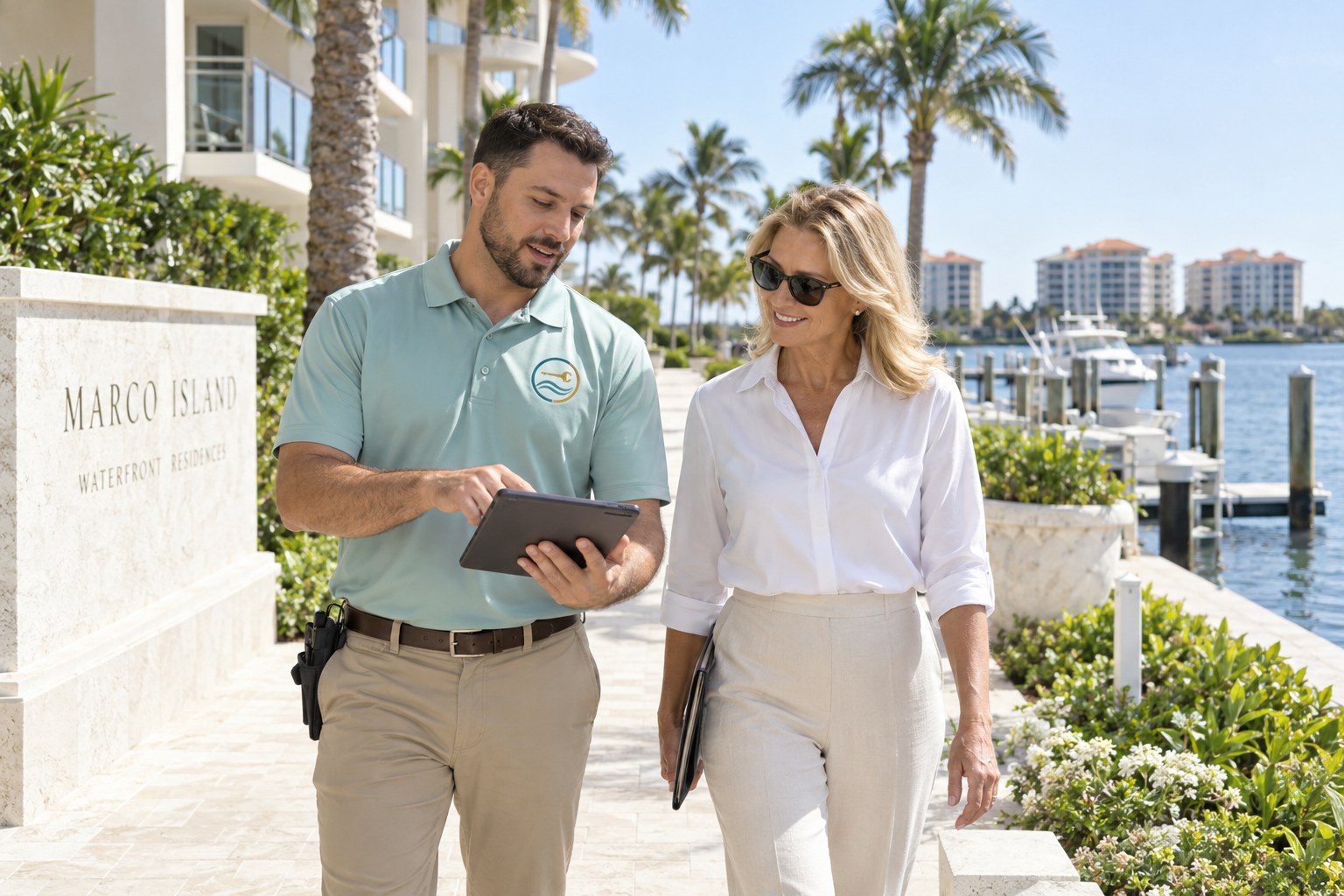
Immokalee is a working inland community where town streets give way to fields, packing facilities, equipment yards and long rural drives. Locks here protect homes, but also trucks, tool cribs, irrigation sheds and gates. This page walks through how a mobile locksmith approaches that mix, why distance shapes every call, and how you can prepare so the visit goes smoothly. Call us to confirm availability.
A different kind of service area
Most of Collier County's locksmith calls involve a house, a condo or a car in a neighborhood where the next address is a few hundred feet away. Immokalee is different. The town has its own streets, shops, apartments and family homes, but just beyond them lie agricultural properties, packing operations, nurseries, equipment lots and open land where the nearest neighbor may be a quarter mile off. A call can start in a driveway and end at a gate across a field.
That variety changes how we think about a visit. A technician heading to Immokalee considers the drive from the coast, the likely type of job, and the tools and stock to carry. Gate padlocks, heavy-duty hasps, truck cylinders, farm shed deadbolts and ordinary house hardware all ride in the same van. It would be a poor use of anyone's afternoon to arrive and discover we are missing the one part that mattered.
Safety is part of the picture on rural calls as well. Fields at dusk, equipment yards with moving vehicles and unlit gates are not places to work carelessly. We ask whether anyone will be on site, whether there are dogs loose on the property and whether the surface is stable for a van. These questions are not fussiness. They keep the technician and the people on the property out of trouble and make the visit go the way everyone intended.
So we ask more questions on the phone than you might expect. What kind of lock is it? Is it on a building, a gate, a trailer or a vehicle? Who owns it, and who is on site? Can someone meet the technician at a clear spot on the road? Honest answers let us plan the trip well. Please call to confirm availability for your location and your type of job before anyone drives out.
Town homes and apartments in the heart of Immokalee
In town, the day-to-day locksmith needs are familiar: a lost key, a deadbolt that no longer turns, a door that has been forced and needs repair, or a change of locks when tenants move. Many homes here are modest single-story houses or small multi-unit buildings, and families often share one set of keys among several relatives. Keeping track of who holds what is hard, which is why a rekey after any change in the household is worth considering.
Rental properties bring another thought. A landlord or property manager who has had a tenant leave should rekey before the next one moves in, so earlier keys stop working. We can rekey several doors to one key and label the set clearly. For a unit in a small building, we may also check the shared entry hardware, though that belongs to the owner or management, and we confirm authority with them before touching it. Tenants should not be asked to change building locks on their own.
Ownership checks are routine here, as they are everywhere. We ask for identification and some proof of connection to the property, such as a lease, a utility bill or a call to the owner. This protects residents who rely on the safety of their doors. If you cannot show proof on the spot, tell us honestly, and we will explain what alternatives exist, for example reaching the property manager by phone while the technician waits.
Farm properties, gates and long driveways
Rural property security starts at the gate. A farm gate with a chain and padlock is one of the oldest locks in the world, and it still needs thought. A padlock exposed to rain, sun, fertilizer dust and constant opening wears quickly. Shrouded shackles resist cutting tools better than open ones, and a protective hasp that hides the lock body from bolt cutters adds real difficulty. We can discuss which suits a particular gate and how many workers need access.
Many properties have a shared key situation: the owner, a foreman, a delivery driver, a seasonal crew. Keyed-alike padlocks let a single key open every gate on a property, which is convenient but means one lost key affects them all. Sometimes the better setup is a master key arrangement, where each person has a key that opens only their lock, while the owner has a key that opens everything. We explain the options plainly and let you pick what fits your operation.
Long driveways bring their own problem: a lockout far from help. If you work alone on a large property, consider leaving a spare key in a secure lockbox at a spot you control, or with a trusted neighbor or family member. We can also set up simple, durable hardware on outbuildings so a lost key is an inconvenience rather than a lost afternoon. Think about the worst day, then choose hardware that handles it.
Chains deserve a note of their own. A chain is only as strong as its weakest link and the padlock that closes it, so a heavy chain with a flimsy lock is theater. Look at the chain gauge, the way it wraps the post and whether the gate can be lifted off its hinges. Sometimes the simplest improvement is turning the hinge pins upside down or welding the tops so the gate cannot simply be lifted away. A locksmith can advise on the lock, and a fencing contractor can handle the metalwork.
- Shrouded padlocks resist cutting better than open shackles
- Hasps should hide the lock body and use hidden fasteners
- Keyed-alike sets reduce key clutter but raise loss risk
- A master key system gives each person limited access
Work trucks, trailers and the keys that go missing
Work trucks live hard lives. They carry tools, ladders and sometimes cash or product, and they pass between drivers, so keys disappear. Common requests include a duplicate key cut from a code, a replacement for a lost key with a transponder chip, and a stuck ignition. The details differ by vehicle category, and we describe options in general terms: a basic metal key, a chip-equipped key, a remote head key, or a push-button start fob. Programming equipment decides what can be done on site.
Before we cut or program any vehicle key, we check ownership or authority. For a company truck, that may mean the registration in the business name, a letter from the owner, or a call with the person responsible for the fleet. We note this not to slow you down but because a key to a vehicle is a key to everything inside it. We would rather ask one more question than hand over access to the wrong person.
Trailers and equipment have locks too: hitch locks, coupler locks, toolbox cylinders, tailgate latches. These often use inexpensive cylinders that have corroded or been bent by repeated forced attempts. We can usually replace or rekey them so one key covers the truck, the toolbox and the trailer. A tidy key ring helps a small crew far more than a pocket full of near-identical keys, and it reduces the number of emergency calls later.
Equipment sheds, tool cribs and outbuildings
An equipment shed holds some of the most valuable things on a property, yet its door often has the weakest lock. Metal sheds and block outbuildings frequently use a basic hasp and a padlock, with hinges that can be unscrewed from the outside. A good lock cannot help a door whose screws are exposed. We look at the full arrangement: hinges, hasp, fasteners, door skin and lock, and recommend improvements in order of usefulness.
For doors that see constant use, a rugged deadbolt or a heavy-duty mortise or rim lock may suit better than a padlock. Rim locks mount on the surface, which can be easier on thin metal doors. A cylinder with a protective collar resists twisting. Where workers share access, a keypad or lockbox can remove the need for a physical key, though it requires periodic code changes when crew members leave. We explain what each option asks of you so there are no surprises later.
Dust, fertilizer residue and moisture shorten the life of cylinders in agricultural buildings. Regular cleaning and a suitable dry lubricant extend it. When a lock does fail, resist the urge to hammer or pry, since forced attempts damage the door as well as the lock. Call us and describe the building. Tell us what the door is made of, whether the lock is mounted on the surface or set into the door, and whether it faces the weather. Those details tell us which cylinders, collars and screws to bring. If it is complicated, a technician visits and the service call charge is explained before dispatch, and you will know the plan before work begins.
Understanding distance on a call
Immokalee lies inland from Naples, and a locksmith who serves the whole county has to be honest about distance. We do not promise arrival times, and we do not pretend the drive is shorter than it is. What we can do is plan carefully, be clear on the phone about whether we can take the job, and tell you what the visit will involve. Call us to confirm availability for your address and the type of work.
Distance also affects how we group work. If you have several doors, a gate and a truck that all need attention, bundling them into one visit makes better use of the trip. A property manager with several buildings can line up the list and have everything handled at once. A family with a rental and a home can do the same. Planning ahead gives everyone more flexibility than a series of separate emergency calls.
For urgent lockouts, we still try to help. A person locked out of a house or vehicle deserves an honest answer about what is possible. If a quick fix is available by phone, such as checking for an unlocked window, a spare key held by a neighbor or a way to reach the owner, we mention it. When a visit is the right answer, we gather the details that let the technician arrive prepared and avoid a second trip.
Rekeying a property that has seen many hands
Agricultural and rental properties often accumulate keys. Workers come and go, managers change, contractors borrow gate keys, and nobody can say with confidence how many copies exist. Rekeying resets that situation. We change the internal pinning of the cylinders on gates, sheds, houses and vehicles so earlier keys no longer work, and we issue a clean set. It is usually the best first step after a change in management or after a theft scare.
To make a rekey useful, we recommend keeping a simple log. Write down which doors and gates the keys open, who holds each key and when it was issued. It can be a page in a notebook. When someone leaves, you collect their key and, if the situation calls for it, rekey the affected locks. A written record turns key control from a vague worry into a routine habit, and it takes only a few minutes per month.
Not every lock can be rekeyed. Heavily corroded, bent or cheap cylinders may fail to hold a clean new pinning, and replacing them costs less trouble than repeatedly returning. We tell you plainly which locks are worth keeping. And as always, we check ownership or authority before changing who can enter. For a business or farm, that usually means speaking with the owner or an authorized manager who can confirm the work.
Weather, heat and the wear on outdoor hardware
Southwest Florida's heat, sun and summer rains punish exterior hardware. Direct sun can bake finishes and soften plastic parts. Heavy rain brings moisture into key slots and latch mechanisms. Salt air is less of a concern inland than at the beaches, but humidity and agricultural dust still combine into a sticky film that clogs pins. Locks outdoors age faster than the same lock inside, and they appreciate regular care.
A practical maintenance routine is small. Wipe the lock face, clear debris from the keyway with a brush or a blast of compressed air, and apply a dry graphite or PTFE-based lubricant, not heavy oil. Check that the hasp swings freely and the screws are tight. Look for rust bleeding from the hinges, which signals moisture trapped under a coating. These steps take minutes and often keep a lock working for years longer.
Hurricane season matters inland too. Strong winds and flooding rains can shift doors, damage gates and leave properties temporarily exposed. If a gate or building door will not lock after a storm, we can assess whether realignment, a new hasp or a replacement lock is the right answer. Because storm weeks are busy for everyone, plan ahead when you can, and call early if your hardware shows signs of wear before the season begins.
What to tell us and what to expect
Good communication shortens every job. When you call, tell us what the lock protects, what kind of lock it is, what has gone wrong, and who is on site. If it is a vehicle, tell us the general category and whether it uses a metal key, a chip key or a push-button fob. If it is a gate, describe the hasp and whether the shackle is cut or the key is lost. A photo helps. We will then explain the likely approach and whether we can take the job.
Quotes are given by phone for straightforward jobs. If a job is complicated, a technician visits and the service call charge is explained before dispatch, so you can decide with clear information. We do not push upgrades, and we do not hurry decisions. Our aim is to leave the lock working, explain what we found and, if needed, point out one or two sensible improvements for another day.
Please be ready to confirm ownership or authority. For a house, that may be identification and a bill. For a business or farm, it may be a conversation with the owner, a company document or a call to a manager. For a vehicle, it is registration or a similar record. This habit is part of why neighbors can trust a locksmith at the door. Contact us with questions, and we will help you prepare.
Frequently asked questions
Do you serve both Immokalee town and the farm areas around it?
Yes, we handle town homes as well as rural properties, gates, outbuildings and work vehicles. Distance matters, so please call us to confirm availability for your exact location and the type of job. The more detail you give about the lock and the access route, the better the technician can prepare.
Can you rekey several gates and sheds to one key?
Usually yes, if the locks are in workable condition. Keyed-alike sets let one key open every lock, while a master key system lets each person open only their assigned locks. We explain the tradeoffs, since one lost key in a keyed-alike set affects every lock. Badly corroded or bent locks may need replacement instead.
What do you need to see before opening or rekeying something?
We check ownership or authority first. For a house, that is usually identification and a bill or lease. For a business, farm or fleet vehicle, it may be registration, a company document or a call with the owner or manager. This protects the people who depend on those locks and keeps access in the right hands.
Can a locksmith make keys for work trucks and trailers?
We can often cut or program keys for many vehicle categories, including basic metal keys, chip keys and some fobs, depending on equipment and the vehicle. Ownership or authority is confirmed first. Trailer locks, hitch locks and toolbox cylinders can usually be replaced or rekeyed so one key covers everything.
How is a complicated job handled when the property is far out?
If a job cannot be judged by phone, a technician visits and the service call charge is explained before dispatch. Grouping several doors, gates and vehicles into one visit makes better use of the trip. Quotes for straightforward work are given by phone, and we confirm availability before anyone drives out.