
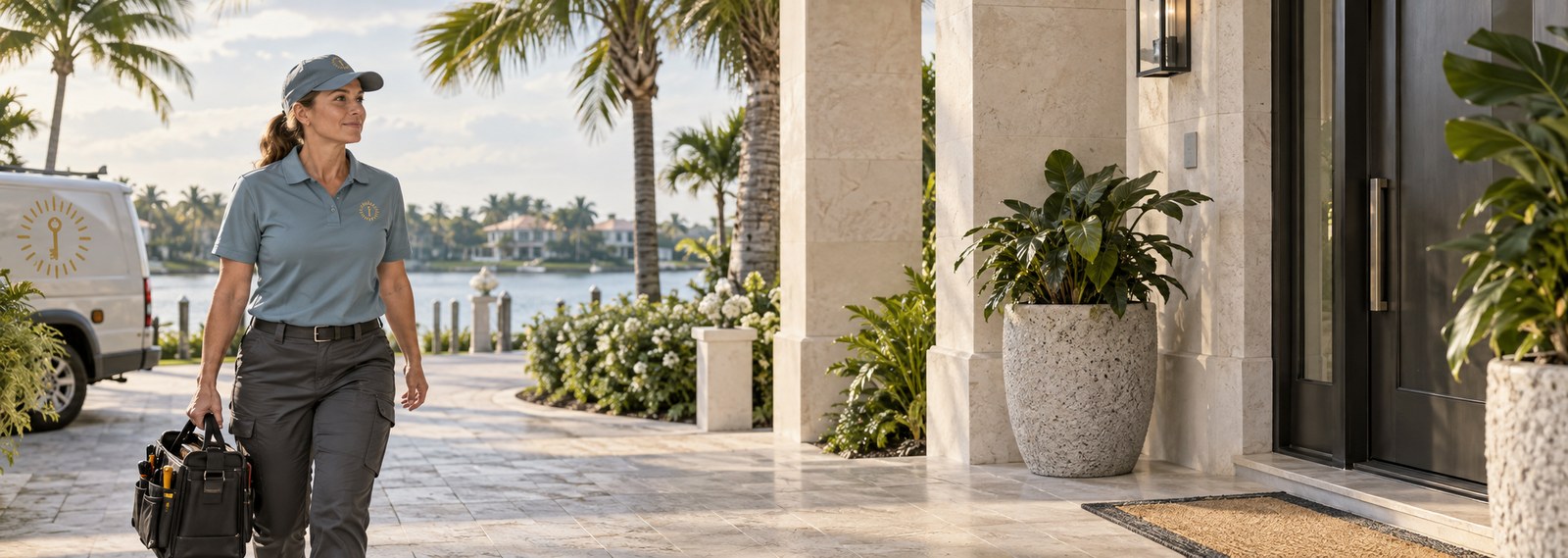
A deadbolt is the part of your front door that does the real work of keeping it shut. On the Gulf Coast it also has to survive humidity, salt and heat. This page walks through the choices that matter: cylinder style, bolt length, the strike plate and screws behind it, finishes, and how a technician installs one so the door closes cleanly.
What a deadbolt does that a doorknob lock does not
A standard knob or lever lock holds the door with a spring latch, a small beveled piece that slides into the frame. That latch is designed for convenience, not strength, and a thin tool or a firm shove can defeat it on many doors. A deadbolt is different. It uses a solid metal bolt that extends from the door edge into the frame, and it is moved only by turning the key or the thumb turn. Nothing pushes it back by itself.
That difference in design is why most residential codes and insurance advice treat the deadbolt as the lock that really secures an entry door. The latch keeps the door closed against wind and casual contact, while the bolt keeps it locked against someone trying to get in. For homes and condos in Naples, where many doors face lanais, courtyards or shared walkways, a good bolt makes a real difference.
A deadbolt is only as strong as the whole assembly. The cylinder, the bolt, the strike plate, the screws and the door and frame around them all play a part. A strong bolt set into a weak frame will not help. When a technician looks at your door, they consider all of those parts together and explain which are fine and which could be improved.
Single cylinder, double cylinder and thumb turn designs
The most common residential deadbolt is the single cylinder type. It has a keyway on the outside and a thumb turn on the inside, so anyone in the house can lock or unlock it without a key. This is the safest arrangement for a family, because there is never a moment when the people inside are trapped behind a door that needs a key to open during an emergency.
A double cylinder deadbolt has a keyway on both sides. It is sometimes suggested for doors with glass nearby, since a thumb turn within reach of a broken pane could be turned from outside. The tradeoff is serious: in a fire or other emergency, people may have to find a key in the dark. Many local codes limit or prohibit double cylinder bolts on residential exits, and we discuss that candidly before suggesting one.
There are also keyless variations, including a thumb turn on the outside with a keypad and a lock that lets you set a code. Some owners prefer a deadbolt that can be opened from inside by hand and from outside by key only, with the interior left easy to reach. Whatever you choose, the technician will match the choice to your door, your household and any condo or association rules.
Bolt throw, and why the length matters
Throw is the distance the bolt extends beyond the edge of the door when locked. Many standard deadbolts have a throw of about an inch, which is the common recommendation for exterior doors. A longer throw reaches deeper into the frame and offers more resistance against someone pushing or prying at the door. A short throw, especially on an older lock, can slip out of position if the frame has shifted.
Throw only works if the frame holds it. If the bolt reaches into a thin strip of wood trim rather than the solid structural framing behind it, the length is partly wasted. A technician will check what sits behind the strike location and recommend screws long enough to reach the stud. That connection between the bolt, the strike and the stud is what resists force.
Door thickness and edge preparation matter too. A standard front door is around one and three quarter inches thick, and the bolt is sized for that. Thinner doors, glass doors and some older entries require different hardware. We bring options on the van and measure before we recommend anything, since fitting the wrong bolt leads to a door that sticks, rattles or fails to lock.
The strike plate and screws that carry the load
Behind every deadbolt is a strike plate, the metal piece set into the door frame that the bolt enters. It is often the weakest link. Many builder installs use a small brass plate held by short screws that bite only into a thin piece of door jamb. A forceful kick can split the jamb and send the plate flying while the bolt itself is untouched.
A reinforced strike makes a big difference. A technician can install a heavy gauge strike plate with a deep box and secure it with long screws, typically three inches, that pass through the jamb and into the stud behind. Some owners add a full length door jamb reinforcement as well, which spreads the force along the frame instead of at one point.
This reinforcement is inexpensive in effort compared with its benefit, and it takes only a few minutes when we are already installing or rekeying a lock. If you have a deadbolt and are unsure about the strike, ask us to look. We can tell by inspection whether the screws are long enough and whether the frame is solid, and we explain what we find without upselling.
Salt air, humidity and the finishes that last
Coastal air is hard on metal. Salt in the breeze, condensation after a cool night and the steady humidity of a Gulf summer all work on exposed finishes. A deadbolt on a door that faces the water or sits on a sunny, open walkway can show pitting or tarnish within a short time if the finish is thin.
Finish quality varies widely. Solid brass underneath with a protective coating tends to resist corrosion better than plated pot metal. Stainless steel is another durable option, although it comes in fewer styles. Some finishes are designed for coastal use and are tested against salt spray, and a technician can suggest ones that fit the look of your door while holding up outdoors.
Internal parts matter as well. Even if the exterior survives, a cylinder with unprotected steel pins and springs can corrode inside and become stiff. Choosing a cylinder with corrosion resistant internals pays off, as does simple upkeep, like wiping the exterior with a damp cloth to remove salt film and applying a lock lubricant now and then. We explain the routine when we install.
Security grade and what the labels actually tell you
Residential deadbolts are commonly rated in grades. The ratings are based on standardized testing for things like cycle life, strike resistance and how much force the bolt can handle. Higher grades generally mean a sturdier build. A technician can explain the rating of a lock in plain terms and which grade fits your door and your budget.
Be cautious about packaging claims. A lock may advertise itself with strong sounding words that say little about how it performs. What matters more is the actual construction: the thickness of the metal, the number and quality of the pins, resistance to picking and bumping, and the strength of the bolt and mounting. Ask the technician to show you the hardware rather than relying on the box.
For most homes, a mid to upper range grade with a reinforced strike gives a solid improvement over a basic builder lock. For rentals, where wear and keys are a concern, a durable, rekey-friendly design is often the better pick. For a condo with a fire rated door, the lock must also be approved for the door type. We ask about the building before recommending anything.
Installing a deadbolt cleanly on an existing door
If your door already has a deadbolt hole, installation is a matter of replacing the old unit and fitting the new one. The technician removes the old bolt and cylinder, cleans the bore, checks the edge hole and the latch mortise, and installs the new hardware. A proper fit means the bolt moves freely in and out without rubbing, and the key turns without force.
If the door has no deadbolt, a new one needs two holes: a large cross bore through the face of the door for the cylinder and a smaller bore into the edge for the bolt. The technician uses a hole saw and a template, which gives clean, correctly spaced holes. Careful work here prevents splits and keeps the door looking tidy. Steel and fiberglass doors require different bits than wood.
After installation, the technician aligns the strike plate so the bolt meets it cleanly. If the door has swelled in humid weather or the frame has settled, adjustments may be needed so that the bolt does not bind. The goal is a bolt that slides in with a smooth, solid feel even in the middle of a humid August afternoon. We test it repeatedly before we leave.
Doors that need extra thought
Not every entry is a plain wooden slab. Fiberglass and steel doors, common in newer Naples builds, have foam or hollow cores that make cutting and mounting different from solid wood. Glass-paneled doors, sidelights and French doors need special attention because the lock location may sit near glass, which affects the choice between single and double cylinder.
Impact-rated doors and windows, installed in many coastal homes as hurricane protection, are built to demanding standards, and altering them can affect their rating. If your door is impact-rated, tell us. The technician will work with the existing preparations rather than cutting new holes where they could compromise the door, and will recommend a lock that fits the existing bores.
Double doors, such as paired entries with an active and a fixed leaf, add another layer. The fixed door is usually held by flush bolts at the top and bottom, and the deadbolt sits on the active door. We check that both leaves align and that the bolt meets a solid strike. If the doors have shifted, a few adjustments often make a noticeable difference to how the whole entry feels.
Ownership, authority and who may request the work
Changing a deadbolt changes who can enter the home, so we always confirm ownership or authority before starting. That means asking for identification and a document connecting you to the property, such as a deed, closing paperwork, a lease with the owner's consent or written approval from the owner or association. Without that, we do not alter any lock.
For rentals, the owner or manager normally authorizes the work. A tenant may request a repair, but a change in lock hardware often needs the landlord's approval, and in some buildings the association too. We ask these questions up front so there are no surprises on the day of the visit, and we explain why when we need documents.
If you are a buyer who has just taken possession, bring your closing document. If you manage a vacation rental, bring proof of your management role. The point of the process is protecting the people who live in or own the home, including you. It takes only a minute at the door, and it is part of how we earn the trust of the neighborhoods we serve.
Quotes, scheduling and next steps
Deadbolt work ranges from a simple swap to a full reinforcement of the door and frame, so we do not publish fixed amounts. Call us with a description of the door, the lock you have now and what you want to improve. We give you a quote by phone. If the job is complicated, a technician visits and the service call charge is explained before dispatch.
We do not promise arrival times. Conditions in Collier County change with traffic, season and weather, and we would rather give you an honest answer than a hopeful one. Call to confirm availability. If you are planning a larger project, such as upgrading several doors before a hurricane season or a seasonal return, calling in advance gives us room to schedule well.
If you are not sure what you need, describe what worries you. Maybe a door sticks in the humidity, or a key has become hard to turn, or you simply want better protection. A short conversation will usually point to the simplest fix. You do not have to commit to anything, and you will never be pressured to buy more than the door actually needs.
Care and habits that keep a deadbolt working for years
A deadbolt does not ask for much, but a little attention goes a long way in a humid climate. Every few months, wipe the faceplate and keyway area with a soft damp cloth to remove salt film and dust, then dry it. Work the bolt in and out with the door open, so you can see and feel whether it moves freely. If it drags, squeaks or catches, that is an early warning worth acting on before it becomes a lockout.
When lubricating, choose a product made for locks, such as a dry lubricant, and use it sparingly. A small puff into the keyway, followed by inserting and removing the key a few times, spreads it evenly. Avoid heavy oils and general purpose sprays, which can collect grit and turn into a gummy layer inside the cylinder. If you are unsure which product to use, ask the technician during a visit and they can show you.
Watch for the quiet signs of trouble. A key that turns only with a wiggle, a bolt that does not fully extend, a door that must be lifted or pulled to lock, or a thumb turn that feels loose are all clues. Often the cause is a door that has shifted slightly because of humidity or settling, and a small adjustment of the hinges or strike plate puts everything back in line without replacing a thing.
Finally, keep your keys in good shape. Worn or bent keys can damage pins, and a copy of a copy can drift in accuracy. If a key sticks or feels rough, have a fresh copy cut from a clean original. Keeping one spare in a safe place, with someone you trust, means that a lost key is an inconvenience rather than an emergency, and that your deadbolt can keep doing its quiet job.
Frequently asked questions
Is a double cylinder deadbolt a good idea?
It depends on the door and local rules. A double cylinder needs a key on both sides, which can trap people during a fire or emergency. Many codes limit its use on residential exits. For most homes, a single cylinder with a thumb turn is safer. A technician can explain the tradeoffs for your specific door.
What is bolt throw and how much do I need?
Throw is how far the bolt extends from the door edge when locked. About an inch is a common recommendation for exterior doors. What matters equally is that the bolt reaches solid framing and that the strike plate is secured with long screws that reach the stud, not just the thin jamb.
Will salt air ruin a new deadbolt?
Salt air can wear a poor finish quickly, but good materials and simple care slow it greatly. Solid brass or stainless parts, corrosion resistant internals and occasional wiping and lubrication all help. A technician can suggest finishes that suit coastal conditions and explain the upkeep routine.
Can you add a deadbolt to a door that has only a knob lock?
Usually, yes. The technician drills a clean bore through the door face and into the edge, then fits the bolt and strike. Steel, fiberglass and wood doors need different tools. Impact-rated or fire rated doors may limit what can be done, so describe the door when you call.
Do you check that I own the home first?
Yes. Before changing, rekeying or installing any lock, we confirm ownership or authority with identification and a document tying you to the property. For rentals, the owner or manager normally authorizes the work. This protects everyone who lives in or owns the home.