
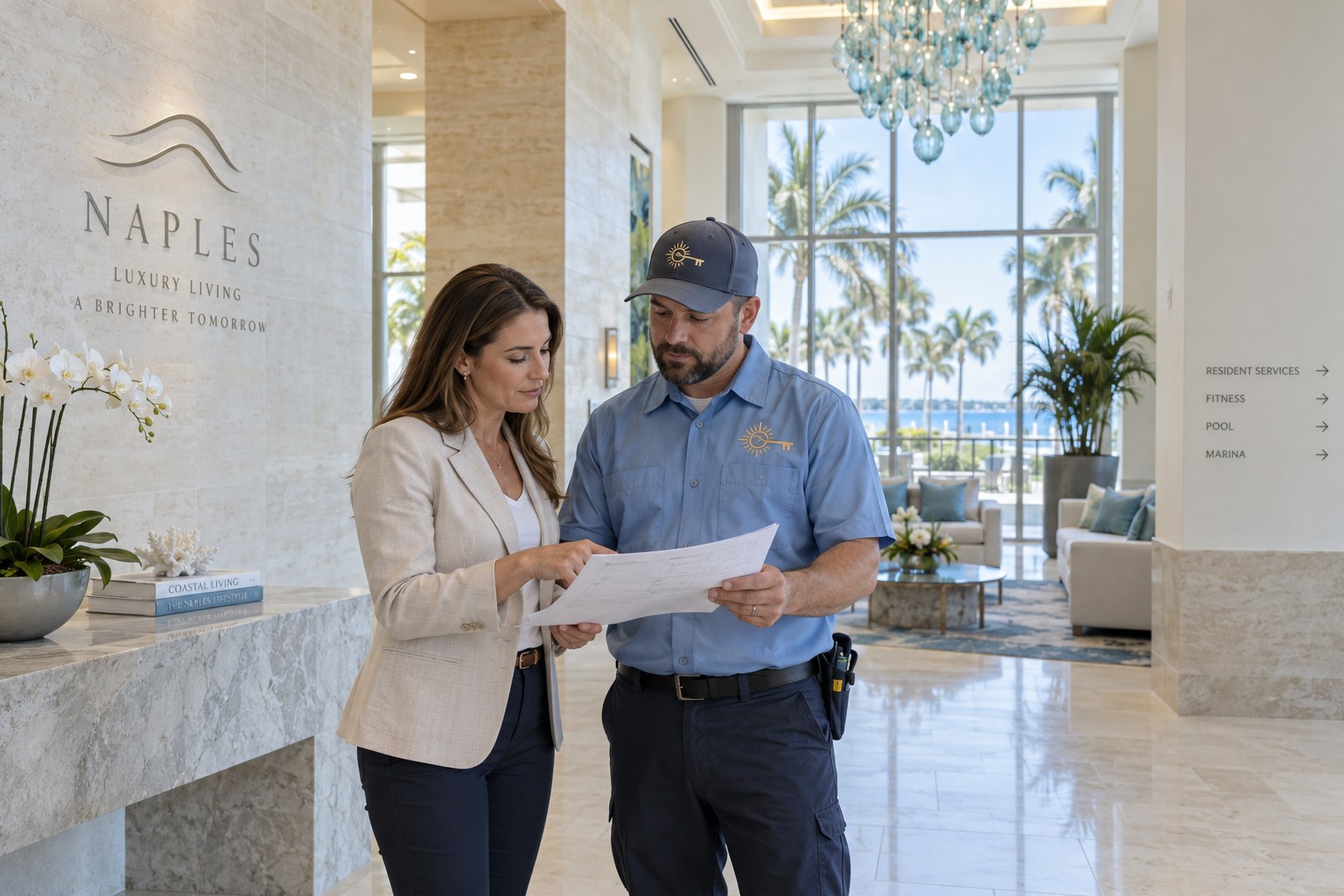
A commercial door is not a residential door made bigger. It carries more traffic, serves more people, and often has legal duties around how it opens in an emergency. This page explains how a mobile locksmith looks at storefront, back-of-house and suite doors around Naples and Collier County, what the hardware pieces do, and how humid, salty Gulf air changes the way each opening should be assessed.
Why a business door is a different problem
A front door at a house opens and closes a few dozen times a day. A storefront door can do that in an hour. The latch, hinges, closer and strike plate all wear faster, and small misalignments that a homeowner would never notice become daily irritations for staff and customers. When a technician arrives at a business, the first thing worth understanding is how the door is actually used, not just what is installed on it.
Commercial openings also tend to be built from heavier parts. Hinges are often continuous or heavy-duty, frames may be hollow metal or aluminum storefront extrusions, and the hardware is usually mortised into the door rather than bored through it. That means repairs are more about adjusting and replacing wearing parts than swapping an entire lockset, and it means the right replacement part has to match the existing preparation in the door.
There is also a people side. A shop owner may be standing there with customers waiting, a manager may be unsure who holds the keys, and an employee may have called on behalf of someone who is out of town. A good technician slows the conversation down just enough to confirm who has authority over the opening before any lock is opened, changed or rekeyed.
Reading a storefront opening from the outside in
Most Naples storefronts are glass in an aluminum frame, and the locking hardware is small because the stile of the door is narrow. A technician looks first at how the door hangs: whether the bottom corner on the latch side drags on the threshold, whether the gap along the top is even, and whether the glass shows any sign of the frame having racked. A door that is out of square will make even a brand new lock feel broken.
Next comes the lock itself. Many aluminum storefront doors use a surface or mortise lock with a hook bolt or a short deadbolt that throws into the frame. The cylinder is often a thumb-turn on the inside and a keyed cylinder on the outside, and the cylinder can usually be swapped without touching the rest of the lock. Knowing that saves a lot of cost and time when the only real concern is who holds keys.
Finally, the technician checks the strike and the keeper in the frame. The strike is where the bolt lands, and if it has shifted by even a few millimeters the bolt will bind, the key will feel gritty, and staff will begin to lift or shoulder the door to close it. Those habits wear out the lock faster than anything else, so catching the alignment issue early is usually the real repair.
Closers, and why they quietly decide everything
A door closer is the hydraulic arm near the top of many commercial doors, and it controls how fast the door swings shut and how firmly it latches. When a closer is set too slowly, a door will hang an inch open and never engage the latch, which defeats the lock completely. When it is set too hard, the door slams, the strike takes a beating, and staff start propping the door open with a bucket or a brick.
Closers have two or three adjustment screws that control the sweep, the latch speed and sometimes a back-check that cushions the door if a gust catches it. Coastal wind and the pressure difference between an air-conditioned shop and a warm sidewalk can push a door in surprising ways. A technician will usually test the door several times, in different conditions, before deciding the closer needs adjustment or full replacement.
Oil leaks are a clear sign a closer has reached the end of its life. A dark film on the arm or a stain on the door below the closer means the seals have failed, and no amount of tightening will bring it back. Replacing it is a small job when the mounting holes match, and it often fixes complaints that people assumed were about the lock.
Exit devices and back-of-house doors
Behind most shops and offices is a service door that people use to take out trash, receive deliveries and leave in an emergency. Many of these use a push bar, also called an exit device, which lets someone leave by pushing without needing a key or turning a knob. The outside is often a lever or a keyed cylinder that stays locked unless the door is deliberately unlocked.
A technician checking an exit device looks at the push bar's travel, the latch bolt that retracts into the door edge, and the cylinder dogging that holds the bar down during business hours. Worn exit devices often feel sticky, fail to relatch, or leave a gap between the bolt and the strike. Because these doors are part of how people leave a building safely, they should work smoothly and predictably every time without any improvisation.
It is worth saying that the rules around exits vary by occupancy and by local code, and a locksmith is not a code inspector. What a technician can do is keep the device working as it was designed, tell you plainly when something looks worn out or modified, and suggest that a building owner confirm questions about code with the proper local authority.
Cylinders, keying and who holds what
The cylinder is the small part that takes the key, and on most commercial doors it can be removed and replaced independently of the rest of the lock. This is why many business owners can improve security without replacing hardware: swapping or rekeying a cylinder changes who can open the door while leaving the latch, closer and trim in place.
Commercial keying can be simple or layered. A single shop may only need one key for every door, while a larger operation might want one key for the front, a different key for the stockroom, and a master that opens both. Planning that arrangement before cutting any keys avoids a future where a part-time worker holds a key that opens the office safe room.
Keyways matter too. Some cylinders accept keys that can be copied at any hardware counter, while restricted keyways require the original owner or an authorized contact to approve duplicates. For a business that wants to control who makes copies, a restricted system is worth discussing early, because moving to one later means changing every cylinder at once.
- Single key for every door in a small shop
- Separate keys by room with one master for the owner
- Restricted keyways where copies need authorization
- Keypad or code locks for shared areas with changing staff
What salt air and humidity do to commercial hardware
Naples sits beside the Gulf of Mexico, and the air carries moisture and a trace of salt most of the year. On a door that is touched dozens of times a day, that means corrosion begins at the finish, then moves into the springs, the latch tail and the inside of the cylinder. Lock bodies that look fine from the outside can feel stiff or inconsistent long before anyone sees rust.
Material choice helps. Stainless steel, solid brass and powder-coated finishes designed for outdoor use last noticeably longer than plated zinc or plain steel in a coastal environment. Hardware closest to the water or the sprinklers tends to age fastest, so a technician may recommend upgrading exterior pieces while leaving interior hardware alone.
Maintenance matters as well. A dry graphite or Teflon-based lubricant in a cylinder lasts better than oily sprays, which attract grit. Hinges and closer arms benefit from occasional cleaning and a light protective coating. A technician can show staff what to do in a few minutes, and it is often the most economical way to prevent a stuck lock during a busy weekend.
Hurricane season and keeping openings ready
Anyone running a business in Collier County plans around hurricane season, and the doors are part of that plan. Before a storm, owners often secure glass doors with shutters or boards, and they want to be sure every lock, every strike and every hinge is working so the opening can be closed tightly without forcing anything.
After a storm, doors may be swollen, warped or jammed because of water intrusion or pressure. A technician can sometimes release a stuck opening by adjusting hinges, planing a swollen edge, or replacing a bent strike. Where a frame has shifted, the repair may involve a carpenter or glazier first, and the locksmith works after the structure has been set right.
It is useful to keep a short list of every door in your business and the key that opens it. In an emergency, you will not want to be guessing which key fits the back storeroom while a storm approaches. A clear list also helps a technician arriving after a storm understand the building quickly, which saves time when time is limited.
Verifying authority before work begins
Commercial buildings often have several parties involved: a tenant, a landlord, a property manager and sometimes an association. Before a technician opens, rekeys or replaces anything, they need to confirm that the person asking has the authority to make that change. Sometimes that is straightforward, such as an owner showing a business license and identification. Other times it requires a call to the landlord.
This is not red tape for its own sake. A locksmith who opens a door for the wrong person can cause real harm, and a business owner would never want that to happen to their own space. Having a lease, a management letter or a simple written authorization on hand makes the process quick and predictable.
If authority cannot be confirmed, a technician will explain what is missing and how to resolve it. That may mean contacting the landlord, getting a signed note from the property manager, or waiting until the legal tenant can be present. It can feel inconvenient in the moment, but it is the same standard that protects your own business when you are the one who needs help.
What a visit looks like and how quoting works
When you call, the dispatcher will ask about the door type, what is wrong, and whether anyone is locked in or out. Describing the door in plain terms is enough: glass storefront, metal back door, wooden office door. A photo of the hardware, if you can safely take one, helps the technician bring the right parts. Please call us to confirm availability, since schedules vary.
For straightforward jobs such as a cylinder swap or a closer adjustment, a quote is given over the phone before the technician heads out. For complicated openings where the issue is unclear, a technician visits first and the service call charge is explained before dispatch, so there is no surprise at the door.
On site, the technician will walk the opening with you, explain what they find, and describe the options, including doing less if less is enough. Work is tested before the technician leaves, and you receive the new keys and a plain note of what was changed. Keeping that note with your business records makes future visits much simpler for everyone.
Preparing your business before you call
A few small steps make a commercial visit go quickly. Clear the area around the door, unlock any interior doors that need to be reached, and have a person with authority available. If possible, gather the keys you currently hold, even broken or worn ones, because the cut of an old key often tells the technician exactly what system you have.
Think about what you actually want from the visit. Some owners need only a working lock, while others want to know who holds copies, or to upgrade all exterior locks to match. Telling the technician your goals up front helps them recommend the right level of work instead of guessing.
Finally, keep a simple record after each visit: the date, what was done, how many keys were issued and who received them. When a staff member leaves or a lease changes, that record is the starting point for deciding what to rekey. Businesses that do this rarely scramble when something goes wrong, because they already know where their keys are.
Strikes, thresholds and the small parts that cause big complaints
Ask a technician what they fix most often on commercial doors and the answer is rarely the lock. It is the strike plate that has drifted, the threshold that has lifted, or the hinge screws that have worked loose in a hollow metal frame. These parts cost little, yet they decide whether the bolt slides home smoothly or scrapes every time someone leaves for the evening.
Loose hinge screws deserve special mention. When the top hinge loosens, the door sags toward the latch side, and the bolt no longer lines up with its keeper. Tightening or replacing screws with longer ones that reach the structural stud often restores the alignment in minutes. Skipping that step and replacing the lock instead means the new lock will fail the same way within months.
Thresholds on coastal buildings can also lift as concrete settles or rain water works underneath. A threshold that is a quarter inch too high will catch the bottom of the door and prevent the latch from engaging fully. A careful technician checks the whole opening, then tells you honestly which part is causing the trouble.
Deciding between repair and replacement
Not every worn lock deserves rescue. A technician weighs how old the hardware is, whether parts are still made, and how much corrosion has set in. A stiff lock with clean internals might need only cleaning and the right lubricant, while a cylinder with pitted pins or a latch with a cracked spring is better replaced than nursed along.
Think about the opening's future too. If you plan to repaint, change tenants or renovate, it may be sensible to combine hardware upgrades with that work rather than paying for two visits. If the business is temporary, such as a seasonal shop, a simpler fix may be more practical than a full upgrade.
A good technician will lay out the choices in plain terms, including the least costly option that will actually work and any risks it carries. You decide, and the work is done to the level you choose. If you need time to consult a landlord or partner, the technician can leave the door secured in its current state.
Frequently asked questions
Can you fix a commercial door lock without replacing the whole lock?
Often yes. Many problems come from a worn cylinder, a misaligned strike or a tired closer rather than the lock body itself. A technician checks how the door hangs, cleans and adjusts what can be adjusted, and only replaces parts that have truly worn out. Please call us to describe the door so we can bring suitable parts.
Do you need to confirm I own or manage the business?
Yes. Before opening, rekeying or replacing hardware, the locksmith checks that the person asking has authority over the space. A lease, a management letter or identification tied to the business usually covers it. If a landlord controls the door, we may ask you to contact them first.
Why does my storefront lock stick more in summer?
Heat and humidity cause metal to expand slightly and swell wooden frames, and salt air speeds up corrosion inside the cylinder. A door that is slightly out of square will feel worse in these conditions. Cleaning, lubricating with a dry product and adjusting the strike often brings it back to normal.
How do I get a quote for a commercial door?
Quotes are given by phone for straightforward work once you describe the door and the problem. If the job is complicated or the issue is unclear, a technician visits first and the service call charge is explained before dispatch. Please call us to confirm availability and next steps.
Should I rekey or replace the locks when a tenant changes?
In many cases rekeying the cylinders is enough, because it makes old keys useless without replacing the hardware. If the locks are badly worn or corroded, replacement may make more sense. A technician can look at the doors and explain the tradeoffs so you can decide with full information.