
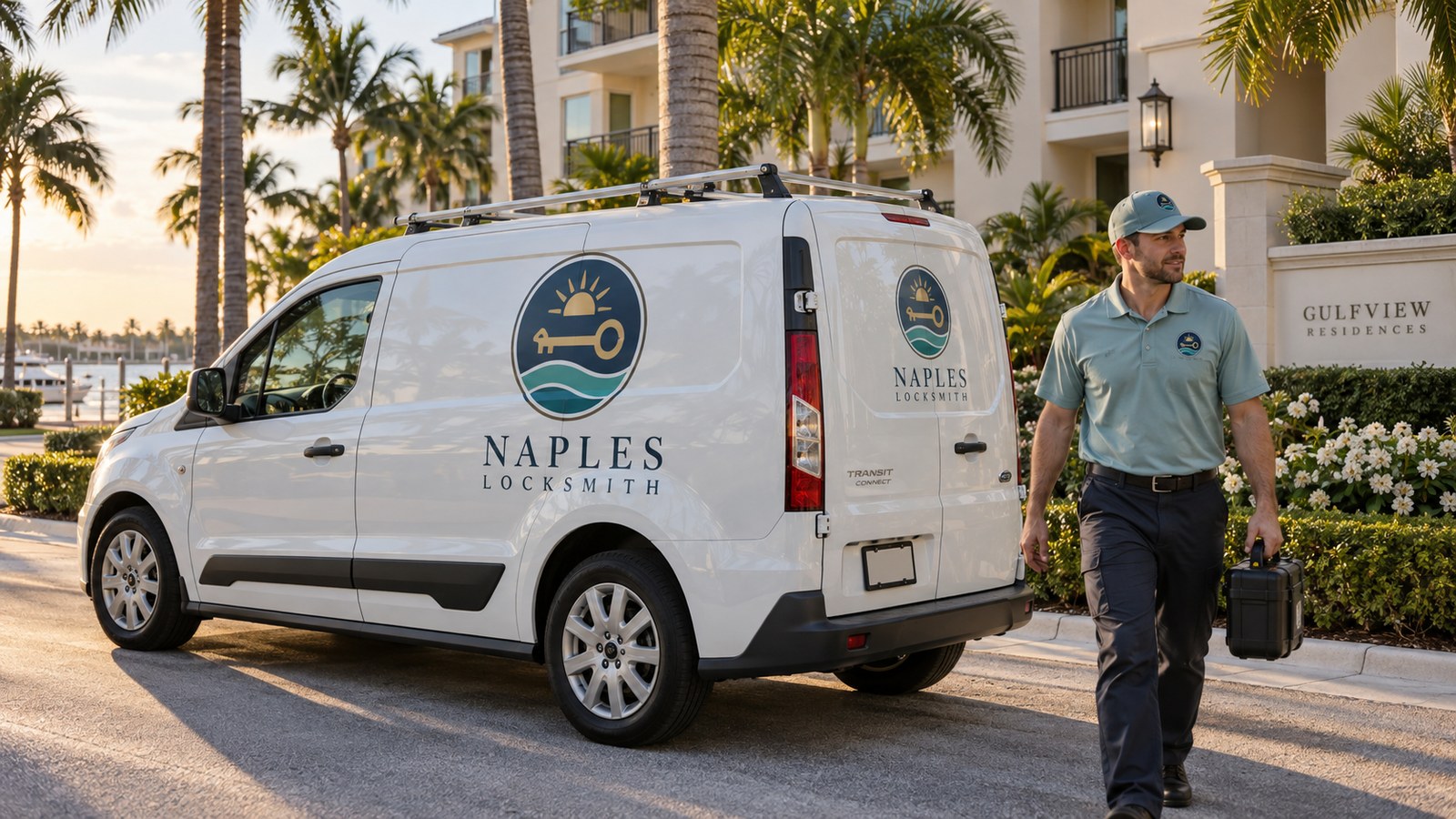
Every autumn, Naples owners start preparing homes for winter tenants who will arrive with luggage, golf clubs and high expectations. The locks are the first thing a new tenant touches and the last thing most owners think about. This page walks through a calm, thorough lock turnover so the door opens smoothly on arrival day and the home stays secure all season.
Why the lock check belongs at the top of your list
When an owner prepares a seasonal rental, the usual checklist covers deep cleaning, air conditioning service, linens, pool care and a fresh coat of paint on the lanai. Locks tend to land near the bottom, if they appear at all. Yet a tenant who flies in after a long trip and cannot get the front door open will form a first impression that no amount of fresh paint can repair. Starting with the locks means any problem surfaces while there is still time to fix it.
There is also a practical reason. A house that sat closed up through a humid Southwest Florida summer has had months of moisture, heat and salt in the air working on its hardware. Deadbolts that once turned easily can feel gritty, latches can stick in warped frames, and keypad batteries may have drained or leaked. Finding these things in October is an inconvenience, but finding them on the morning of arrival is a scramble.
Think of the lock check as a rehearsal for the tenant's first five minutes. Walk through the process exactly as they will: pull into the drive, retrieve the key or enter the code, open the front door, drop bags, then try the garage entry and the lanai. Anything awkward on your rehearsal will be awkward for them. Call us if something fails, and we can confirm availability for a visit well ahead of arrival day.
Rekeying as the reset button between tenants
A seasonal home often passes through many hands over a few years. Prior tenants, cleaners, pool service workers, a property manager, a handyman and a neighbor who checks the mail may each have held a key at some point. Even when everyone is trustworthy, you cannot say with certainty how many copies exist. Rekeying is the clean way to turn that uncertainty into a known number, because it makes every older key useless.
The process is straightforward. A technician removes each cylinder, changes the internal pin pattern and returns it to the door. New keys are cut to match. Because the locks themselves remain on the doors, the house looks unchanged, but the old keys no longer work. Most standard residential deadbolts and knobs can be rekeyed on site in a single visit, and the tech can pin multiple doors to one key so tenants carry a simple ring.
Timing is worth a thought. Winter tenants usually arrive in a tight window between late autumn and January, and locksmith schedules across Collier County fill up as owners prepare. If you rekey in early fall, you also leave room to correct problems the technician finds. We check ownership or authority before rekeying anything, so bring a utility bill or management agreement and ID that matches. Quotes are given by phone.
Walking every exterior door, not just the front
Owners naturally focus on the front door, but a thorough turnover includes every way in. Make a list: the front entry, the garage-to-house door, the overhead garage door and its keypad or opener, the lanai slider, any side door, the pool cage door, a laundry room exterior door and sometimes a gate into a courtyard. Each of these has its own lock, its own wear pattern and sometimes its own key. Missing one leaves a gap in your security.
Sliding glass doors deserve special care. Their latches are often light-duty and the track collects sand and debris, which can make the door hard to close fully. Many owners add a secondary bar or pin lock for the slider. A technician can check whether the latch hook is engaging the keeper properly, since salt air and settling can leave it just out of line and easy to defeat. Louvered or jalousie style doors on older homes need even closer attention.
For each door, test the lock with the door open, then closed, and then from the outside. Have someone stand inside while you try the keys from outside. Check the weather stripping, since a lock may bind where the door swells in humid weather. Write notes as you go. A tidy list of what each door needs lets you describe the job accurately when you call, and it helps the technician arrive with the right parts.
Smart locks, keypads and the battery question
Many seasonal homes now have keypad or smart deadbolts, which are convenient for handing out codes to tenants and cleaners. They also depend on batteries, and a home that sat vacant may have dead or leaking cells inside the lock body. Replace the batteries with fresh ones before tenants arrive, and do not rely on the low battery warning alone. Some locks beep only in the last few days of life, which is not much help for a house nobody visits.
After the new batteries go in, run through the code settings. Delete any old tenant or contractor codes you no longer need, create a code for each new household and note the dates it should work. If the lock supports scheduled codes that expire automatically, use them. Test the lock from the outside with the door open to make sure it throws and retracts the bolt fully, because a motor weakened by humidity may stall partway.
Keep a mechanical backup. Even good electronic locks can fail, and a power outage or a dead battery on a holiday weekend is not the moment to learn that no one has a physical key. If the lock has a key override cylinder, make sure it still turns freely. We install and program many common keypad and smart locks and can show owners how to manage codes themselves. Call to confirm availability before the busy season.
The shed, the pool equipment and other forgotten locks
A seasonal rental tends to have more locked spaces than the main house. There may be a storage shed in the yard, a detached garage, a pool equipment closet, a lockable cabinet on the lanai, a bike storage cage or a golf cart enclosure. Each of these holds something of value, from tools to chemicals to expensive outdoor furniture cushions, and each is protected by a lock that probably gets less attention than the front door.
Padlocks and hasps rust quickly near the Gulf, and a lock that has not been opened in months may refuse to turn at all. Do not force it. A technician can open a stuck padlock, loosen a seized cylinder or replace the hardware with a corrosion-resistant model. For chemicals and anything that could harm a child, a proper lock matters beyond theft, because pool treatments and fertilizers should never be easy to reach.
Decide what the tenant can access and what stays private. Many owners keep an owner closet or garage cabinet locked on a key that tenants never receive. Doing this cleanly is easiest when the locks are keyed separately from the main set. Mention it when you call, and we can pin the tenant doors to one key and leave the owner storage on a different one, so the household can use the home without touching your belongings.
Gated communities, condo towers and shared entrances
Seasonal rentals in Naples often sit inside gated or golf communities, or in condo buildings where the front door of the unit is only one of several barriers. Gate access, lobby fobs, elevator cards and mailbox keys may all be controlled by a community office or building manager, not by you. Check early what the association requires for new tenants, because registering a household can take days and some communities limit how many fobs a unit receives.
Locks on the unit itself are usually the owner's responsibility, but associations sometimes insist on keeping an emergency key or have rules about which hardware may be installed on the front door. Read the rules before ordering new locks. A locksmith should not replace shared building hardware or alter a gate system without the association's authorization, and we will stop and ask if there is any doubt about whose lock it is.
Remember the human side. Tenants arriving from out of state may not know where to pick up a gate remote or how the guest list works. A short instruction sheet that lists the gate code process, the door lock method, the garage entry and who to call when something fails will head off confusion. Include a note to contact us if a lock misbehaves, and we will confirm availability when you call.
Handing over keys without losing control
How you pass keys to a tenant depends on whether you will be there. If you live out of state, a lockbox, keypad code or a trusted local contact are the common options. Whichever method you choose, record who has what. A simple list showing key tags, who holds them and when they should come back is enough, and you will thank yourself when a spare goes missing at the end of March.
Limit the number of copies. A household of two does not need six keys, and each extra key is another thing to lose. If tenants request more, you can have them cut by a locksmith using a blank that discourages casual duplication, and note the new count. Ask about restricted keys for the main doors, since a restricted blank cannot be copied at a hardware store without authorization.
At the end of the lease, collect every key and log each one before the tenant leaves. If any key goes missing, rekey before the next household. This is simpler when the keying has been kept tidy all along. Owners who treat the key set as a controlled inventory tend to have fewer lock emergencies, fewer awkward conversations and a calmer arrival day for everybody involved.
Hurricane season leftovers and what they do to doors
The months leading up to snowbird season overlap with the back half of hurricane season. A home may have been shuttered, hit by heavy rain or simply swollen by weeks of damp air. Doors absorb moisture and can shift slightly in the frame, which pulls the bolt out of line with the strike. The result is a lock that works with the door open but resists when you try to close it, or a latch that catches only with a hard shove.
Watch for a bolt that scrapes the strike plate, a door that rubs at the top corner, hinge screws that have loosened and a shiny worn spot where the bolt keeps hitting the wrong place. Many of these problems are solved by adjusting the strike, tightening or lengthening hinge screws or planing a small amount from the door edge. A technician can often fix alignment as part of a lock visit.
If storm shutters or impact doors are installed, check their locks and latches too, since they sit unused for long periods. Test each mechanism, lubricate with a product that suits the material and replace anything that feels crusty. A door that is easy to lock is a door that people will lock. For doors damaged by wind or flooding, we can help assess whether the lock or the door needs attention first.
Building a repeatable pre-season routine
The best way to avoid last-minute stress is to do the same sequence every year. Pick a week in early autumn, put it on the calendar and treat it like the annual pool service. Start with an inventory of keys and codes, then walk every door, then decide what needs rekeying, repair or replacement. Tackle the work in order of importance: main entries first, garage and slider next, storage last.
Keep a short folder with the previous year's notes. Record what was replaced, which locks are on which key, which battery type each device uses and the dates of service. Next year you will not need to rediscover that the lanai slider uses a hook latch or that the shed takes a particular padlock. Photographs of each lock help a technician bring the correct parts before the visit begins.
Finally, schedule the visit rather than hoping to fit it in. Locksmiths in Collier County have busy stretches when owners all prepare at once. Call us to confirm availability, describe your doors and your arrival date, and we will explain what a visit involves. If the job is complicated, a technician visits first and the service call charge is explained before dispatch, so there are no surprises on the day.
What a smooth arrival day looks like
Picture the tenant's arrival. They find the gate instructions clear, pull up to the house and open the front door on the first try. The garage entry works, the lanai slider glides shut and locks, and the keypad has a code that matches the sheet on the kitchen counter. Nothing sticks, nothing beeps at them and nobody has to make a phone call. That ordinary experience is the result of the quiet preparation you did weeks before.
It is worth being reachable on the first day anyway. Even a well-prepared home can surprise a tenant, whether it is a misplaced key or a code typed wrong too many times. Provide a number to call and, for lock trouble, make it easy for them to reach a locksmith with your authorization on file. Letting us know in advance that a particular tenant may call helps us handle the visit smoothly.
After the first week, check in. Ask whether every door has behaved and whether anyone has trouble with the keys. Small complaints early are easier to fix than ones that simmer until the lease ends. When the season closes, repeat the process in reverse: collect keys, clear codes, rekey if needed and prepare the home for the quiet summer ahead. Doing it every year makes the whole thing nearly effortless.
One more habit is worth adopting: photograph the finished work. After the technician leaves, take a picture of the key tags, the lock labels and any note about which key opens which door, and store them with your lease paperwork. If a tenant calls from the driveway late in the evening, you can answer in seconds rather than searching your memory. That small record also makes the next owner, manager or caretaker far more capable.
Frequently asked questions
How early should I schedule a lock turnover before tenants arrive?
Early autumn is a good target, because it leaves time to fix surprises and avoids the rush when many owners prepare at once. Call to confirm availability and describe your doors and arrival date. Booking ahead also lets a technician bring the right parts if a lock needs replacement rather than a simple rekey.
Do I need to rekey if the same tenants are returning?
Not always. If the same household returns and you trust the key count, a careful inspection may be enough. If copies were made, a cleaner or contractor held keys or the count is uncertain, rekeying is the cleaner choice. A technician can talk through the tradeoffs with you by phone.
What should I do about smart lock batteries in a home that sat empty?
Replace them with fresh cells before tenants arrive, then clear old codes, set new ones and test the bolt from outside. Keep a mechanical key as a backup in case of a power or battery failure. If the lock stalls, a technician can check the motor and the door alignment.
Can you handle the shed and pool equipment locks too?
Yes. Sheds, detached garages, equipment closets and cabinets can be opened, repaired, rekeyed or replaced with corrosion-resistant hardware. We can also key them separately from the house so tenants never receive access to owner storage. Describe each lock on the phone and we will explain the approach.
What proof do you need before working on my rental?
We check that you own the property or act with the owner's authority before rekeying or opening anything, usually with an ID that matches a utility bill, lease or management agreement. For condos and gated communities, shared hardware belongs to the association, so we only work on the unit itself.