
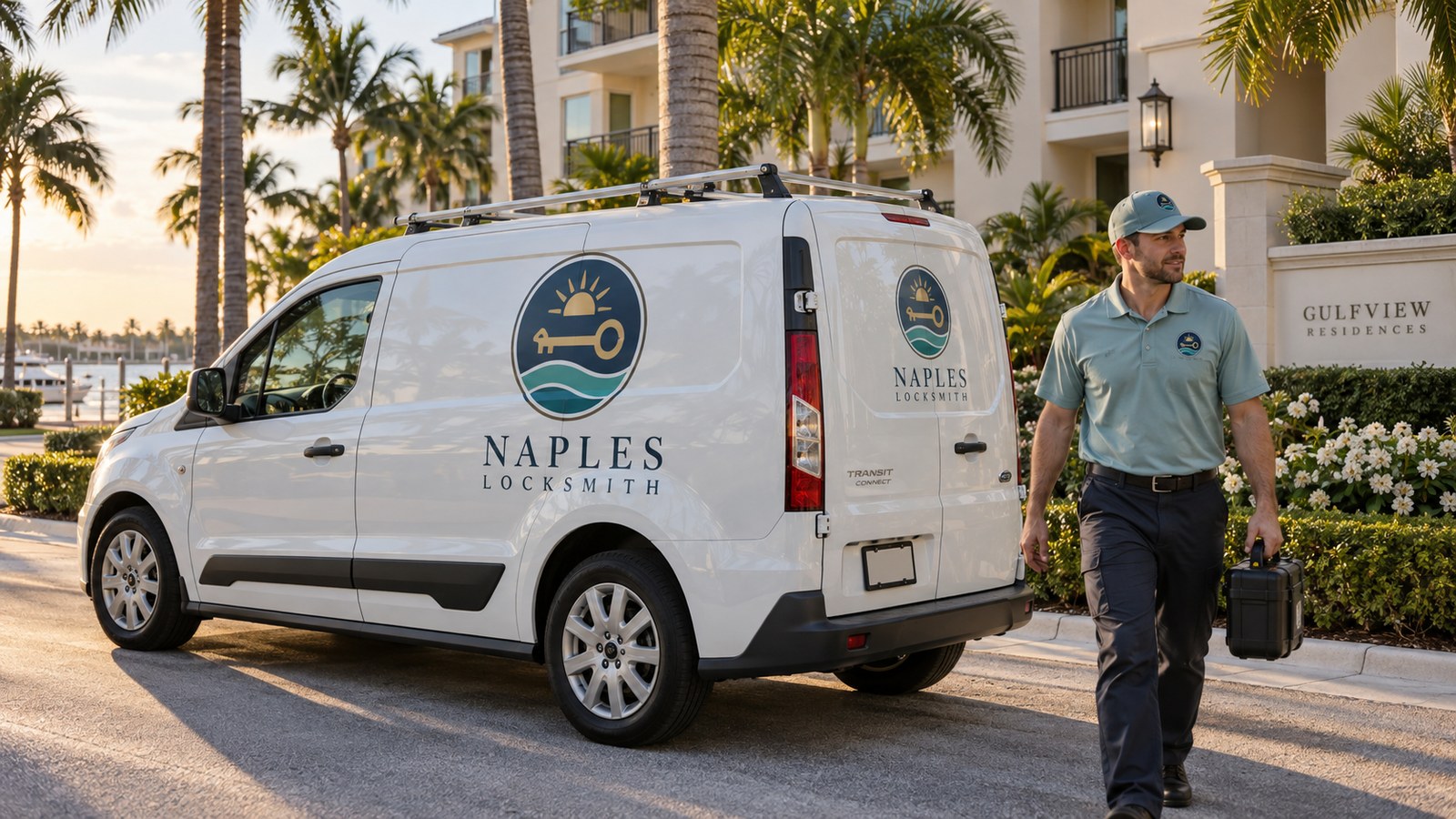
Gated and golf communities are a defining feature of life around Naples, and the entrance gate is the one door every resident, guest, delivery driver and emergency vehicle depends on. Behind the arm or the sliding panel sit a manual keyed override, an emergency key box and a pile of resident fobs that need tending. This page explains how those pieces fit together and how a board can keep them under control.
What sits behind a community entrance gate
From the driver's seat, an entry gate is a barrier that rises or slides open. Behind that simple action sits a small system. An operator motor moves the arm or panel. A control board decides when it should move. Sensors, loops in the pavement and photo eyes keep it from closing on a car. A reader accepts a fob, a card, a code or a remote. And somewhere on the cabinet is a lock that lets a person with a key take over by hand.
Each part has its own owner in practice. The gate company, whether it installed the system or later took over service, typically looks after the operator and controller. The management office handles resident credentials. The board sets the policy. A locksmith generally becomes involved at the points where physical keys and mechanical locks meet this electronic system: the cabinet lock, the manual release, the emergency key box and sometimes the pedestrian gate beside the main entry.
Understanding who handles what is the first step in solving any problem. A gate that will not open for a resident could be a dead fob, a reader fault, a controller issue or a mechanical jam. Calling the right party saves time. We help with the lock-and-key side, and we are glad to say plainly when a problem belongs to the gate service company instead. Honest sorting of the issue is part of the job.
The manual keyed override and why it exists
Every powered gate needs a way to move when power fails or the operator breaks. Many operators have a release mechanism that disengages the motor so the gate can be pushed by hand. The release is often protected by a cabinet lock or a keyed cover, so only authorized people can reach it. In a Gulf coast community, where storms regularly cause outages, that manual path is more than a convenience.
A keyed cabinet is usually a simple cylinder lock, and like any cylinder in a salty, humid setting, it wears. Keys stick, cylinders seize and covers corrode shut. The worst time to learn this is during a power outage with a line of cars waiting. A periodic check of the cabinet lock, with a trial turn of the key and a drop of suitable lubricant, is a small habit with a large payoff.
Keys to the cabinet and the manual release deserve careful control. Anyone who can open the cabinet can release the gate, and a released gate stands open. The community should know exactly how many keys exist, who holds them and where spares are stored. If a key goes missing, rekeying the cabinet lock is a modest job that closes the gap. We can do that on site and test the new keys on the spot.
Emergency key boxes in general terms
Fire departments and other responders need to get through gates quickly. Many communities install a small, secure box at the entrance that holds a key or opener for the gate. Responders carry a master key that opens such boxes, so they can reach the gate controls without delay. The system is simple in concept and important in practice, because a locked gate can delay help to a resident in trouble.
The rules for these boxes vary by jurisdiction, and the responding agency usually controls which box type is used and how it is keyed. Communities should work with the local fire authority on the details rather than guessing. We do not speak for any agency. What we can say is that the box itself is a lock like any other, and it needs to be mounted securely, protected from corrosion and checked now and then.
Inside the box, the contents must be current. A key that no longer fits the cabinet, a remote with a dead battery or a card that has been deactivated defeats the purpose. After any change to the gate cabinet lock or to the access system, update what is stored in the box, and confirm the change with the responding agency as needed. A short checklist to run after each change prevents the awkward discovery that the box holds an outdated item.
Fobs, cards and remotes: what residents actually carry
Resident credentials come in several forms. A proximity fob is a small plastic token that a reader detects when held near. A card works similarly. A remote, often clipped to a sun visor, sends a signal from a distance. Some communities use a windshield tag that a long-range reader detects automatically as a car approaches. Each type has its own advantages, and many communities use more than one.
Each credential carries a unique number that the system recognizes. When a resident is added, the office registers that number in the controller. When the resident leaves, the number is removed or disabled. This is why fobs are more manageable than physical keys: they can be turned off remotely, without collecting the object. A lost fob becomes a minor administrative item, not a security hole, provided someone acts on it.
The weak point is the gap between a resident leaving and the office finding out. A fob left in a rental car, kept by a former tenant or passed to a relative continues to open the gate until someone disables it. Good communities reconcile their credential list with the resident roster regularly, so inactive fobs are found and shut off. It is a paperwork task, not a mechanical one, but it is where much of the real control happens.
When residents leave, lose fobs or sell their homes
Three events call for a credential update: a sale, a lost fob and the end of a tenancy. For a sale, the old owner's credentials should be deactivated at closing and the new owner issued fresh ones. Many communities require a notice from the title or closing agent so the office knows when the change occurs. A short, clear checklist for the office keeps the process consistent.
A lost fob is simpler. The resident reports it, the office disables the number and issues a replacement. Reporting quickly matters, because a lost fob can open the gate for whoever finds it. Residents should understand that calling right away costs them nothing and protects the community. If the fob is later found, it remains disabled, and a new one stays active.
Tenants and seasonal residents bring turnover. A tenant's credentials should be tied to the lease term and shut off at the end. Seasonal residents who leave for months may keep their fobs but should understand that the credentials remain active unless the office pauses them. Some communities pause access for absent owners, which reduces risk. Whichever approach the board chooses, consistency is what makes it work.
Pedestrian gates, golf cart gates and secondary entrances
The main vehicle gate is rarely the only way in. Many communities have a pedestrian gate beside the entrance, a golf cart crossing, a back service entrance or a gate to a beach path or canal walkway. These secondary entrances are often the weak point. A pedestrian gate with an old lock, a propped latch or a shared key defeats the purpose of controlling the main gate.
Hardware at these gates faces the same salt and humidity as the main gate, often with less attention. Latches stick, hinges corrode and locks seize. Some use a keypad or a fob reader that matches the main system, while others rely on a simple keyed lock. We inspect each one and recommend changes that suit its use, from rekeying to a full lock replacement with corrosion-resistant hardware.
Service entrances raise another question: who uses them? Landscapers, delivery drivers, pool crews and contractors all need access, but not necessarily the same access as residents. Giving them a separate credential, with scheduled hours, keeps the main resident list clean and makes it simple to remove a vendor when the contract ends. A thoughtful plan reduces the temptation for residents to open the gate for anyone who knocks.
Keeping gate hardware working through humidity and storms
Salt, heat and rain rarely give gates a rest. Cabinet locks corrode, hinges stiffen and battery backups drain. Water can enter electrical boxes and cause intermittent faults that are hard to diagnose. A regular maintenance schedule, ideally before hurricane season and again after, helps catch these problems early. The tasks are small: clean, lubricate, test, record.
Battery backups deserve special mention. Many operators have batteries that keep the gate working through short outages. Those batteries age, and in Florida heat they age faster. A battery that no longer holds a charge means the gate stops working the moment power fails. The gate service company usually handles this, but the board should make sure someone is responsible for checking them on a schedule.
Storms also test the manual release. After a hurricane, many communities must operate the gate by hand for days. Staff who have never used the release can waste precious time. A short practice drill, done in calm weather, makes sure the key works, the release moves and someone knows what to do. We are happy to inspect the lock and key side of that process as part of a pre-season check.
Guests, deliveries and the human side of the gate
No gate system works unless people use it as intended. Residents let in friends without checking, hold the gate open for the car behind them and give the code to the pool cleaner. These small kindnesses add up to a gate that mostly serves as a speed bump. A friendly reminder from the board about tailgating, guest registration and delivery procedures does more than any hardware upgrade.
Guest management is usually handled through a call box, a resident app or a guard house. Whatever the method, the guest list should be tidy. Old entries for former tenants, expired vendor passes and repeat visitors who no longer need access should be cleared periodically. A quarterly review, scheduled on the calendar like the pool inspection, keeps the list honest and manageable.
Delivery drivers are a daily reality. Giving them a simple, controlled route, such as a call box with a directory or a dedicated delivery code, prevents residents from opening the gate repeatedly. Some communities restrict delivery windows. The more the system supports ordinary life, the fewer shortcuts residents invent, and shortcuts are where most security erodes. We can discuss how the physical hardware supports that plan.
Finally, remember the neighbors who rely on the gate for peace of mind. A well-run entrance sends a message that the community looks after its shared spaces. It need not be intimidating or fussy. A reliable gate, a tidy credential list and a clear procedure for exceptions are quiet signs of good management, and residents tend to notice when those signs are missing.
Who is allowed to change the locks and credentials
Before we touch any lock on a community gate, we confirm authority. That means a board officer, the manager or a designated representative. We may ask for confirmation from the board or a call to the management office. The gate is a shared asset and an important safety element, and nobody should be able to change it simply by asking. This protects the community and the person who requested the work.
We also coordinate with the gate service company where needed. Changing a cabinet lock is a locksmith's job, but reprogramming a controller or reader is usually theirs. A smooth project involves both. Let us know who your gate company is, so we can plan the order of work and avoid stepping on each other. When the pieces fit, residents see no disruption.
Documentation is important. After any change, record what was done: which locks were rekeyed, how many keys were issued, who holds them and when. Store the record with other community documents. When leadership changes, a clear trail saves the new board from guessing. It also helps if a question comes up later about access to the gate at a particular time.
Rekeying the gate cabinet and updating the emergency box
A common reason to call us is a lost or unaccounted-for cabinet key. The fix is a rekey. We change the cylinder so old keys no longer work, issue new keys and test them. If the cabinet uses a standard cylinder, this is quick. If it uses a specialized or proprietary lock, we explain the options and may need to coordinate with the gate company or the box manufacturer.
At the same time, we recommend reviewing the emergency box. Does it contain a current key? Does its own lock work? Is it securely mounted? If the cabinet lock was rekeyed, the key in the box must be replaced with the new one, and the responding agency may need to be informed. We make a note of this in our summary so it does not get forgotten.
We also look at the little things. Are the cabinet hinges sound? Does the door close firmly? Is there a weather seal, and is it intact? A cabinet that does not close properly lets in moisture and dust, which shorten the life of electronics. A few minutes of attention to these details can prevent a service call for a failing controller later.
How to prepare when you call
A helpful call starts with a short description. Tell us the community name, which gate is involved and what has gone wrong or what you want to change. Mention whether the problem is a lost key, a stuck cabinet lock, a failed emergency box or a general review. If you know the gate company, tell us. If fobs are the issue, note that credential changes are usually handled by the office and the gate company.
Have authority information ready. Tell us who you are in the community, whether a board member, manager or committee chair, and who can confirm that. Quotes are given by phone based on what you describe. If the project is more involved, a technician visits first, and the service call charge is explained before dispatch. Please call to confirm availability for the day you need.
Finally, think about timing. A gate is in constant use, and work should be planned so traffic is not blocked. Early mornings and mid-day lulls are often quiet. The board can announce a short window to residents and provide an alternate path if needed. With a bit of planning, the work is done and the gate is back to ordinary service before most people notice it was touched.
Frequently asked questions
What is the manual override on an entry gate?
It is a release that lets the gate be moved by hand when power fails or the operator stops working. It is often protected by a keyed cabinet lock. Keys to it should be controlled carefully, because anyone who can open it can release the gate.
Who decides how the emergency key box is keyed?
Usually the local fire authority or responding agency specifies the box type and keying. Communities should work with them directly. We can service the box as a lock, keep it secure and help update its contents after any change.
What should we do when a resident loses a fob?
Report it right away so the office can disable that fob and issue a replacement. Fobs are managed by the office and gate company, not by the locksmith. Quick reporting keeps a lost fob from opening the gate for a stranger.
Can you rekey the gate cabinet lock?
Yes, in most cases. We confirm board or manager authority, change the cylinder, issue new keys and test them. If the lock is specialized, we explain the options and coordinate with the gate service company.
How are gate hardware jobs quoted?
Quotes are given by phone based on your description. If a job is complicated, a technician visits first and the service call charge is explained before dispatch. Please call to confirm availability.