
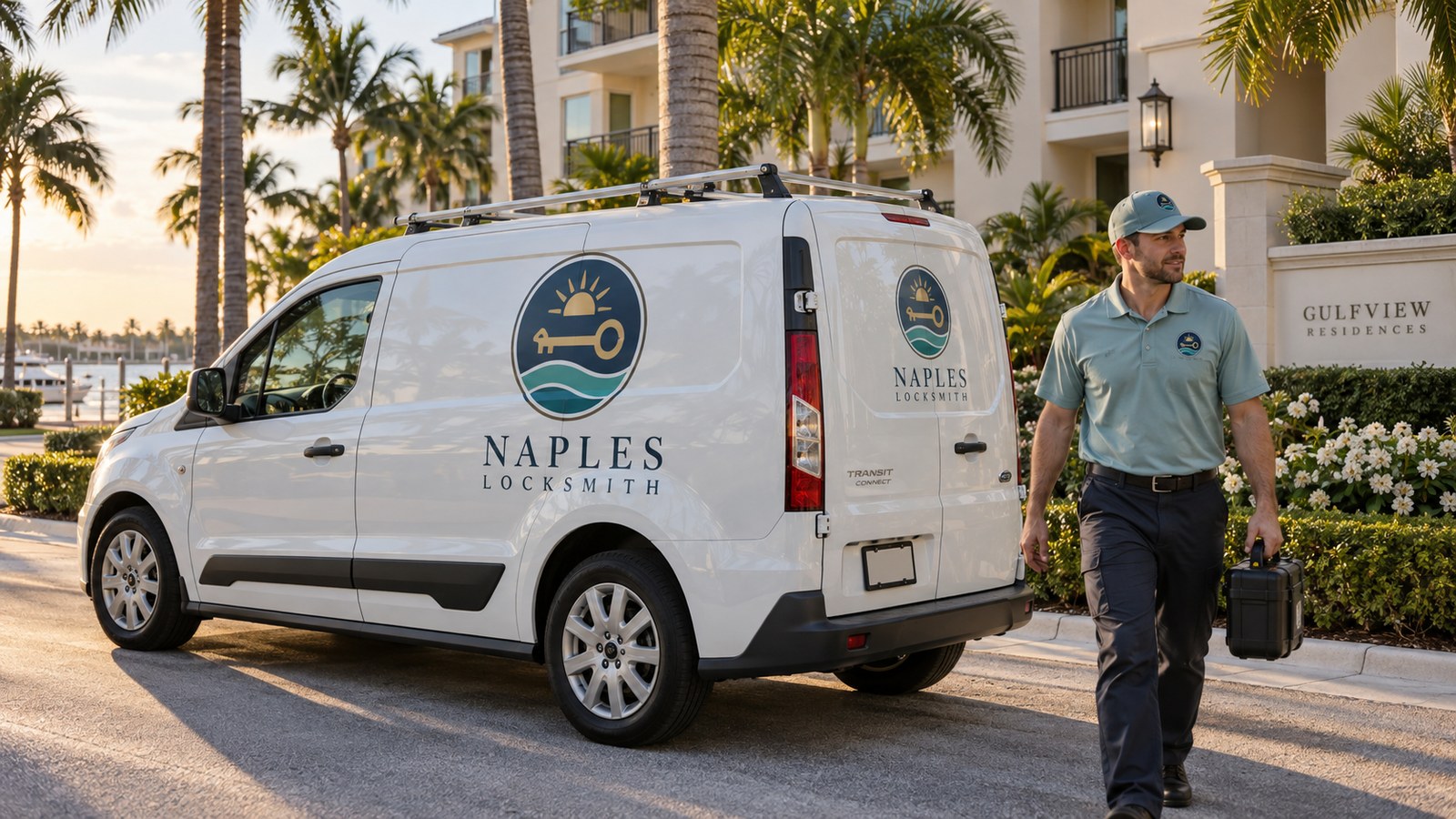
A guest leaves on Sunday morning, and by afternoon you realize the key never came back. In a vacation rental near Naples, that small problem touches the next arrival, your insurance conversations with the owner, and the safety of the place. This page explains how a mobile locksmith handles the situation calmly, from the first phone call to a clean record of every key.
The moment you notice the key is gone
Most owners find out in the same way. The cleaner arrives, the unit is tidy, the lockbox is empty or the key hook is bare, and there is no note. Before anyone calls a locksmith, it helps to spend ten quiet minutes looking. Check the beach bag hooks, the pool towel basket, the car port, the planter by the door and the trash bins. Guests often drop a key into a bag that goes straight to the airport shuttle, and a polite text to the guest sometimes solves everything.
If the key is truly gone, treat the door as no longer private. Anyone who ends up holding that key, whether the guest, a rideshare driver or a stranger who found it on a sidewalk, could in theory still walk in. That does not mean panic, because a key with no address attached is hard to use. It does mean the lock should be changed before the next paying guest sleeps there, and certainly before the unit sits empty over a long stretch.
When you call us, have a few facts ready: the property type, how many exterior doors have locks, whether a smart lock or deadbolt is on the front door, and the day the next guest arrives. Quotes are given by phone, and if the job is complicated, a technician visits and the service call charge is explained before anyone is dispatched. Call to confirm availability for your date, since turnover days are busy across Collier County.
Why rekeying beats waiting and hoping
Some owners hope the key will turn up and decide to wait out the week. The trouble is that a missing key has no expiration date. The guest may have tossed it into a luggage pocket and forgotten it, which is harmless, or the key may have slipped out near the beach parking lot, which is not. Since you cannot tell the two apart, the sensible answer is to make the old key useless, and rekeying does exactly that without replacing the hardware.
Rekeying means a technician removes the lock cylinder, changes the small internal pins to a new pattern and cuts fresh keys that match. The old key stops working the moment the cylinder is reassembled, even though the deadbolt looks identical on the door. For a rental, that is often better than replacing the whole lock, because the finish stays consistent, the screw holes stay clean and the job is finished in a single visit for most standard locks.
There are cases where rekeying is not the right call. A lock that is worn, sticky in the salt air or cracked from years of sun may be better replaced while the technician is already there. A good locksmith will tell you which situation you are in rather than steering you toward the bigger job. Ownership matters here too: we confirm that you own the property or manage it with the owner's authority before changing any cylinder.
Proving you are allowed to change the locks
Property managers sometimes find this step surprising, but it protects everyone. A locksmith who rekeys a door for the wrong person could lock out the actual owner, and a rental in Naples may have an owner who lives in another state, a management company on contract and a homeowners association with its own rules. Before opening, rekeying or programming anything, we check that the person calling has authority over the property.
Normally this is quick. A photo ID that matches the owner's name on a utility bill, a lease or management agreement, or a call back to the owner usually settles it. Condo buildings and gated communities may add a layer, such as a building manager who must be told about lock changes on shared entrances. Interior unit doors are usually yours to change, but the lobby or amenity doors are not, and a locksmith should never touch them without the association's say so.
If the owner cannot be reached and the manager has only a verbal arrangement, we may ask you to get a short written note first. That sounds fussy, but it avoids a messy dispute later. Having the paperwork in a folder or phone gallery makes every future lock call easier, whether it is a lost key on a Sunday or a routine annual rekey before the winter season starts.
What happens on the visit itself
A technician arrives with a mobile kit that includes a pinning set, a key cutting machine, spare cylinders and a handful of common deadbolts. On a typical rental the work begins at the front door. The tech tests how the lock turns, checks whether the strike plate lines up and looks at the door edge for swelling, because humidity along the Gulf Coast often makes doors drag and puts strain on the bolt.
Next the cylinder comes out, is repinned and goes back in. The tech cuts new keys, tries each one several times, and then moves to the back slider, the garage entry, any side door, the pool cage door and any storage closet that holds linens or beach chairs. Each lock is tested with the door open first, so nobody gets locked outside during the test. Sliding doors often use a different lock type, and it may need a separate approach.
The whole job tends to be calm and fairly quiet. Plan to be present, or have the manager nearby, because you will want to count the new keys, confirm each door opens and sign off on what was changed. If a complicated door or an older lock turns up something unexpected, the tech will explain the options and the charge for that extra work before doing it, not after.
Key-matching across all the doors
A rental with three or four exterior locks becomes a headache if each one needs a different key. Guests do not want a jangling ring of five keys, and cleaners do not want to hunt through a pile of tags. While the cylinders are already apart, the technician can pin them all to the same new key, which is called keying alike. Guests then carry a single key that opens the front door, the lanai and the garage entry.
Keying alike does have a tradeoff. If one key is lost, every matching lock is exposed at the same time. For a vacation rental that gets turned over regularly, most owners find the convenience worth it, as long as the keys are controlled and the locks are rekeyed on a schedule. Some owners keep one door, such as an owner's closet, on a separate key so personal belongings stay private even from cleaners and guests.
You can also ask for a master key that opens everything while individual guest keys open only the main doors. That arrangement is more involved and is covered in another page of ours for businesses, but it works for larger rental houses with several bedrooms that each have a lock. Ask on the phone, and we will explain whether your doors can support that layout or whether it is simply not worth the extra cost and complexity.
Lockboxes, keypads and smart locks as alternatives
Many Naples owners avoid the whole lost-key problem by not handing out a physical key at all. A lockbox on a hook or gate holds a key that guests retrieve with a code. It is simple and inexpensive, but it has weaknesses: the box can be left unlatched, the code often stays the same for months and a box mounted outside is exposed to salt air that can stiffen the buttons. If you use one, change the code between every stay and check the box for corrosion each season.
A keypad deadbolt removes the physical key from the guest's pocket entirely. The code lives in the lock, and the owner can change it in moments. Some keypad models let you assign a temporary code per reservation that expires on its own. The downsides are batteries, which should be replaced on a schedule, and the need to keep a backup mechanical key somewhere safe in case the electronics fail during a storm outage.
A smart lock tied to an app goes one step further, sending a notice when a code is used. That is useful for owners who live elsewhere and want to confirm that a guest has arrived or a cleaner has left. Whatever you choose, treat it as a system. Think about power loss during hurricane season, humidity near the coast and who will troubleshoot the lock at night. We can install and program these and help you pick one that suits the door.
Keeping a clear record of every copy
The most common reason owners end up in this situation is not carelessness, it is poor records. Over a few seasons a rental accumulates keys: the original set from the builder, a copy for the cleaner, one for the property manager, one in the lockbox, a spare under the care of a neighbor and a couple of orphaned keys in a kitchen drawer. When one disappears, nobody can say how many others are out there.
A simple key log solves most of it. Write down each key's tag number, who holds it, the date it was issued and the date it was returned. Keep the log in a shared note that the owner and manager can both see. When keys are cut, ask the locksmith to use a restricted or stamped blank where available, since these discourage casual copying at a hardware store kiosk.
After a rekey, start the log fresh. The new set is the only set, so label it and treat any other key as dead. Many owners include a short line in their house rules asking guests to leave the key on the counter at checkout, and a reminder message on the morning of departure helps. None of this is dramatic, but it turns a lost key from a crisis into a minor cost and a quick phone call.
Between stays: the schedule that saves trouble
Short-term rentals have a rhythm of check-out, cleaning, inspection and check-in, and the gap can be only a few hours. That compressed window is where lock problems get exposed. A cleaner who finds a sticking deadbolt on a Saturday has little time to solve it, and a guest who cannot get in at the end of a long flight starts the stay frustrated. Building a few lock checks into the turnover routine is cheaper than emergencies.
A good habit is a ninety-second inspection at each turnover. Lock and unlock every exterior door twice, listen for grinding, check that the latch fully extends and glance at the screws on the strike plate. Test the keypad batteries by watching how the display behaves. Report anything sluggish to the manager the same day. Salt air and sand are hard on moving parts, and a small spray of the right dry lubricant now and then keeps cylinders turning smoothly.
Beyond the routine, schedule a full rekey at least when a long-term cleaner or contractor leaves, when ownership changes or whenever the key count is uncertain. During busy winter months, locksmiths in Collier County are in demand, so booking in the slower summer weeks gives you more flexibility. Call to confirm availability, and we can fit the work around your calendar rather than around an emergency.
When the guest is the problem, not the key
Occasionally a missing key points at a bigger concern, such as a guest who stayed beyond checkout, a dispute over a deposit or a possible theft. A locksmith is not the right party to resolve any of that, and we will not enter a unit when someone claims to be a tenant and the owner disputes it. If occupancy is in doubt, the clean path is to involve the owner, the platform you booked through and, when needed, local law enforcement.
Tell the technician about any such situation upfront. If a guest might still hold a key and be inside, we need to know before arriving, because opening a door with a person inside is a different matter from rekeying an empty unit. Our role is to restore control of the lock once you have established that you have the authority to do so, not to referee a disagreement over who may enter.
On the practical side, document everything. Photograph the door, the lockbox and the state of the unit, save messages with the guest and write down times. If a damage claim or deposit dispute follows, those notes help. Once the situation is settled, a rekey closes the book: the old key is dead, the new set is in your hands and the next guest arrives to a door that works exactly as it should.
Preparing for storms and long vacancies
Naples rentals face a seasonal pattern that other regions do not, and it shapes how you think about keys. During hurricane season an owner may board up, travel inland and leave the unit unattended for days. Anything that depends on power, such as a keypad or smart lock, should have a mechanical backup, and a trusted person nearby should hold a current key. Decide before the storm who that person is, because roads and phone lines can be unreliable afterward.
After a storm, doors sometimes warp, strike plates shift and salt-laden moisture works into the cylinders. A lock that worked fine in spring may bind in the fall. Have the locks checked once things dry out, and if a door no longer latches cleanly, address the alignment before the next guest arrives. A door that cannot be secured is a liability for the owner and an invitation for trouble in a quiet neighborhood.
Long vacancies deserve the same attention. When a rental sits empty over the summer, rekey before the season restarts so that every key in circulation from last year is retired. Replace worn exterior hardware while the unit is empty, since noisy work disturbs guests. Call us to talk through a schedule, and we will explain what can be done in one visit and what is worth planning around your booking calendar.
Frequently asked questions
Should I rekey or replace the lock after a guest keeps the key?
Rekeying is usually enough if the lock is in good shape. It changes the internal pins so the old key stops working while the hardware stays on the door. If the lock is worn, corroded by salt air or loose in the frame, replacing it may make more sense. The technician will look at the lock and explain which fits your door.
Can you rekey every door on the rental in one visit?
Usually yes, for standard deadbolts, knob locks and most slider locks. The tech can pin them all to a single new key so guests carry just one. Unusual or older hardware may need extra time or parts. Describe your doors on the phone, and a quote is given by phone, with any complicated job explained before dispatch.
Do you need proof that I own or manage the property?
Yes. Before rekeying or opening any door, we check ownership or authority, such as an ID matching a utility bill, a management agreement or a call to the owner. This protects owners from unauthorized lock changes. For condos, shared entrances belong to the association, so only the interior unit locks are changed.
Is a lockbox safe enough for guest entry?
A lockbox can work if you change the code between every stay and check it for corrosion. Its weakness is that a code can be shared or remembered. Keypad or smart locks give more control because codes can be set per reservation. Whichever you choose, keep a backup mechanical key stored safely.
How do I keep track of copies in the future?
Keep a simple log with each key's tag number, holder, issue date and return date, and store it where the owner and manager can both read it. After a rekey, start a new log. Ask about stamped or restricted key blanks, and avoid casual duplication at hardware store kiosks. Call us to talk through a plan.