
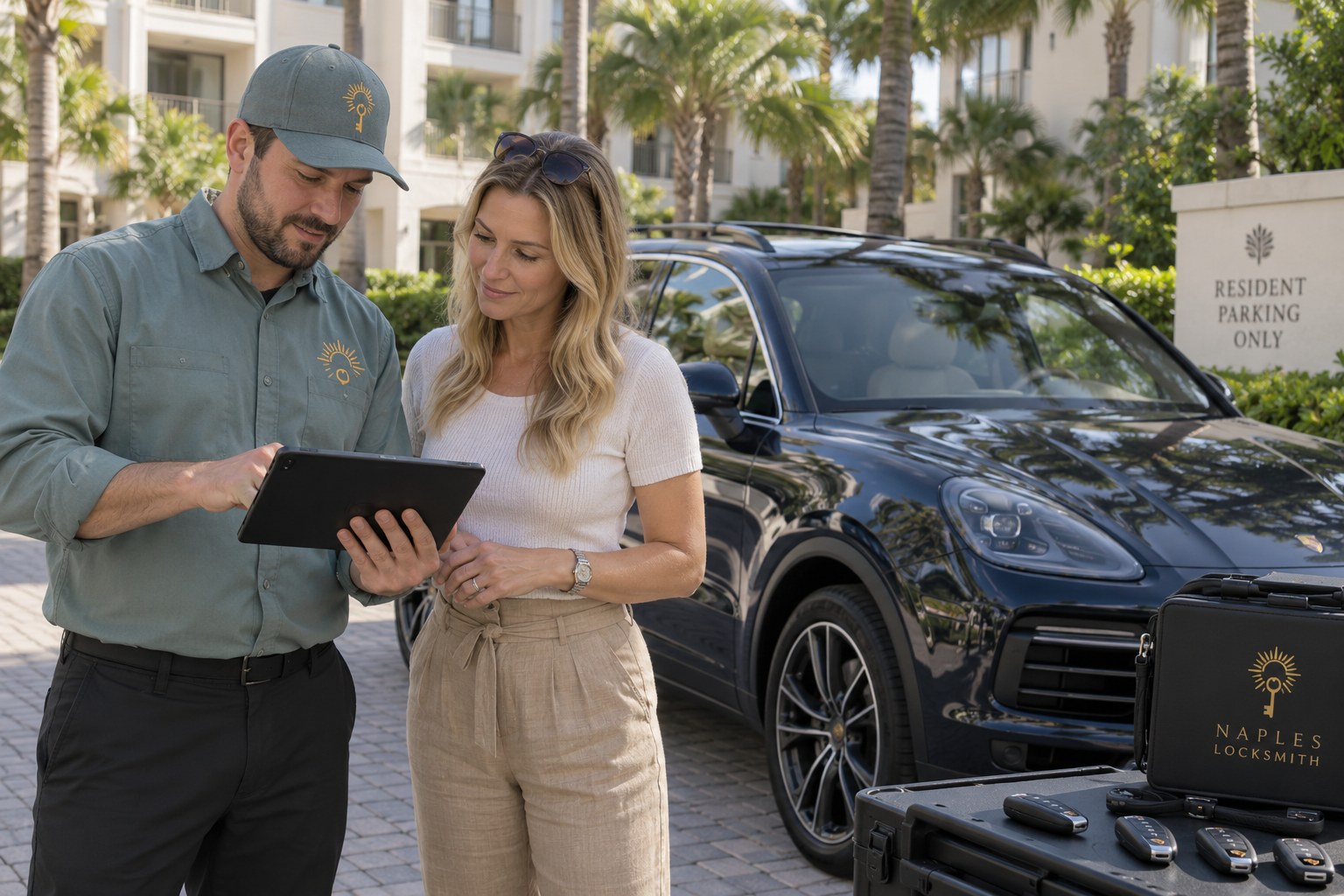
Losing every key to your car is stressful, but it is a problem locksmiths solve regularly. This page walks through the general process in Naples and Collier County: how ownership is confirmed, how a replacement key is cut or generated, what to gather beforehand, and how a technician decides whether the job can be done at your location or needs a longer visit.
First, a calm look at where the key might be
Before you call anyone, take five unhurried minutes to retrace your steps. Keys turn up in jacket pockets, beach bags, the bottom of a purse, the cup holder of a different car, between sofa cushions and on the kitchen counter under a stack of mail. In Naples, they also turn up in golf bags, on boats and in tote bags carried from a condo lobby to the pool. A thorough search costs nothing and sometimes ends the whole problem.
Ask the people you were with, check the last place you remember using the car, and call any restaurant, shop or club you visited. If the key has a remote fob, it may have fallen out of a pocket in the parking lot. Look under the car and around the tires. If you were near the water, a key can slip into sand or into a canal, and then the question becomes one of replacement rather than recovery.
If you have a spare key at home, think about who can bring it to you. A friend or family member with access to your home can sometimes solve the whole situation in an hour. Many people forget they have a spare in a drawer, a safe or with a neighbor. If a spare exists and can reach you, that is almost always the simplest answer, though you may still want to deal with the lost key to keep the vehicle safe.
Why a lost key can be a security matter
A lost key is not only an inconvenience. If it was lost in a public place and has a tag, your address, or a recognizable remote, someone who finds it could try to match it to your vehicle. Most modern keys are not trivially usable by a stranger, but a physical key that fits the door and the ignition remains a concern. It is sensible to treat a missing key as potentially in someone else's hands.
For many vehicles, a technician can program a new key and erase the old one from the car's memory, so the lost key will no longer start the engine. The process depends on the vehicle, and not every vehicle supports it equally. Ask the technician about the options for your particular car. In some cases, only the electronic part can be disabled, and the physical blade could still open the door.
If the key was lost together with your home keys or your wallet, think more broadly. The finder may have your address, and the combined set can be more worrying than a lone car key. In that situation, rekeying the house is worth discussing alongside the car. A locksmith can handle both, and give you plain advice about which steps make sense and which are optional.
How ownership is confirmed before any key is made
Anyone who can make a key for your vehicle can, in effect, drive it away. Because of this, a responsible locksmith confirms ownership or authority before cutting or programming a new key. That is not suspicion of you. It protects you from someone else doing the same to your car. Expect to be asked for identification and for proof that the vehicle is yours.
Typical documents include a government photo ID, the vehicle registration, the title or a lease agreement, and in some cases an insurance card. The name and the vehicle identification number should line up. If the car is a company vehicle, a rental or a family vehicle in someone else's name, the technician may need a letter or a call from the registered owner. Explain the situation openly and we will tell you what is acceptable.
If you cannot get to your documents because they are in the car, say so. Sometimes registration copies exist on your phone, in a photo, or through an online account. The technician will let you know whether that is sufficient. Ownership checks are the one step we cannot skip, and being prepared for it makes the whole job much faster once the technician arrives.
- Photo ID that matches the registered owner
- Registration, title or lease paperwork
- Vehicle identification number, visible at the dash or door jamb
- A letter or phone confirmation if the car is in another name
Types of keys and what they mean for replacement
Vehicle keys fall into a few general categories, and the type determines how a replacement is made. A traditional mechanical key is a plain cut metal blade that turns the ignition and the doors. These are the simplest to duplicate or generate from a code, because there is no electronics involved. They are most often found on older vehicles.
A transponder key has a small chip inside the plastic head. The chip communicates with the vehicle's immobilizer, and the engine will not start unless the chip is recognized. Making a replacement means cutting the blade and also programming the chip to the car. A remote head key combines a transponder with lock and unlock buttons, while a smart key or proximity key allows push-button start with the key staying in a pocket.
Each type needs different tools, and some need access to the vehicle's computer. Tell the locksmith the make, model and approximate age of your car when you call, and any details such as push-button start or a flip-style key. That allows the technician to prepare the right blanks and programming equipment, and to say honestly if the job needs more than a quick visit.
Cutting a key when no original exists
When every key is lost, the technician cannot copy a working key, so the key must be created from information. For many vehicles, the key cut can be derived from the vehicle identification number, using code data that locksmiths are authorized to access, and then cut on a portable machine. This is called cutting by code, and it can be done on site with the right equipment.
In other cases, the cut is taken directly from the lock. The technician may decode the door lock or the ignition by inspecting its wafers, then cut a key to match. This takes patience and skill, and it sometimes requires removing a lock cylinder for closer work. It is slower than cutting by code, but it is a reliable way to make a working key for a vehicle that has none.
After cutting, the key must be tested in the door and the ignition. A key that turns the door but not the ignition, or vice versa, signals a problem with the cut or with the lock itself. The technician checks smoothness, tries the key several times, and adjusts as needed. Only then does programming of the electronic portion begin, if the vehicle has one.
Programming the electronics
For a vehicle with a transponder or smart key, a physical cut key is only half the job. The car needs to learn the new key, and that usually involves connecting a programming tool to the diagnostic port under the dash. The tool communicates with the car's computer, adds the new key's identity to the list of accepted keys, and, in many cases, can delete lost keys from memory.
Some vehicles allow on-board programming if you already have a working key, but when all keys are gone this option is not available. A technician then uses professional equipment that can read the immobilizer data and register a new key. The procedure varies by make, and some vehicles require additional security steps or a waiting period built into the car's own system. We explain what applies to your car when you call.
Vehicles that are more complex, or those with unusual security systems, may need work that cannot be done on the roadside. In those cases, the technician may suggest a longer visit or moving the vehicle. If the job is complicated, a technician visits and the service call charge is explained before dispatch. We would rather tell you clearly up front than surprise you at the curb.
Mobile visit or longer job: how the technician decides
Most lost-key calls can be handled where the vehicle sits, whether that is a driveway, a condo garage, a shopping center lot or a beach parking area. The technician comes with portable key cutting equipment and programming tools. That is the great advantage of a mobile locksmith: no towing, no waiting while a car sits somewhere. For many common vehicles, the job fits into a single visit.
Some jobs call for more time. A vehicle with an unusual security system, a damaged ignition, or an older lock that is hard to read may need extended work. If the ignition cylinder is worn, it might need repair or replacement. If the vehicle is in a spot with poor access, such as a tight garage, the technician may need to adapt. These cases are discussed openly before work starts.
Weather also plays a role. Summer in Naples brings intense heat and sudden thunderstorms, and a technician working in a parking lot during a downpour needs patience and a safe place to work. If conditions are unsafe, the visit may be adjusted. Call us to confirm availability, describe your location and your vehicle, and we will tell you what to expect.
What to gather before the technician arrives
A small amount of preparation shortens the visit considerably. Gather your identification, the registration or title, and the vehicle's year, make and model. If you can, take a photo of the vehicle identification number at the base of the windshield or on the driver door jamb. Tell us if the car has push-button start, a flip key, or a separate remote.
If you have any part of the old key, such as a broken blade or a spare remote, set it aside and mention it. Even a dead remote can help identify the correct replacement. If the key was lost in the water, a damaged key may still be useful for programming. Write down where the car is parked, any gate codes, and building rules for service vehicles.
Make sure the car is accessible. If it is locked, the technician will have to open it first, which is a separate step with its own ownership check. If you are in a parking garage, tell us the level and any height restrictions. In a gated or condo community, let the gate or the front desk know to expect a locksmith, so there is no delay at the entrance.
Locked in or locked out while the key is missing
Sometimes the missing key is inside the locked car. If you can see it on the seat or in the ignition, the problem becomes a lockout rather than a lost-key situation. The technician opens the car without damage, and you retrieve the key. This is often a simpler and quicker service than making a new key, so describe what you see when you call.
If the key is genuinely gone and the car is locked, two steps are needed: open the vehicle, and then create a key. The technician can do both in a single visit in most cases. Opening is done with specialized tools that avoid scratching paint or bending doors, and modern vehicles have particular airbag and wiring locations that must not be disturbed.
While you wait, stay somewhere safe and shaded. Naples afternoons are hot, and a parked car in direct sun gets uncomfortable quickly. Do not leave children or pets in a closed vehicle. If someone is trapped inside, call emergency services first. A locksmith can help with everything else, but a safety emergency always comes first.
Preventing the next lost-key day
Once you have a new key, think about how to avoid a repeat. The best protection is a spare. Make one extra key while a technician is on site, since cloning from an existing key is easier than building one from scratch. Keep the spare somewhere safe, such as at home or with a trusted person, and not in a magnetic box under the car.
Consider a key finder tag that attaches to your ring. These small devices can help you locate a key in a house or a bag, though they are less useful if the key falls into water or sand. For beach days, a waterproof pouch or a lanyard can keep a key attached to you. Some people leave the key in a locked glovebox of a second vehicle, if they have one.
Finally, keep documentation handy. A photo of your registration and insurance on your phone, and a note of your vehicle identification number, make the next replacement much smoother. If you are a seasonal resident, leave a spare key and paperwork with a trusted neighbor or property manager. A little planning turns a bad day into a minor inconvenience.
Seasonal residents, rentals and borrowed cars
Naples fills and empties with the seasons, and a good share of cars here belong to part-time residents, are registered in other states, or are rentals and borrowed vehicles. A lost key in those circumstances calls for a little extra thought. The technician still needs to confirm that you have authority over the car, and out-of-state registration is perfectly acceptable as long as the paperwork is clear and matches your identification.
If you are driving a rental, contact the rental company first. They often have their own procedure and may prefer to supply a replacement themselves. If you are using a friend's or relative's car, call the owner and ask them to confirm by phone that you have permission. A short, direct call from the registered owner is usually all a technician needs to proceed.
Snowbirds who keep a car stored for the summer should consider leaving a spare key and a copy of the registration with a trusted neighbor or property manager. A car that sits for months can develop a dead battery or a stiff lock, and a lost key on top of that is a hard way to start the season. Planning ahead keeps the return in autumn pleasant.
Frequently asked questions
Can a new car key be made if I have no original key at all?
Yes, in most cases. The technician confirms ownership, then cuts a key by code or by reading the lock, and programs the electronics if the vehicle has any. The details depend on the vehicle, so tell us the make, model and approximate age when you call. Unusual systems may require a longer visit, which will be explained.
What documents will I need to show?
Usually a government photo ID and proof the vehicle is yours, such as the registration, title or lease. The name on the documents should match the owner. If the vehicle is registered to someone else, such as a family member or a company, the technician may need a letter or a call from that person. We explain what is needed when you call.
Will the lost key still work after a new one is made?
It depends on the vehicle. Many cars allow the lost key to be removed from the memory so it can no longer start the engine. The physical blade might still open the door. Ask the technician what your car allows. If you are worried about someone finding the key, tell us so we can plan accordingly.
Can the work be done where my car is parked?
Often yes. A mobile technician brings portable cutting and programming equipment to a driveway, garage or parking lot. Some vehicles or damaged ignitions require longer work. Describe the car and the location when you call, and we will tell you whether a mobile visit is likely. Please call to confirm availability.
How is the price decided?
Quotes are given by phone once we know the vehicle and the situation. If the job is complicated, a technician visits and the service call charge is explained before dispatch. We do not start work until you understand and agree to the plan. Call us with the details of your vehicle and your location.