
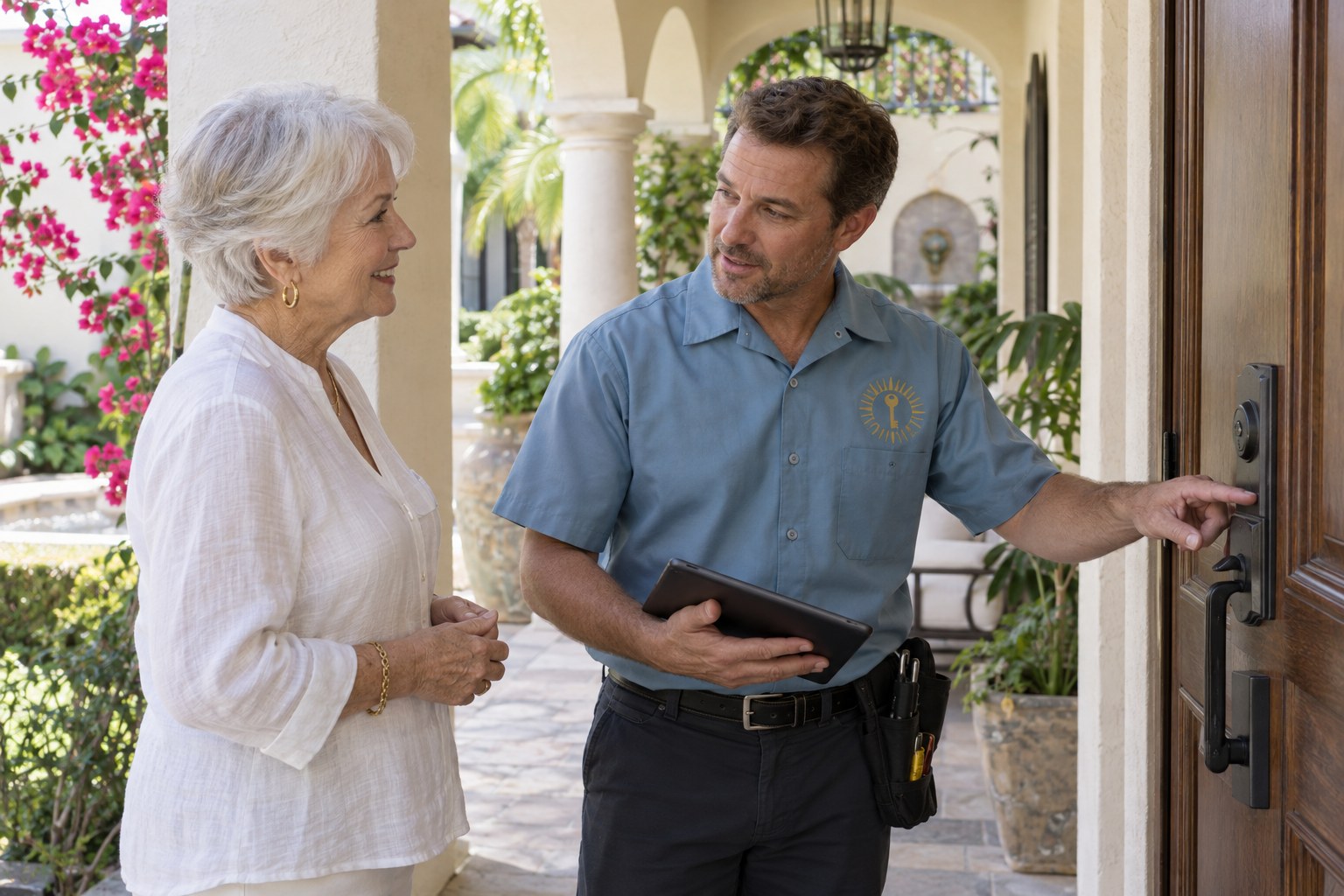
After a long drive or flight south, with the car full of bags and the season ahead, the last thing you want is a front door that refuses to open. Locks left idle through a humid Florida summer can seize, stiffen or stick. This page explains why, how a technician sorts out the cause carefully, and what to do before you leave next spring.
The scene at the front door
You have been looking forward to this arrival for weeks. The house is where you spend the best months of the year, and the plan is simple: unload, open windows, start the air conditioning, and settle in. Then the key slides into the lock, and nothing happens. It goes in partway, or it goes in fully but will not turn, or it turns a little and stops like it has hit a wall.
Pause before applying force. The temptation to twist harder is strong, especially after a tiring trip, but a key under heavy torque can bend or break inside the lock, and then a stiff lock becomes a jammed one. Try gently rocking the key, pulling it back slightly while turning, or lifting the door by the handle to take pressure off the bolt. If it does not give easily, stop.
Check a few simple things. Is the key the right one for this door? A ring with a dozen look-alike keys makes mistakes easy, especially when you have not used it for months. Is the key clean and straight? Is the door closed all the way? If the answers are all fine, the lock itself is the likely culprit, and it is time to call someone who can help.
What months of idleness do to a lock
A lock is a mechanism that likes to be used. Springs stay springy and pins stay loose when they move regularly. Over a long, damp summer in a closed-up house, moisture settles into every crevice, and a thin layer of corrosion forms on pins, springs and the inside of the cylinder. Without regular use to wipe things clear, the corrosion thickens.
Humidity inside a closed home can stay high even with the air conditioning set to a low level, and a door that faces the water or a sunny lanai experiences wide swings in temperature. These cycles pull moisture in and out of the cylinder. Old lubricant can dry out or turn tacky, and dust and salt add to the mix. After months, the lock feels like it has been glued.
The door can also change. Wood swells in the heat and damp, hinges loosen, and the frame shifts slightly. A bolt that once slid cleanly into the strike may now rub against it. In that case the key may turn, but the bolt will not retract, or the other way around. Sorting out whether the lock or the door is at fault is part of the technician's job.
Lock trouble or door trouble
It helps to know where the resistance lives. If the key will not enter or will not turn at all with the door open, the problem is in the cylinder. If the key turns but the bolt feels stuck or the door has to be pushed or pulled to lock, the issue is usually alignment between the bolt and the strike plate. Both can occur at once on a door that has been closed up for a season.
A simple test a technician uses is to open the door, if possible, and turn the key while looking at the bolt. A clean cylinder will move the bolt freely with the door out of the picture. If the bolt moves with ease when the door is open but binds when closed, the door has shifted. If the bolt resists even when out of the door, the lock mechanism is the problem.
When the door is locked and you cannot open it, the technician has to reason from the outside. They watch how the key behaves, feel for grit or bind, and consider the type of lock. The conversation matters too. Tell them how long the house was closed, whether storms came through, and whether the lock was already difficult before you left.
Diagnosing carefully before touching anything
A careful technician begins with questions and a look. They inspect the key for wear or bending, examine the keyway with a light and listen to what you tell them about the lock's past behavior. A worn or bent key is a surprisingly common cause of a lock that will not turn, and replacing it can solve the problem outright.
Next comes a gentle test. The technician tries the key with minimal pressure, perhaps with a drop of lock lubricant to see whether the pins loosen. They may try a different key, such as a spare, to rule out the key itself. If the lock responds, cleaning may be all that is needed. If it does not, the technician moves to more involved methods.
Throughout, the goal is to avoid damage. Forcing a lock that is corroded can break the key or the cylinder. We explain what we see and what we recommend before taking any step that risks the hardware. You will know whether the plan is to loosen the lock, replace it or work around it, and you will have a say in each decision.
Loosening a stiff lock without harming it
If the cylinder is only moderately sticky, a technician can often loosen it with the right lubricant and patience. A dry lock lubricant, applied in small amounts, works into the pins and springs. Inserting and removing the key repeatedly spreads it, and gentle wiggling helps break the corrosion bond. This may take several minutes, and the lock often begins to loosen gradually.
If more is needed, the cylinder may be removed from the door and serviced on a bench. With the plug out, the technician can clean pins and springs individually, remove built-up deposits and test each part. Light corrosion can be polished away. Springs that have weakened can be replaced. When the parts are reassembled, the lock often turns smoothly again.
There are limits. If the pins are pitted, springs broken or the plug scored, cleaning will not restore the lock. In that case the honest answer is replacement. A technician will explain this and show you the condition inside so you can see for yourself. A new cylinder or a new deadbolt gives you a fresh start for the season.
When the door is still locked and you are outside
If the key will not open the door at all, the technician has to find another way in. Picking is the first approach, using fine tools to work the pins. A corroded lock can be difficult to pick, but patience often succeeds. If the cylinder is too stiff, a bypass method or removing the cylinder from the door edge may allow access to the bolt mechanism.
As always, ownership matters. A snowbird arriving after months away may have trouble proving they live in the home, especially if their identification shows a northern address. Bring something that ties you to the property: a tax bill, a closing document, a utility statement or mail addressed to the Naples address. A neighbor or the property manager may also confirm your identity.
If you are waiting outside, find shade. Florida afternoons are strong even in winter, and a trip-weary traveler needs a comfortable place to sit. Check with a neighbor, a clubhouse or a community office. We do not promise arrival times, and we ask you to call to confirm availability. We would rather be honest than leave you waiting on a guess.
Other locks that may have stiffened while you were away
The front door is rarely the only one affected. The lanai door, garage entry, side gate, pool bath, shed and mailbox may all have suffered the same summer. A short walk around the property with each key will tell you which ones are fine and which ones are protesting. It is better to discover problems on arrival day than in the middle of the season.
Garage doors and openers deserve a check too. Remote batteries die, tracks collect dust, and keypads can fail after months of heat. A garage entry that is a secondary way into the house is useful when the front door acts up. If the garage side door lock is also stiff, mention it when you call so the technician can plan for several locks.
Windows and sliding doors have latches that can seize as well. These are usually simple, but if a slider will not lock or unlock, that affects both security and the ability to ventilate. A technician can address slider latches, or advise you on the right specialist. Describe each problem when you call, so the visit can cover as much as possible.
Replacement or repair after a long idle season
After the diagnosis, the question is whether to repair or replace. If the lock responds well to cleaning and lubrication, and the key and cylinder are sound, repair is a sensible choice. It keeps your existing hardware and your matching keys, and the lock may serve for years more with proper care.
If the lock is worn, pitted or seized beyond rescue, replacement is wiser. A new deadbolt with a corrosion resistant finish and internals will cope better with the Gulf summer ahead. A technician can fit a lock that matches your other doors, and key it to your existing key if you wish. We look at the door and strike at the same time.
Consider your plans. If you are leaving again in spring, a lock that is slightly marginal may not survive another closed summer. Replacing it now means one less worry when you return. If the lock is still healthy, a pre-departure routine can keep it that way. The honest choice depends on what we find, and we never push work you do not need.
A pre-departure routine for next spring
Before you leave for the summer, spend half an hour on your locks. Work each key in each lock a few times to be sure it turns freely. Wipe the exterior with a damp cloth to remove salt and dust, then dry it. Apply a small amount of dry lock lubricant to the keyway, and insert and remove the key to spread it.
Ask a trusted person to visit the house now and then. Even a monthly check, where someone opens the door, turns the lock and checks the home, keeps parts moving. A property manager, neighbor or caretaker can do this. If you give someone a key, note who has it and consider rekeying when you return if you want to reset access.
Leave a spare key somewhere secure, such as with a trusted neighbor or in a lockbox you control. Note where it is and tell your family. On the day you return, a spare gives you a second chance if the primary key struggles. Write the plan on a card and keep it with your travel documents, so you do not have to remember it in a rush.
Hurricane season and the closed-up home
Summer absence overlaps with hurricane season, and storms add another layer. Shutters, wind driven rain and power outages all affect a closed home. Water can find its way around door frames and into hardware, and a power outage means air conditioning stops and humidity rises quickly. Locks that were fine in May may be damp by October.
Before leaving, check that doors close tightly and that weatherstripping is sound. If a door has been rubbing or sticking, address it before you go. A caretaker can open the home after a storm to check for damage, and having reliable locks makes that easier. If a storm passes, ask your caretaker to test the doors, not only look at them.
On your return, expect that some hardware may need attention. Do not be discouraged. Humidity is part of life here, and a locksmith's work is largely about helping homes cope with it. A little maintenance each year keeps small problems from becoming lockouts, and makes the start of each season smoother.
Quotes, service calls and planning your arrival
A stiff or seized lock varies enormously in what it needs, so we do not post amounts online. Call us, describe the symptoms and the lock, and we will give you a quote by phone. If the job is complicated, a technician visits and the service call charge is explained before dispatch.
If you know you are returning soon and want to head off trouble, call ahead. A locksmith can check your locks right after you arrive, while you are still unpacking. We ask you to call to confirm availability, particularly at the busy start of the season when many seasonal residents are returning at once.
Bring identification and something that links you to the home. Tell us how long the house was closed and what you noticed. We will diagnose carefully, explain your options and let you decide. The goal is simple: you in your own home, with a key that turns the way it should, ready to enjoy the season.
Arrival day checklist for a house that has been closed
A closed home deserves a gentle reopening. Before you carry in the first suitcase, try every exterior key in its lock with the door open, if you can. Doing it this way avoids discovering a problem only after you have shut yourself in or out. Note which locks feel rough, and write them down so you can mention them when you speak with a technician.
Open the door slowly and check the threshold, the frame and the hinges. Look for swelling, peeling paint or moisture marks that suggest water has been getting in. A door that rubs at the top corner may have shifted on its hinges, and tightening the hinge screws is sometimes enough. Do this before you assume the lock is to blame.
Next, run the whole cycle of locking and unlocking from both sides, including the thumb turn inside. Try the lanai and garage entry as well. If any lock needs more effort than it did last season, treat that as an early warning. It is much easier to schedule a visit now than to call during a rushed evening when guests are waiting.
Finally, walk through the house and confirm that nothing has been disturbed. If anything looks wrong, or if there are signs someone has been inside, call the proper authorities first. Once that is settled, think about rekeying, because a key that has passed through many hands over a summer, from caretakers to service people, is worth retiring.
Frequently asked questions
Why would a lock seize while I was away?
A closed house in a humid climate lets moisture and salt settle inside the cylinder, where thin corrosion forms on pins and springs. Without regular use to keep parts moving, the corrosion thickens and old lubricant dries out. The result is a key that sticks or will not turn.
Should I force the key?
No. Forcing a stiff key can bend or snap it inside the cylinder, turning a stiff lock into a jammed one. Try gentle rocking and lifting the door slightly, and if it does not give easily, stop and call for help.
Can the lock be saved or must it be replaced?
Often it can be loosened by cleaning and proper lubrication, sometimes with the cylinder serviced on a bench. If the pins are pitted or springs broken, replacement is the better choice. The technician shows you what is inside and lets you decide.
I live up north. How do I prove this is my home?
Bring identification and a document connected to the Naples address, such as a tax bill, closing paperwork, a utility statement or addressed mail. A property manager or neighbor may also help confirm. We check ownership or authority before opening or changing any lock.
What can I do before I leave next spring?
Wipe the locks, apply a little dry lubricant, work each key a few times, and have someone visit the house now and then to turn the locks. Leave a spare with a trusted person, and consider rekeying when you return if you want to reset who holds keys.