
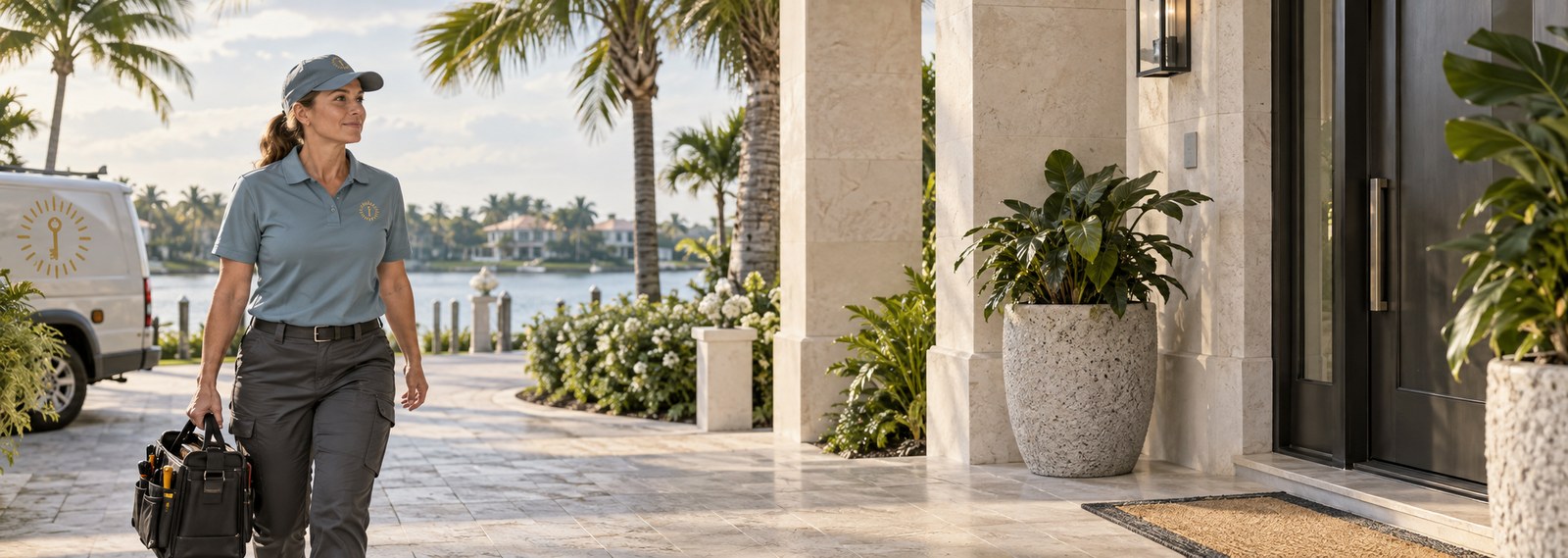
On a canal-front home, the door that faces the dock is often the one nobody thinks about. It gets sun, salt and storm weather, and it opens onto a view that is private in the best way and unobserved in the worst. This page covers deadbolt quality, reinforced strikes, sight lines, lighting and the habits that keep a waterside door secure.
The door that faces the water
Waterfront living in Naples and Marco Island has a particular rhythm. The front of the house faces the street, with a tidy entry and a visible address. The back faces a canal, a dock and maybe a boat, and that side is where the family actually lives. The back door, often a sliding glass door or a French door set, is used constantly and noticed rarely.
That contrast matters. A front door is seen by neighbors and passing traffic, while the waterside door is usually seen only by the people on boats and the homes across the canal. Visibility is a quiet form of security, and on the water side there is often less of it than people assume.
The back of a canal home also takes a beating. Sun bleaches finishes, salt air attacks metal, storms push rain sideways, and the constant moisture off the water works at every seam. A deadbolt that was installed years ago may be tired without looking it.
When you call us about a waterside door, describe it. Is it a solid hinged door, a French pair, or a slider? Quotes are given by phone, and if the setup is complicated, a technician visits first and the service call charge is explained before dispatch.
What makes a deadbolt good
Not all deadbolts are equal. A strong one has a solid steel bolt that extends at least an inch into the frame, a hardened insert that resists sawing, and a cylinder that resists picking and drilling. These features are not obvious from the outside, and builder-grade hardware often skips them.
Grades matter. Residential deadbolts are rated by independent standards, with the highest grade offering the toughest construction. A technician can identify the grade of your existing deadbolt and tell you whether it is worth keeping. Many older ones are lightweight and could be replaced for a real improvement.
Finish matters on the water. Look for finishes designed for corrosion resistance, such as solid brass, stainless or specialty coatings made for coastal use. A shiny plated lock may look fine on day one and peel within a couple of seasons.
Keyway design counts too. A restricted keyway limits unauthorized copies, and a sealed cylinder resists the intrusion of salt and moisture. Together these make a deadbolt that lasts and keeps its security.
- Solid steel bolt with a deep throw
- Hardened insert against sawing
- Corrosion-resistant finish for salt air
- Restricted keyway to control copies
- Higher-grade rating confirmed by a technician
Reinforced strikes and long screws
A deadbolt is only as strong as what it is anchored to. The strike plate, the metal piece on the frame that receives the bolt, is attached with short screws in many homes, and those screws bite only into the thin trim of the door frame. A firm kick can split the frame and defeat the lock without touching it.
A reinforced strike changes that. A heavy-duty plate, installed with long screws that reach through the frame into the wall stud behind, spreads the force across a much stronger structure. It is among the most effective and economical improvements a door can receive, and it is invisible once installed.
Frames matter as much as plates. A hollow or rotted frame, common where moisture has been working at the wood for years, holds screws poorly. A technician can probe the frame for softness and recommend repair or a metal reinforcing plate before any new lock goes in. A strong deadbolt in a weak frame is only half a solution.
Hinges deserve the same attention. Long screws in the hinge side help hold the door in the frame. If the hinges are on the outside, security hinges or pinned hinges prevent the door from being lifted off. Hinges on the interior side avoid that issue.
A technician can check the frame, the strike and the hinges and recommend upgrades that fit your door. It is a modest visit with a lasting benefit.
Sliding glass doors and French doors
Many canal homes use large sliding glass doors to open the living space to the water. These doors have their own locks, usually a simple latch that engages a hook, and these are not designed for security. A determined person can lift or force many sliders, and the track is a weak point.
A slider can be strengthened. A secondary lock, a pin through the frame, a bar in the track or a keyed lock on the track side adds layers. Anti-lift devices keep the door from being raised out of its track. These measures are inexpensive in effort and easy to use every day.
French doors are pairs of hinged doors meeting in the middle. One door is usually fixed in place by bolts at the top and bottom, and the other carries the lock. Weak bolts and thin frames make them vulnerable, and the central gap is a place where pry tools can work.
We can look at the door type and recommend a combination of keyed locks, bolts and bars that suits it. Quotes are given by phone, and we confirm ownership or authority before installing or rekeying anything.
Sight lines from the dock and the canal
Security is partly about who can see what. On a canal lot, the back of the house often has a lawn or lanai, then a seawall or dock, then open water. Boats can approach the property from the water side without passing any gate or street camera, and a dock offers an easy, quiet landing.
Think about sight lines from the house outward and from the water inward. Can you see the dock from the kitchen or living room? Can a neighbor see your back door from their lanai? Open views deter unwelcome visitors, while overgrown landscaping and tall screens create hiding places.
Trim shrubs near the back door and under windows to remove hiding spots. Keep sheds and storage boxes away from the door. Think about whether privacy screens, while pleasant, block your own view of the water as well.
None of this means living behind bars. It simply means balancing privacy and visibility so that someone at your back door is visible to you, your neighbors or both.
Lighting around the waterside
Good lighting is among the simplest deterrents. A well-lit back door, dock and lanai make it hard for anyone to approach unnoticed. Motion-activated lights startle visitors and alert you, while steady low lights along paths and at the seawall provide a gentle, constant glow.
On the water, lighting has a second role. Boaters and fishermen see lights and understand a home is attended. A pair of fixtures facing outward at the dock and at the back door is a modest addition that improves both safety and appearance.
Choose fixtures made for marine conditions. Salt and humidity corrode ordinary lights and their wiring. Sealed, corrosion-resistant fixtures with good gaskets last far longer. Warm-colored bulbs are kind to the eye and to wildlife, which matters in many Southwest Florida neighborhoods.
Cameras and doorbell devices are an option, though they require good Wi-Fi at the back of the house. We focus on locks and hardware, but we are happy to talk through how lighting and cameras fit with your doors.
Salt, sun and storms on the hardware
The waterside climate is demanding. Salt in the air settles on every exposed metal surface and, combined with humidity, accelerates corrosion. Direct sun fades finishes and bakes plastic parts. Storms drive rain into seams and around door edges, and prolonged wet conditions swell wood and corrode fasteners.
Expect hardware on the water side to age faster than on the street side. A deadbolt that lasts a decade inland may show wear in half that time on a canal. Plan for inspections and, when needed, replacements, rather than waiting for failure.
Rinse exterior hardware occasionally with fresh water to remove salt, then wipe dry. Use a dry lubricant on moving parts rather than heavy oil. Check weatherstripping and seals, since keeping water out of the door helps the lock last.
After a major storm, inspect every lock and door. Flooding, wind-driven rain and flying debris can bend frames, loosen hinges and soak electronics. A quick check can catch problems before the next cycle of weather.
Hurricane season and the back door
Hurricane season is a fact of life here, and the waterside is often the most exposed part of the house. Doors with large glass areas need protection from wind pressure and debris, and many owners install impact-rated doors or storm shutters. Your lock and its anchoring play a role in how well the door holds.
Before a storm, make sure the door latches and locks fully. A door that is only half-latched can be pushed open by wind and pressure. Check that the deadbolt extends into the strike, that the hinges are tight and that any added storm bars or bolts are in place.
After a storm, expect delays and traffic. Call early if a lock is damaged, and please call to confirm availability, since many homes need help at once. A secure door matters more when neighbors have left and streets are quiet.
If you leave for the summer, check your doors before departing. Snowbirds who close up a house for months should test each lock, secure sliders with bars and make sure someone trustworthy can check the property after weather events.
Seasonal homes, rentals and boat visitors
Many canal homes are only occupied part of the year, or rented to a stream of guests. That creates its own risks. An empty home is quiet, and a rental sees many people with keys and codes. The waterside door deserves special attention in both cases.
For rentals, consider a keypad or smart lock on the back door with individual user codes, so access can be changed between guests. Make sure the door has a backup key and that it works in humid air. Show guests how to lock the slider and the door, particularly at night.
Boat traffic brings its own questions. Guests who come and go by boat may use the back door more than the front, and may leave it unlatched while loading. A clear instruction card by the door helps, and a latch that engages automatically avoids many mistakes.
We confirm ownership or authority for any work on these doors. If you are a manager, have your authorization ready. If you are a tenant, we may need permission from the owner.
Keypads and smart locks at the back of the house
A keypad deadbolt can be a good fit for the waterside door, since family, guests and workers tend to use it, and carrying a key to the dock is awkward. You can step out to the boat without keys and return by entering a code. The tradeoff is that electronics must withstand moisture and salt.
Choose a keypad rated for outdoor use, with sealed buttons and a tough finish. Mount it where it is not hit by direct spray from sprinklers. Check the battery compartment now and then for corrosion, and replace batteries on a schedule.
A good keypad also keeps a mechanical backup key. Make sure the cylinder works, since salt can seize it from lack of use. If power fails during a storm, you still want a reliable way to open and secure the door.
Smart locks with phone apps add convenience but depend on Wi-Fi at the back of the house, where signals are often weak. Test the signal before installation. A technician can program codes with you and explain how to remove them later.
Dock gates, seawall steps and the path to the door
The back door is only the last barrier. Many canal homes have a gate at the side of the house, a path along the seawall or a set of steps to the dock. Each of these can slow or stop an unwelcome visitor, and each has hardware worth checking.
Side gates should have a latch that cannot be reached over the top and a lock that suits the weather. A padlock on a gate faces salt directly, so choose weather-resistant models and keep them clean. A gate that swings freely invites trouble.
A lock on the dock access is optional, but some owners add a gate at the seawall steps to keep casual visitors off the property. It also protects against children wandering near the water, which is a safety consideration as well as a security one.
We can look at gate hardware during a visit and suggest options. Gate locks vary widely, and the right choice depends on how you use the space and how much exposure the hardware gets.
What a technician looks at during a visit
On a visit, the technician starts with the door itself. Is it solid, hollow or glass? How thick is the frame? Is the door square, and do the hinges hold? These basics determine what hardware is suitable and what improvements are worthwhile.
Next comes the lock. We check the deadbolt grade, the finish, the condition of the cylinder and the bolt's throw. We test the key and the operation, and look for corrosion. We also examine the strike plate and screws, since weak anchoring is common.
We then discuss options. A new deadbolt, a reinforced strike, a secondary lock for a slider, a keypad or a rekey to match your other doors are typical suggestions. We explain tradeoffs honestly, including when an upgrade is not necessary.
Quotes are given by phone, and complicated jobs start with a visit and a clear explanation of the service call charge before dispatch. You decide what to do, and we do the work neatly.
A practical plan for the dock side
A good plan combines several small steps. Install a quality deadbolt with a corrosion-resistant finish. Reinforce the strike and the hinges with long screws. Secure sliding doors with a bar or pin. Improve the lighting and trim the landscaping so the door is visible.
Then add habits. Lock the back door every evening, not only when leaving. Check the slider latch and track once a month. Rinse and wipe the hardware seasonally. Test the keys, and keep a spare in a safe place.
Review the plan each year before the storm season. Ask whether anything has changed, such as a new tenant, a new boat, a renovation or a damaged frame. A short walk around the waterside takes only minutes.
If you would like help, call us and describe your home. We keep the conversation plain, offer honest advice and never push you to buy more than you need.
Frequently asked questions
What kind of deadbolt is best for a canal-front back door?
Look for a solid steel bolt with a deep throw, a hardened insert, a restricted keyway and a corrosion-resistant finish suited to salt air. A technician can check the grade of your current lock and advise whether to keep or replace it.
Is a reinforced strike plate really worth it?
Yes. A strike with long screws that reach the wall stud spreads force across a much stronger structure and resists kick-in attempts. It is a modest change that makes a real difference, and it is invisible once installed.
How do I secure a sliding glass door facing the water?
Add a secondary lock, a pin or a bar in the track, and an anti-lift device. These layers resist forcing and lifting. We can recommend a combination for your slider, and we confirm ownership or authority before installing anything.
Does salt air shorten the life of door hardware?
It does. Salt and humidity accelerate corrosion, so waterside hardware ages faster. Choose corrosion-resistant finishes, rinse and dry the hardware occasionally and have older locks inspected before storm season.
How do I get a quote?
Call us and describe the door and its condition. Quotes are given by phone, and if the job is complicated, a technician visits first and the service call charge is explained before dispatch. Please call to confirm availability.