
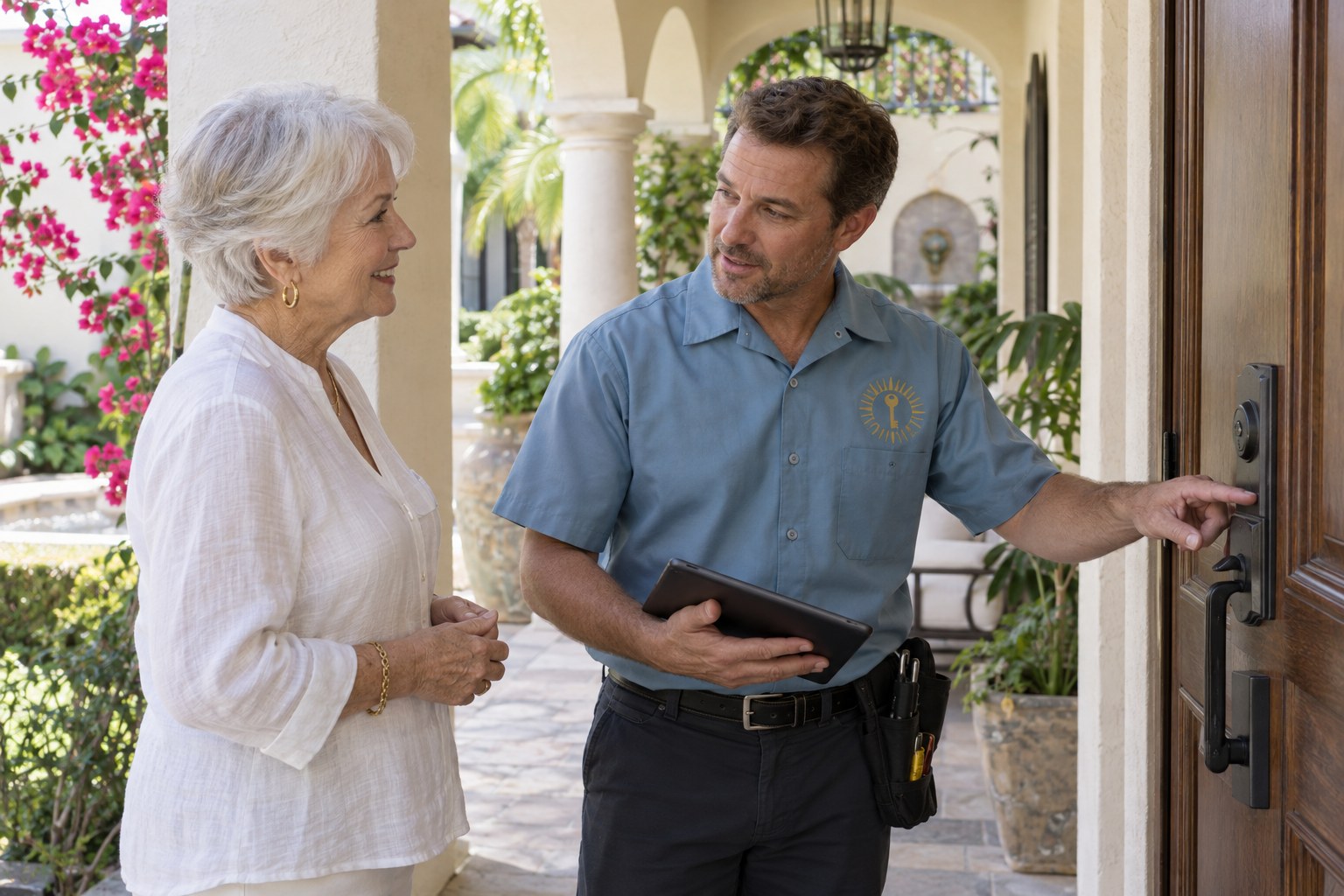
A dog walker, pet sitter or visiting groomer needs to get in while you are at work or away. Handing over a copied key works until the key is lost, passed along or forgotten in a pocket. This page explains how personal keypad codes and scheduled access give regular visitors entry without a spare key, and how to switch access off cleanly.
The quiet risk of a copied key
Handing someone a spare key feels friendly and simple. The trouble is that a key carries no memory of who holds it. It can be copied at any hardware counter in minutes. It can be dropped on a beach, left in a car, lent to a friend or put into a drawer where someone else finds it. You will not know about any of that, and there is no record of when it was used.
Dog walkers are often kind, reliable people, and the risk is rarely malice. It is carelessness and drift. The person you hired may subcontract a walk to a friend, or a service may rotate staff, and the key moves with them. Months later you may have several people who could enter your home, none of whom you chose, and no easy way to take the key back.
A personal keypad code changes that picture. Each visitor gets a code that belongs only to them. You can see which codes exist, you can add or remove them in seconds, and no physical object leaves your hands. The lock still has a key for you, but your walker does not need one. That small change moves control back to you.
How keypad and smart deadbolts work
A keypad deadbolt replaces the standard deadbolt on your door. On the outside there is a panel of numbered buttons, and on the inside a thumb turn and a battery compartment. You enter a code, the motor inside retracts the bolt, and the door opens. When you leave, the bolt can be extended by touching the keypad or by turning the thumb turn on the inside.
Many models store multiple user codes. You might set one for yourself, one for the dog walker, one for a cleaner and one for a family member. Some models connect to a phone app, letting you create temporary codes or see a log of entries. Others work entirely offline and are managed on the keypad itself. Either approach is workable, and the right one depends on how comfortable you are with apps and Wi-Fi.
A good unit should also have a keyed override, hidden behind a small cover. If the batteries die, or if the electronics fail, you can still unlock the door with a physical key. A technician will explain which battery type the unit uses, how to check low battery warnings, and where to keep a spare key. Battery care is the main upkeep, and it is worth a reminder every few months.
- Personal code for each visitor, never shared
- Codes can be added or removed without changing keys
- Keyed override for emergencies and dead batteries
- Optional app, schedule and entry history on some models
Scheduling access to match the walk
Some keypad and smart locks let you limit when a code works. If your dog walker comes on weekdays between noon and two, you can set the code to function only in that window. Outside those hours, the code does nothing. That prevents surprises, such as a visit at midnight, and it gives you comfort when you are on a plane.
Not every lock has scheduling. Simpler models rely on you adding and removing a code manually. If scheduling matters to you, say so when you call, and the technician will recommend models that support it. Be aware that schedule features often require a connection to a hub or a phone app, and that adds a layer of setup and a dependency on your home network.
Think about real life, not just ideal schedules. A walk may run late because of rain, a dog may need an unexpected visit during a heat advisory, or a vet appointment may change the plan. A schedule that is too narrow can lock your helper out when you need them most. Allow a sensible margin, and agree on a way for your walker to reach you if the code fails.
Choosing a good code
A code is only useful if it is hard to guess. Avoid birthdays, house numbers, repeated digits or simple sequences like 1234. A six-digit or longer code is better than four, if the lock allows it. Give each person a separate code rather than sharing one among several helpers, since a shared code cannot tell you who came or let you remove one person without disrupting the others.
Tell your walker how to treat the code. It should not be written on a tag, saved in a note with your address, or texted to a friend. A short, friendly conversation does the job: this code is only for you, please do not share it, and I will change it when our arrangement ends. Most professionals appreciate the clarity.
Some locks include a feature that hides the code from onlookers, such as letting you press extra digits before or after the real code. This makes it harder for someone watching to learn your code from smudges on the keypad. Wiping the panel occasionally also helps. Coastal air can leave a film on touch surfaces, so a quick clean keeps the keypad readable and less revealing.
Humidity, salt air and outdoor keypads
A keypad on an exterior door in Naples faces a difficult environment. Salt air, humidity, afternoon rain, summer sun and occasional storm-driven spray all test the finish and the electronics. Poorly made units show corroded contacts or fogged buttons within a season. Before buying, ask the technician about models built for outdoor use and for humid coastal areas.
Placement matters too. A door under a covered entry or a lanai is gentler on electronics than a door fully exposed to rain. If your door faces west and bakes in afternoon sun, look for a unit rated for high heat, since plastics can warp. Our technicians have a good sense of which products tend to hold up, and they will tell you honestly when a budget choice is likely to disappoint.
Maintenance is simple. Wipe the keypad with a damp cloth every so often, avoid harsh solvents, and replace batteries on schedule, using the brand the manufacturer recommends. During hurricane season, check that the unit powers on and that the keyed override still turns. A lock that quietly works for years is the result of a few minutes of attention a few times a year.
Condos, gated communities and shared entrances
If you live in a condo or a gated community, access to your door is only part of the story. The dog walker also has to pass through a front desk, a lobby, a gate or an elevator. Ask your building management how visitors and service providers are authorized. Many buildings require a list of approved vendors or a code at the entrance, and these are separate from your unit lock.
Some associations have rules about what locks may be installed on unit doors. Others require that management be able to open the door in an emergency. Check the governing documents before replacing hardware. A technician can install a keypad that meets building rules, but only you and your association can decide what is allowed.
For gates, many communities issue resident codes or transponders. Ask whether your walker can receive a visitor pass or a recurring authorization. This keeps your own gate code private. Make sure the dog walker understands the process before the first visit, and consider doing the first walk together so any hiccups at the gate or the lobby are sorted out while you are present.
Using a lockbox as a simpler option
If replacing the deadbolt is more than you need, a lockbox can hold a spare key and open with a code. Mounted on a railing or a wall, it allows your walker to retrieve the key and let themselves in. This approach is easy and inexpensive in effort, and it does not require changing the door. The tradeoff is that a physical key still exists and could be copied.
To reduce risk, choose a sturdy box with a covered keypad, and mount it out of sight from the street. Change the combination whenever the arrangement ends or someone new takes over. Do not put the box on a decorative rail where it is obvious, and do not leave the key in it overnight if you can avoid that.
A technician can mount the box correctly into a solid surface and rekey the lock so the key inside is distinct from your main key. That way, if something goes wrong, you can change the cylinder without disturbing the rest of your home. For many people a lockbox serves as a stepping stone before moving to a full keypad lock.
Ending the arrangement cleanly
Every dog walker arrangement ends eventually, whether because you move, change schedules, find a different service or the walker retires. Planning for that moment from the beginning makes it painless. With a personal code, you simply delete the user from the keypad or the app. There is nothing to collect, no awkward request for a key back, and no worry about copies.
With a physical key, the process is harder. You ask for the key, and trust that no copy exists. If you are not sure, the safest course is to rekey the lock. A technician can rekey a single deadbolt quickly, and you receive a fresh set of keys. This is why many households with regular visitors choose keypads. The cost of changing access becomes a matter of seconds.
Keep a simple note of who has a code and when it was issued. Review it every few months. If someone has not visited in a while, remove their code. It is a small habit with a large effect. Anyone you let in should be able to stay on your list for as long as they are useful, and no longer.
Ownership, authority and who may change the lock
Before replacing or rekeying a deadbolt, the technician confirms that you have the right to make the change. If you own the home, a photo ID and some link to the address is usually enough. If you rent, the lease and the landlord's approval matter, since many leases restrict lock changes or require the landlord to keep a key.
The same is true in a shared household. If two adults live in the home, both generally have a say in who gets a code. A technician will ask whether the other adult is aware of the change, and will not take sides in a disagreement. We only proceed when the person requesting the work has clear authority to do so.
These checks are simple and rarely cause problems. They protect you, and they protect the people who share the home. If you are not sure who has the authority, such as in a seasonal home owned by a family trust, call us and describe the situation. We will tell you what we need to see before scheduling a visit.
What to expect when you call
When you call, tell us about your door: the type, whether it faces the weather, and what lock is currently on it. Tell us how many people will need access, whether you want schedules and whether you prefer a phone app. We will discuss options and give a quote by phone. Please call to confirm availability for your preferred day.
On the day, the technician checks the door preparation, removes the old deadbolt and installs the new one. They will set up codes with you, test each one, and show you how to change them later. They also verify the keyed override, so you know how to open the door if the batteries run down. Most installations finish in a single visit.
If the door needs repair, such as a misaligned strike or a worn bore, the technician will explain this before starting. If the job is more complicated than expected, a technician visits and the service call charge is explained before dispatch. We want your dog walker to arrive, do a good job and leave without anyone worrying about a key.
Pets, doors and the moment of entry
Letting someone into a home with an excited dog is its own small choreography. Many dogs rush the door when a visitor arrives, and some are protective. Before the first walk, introduce your dog to the walker while you are present, so the animal learns the person is welcome. Ask the walker how they prefer to enter, for example by calling out softly or by waiting for the dog to settle.
Door hardware plays a part. A lever handle is easier to open with a leash in one hand and a bag in the other. A keypad that beeps loudly may startle a nervous dog, and some models let you turn the sound down. Check that the door closes fully behind the walker, because a latch that does not catch can let a curious pet slip out when the visitor leaves.
Think about the gap between the door and the car or the yard as well. A gate that does not latch, a pool cage with a loose door or a fence panel with a gap can all matter. A technician can adjust a strike plate, fit a closer to a screen door, or add a secondary latch to keep a pet safely inside the property while the walker is coming and going.
Vacations, storms and extended absences
Pet care becomes more complicated when you travel. A walker or sitter may need access for days in a row, possibly while a storm approaches. Before you leave, test every code from outside while the door is closed, check that the batteries are fresh, and confirm that the sitter knows how to use the keyed override. Few things are worse than being locked out of a house with an anxious dog inside.
During hurricane season, consider what happens if power fails. Most keypad locks run on batteries, so they keep working during outages, but a Wi-Fi hub will not. If your lock depends on an app or a hub for codes, make sure the codes are stored in the lock itself. Discuss with the sitter what to do if conditions worsen, and who to call if the door fails.
When you return, remove temporary codes right away. It takes less than a minute and closes a loop you might otherwise forget. If a sitter stayed overnight, check that the door and windows were left locked. If you have any doubt about a key that was handed out, call a technician to rekey the lock rather than guessing.
Frequently asked questions
Can each visitor have their own code?
Yes. Most keypad deadbolts store several user codes, so you can give the dog walker, a cleaner and a family member separate ones. That lets you remove one person without disturbing the others. Ask about the number of codes a model supports when you call, and we will recommend a unit that matches your household.
What happens if the batteries die?
Quality keypad locks warn you when batteries run low, and they include a keyed override behind a small cover so you can still unlock the door. Keep a spare key somewhere safe and replace batteries on a schedule. The technician will show you where the override is and how to change the batteries before leaving.
Is a keypad lock reliable in Naples humidity?
It can be, if you choose a model built for outdoor and coastal use and place it under cover when possible. Salt air and moisture shorten the life of cheap units. Wipe the keypad occasionally and check the batteries. We will recommend products that tend to hold up and tell you honestly if a model is a poor match.
How do I stop access when I no longer need the walker?
Delete the walker's code from the keypad or the app, and access ends immediately. No key needs to be collected. If you used a lockbox or a copied key, the safest approach is to rekey the lock or change the lockbox combination. A technician can do either quickly and give you fresh keys.
How do I get a quote for a keypad installation?
Call us with a description of your door and the features you want, such as personal codes or schedules. Quotes are given by phone. If the job is complicated, a technician visits and the service call charge is explained before dispatch. Please call to confirm availability for the day you prefer.