
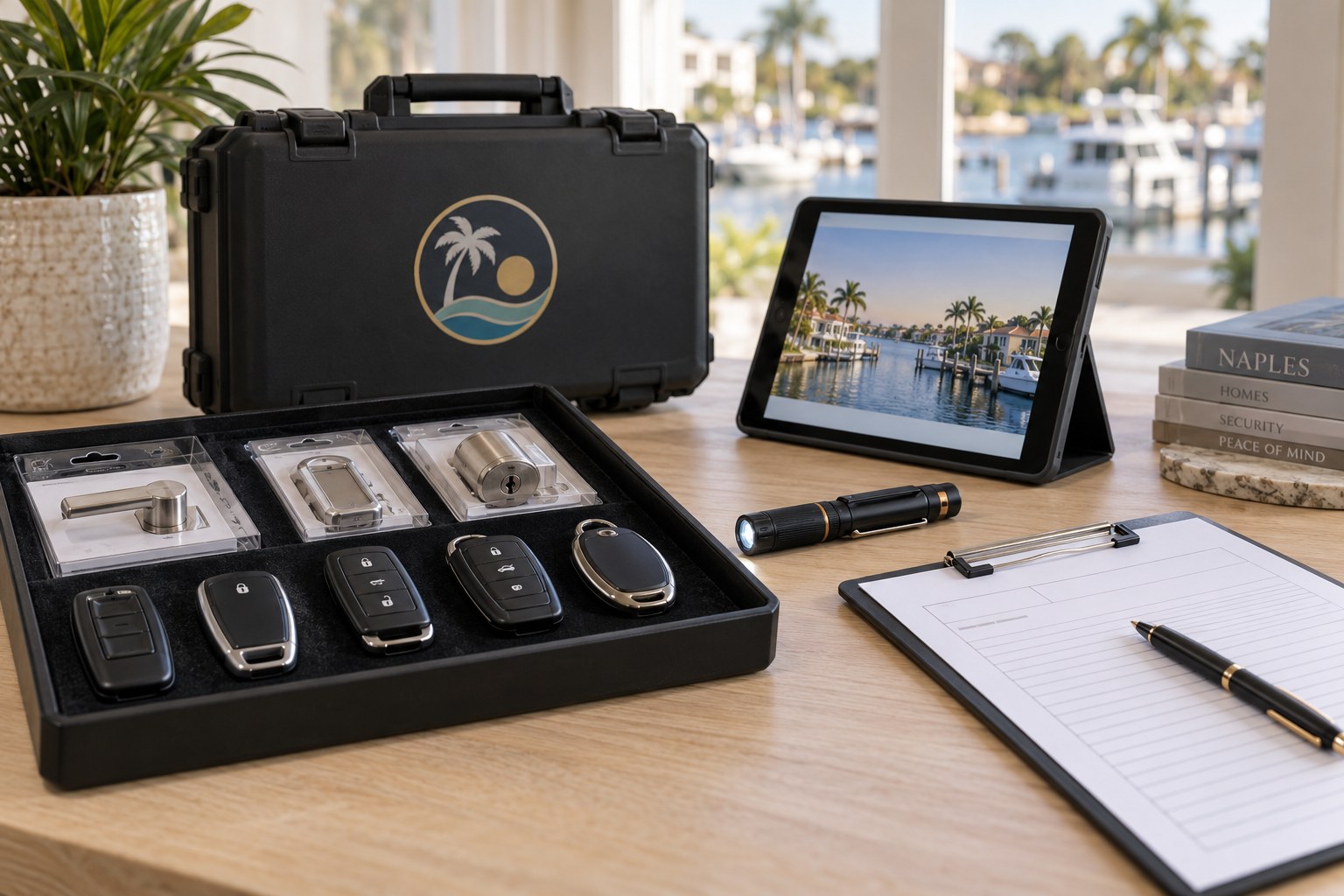
Many Naples homes include a guest wing, a casita beside the pool, or an in-law suite with its own bath. Visitors and family members there deserve privacy, but a locked door must never become a trap. This page covers the hardware that works, how emergency release is handled, and what a technician checks before installing anything on an interior door.
Why a guest suite needs a different kind of lock
The lock on a front door and the lock on a guest bedroom do entirely different jobs. An entry lock exists to keep outsiders out, so it is built to resist force and to be locked from either side with a key. A privacy lock on an interior door exists to give a person a few moments of quiet, to signal that the room is in use, and to be opened quickly from the outside in an emergency. Mixing the two ideas leads to poor results.
In a house with a guest wing, a casita or an in-law suite, the occupants may be elderly parents, adult children, visiting friends or seasonal relatives who stay for weeks. They want to change clothes, rest, make private calls and keep personal belongings undisturbed. They do not want to be fussing with a key, and they certainly do not want a lock that could trap them if they fall ill or become confused.
That is why most good guest suite hardware uses a thumb turn or push button on the inside and a small emergency release on the outside. It balances dignity with safety. A technician will talk through who will stay in the room, how steady they are on their feet, and whether anyone in the household may need to reach them quickly. Those answers shape which lock makes sense.
Privacy sets, passage sets and keyed sets
Door hardware comes in a few basic families, and knowing the names helps you ask for what you want. A passage set has a handle on both sides and no lock at all; it simply latches the door closed. A privacy set adds a small button or turn on the inside that locks the handle, and it opens from the outside with a thin tool or coin slot. This is the usual choice for bedrooms and bathrooms.
A keyed entry set has a cylinder on at least one side and needs a key to unlock. That is the right choice for a home office, a storage room or a liquor cabinet, but it is generally not appropriate for a bedroom someone sleeps in. If a key is lost, the person is locked out or in, and key-operated interior locks require a clear plan for where spares are kept.
Between those sits a range of finishes and handle styles: lever handles in a brushed or oil-rubbed finish, round knobs, and slimmer modern shapes. Lever handles are easier on arthritic hands, which matters for older guests. A technician can match the finish to the other doors in the hallway so the new hardware looks like part of the house rather than an afterthought.
- Passage set: latches only, no lock
- Privacy set: inside button, emergency release outside
- Keyed entry set: key required, best for offices and storage
- Lever or knob styles chosen for comfort and appearance
Emergency release and why it is non-negotiable
Every bedroom or bathroom lock should be openable from the outside without the key, using something you can find in seconds. Privacy sets handle this with a small hole or slot in the outside knob or lever that accepts a thin pin, a small screwdriver or a coin. Pressing the pin releases the inside button, and the door opens. It is deliberately simple so that a worried family member can use it.
It is worth showing the household where the release tool lives. A small pin or flat tool can be taped to the top of the door frame or kept in a labeled kitchen drawer. If a guest has fallen, felt unwell, or a small child has locked themselves in, the person responding should not need to hunt for anything. Technicians often leave a spare release pin with the customer for this reason.
Some people ask for keyed locks on guest suites because they worry about privacy. We understand the concern, but we will gently explain the risks and suggest alternatives. If a keyed lock is truly needed, for example on a locked storage closet, it should not be on a room where someone sleeps. Where a household includes young children or frail adults, extra care with release hardware is always the better choice.
In-law suites and the dignity question
An in-law suite is more than a bedroom. It may include a sitting area, a kitchenette and a private bath, and it often has an entrance from the main house plus a separate exterior door. The occupant may want to lock the exterior door at night, close the interior door during the day for quiet, and still feel connected to the family. Hardware can support that balance if it is chosen carefully.
For the exterior door, a standard deadbolt with a thumb turn inside is appropriate. It locks the door against outsiders, and anyone inside can leave without a key. For the interior door that connects to the main house, a privacy set is usually enough. Together they create a pair of rules: the outer lock protects the suite from outside, and the inner lock protects the occupant's privacy without sealing them off from help.
If the occupant has memory concerns, speak with a technician before installing anything that locks from the inside. Some families prefer a door that never locks, with a simple latch and a small sign, or a lock that can be defeated easily. Others choose a door alarm. A locksmith can explain hardware, but decisions about care belong with the family and, where appropriate, a medical professional.
Casitas, pool houses and detached guest rooms
Southwest Florida homes often include a casita attached to the pool area or a detached room across a courtyard. These feel private by design, yet they are also exposed to humidity, salt air and pool chemicals. Interior-grade hardware installed on an exterior casita door often corrodes within a season or two. The finish pits, the latch sticks and the cylinder stiffens.
For any door that opens to the outdoors, ask for exterior-rated hardware with a corrosion-resistant finish, and a deadbolt that is separate from the handle. Stainless steel or solid brass tends to hold up better in Gulf air than thin plated metal. The technician will also check the weatherstripping and the strike plate, since a door that does not seat properly will force the lock to work harder and wear faster.
Casitas used as vacation rentals or for visiting guests deserve one more thought: how the guest gets in. A keypad deadbolt can make arrivals simple, because each stay can have its own code. A traditional key is easy to lose near a pool. The right answer depends on how often the room is used, who is coming, and whether a host will be present to greet people.
Bathroom doors and shared hallways
A guest suite with its own bath usually needs a privacy lock on the bathroom door as well. Bathroom locks see more moisture than almost any other interior hardware, which means finish quality matters. Cheap plated hardware can flake or seize in a steamy room, and a stuck bathroom lock is a particularly unpleasant problem. A mid-grade privacy set with a solid internal mechanism is the sensible baseline.
Where a bath is shared by two bedrooms, a jack-and-jill layout, each side needs its own lock, and both should be easy to release from outside. Consider the traffic pattern. Guests who arrive in the evening and leave in the morning will be sharing space with family, and a simple occupancy habit, such as closing both doors and locking only the one in use, avoids awkward moments.
Doors that swing into narrow hallways or around tight corners may need different handle shapes so knuckles do not hit the wall. A technician will test the swing, the clearance and the reach of the thumb turn, and may suggest a lever with a short return. These details look minor, yet they decide whether the new hardware feels pleasant or irritating over months of use.
Installing on an existing door versus a new one
Most interior doors in Collier County homes are already prepared for standard lock sets. A typical hole pattern includes a large bore through the face of the door and a smaller bore in the edge for the latch. If your door matches that pattern, installing a new privacy set is a quick job. The technician measures the backset, confirms the door thickness, and mounts the hardware so it lines up cleanly with the frame.
Older doors, or doors that were previously fitted with a different style of lock, sometimes need patching or a different strike plate. Holes that are too large can be covered with a trim plate, and oversized latch mortises may call for a filler piece. Fitting these adjustments carefully keeps the door looking neat, and it protects the door from splitting when the latch is struck repeatedly.
If a door is hollow-core, the hardware choice matters. Hollow doors are light, and they flex when a handle is turned hard. A well-designed privacy set will still work, but you should not expect it to hold against force. For a guest suite this is fine, since the goal is privacy and not security. For an exterior or storage door, a solid-core door and a stronger lock are better pairings.
Sliding, pocket and barn-style doors
Not every guest room has a hinged door. Pocket doors slide into the wall and use a flush pull with a small lock. Barn-style doors hang from a track and can use a surface latch or a bolt. Sliding glass doors to a lanai have their own latch and pin systems. Each style needs hardware designed for it, and the wrong choice leads to a lock that looks fine but fails to engage cleanly.
Pocket door locks are usually small and low-profile, with an inside turn and an outside release slot. They suit a bath or a bedroom, but the door's edge is thin, so the mechanism has to be installed carefully. Barn doors offer less privacy because there is often a gap around the edges, and a surface bolt only secures what sits flush. If sound and sight privacy matter, consider adding a soft seal or switching to a hinged door.
Lanai sliders deserve extra attention in a guest suite that opens to the outdoors. The factory latch is often weak, and a secondary pin or a bar in the track makes a meaningful difference. A technician can add a keyed or thumb-turn secondary lock so guests can secure the room from the inside at night and still leave quickly if they need to. Tell us what style of door you have and we will bring the right parts.
Keeping guests safe and comfortable
Think of the lock as part of a welcome. A guest who arrives and finds a clearly working door, an obvious way to lock it, and a note explaining the release is more at ease than one who has to ask. A short card on the nightstand that says how the lock works and where to find help is a thoughtful touch and costs nothing.
Keep an eye on small things. Night lights along the path to the bathroom, a clear floor, and a lock whose button is easy to feel in the dark all help older guests. If the occupant uses a walker, check that the handle height and the door swing still work. Lever handles, wider openings and soft-close hinges all reduce accidents without making the room feel clinical.
Seasonal visitors who return each winter often appreciate consistency. Use the same lock style in each guest room so people are not relearning something every time. When you rekey the main house, remember to rekey or reset any guest suite keypad too, so a former house sitter or a past guest does not keep access. A quick call to a technician keeps everything aligned.
What to expect when you call
When you call, describe the room, the type of door and who will be using it. If you can send a photo of the current hardware, that helps the technician bring the right parts. Tell us whether the door is hinged or sliding, interior or exterior, and whether anyone with limited mobility will stay there. We will talk through options and give you a quote by phone.
The technician will arrive, examine the door and frame, and confirm the work with you before starting. Most privacy lock installations are straightforward and finish in a single visit. If the door needs repair, such as a patched bore or a replaced strike plate, that will be explained before work begins. If the job is complicated, a technician visits and the service call charge is explained before dispatch.
Because this is work on your own home, we confirm that you are the owner, a resident or someone authorized to make changes. If you rent, please check with the landlord first. Call us to confirm availability for your preferred day, and let us know about any special needs so the visit goes smoothly for everyone in the household.
Rental guests, hosts and the shared-house shuffle
Some Naples homeowners rent a spare room or a casita for part of the season, and that changes the lock conversation. A paying guest expects the room to lock reliably, and a host expects to be able to reach the room in an emergency, such as a water leak or a smoke alarm. A privacy set with an outside release is a good compromise, but the room's exterior door may need a proper keyed or keypad deadbolt.
When guests come and go, keys become a problem. A guest may leave with the key, forget to return it, or lose it. A keypad lets you change the code between stays, which is far simpler than rekeying. If you stay with keys, rekeying the guest suite entry between long-term tenants is a reasonable habit, and a technician can do it quickly. Check local rules and your association's policy on rentals as well.
Insurance and local regulations may affect what you can offer, and we are not the right source of advice on those. What we can do is make sure the door works, the lock is appropriate and the emergency release is easy to use. Keep a record of who stayed when, and keep a set of keys where you can reach them, so you are never the one waiting outside.
Frequently asked questions
Should a guest bedroom have a key lock or a privacy lock?
A privacy lock is usually the better choice for a bedroom or bath. It locks from the inside with a button or turn and opens from outside with a simple release tool, so no one can be trapped. Keyed locks suit offices and storage rooms. If a household includes children or frail adults, a privacy lock with an easy release is the safer pick.
How does the emergency release work from the hallway?
Most privacy sets have a small hole or slot in the outer handle. Pressing a thin pin or small screwdriver into it releases the inside lock and lets the door open. Keep the tool where family members can find it, such as on the door frame or in a labeled drawer. The technician will show you how it works before leaving.
Can the casita door be locked without a key from inside?
Yes. An exterior deadbolt with a thumb turn inside lets a guest lock the door at night and leave without searching for a key. Outside, a key or keypad provides entry. Choose exterior-rated hardware with a corrosion-resistant finish, since pool air and Gulf humidity wear down ordinary indoor locks quickly.
Will new hardware fit my existing interior door?
Usually yes. Most interior doors have standard bore and edge holes that accept a new privacy set. Older or modified doors may need trim plates, patching or a different strike. The technician measures and checks before installing, and explains anything unusual. Photos of the current lock help us bring the right parts when you call.
How do I get a quote for installing guest suite locks?
Call us with the number of doors, the type of door and the style of lock you are considering. Quotes are given by phone. If a job is complicated, for example with sliding doors or damaged frames, a technician visits and the service call charge is explained before dispatch. Please call to confirm availability.