
It takes one curious twist of a small button, and a child is on the other side of a locked bedroom door. Most interior locks are built to open easily from outside once you know how. This page covers staying calm, the quick release methods that work, when to call a locksmith and how to replace the knob so it does not happen again.
Start by staying calm, and keep your child calm
The first thing a child hears through the door is your voice, so let it be steady. A frightened parent makes a frightened child, and a frightened child may start pulling and banging at the knob. Speak slowly, tell them that you are right there and that the door will open soon.
Ask what they can see and what they can reach. Is there a window? Is anything dangerous in the room? Are they hurt or upset? If the child is very young, crying is normal and not necessarily a sign of an emergency. If there is a real emergency, such as smoke, illness or injury, call emergency services at once rather than a locksmith.
Try to talk them through the lock. A small push button in the center of the knob, or a tiny turn-lock on a lever, is what they pressed. Many children can unlock it themselves with guidance, especially if you describe it simply. Do not shout instructions or rush them.
If that does not work, give them a simple task like sitting on the bed and singing a song while you work on the door. It is a small kindness that makes the next few minutes easier for everyone.
Why interior locks are built to be opened from outside
Bedroom and bathroom doors use privacy locks, not security locks. Their purpose is to give a person some privacy, not to keep anyone out against determination. Because of that, nearly all of them include an emergency release on the outside, meant for exactly this kind of moment.
On a typical privacy knob, the outside has a small round hole in the center of the knob or a slot in the face of the knob. Inserting a thin tool and pushing or turning releases the lock. It is a design feature, not a flaw, and it is why you rarely need to damage a door in a household emergency.
Different manufacturers use different shapes. Some use a round hole and a straight pin, others a narrow slot and a flat tool, and still others a tiny star-shaped recess. Most homes have several types, since doors are often replaced over time.
Keep in mind that the release is meant to be simple enough for any adult to use. It does not take special skill, only the right tool and a little patience. Most parents who try it once say that the second time felt easy, which is exactly why showing someone else in the family is worthwhile.
If you are unsure what kind you have, take a close look at the outside of the knob or lever, and compare it to the inside. A technician can identify the type at a glance and tell you which tool will work.
The quick pin release method
For a knob with a small round hole, straighten a paperclip or use a thin pin or small screwdriver that fits the hole. Push it straight in until you feel resistance, then press firmly. You will usually feel or hear a click, and the knob will turn. Some models need a gentle turn at the same time.
Go slowly. Pressing too hard or at an angle can bend the pin or jam the mechanism. If the pin does not seem to go in, check that you are lined up with the hole and that nothing is blocking it. A flashlight helps, especially in the evening.
For a flat slot, a small flat screwdriver or a coin edge may work. Insert it into the slot and turn it a quarter turn in either direction. The slot is usually aligned with the lock bar, so a turn in line with the slot releases it.
If the door still will not open, the issue may be something other than the push button. The latch might be stuck, the door might be swollen, or the lock might be broken. At that point, stop and call for help rather than forcing the door.
- Round hole: straightened paperclip or thin pin, push straight in
- Flat slot: small flat tool, quarter turn
- Lever with a small turn-lock: a coin or screwdriver in the slot
- No visible release: stop and call for help
What not to do
Avoid kicking, shoulder-charging or prying the door. It can injure you, startle the child and wreck the frame, leaving a repair that costs far more than the lock. Doors opening inward can also hit the child if they are standing behind them.
Do not use a credit card or a knife on a latch unless you know the door is a spring latch type. These tools can break off in the gap and make matters worse. A card can slip a plain spring latch, but many privacy locks have a latch shaped to resist this, and forcing it only damages the frame.
Do not remove hinge pins without thinking. This works on some outward-opening doors, but on an inward-opening bedroom door, it may drop the door onto a child. If a window is the only way in, think carefully about safety and heights before climbing.
If you are not sure, wait. A locksmith can open the door without damage, and the delay is usually shorter than the repair of a mistake.
When to call a locksmith
Call us if the release will not work, if you cannot find one, or if the lock is damaged. We ask for the address and confirm that you are the resident or have authority over the home. A parent at the door is rarely a concern, but the check applies to every call.
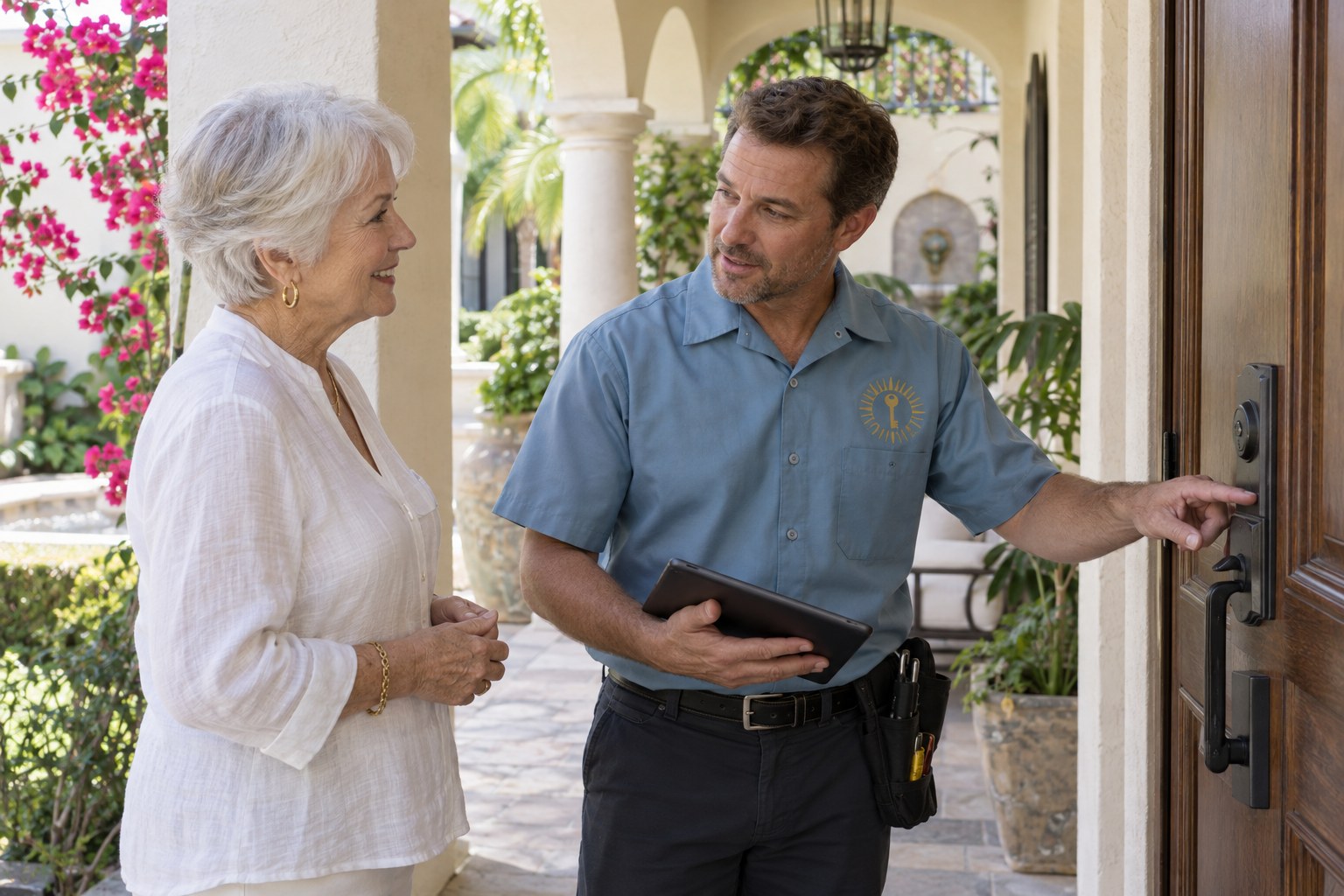
On arrival, the technician talks to the child through the door, reassures them and then opens the lock. Most privacy locks open in moments, and the door is left working. If the lock is broken, we can replace it on the spot.
Please call to confirm availability, and tell us if the child is distressed or if there is any urgency beyond a simple lockout. If anyone is in danger, call emergency services first. A locksmith is not a substitute for medical or emergency help.
Quotes are given by phone. If the job is more complicated than a simple release, a technician visits first and the service call charge is explained before dispatch.
Why it happens in older homes
Many older Florida homes have original interior hardware that has been painted over several times. Paint clogs the release hole, and decades of use wear the internals. A lock that once opened with a gentle touch may now need a strong push, or may not respond at all.
Humidity plays a part. Air conditioning cycles and wet summers swell wooden doors and frames, making them press against the latch. A bolt that slides freely in dry weather can bind when the door swells, and a lock that is mildly stiff may become impossible.
Some rental properties and vacation homes use a mix of whatever knobs were on sale at the time. That means different release methods on different doors, and no single tool that works for all. A quick survey of your home, done once, saves panic later.
If you own an older house, a technician can walk through and identify each lock, check that releases work and make notes for you. It is a short visit that pays for itself the first time a door sticks.
Swapping to a safer knob
The best fix for a repeat problem is to remove the cause. Replace the privacy lock on a child's bedroom with a passage knob, which has no lock at all, or with a dummy knob if the door is meant to stay closed. Children cannot lock themselves in a door that does not lock.
If you want the bedroom to remain lockable for teenagers or adults, choose a privacy set with an easy outside release and show everyone in the household where it is. Some modern sets have a push-button that pops open when the door is opened from inside, which prevents accidental locking.
Levers are also easier for small hands and for adults with limited strength than round knobs. A lever set with a thumb-turn is simple to operate but can still be locked by a determined child. For very young children, no lock is the safest answer.
A replacement takes only a short time for a technician, and the new set uses the existing holes in most doors. We can fit a whole house of interior hardware in one visit if that suits you.
Bathrooms, closets and other doors
Bedrooms are not the only place children get stuck. Bathrooms are a frequent case, since the door is often kept closed and the lock is within easy reach. A bathroom lock should always have an outside release that you know how to use and can reach quickly.
Closets, pantries and linen cupboards sometimes have locks as well, left over from an earlier use. If you do not need them, remove them. Hide-and-seek in a closet that locks from inside is a poor idea.
Sliding doors to a lanai or pool area deserve attention. A child inside can lock a slider and a child outside can be shut out, and neither is safe near water. Many Naples homes have pools, canals or lakes close by, so latches placed high on the door are worth considering.
Take a walk through your home and test each lock with the release method. Teach older children and any babysitters where the tools are and how they work. A minute of preparation helps in a stressful moment.
Childproofing the lock without losing privacy
Some families want a bedroom that closes but cannot trap a child. There are simple choices. Door knob covers fit over a standard knob and require a squeeze and a turn that small hands cannot manage, which keeps a toddler out of rooms you do not want them in, and keeps them from locking the door behind them.
For a child old enough to want privacy, a lock with a visible, easy-to-use release works well. Teach them how it operates in both directions, and agree on rules such as never locking the door when a younger sibling is alone in the room or when they are unwell.
Sound matters as well. A loud click or a distinctive snap tells a parent that the door has locked, and some modern locks make a noticeable sound for exactly this reason. If you cannot hear the lock from the hall, you may not know until your child calls out.
Whatever you choose, test it. Close the door, lock it from inside and open it from outside using the intended method. If you cannot do it quickly and calmly, then neither will you in a stressful moment, and the lock needs a different approach.
Rental homes and vacation properties
Families who rent a house or condo for a vacation are often surprised by a lock they have never used. A child curious about a new bedroom is quite likely to press the button. If you are staying in a rental, ask the owner or manager for the release tool when you arrive.
Owners of rentals can prevent this entirely. Replace interior privacy locks with passage sets on children's rooms, leave a release pin at each bathroom door and include a note in the welcome guide. It reduces calls and improves the stay.
If you are a guest and cannot reach the owner, you can call us. We confirm that you are an authorized occupant, perhaps by contacting the owner or checking the booking, before opening anything. This protects the property and still helps you quickly.
Please call to confirm availability. We would rather give you a clear answer than a rushed promise, and we keep the process as gentle on the door as possible.
Lever handles, thumb-turns and other variations
Not every bedroom has a round knob. Many newer homes use lever handles with a small thumb-turn or a push button on the inside. The outside release on these is often a narrow slot on the face of the lever rose, and a small flat tool turns it. The principle is the same as with a knob, but the tool and the angle differ.
Some doors have a hook and eye latch or a surface bolt, often added by a previous owner for a child or a guest room. Those can only be opened from the side where they are mounted, and if the child is on the wrong side, the only choices are to lift the door off its hinges or to unscrew the hardware. Better to remove them from bedroom doors entirely.
Pocket doors and sliding bedroom doors use small flush pulls with a tiny latch. These are usually released with a thin tool through the pull itself. If you are not certain how yours works, look at the inside where your child is and compare it with the outside. The release is normally a mirror of the lock.
A technician can identify each type in moments and open it without damage. If you have an unusual door, describe it when you call, and we will tell you what to try first and when to wait for a visit.
Teaching the family and preventing the next time
A few simple habits go a long way. Show older children how the lock works and how to release it from the inside. Explain that the button is not a toy and that they should call for you if they are stuck. Practice once with the door open so they understand.
Keep a thin release pin or small screwdriver somewhere you can find it fast, such as a drawer in the hallway or on top of the door frame. Tell any babysitters or visiting relatives. A tool that is easy to grab is worth more than one hidden away.
Check the locks occasionally. If one is stiff or sticky, ask a technician to service it or replace it. A small lubricant suited to locks, applied sparingly, can help, though heavy oils tend to attract dust.
A locked bedroom door is a common household event and almost always ends well. With a calm voice and the right tool, you will have the door open in moments, and a better knob can make sure it does not happen again.
Frequently asked questions
How do I open a bedroom door that my child locked?
Look for a small hole or slot in the center of the outside knob. Push a straightened paperclip or thin pin straight in, or turn a flat tool a quarter turn. Go gently. If the release does not work, stop and call us rather than forcing the door.
Should I break the door down?
No, unless there is an emergency such as smoke or injury, in which case call emergency services. Forcing a door can hurt you, frighten the child and damage the frame. A calm release or a locksmith visit is usually quicker and cheaper in effort than a repair.
Can you replace the lock so this will not happen again?
Yes. A technician can swap the privacy lock for a passage knob with no lock, or a set with a safer release. It usually fits the existing holes. Quotes are given by phone, and we confirm you are the resident before starting.
Do you need proof I live there?
We check ownership or authority for every call, though for a parent at the door it is simple. A piece of mail, an ID with the address or the owner's confirmation is usually enough. We want to help quickly while keeping every home protected.
What if my child is very upset?
Keep talking calmly, and if there is any danger, call emergency services first. Tell us when you call so the technician knows to reassure the child. Please call to confirm availability, and we will explain the next steps and any service call charge before dispatch.