
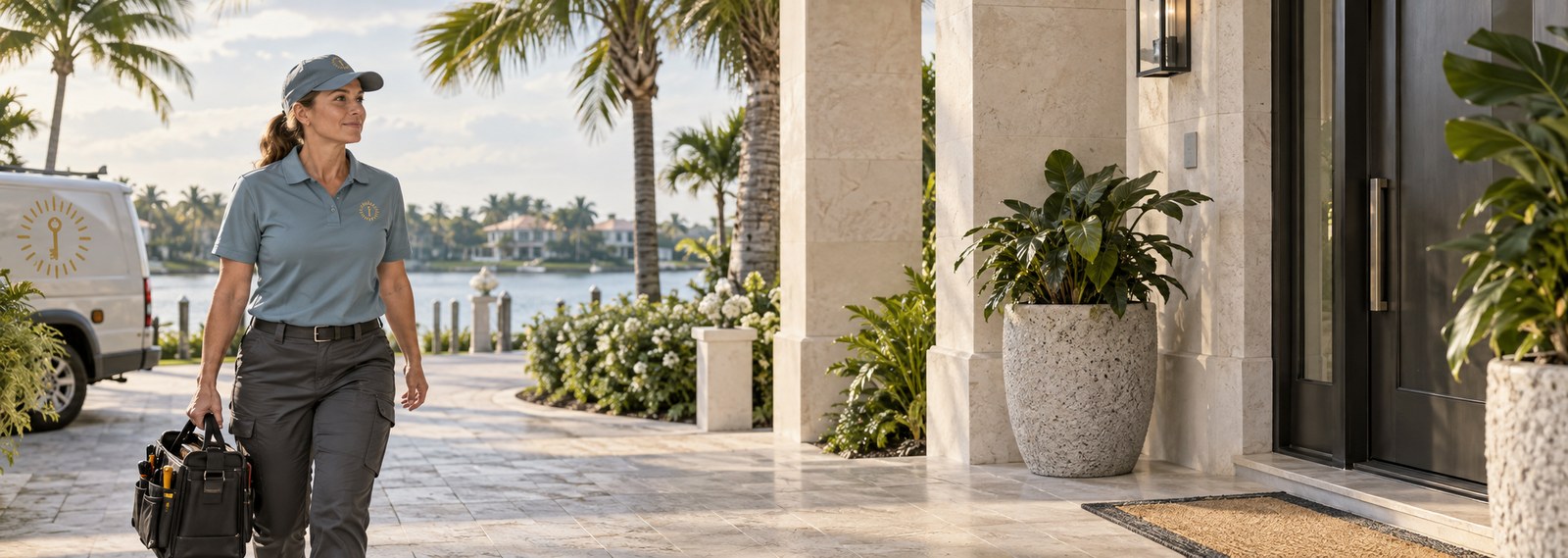
When a parent, aunt or sibling leaves a house behind, the keys are rarely in one place. Some are on a hook, some are with neighbors, and some were handed out years ago to people nobody remembers. This page explains how a Naples locksmith helps heirs gain control of every door, in an orderly way that respects the estate and the paperwork.
Why the keys are the first real problem
Grief has a way of turning small logistics into heavy ones, and a house full of unknown keys is one of the heaviest. The person who lived there knew which key opened the lanai slider, which one worked the garage side door, and which old brass key fit nothing anymore. None of that knowledge transferred. What you inherit is a ring of mystery keys, a few unmarked spares in a kitchen drawer, and the uneasy sense that other people might still hold copies.
In and around Naples this feeling is sharper than usual, because many homes here were second residences or seasonal places. A relative may have lent a key to a pool service, a house sitter, a neighbor who watched the place during hurricane season, or a property manager who has since moved on. Every one of those is a person who could walk in without anyone knowing, and you have no list to check against.
A locksmith cannot recover that list, but a locksmith can make the list stop mattering. Once the cylinders are rekeyed, old copies simply stop working. That is the core idea behind everything on this page: you do not need to find every key that exists, you need to make the keys that exist irrelevant, and then hand out new ones deliberately.
What a locksmith will ask before touching a lock
Before any lock is opened, rekeyed or replaced, the locksmith checks that the person asking has the authority to do so. For a home that belongs to an estate, that usually means a conversation about your role. Are you the named personal representative, a co-heir with the representative's agreement, a spouse who lived there, or someone helping on behalf of the family? The answer changes what documents make sense to see.
Typically the technician will want to see a government photo ID for you and some form of paperwork that ties you to the property or the estate, such as letters of administration, a will naming you, a court document, or a letter from the attorney handling the estate. If the process is still early and nothing has been filed, say so honestly. A technician can often explain what is reasonable to do now and what should wait for the attorney.
This is not red tape for its own sake. The same step protects the estate from a relative who is not authorized, and it protects you if a dispute arises later over who changed the locks and why. Gather what you have, call us to describe the situation, and we will tell you plainly what we would need to see on arrival.
Rekeying versus replacing, explained for heirs
Rekeying means the technician opens each cylinder, swaps the small internal pins to a new pattern, and cuts new keys to match. The lock hardware you already have stays on the door. Old keys no longer turn it. For an inherited house where the hardware is in decent shape, this is usually the sensible first step because it removes every unknown key at once without changing the look of the doors.
Replacing means removing the old lockset and installing a different one. That makes sense when a deadbolt is loose, corroded, damaged or outdated, or when you want a better grade of hardware or a keypad. Coastal air is hard on metal, and a house that sat closed through several humid summers may have hardware that is stiff, pitted or failing. The technician will test each lock and tell you which ones are worth keeping.
Many heirs end up with a mix: most doors rekeyed to a single new key so everyone carries one key instead of five, and one or two doors replaced because they were already past saving. Because the work is done on site, you can decide door by door while the technician explains what each choice involves.
- Rekey: new key pattern, same hardware, old keys stop working
- Replace: new lockset when parts are worn, loose or corroded
- Mixed approach: rekey the sound locks, replace only the failing ones
- Everything can be keyed alike so one key opens every door
Walking the property to find every lock
People tend to think about the front door and forget everything else. A proper walk-through covers more than most families expect. Beyond the entry and the garage door into the house, there is often a lanai slider with its own lock, a side or service door, a screened enclosure gate, a garage service door, a storage closet, a shed, a detached workshop, a mailbox lock, and sometimes a lockable gate at the street or on the dock side of a waterfront lot.
Inside, check for locked bedroom doors, a home office, a gun cabinet or safe, a file cabinet, a desk, and any filing boxes the estate attorney may ask about. Some of these will have keys on the ring and some will not. A technician can open and key those that matter without harming the furniture, though for safes and sensitive containers we will always ask you to confirm that you are the person entitled to open them.
It helps to make a simple list before the visit, even a rough one on your phone. Note each door and what it protects. When the technician arrives, you can go through the list together, and nothing gets forgotten. Missing one shed lock can mean making a second trip months later, and an overlooked key to a back gate defeats the purpose of rekeying the house.
Gated communities, condos and associations
A lot of Naples housing sits behind some kind of access control, and that adds a layer to an estate situation. In a gated or golf community, the home's own locks are separate from the gate credentials. Old gate fobs, transponders and resident codes may still be active under the previous owner's name. Contact the association or management office to update or deactivate them, since a locksmith can change the doors but not the community gate.
In a condominium, the association often has its own rules about who may change entry locks and whether the management keeps a master or emergency key. Some buildings require that a copy be left with the office. Others allow rekeying freely as long as the unit door is not changed in appearance. Ask the office for the written rule before the appointment so the technician can work within it.
Our role is to rekey or replace what you are allowed to change and to tell you honestly when something falls under the association. If a building keeps its own pass key for emergencies, that arrangement stays between you and the board. We can advise on how to handle the unit side, but we will not bypass a building rule just because it would be convenient.
Deciding which doors deserve an upgrade
Once the estate settles, the house may be sold, kept, rented or shared among siblings. That decision shapes how much to invest in hardware. If the home will be listed soon, a clean rekey and a few working, matching locks are usually all a buyer will notice. If someone is moving in, or if it will become a rental or a family place used in winter, it is worth thinking about stronger deadbolts and better strike plates.
A common weak point in older homes is not the lock but the frame. Short screws in a strike plate hold a door shut about as well as a thin latch. A technician can replace those with longer screws that reach the stud, which noticeably improves resistance to forced entry for very little effort. The same attention applies to sliders, where a track bar or secondary lock helps more than any fancy cylinder.
If several relatives will need access, a keypad deadbolt can be a practical choice. Each person gets their own code, and you can remove a code later without collecting keys. Not every door needs this. Often the best result is a rekeyed front door, a keypad on one entry for family and helpers, and plain reliable hardware everywhere else.
Hurricane season and the vacant house
An unoccupied Gulf Coast home carries risks that a lived-in one does not. Humidity and salt air work on hinges, strikes and cylinders, and a lock that has not been turned in months can bind or seize. During hurricane season, a vacant house also needs to be reachable by whoever is checking on it, whether that is you, a sibling, a property manager or an insurance adjuster after a storm.
That is a good reason to settle the key question early. Decide who truly needs access, give them a key or a code, and keep a short written record of who has what. Avoid hiding a spare under a planter or in a fake rock, which is the first place anyone looks. If a lockbox is used for contractors or an adjuster, it can be set to a code and reset when the work is done.
While the technician is on site, ask about lubricating or replacing locks that feel gritty. A dry graphite or suitable dry lubricant helps cylinders in humid air, whereas heavy oil tends to collect grit. If a lock has visible corrosion, replacing it before the next storm season is usually simpler than dealing with a stuck door after one.
Being calm and organized through the process
Nobody expects you to know any of this, and nobody expects you to decide everything in one visit. A realistic order of operations looks like this: confirm your authority, secure the doors against unknown keys, make a small number of new keys, and hold off on anything cosmetic until the estate is clearer. That sequence lets you protect the house now without committing to bigger choices you may regret.
Think about who will be present. If several relatives are involved, agree beforehand who will meet the technician and who will keep the new keys. Mixed signals about who is in charge are the most common source of delays. A short message to the family saying that the locks are being rekeyed on a specific day, and that new keys will be distributed afterward, heads off confusion and hurt feelings.
Keep your receipts and a note of what was done. Estate attorneys and accountants often want records of expenses that protect the property. We will explain what was rekeyed, how many keys were made, and which hardware was replaced, so you have a clear account. If the work turns out to be more involved than a standard visit, a technician comes out and the service call charge is explained before dispatch.
What to gather before you call
A short preparation saves a lot of back and forth. Collect every key you can find, even ones that look useless, and bring them to the visit. A technician can often identify what a key opened by its shape and wear, and sometimes a mystery key turns out to belong to a safe deposit box, a vehicle, or a neighbor's property that deserves to be returned.
Have your ID ready and any documents that show your connection to the estate. Know the address, the number of exterior doors, and whether any locks are already broken or stuck. If you have a sense of which doors are in daily use, say so, because those get priority. Photos of the doors, if you are calling from out of town, help us picture the job before we arrive.
If you live elsewhere, as many heirs do, tell us. We can coordinate around a time when someone local, such as a neighbor or a family friend, can let the technician in, but we will still need you to confirm authority by phone and, where appropriate, in writing. Call us to describe the situation and we will explain the quote process, which is given by phone.
- Every key you can find, labeled if possible
- Photo ID and estate paperwork or attorney contact
- A list of doors, gates, sheds and cabinets
- Association rules, gate fob details and management contact
After the rekey: handing out access wisely
With new keys in hand, resist the urge to give out many copies. Each copy is another thing that can be lost. Start with the people who truly need them, and write down who received which key. If a cleaning service, a lawn crew or a pool technician needs entry, consider a temporary code on a keypad rather than a physical key, since a code can be turned off the day the arrangement ends.
Think about the people from the past too. If a neighbor used to keep a key and has been helpful, a conversation and a new key preserves goodwill. If a former caretaker or contractor no longer has a reason to enter, the rekey has already settled that quietly. There is no need for awkward conversations; the old key simply stops working.
Finally, keep one spare somewhere sensible, such as with a trusted family member or in a locked drawer at your own home, and note the key number stamped on the bow if your keys carry one. When the estate finally closes and the house changes hands, you can hand the new owner a clean set, which is a quiet courtesy that buyers remember.
Sorting the old keys once the new ones are made
After the rekey, you will still be holding the old ring, and it is tempting to throw it all away. Pause before you do. Some of those keys will turn out to belong to things that sit outside the house: a vehicle in the garage, a safe deposit box at a bank, a storage unit, a boat on a lift, a golf cart, or a second property. The estate attorney may need to know about each one, and a key is sometimes the first clue that an asset exists.
A simple method works well. Lay the keys on a table and photograph them. Group them by type: house style, automotive, padlock, small cabinet, and unknown. Label a bag for each group and put them in a box that stays with the estate papers. If a key is stamped with a number or a name, copy that down. A technician can often tell you what category an unlabeled key belongs to, which narrows the search considerably.
Do not try each unknown key in neighbors' doors or in locks at other addresses. Instead, once the estate is in order, ask the attorney how to treat unexplained keys. Unused keys that clearly belong to nothing can be disposed of, but keep them until the estate closes. It costs nothing to hold on to a small box for a few months, and it can save a great deal of puzzling later.
Frequently asked questions
Can I have the locks changed before the estate is formally open?
It depends on your role and the paperwork available. A technician will ask who you are in relation to the property and what documents you have. If you are the person living there or the named representative, it is usually straightforward. If not, we may suggest speaking to the estate attorney first. Call us and describe the situation and we will explain what we would need to see.
Will rekeying stop the keys that other relatives already hold?
Yes. Rekeying changes the internal pattern of each cylinder, so every previous key stops working, including copies held by relatives, neighbors and former helpers. Only the new keys will turn the lock. That is why it helps to agree with the family beforehand on who should receive replacements, so nobody is surprised when their old key no longer opens the door.
Do I need to replace everything or can I keep the old locks?
Often you can keep them. If the hardware is sound, rekeying is usually enough and keeps the doors looking the same. The technician tests each lock and recommends replacement only where parts are worn, loose or corroded. Salt air can be hard on older hardware, so it is common to replace one or two locks while rekeying the rest.
What if the home is in a condo or gated community?
The doors of your unit can usually be rekeyed, but gate fobs, building access and any emergency keys held by management are handled by the association. Ask the office about its rules before the visit. We work within what the building allows and tell you plainly if something needs the association's approval or involvement.
How do I get a quote for an inherited house?
Call us and describe the number of doors, the type of locks and where the house is located. Quotes are given by phone. If the job turns out to be complicated, for example with safes, gates or failing hardware, a technician visits and the service call charge is explained before dispatch. Please call to confirm availability for your preferred day.