
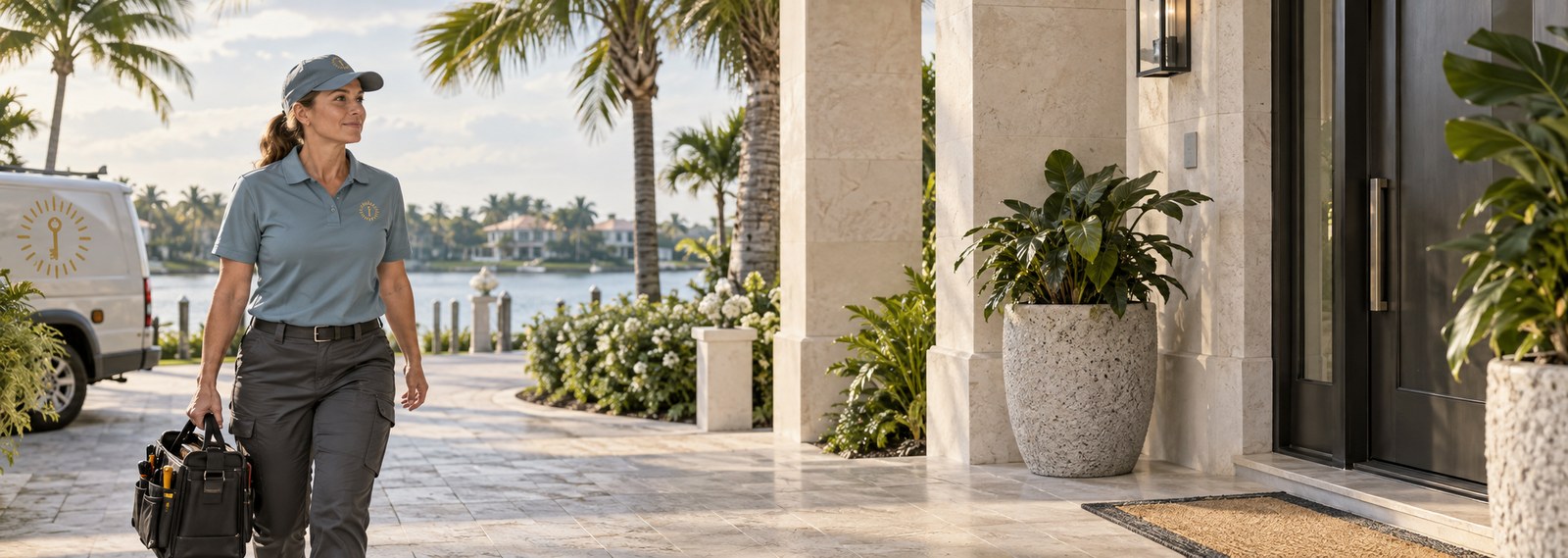
When two people stop sharing a home, the keys do not automatically follow the paperwork. Someone still carries a copy, and that can leave the person staying behind uneasy. This page explains how a Naples locksmith approaches this sensitive job: checking who has the right to change the locks, deciding what to rekey, and keeping the visit calm and orderly.
A sensitive job that deserves a steady hand
Few service calls carry as much emotion as a lock change after a separation. The person calling may be relieved, worried, angry or simply tired, and sometimes all four in one conversation. Our approach is to slow things down. We listen to what happened, ask the practical questions that matter, and explain each step before anything is done. There is no judgment in it. Our job is the door, not the dispute.
It also helps to be clear about what a locksmith can and cannot do. A locksmith can change the locks on a home you have the right to control. A locksmith cannot decide who has the right to live in the home, cannot settle a disagreement between two people who both claim access, and cannot act as a legal authority. Those questions belong with an attorney or the court, and we will say so plainly when they come up.
What we can offer is a careful, well-explained service that does the lock work properly and leaves you with keys you trust. The visit can be quiet and professional, and when the technician leaves, you should understand exactly which doors were changed and who holds which key.
How authority and ownership are checked
Before rekeying or replacing any lock, the technician confirms that you are entitled to make the change. For a home you own, that might mean showing photo identification along with something that connects you to the address, such as a deed, a mortgage statement, a utility bill or tax paperwork. For a rental, it usually means a lease in your name and, depending on the situation, the landlord's consent to the change.
Things get more careful when two people are on the lease or the deed. If both names appear and both are residents, one person changing the locks to shut the other out can create serious trouble for everyone involved. In those cases the technician may ask about any court order, written agreement or legal advice, and may decline until the situation is clarified. This protects you as much as it protects the other person.
If you have a protective order, a separation agreement or a letter from an attorney, have it available. If the other person has already moved out and you are the sole name on the paperwork, the process is usually simple. Call us and explain where you stand and we will tell you honestly what we would want to see before dispatching someone.
What rekeying covers and what it leaves out
Rekeying is the usual answer here. The technician removes the cylinder from each lock, changes the internal pin arrangement, and cuts new keys to match. The hardware stays on the door, and every old key becomes useless. For a house with a front door, a garage entry, a lanai slider and maybe a side door, this can often be handled in a single visit.
The important detail is the full list of entries. People often think of the front door first, but the person who is leaving may have a key to the garage entry, a lanai slider lock, a gate to the pool area, a side door, or a shed. Missing even one means the work is incomplete. The technician will walk the property with you, noting each lock, and will rekey all of them so a single new key works across the house.
What rekeying does not cover is access that is not a key. Garage door openers, shared smart-home accounts, alarm codes, gate fobs, Wi-Fi cameras and any app-controlled lock all need separate attention. We can help with the lock side and point out where other items need changing, but you will need to update those yourself or with the relevant company.
- Front door, garage entry, lanai slider and side doors
- Gates, pool enclosures, sheds and storage rooms
- Mailbox locks, safes and cabinets that held shared items
- Alarm codes, garage openers, smart-lock accounts and gate fobs
Choosing between new keys and a keypad
After a separation, many people prefer to remove any chance of a forgotten spare resurfacing. Standard rekeying does that. But some choose to go a step further and install a keypad deadbolt, because a code can be changed in seconds if circumstances shift. If children visit between households, a keypad lets each household member have a personal code without anyone carrying duplicate keys.
Keypads have tradeoffs worth knowing about. Batteries need checking, and the unit should include a mechanical key override in case the electronics fail. Cheap models are sometimes less durable than a solid mechanical lock, particularly in coastal air where moisture works at contacts. A technician can recommend a model suited to an outdoor-facing door and show you how to set and delete codes before leaving.
There is no right answer for everyone. A plain rekey is dependable, quiet and inexpensive in effort. A keypad adds convenience and flexibility. Some people do both: a rekeyed front door with a keypad on the garage entry for the kids and helpers. We will explain the options, but the decision is yours and does not need to be made in a rush.
Keeping the visit calm and private
There is no reason this has to be dramatic. Schedule the visit for a time when the other person is not expected to be there, if that is appropriate and lawful in your situation. If you think the other person might arrive during the work, it is wiser to arrange for a friend or family member to be present, or to reschedule. A locksmith should never be put in the middle of a confrontation.
If the other person is present and agrees to the change, that is the smoothest path. Some couples in an amicable separation even call us together, and the technician makes new keys for whoever is staying. If the other person is present and objects, the technician will pause and ask for clarity. We do not proceed in the face of a live dispute over who may be in the home.
We keep conversation professional and keep your details private. We will not discuss your situation with neighbors, building staff or anyone who happens to ask. If a neighbor wonders why a technician is at the door, a simple answer that the locks are being serviced is enough. The point is to get a secure home with minimal fuss.
Rentals, condos and shared buildings
In Collier County, a large share of housing is rented, seasonal or part of an association, and each of those adds a rule to consider. If you rent, the lease usually says whether you may change locks, and many landlords require a copy of the new key. Contact the landlord or property manager first, because changing a lock without permission may breach the lease even if your reason is sound.
In a condominium, the association may have rules about who may rekey the unit door, and the building may keep an emergency key. A high-rise often has stricter requirements than a small complex. Check the governing documents or call the management office before the visit. We are glad to work within these rules, and a technician who knows the building policy in advance can finish faster.
For a vacation rental or seasonal home, the picture is more tangled still. Cleaners, property managers and guests may all have had access. A rekey removes old keys, but you will want to coordinate with any manager to hand out replacements. If the home has a lockbox or keypad entry, resetting those is usually part of the same visit.
Safety first: think beyond the lock
If you feel unsafe, the lock is only one part of the answer. Tell someone you trust what is going on, keep your phone charged and near you, and consider speaking with a local advocate or attorney about additional protections. If you are in immediate danger, contact emergency services first. A lock change can follow later, and a technician will understand if you need to reschedule.
Lock work can strengthen the home in small ways that matter. Short strike plate screws can be replaced with long ones, a sliding door can get a secondary bar or pin, and a door that does not latch cleanly can be adjusted. A deadbolt with a one-inch throw that actually reaches the frame is worth more than an expensive-looking lock that is poorly installed.
Lighting and visibility help too, though that is beyond our trade. Think about whether a spare key is hidden outdoors, whether a window latch is broken, and whether the garage door remote is still in a car the other person drives. These are the unglamorous gaps that tend to remain open after an otherwise thorough lock change.
What happens on the day
The technician arrives, confirms identity and authority, and walks the property with you to count and examine every lock. After you agree on the scope, the work begins. A typical rekey of several cylinders proceeds door by door, with the technician testing each new key before moving on. You will be shown the key cuts and asked to try them yourself.
If a lock turns out to be damaged or loose, the technician explains why and offers a replacement option. You are never obliged to accept. The quote is given by phone beforehand, and if the job proves more complicated than described, a technician visits and the service call charge is explained before dispatch. There should be no surprises at the door.
At the end, you receive the new keys and a clear verbal summary of what was done. Ask about additional copies now rather than later, because a second visit costs more of your time. Keep one set somewhere other than the house, such as with a trusted friend, so you are never locked out in the middle of an already difficult week.
Weeks later: tidy up the loose ends
After the immediate step is done, walk through the practical leftovers. Change alarm codes, reset the garage keypad, update any smart-home account that the other person could access, and check whether any shared cloud camera or doorbell login needs a new password. These sit outside the lock itself but undo the purpose of the lock if left alone.
If children move between homes, keep a simple routine for keys and codes. A key on a lanyard in a backpack can be lost on a beach trip or at school, and a keypad code can be changed more easily than a key can be recovered. Teach older children not to share codes with friends and to ring you if a key is lost rather than hide the loss.
Finally, give yourself permission to feel the change. Many people tell us that the sound of a new key turning in a familiar door, quiet and slightly stiff, was the first moment the house felt like theirs again. If you need a follow-up visit, for a lock that sticks or an extra key, call us and we will sort it out.
Garages, sliders and the doors people forget
The most common gap after a lock change is a door nobody thought about. In Southwest Florida homes, the lanai slider is a favorite, because the latch is often a simple hook that has not been looked at in years and the track may allow the door to be lifted slightly. A technician can add a pin lock, a bar for the track, or a better latch, and these small additions often matter more than the main deadbolt does.
Garages deserve their own look. The door from the garage into the house is frequently an interior-grade lock that was never meant for security, and the overhead door opener may have a code that the other person knows. Resetting the keypad code, replacing a worn entry lock, and checking that the emergency release cord on the overhead door cannot be reached from outside are all sensible steps that fit within the same visit.
Outbuildings and gates complete the picture. Pool cages, side-yard gates, storage sheds, a dock box or a detached casita each have their own lock, and each may have had a key on the departing person's ring. We bring pins, keying tools and common cylinders for these, so you do not need to plan a separate trip. Walk the perimeter with the technician and point at everything that has a latch.
Talking to children and household helpers
If children live in the home, the lock change is also a family event, and how it is described matters. Keep the explanation simple and truthful: the locks are being updated so the house is safe, and here is the new key or code you will use. Avoid framing it as taking sides. Children generally cope well with plain, calm information and badly with rumors or overheard arguments.
Household helpers need to be told as well. A cleaner, a nanny, a pool technician or a lawn crew may be accustomed to a certain way in, and a changed lock without notice leads to missed appointments and awkward moments. Decide who still needs access, give them a new key or a dedicated keypad code, and tell the others the arrangement has ended. A keypad code per person makes this tidy.
A quick written note on the refrigerator or in your phone, listing who has which key or code, will help you months from now when you cannot remember. Update it whenever something changes. Treat it as a living record rather than a one-time job, and your locks will keep serving you well beyond this particular chapter.
Vehicles, storage units and other keys that travel
A household split often leaves loose ends beyond the front door. A shared car may have two sets of keys, one of which is with the other person. A boat, a golf cart, a trailer or a storage unit may be in a similar position. A locksmith can discuss vehicle keys separately, and for any vehicle we check ownership or authority before cutting or programming a new key, using registration and identification.
For a car that is jointly owned, be careful. If both names are on the title, neither person can be locked out of the vehicle by the other without raising legal questions. If only your name is on the title, a technician can program new keys and you can decide whether to deactivate the old ones. Remote and fob keys are usually erasable from the car's memory when a new one is programmed.
Storage units, work sheds and padlocks are simpler. A padlock can be replaced at any time, and a storage facility will often allow you to change the lock on your unit if you are the named renter. Make a short list of every place the other person may have had access, and work through it calmly over a week or two rather than trying to fix everything on the first day.
Frequently asked questions
Can I change the locks if my name is not on the lease or deed?
It depends on your situation. If you are not on the paperwork, the technician will need to understand your right to control the home, and may ask for the owner's or landlord's consent. In some cases we will suggest speaking with an attorney first. Call us, explain where you stand, and we will say honestly what we would need to see.
What if the other person is still on the lease or deed?
When both people have a legal right to the home, one person shutting the other out can cause real problems. The technician may ask about any court order or written agreement and may decline until things are clarified. We would rather pause than put anyone in a difficult position. An attorney can help you understand your rights.
Is rekeying enough, or should I replace the locks?
Rekeying is usually enough. It makes every old key useless while keeping the hardware you have. Replacement is worth considering if a lock is worn, loose or damaged, or if you want a keypad. The technician tests each lock on site and gives plain advice, so you can decide door by door.
Will the locksmith involve the other person or contact them?
No. We deal with the person who is entitled to authorize the work and do not contact the other person or discuss your situation with anyone else. If the other person is present and objects during the visit, the technician pauses and asks for clarity before continuing. Our focus stays on the door and on keeping the visit calm.
How do I arrange a visit and get a price?
Call us and describe the number of doors and the kind of locks. Quotes are given by phone. If the job is complicated, a technician visits and the service call charge is explained before dispatch. Please call to confirm availability for the day and time that suit you, and tell us if you would like a quiet, discreet visit.