
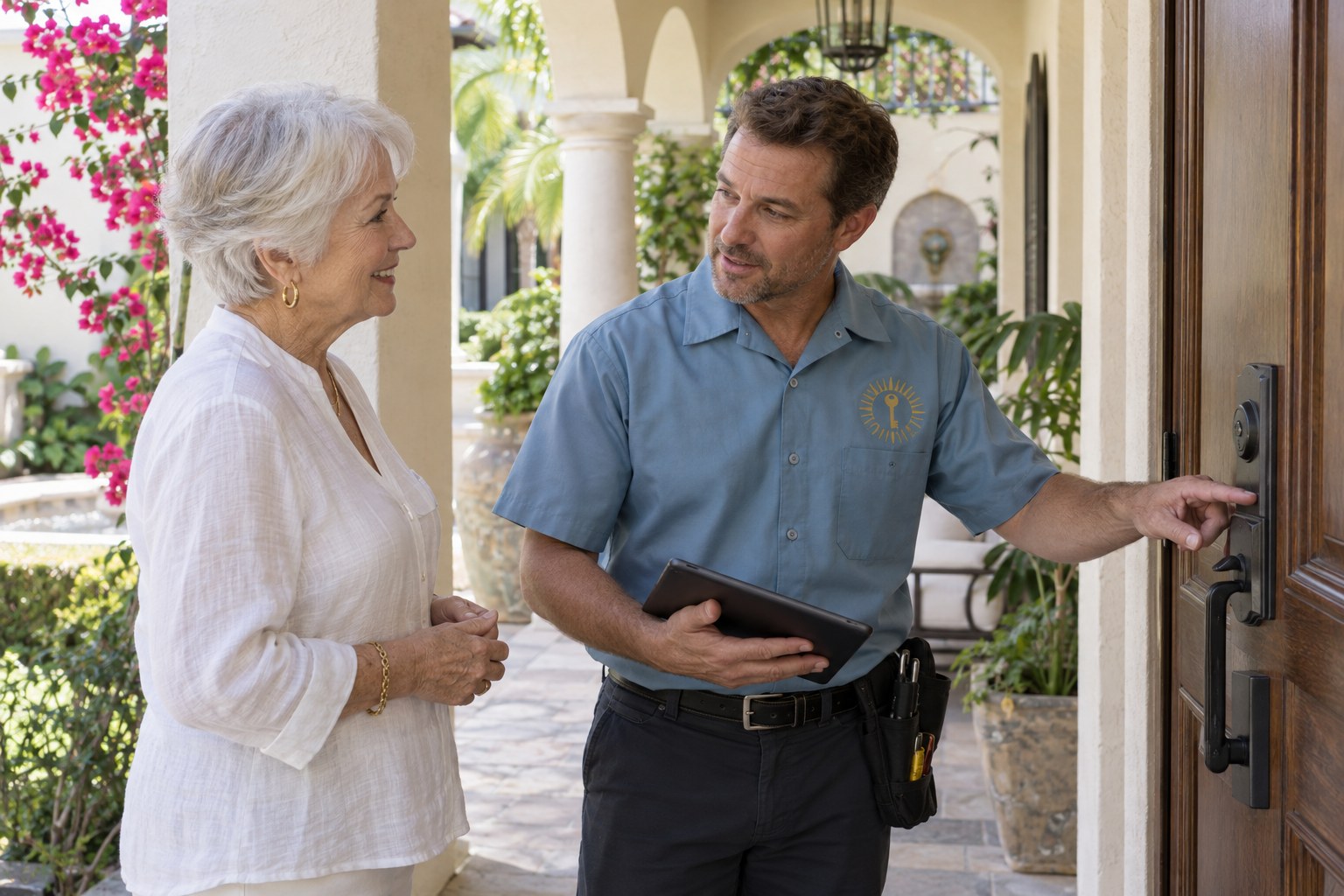
A remodel in Naples can mean a dozen different trades passing through your front door over several months. Each one wants a key, and each key can be copied. This page explains how construction cores and temporary keys work, how to track who has access, and why rekeying at the end of the project is the cleanest way to close the chapter.
The problem with a crowd of trades
A kitchen or bathroom remodel rarely involves one company. A general contractor may bring a demolition crew, then plumbers, electricians, drywall hangers, painters, tile setters, cabinet installers, a countertop fabricator and a final cleaning team. Many of those people arrive on different days, and some arrive before the homeowner is awake.
The usual shortcut is to hand the contractor a house key and trust the process. That works until someone asks to make a copy for a subcontractor, who makes another for a helper. By the time the project is done, nobody can say with certainty how many keys exist or where they are.
That is not an accusation against any contractor. Most are careful. It is simply how keys behave when many hands touch them. A bit of structure at the start, set up by a locksmith before the first hammer swings, turns a vague situation into a manageable one.
When you call us, we ask about the scale of the project, how long it will run, whether the home will be occupied during the work and how many entry points the crew will use. Quotes are given by phone, and we explain what a visit would involve if the situation needs a technician to look first.
What a construction core is
Many commercial and some residential locks use removable cores. A core is the small cylinder that holds the pins and accepts the key, and it can be swapped out with a special control key without taking the lock off the door. During construction, a temporary core is installed for the crew. When the work is done, the permanent core goes back in.
The benefit is that the temporary keys never touch your permanent system. Whatever copies the crew made, whoever lent a key to a cousin, those keys stop working the moment the core is replaced. Your family keys, which stayed in a drawer, remain untouched and valid.
Not every residential door supports a removable core, and many standard deadbolts do not. In those cases, a similar effect is achieved by installing a temporary deadbolt or lockset for the duration and then restoring the original or putting in a new one. A technician can look at the doors in question and tell you which approach fits.
Because the swap is done on site, the lock never leaves the door for long, and the house is not left open. That matters when you live in a canal-front home or a condo where a sliding door or a missing deadbolt is not something to leave overnight.
Temporary keys and how to track them
If a removable core is not practical, the next best option is a dedicated set of keys for the project. Cut a limited number, label each by person or company in your own notes, and hand them over in writing. A simple sheet that lists the date, the person and the key number is more useful than it sounds.
Ask the general contractor to take responsibility for any subcontractor keys. Many contractors prefer this arrangement, since it protects them from blame if something goes missing. Agree that no additional copies are made without telling you. A restricted keyway, where copies can only be made with authorization, backs that agreement up with hardware.
Lockboxes are a middle path. A small key safe on the exterior holds a single key and opens with a code, so the crew can come and go without anyone carrying a physical key home. The code can be changed whenever the crew changes, and nobody has to ask for a key back.
We can talk through which of these suits your project. A weekend refresh of a guest bath calls for something simple. A gut renovation of a waterfront home with six crews over half a year deserves a more careful setup.
- Removable construction core: strongest control, swap at the end
- Limited keys with a written log: simple and familiar
- Lockbox with a changeable code: no keys leave the site
- Temporary lockset: restores the original afterward
Occupied homes and seasonal homes
If you live in the home during the work, your concerns are different from an owner who is away. You want the crew to enter and leave on a predictable schedule, you want your valuables protected, and you need to feel safe at night. A temporary lock on a single work entrance can keep the crew out of the rest of the house.
Seasonal owners, the snowbirds who spend the summer elsewhere, often schedule renovations for the months they are gone. In that case no one is home to open the door, so the crew has unsupervised access. A lockbox or a keypad lock with a unique code for the project becomes especially useful, because activity can be tied to dates.
Condo owners should check association rules first. Many buildings limit working hours, require contractors to register with management and sometimes need a deposit or certificate of coverage. Those are the building's rules and not ours, but they affect when and how the crew arrives, and therefore how you plan the locks.
In every case, we confirm ownership or authority before rekeying, installing or programming anything. If you are a tenant or an agent, we ask for the lease or written permission from the owner so the work is done correctly.
Protecting the rest of the house
A key to the front door is only part of the picture. Contractors often need the garage, a back slider or a side gate, and each of those has its own lock. It helps to decide in advance which entrances are in play and keep every other one secured from the inside so the crew has no reason to wander.
Interior doors matter too. A home office, a closet with documents or a guest room used as storage can be fitted with a temporary privacy lock or locked with a key you keep. Valuables such as jewelry, firearms, medication and paperwork should be removed from the site entirely if the project is large.
Windows and sliding doors on a lanai deserve a look before demolition begins. Dust, scaffolding and open door frames can leave an easy path in. A technician can help secure a patio door with a secondary bar or a pin lock that the crew can release and replace each day.
These steps are low-tech and inexpensive in effort, and they close the gaps that a single key never could. They also make it easier to tell afterward what was touched and what was not.
Humidity, dust and the lock itself
Construction is hard on locks. Drywall dust, paint overspray and sawdust find their way into keyways and latch mechanisms, and in Southwest Florida the humidity and salt air make the problem worse. A lock that was fine in April may stick and drag by August if it is left unprotected through a dusty project.
Before work starts, it is worth covering exposed hardware with painter's tape or plastic where it will be sprayed. Remove decorative handles on doors that are about to be repainted rather than painting over them, because paint in a latch is a common reason for a lock that will not retract.
After the work, a technician can clean and service the locks, check the alignment and replace any part that was damaged. If a door has been rehung or the jamb shimmed, the bolt may no longer line up with the strike, and that is easy to fix while a locksmith is already on site.
If a key turns hard or a deadbolt sticks after a renovation, do not force it. Forcing can snap a key in the cylinder and turn a small adjustment into a lockout.
New doors, new hardware, new decisions
Many renovations include new entry doors, sliding doors or hurricane-rated windows. When a new door goes in, the hardware choice is yours. A locksmith can advise on deadbolt grade, strike plate reinforcement, door jamb strength and whether a keypad, smart lock or traditional cylinder best suits the way your household lives.
It is a good moment to match keys across the house. Instead of carrying one key for the front, another for the garage and a third for the lanai, new locks can be keyed alike so a single key opens everything. That reduces the number of keys in circulation and simplifies the handoff at the end.
Smart locks can help during a project as well, since each person can have their own code and you can see when it was used on models that keep a log. That is useful for homes where the owner is away and wants to know the crew came and went at expected hours.
As always, quotes are given by phone. If your project is complicated, a technician visits first and the service call charge is explained before dispatch, so there are no surprises.
Working with a general contractor versus hiring trades yourself
Some homeowners hire a general contractor who manages everything. Others coordinate the trades themselves, calling the electrician, the tile setter and the painter one by one. The key question changes with the arrangement. With a general contractor, you can usually agree on one point of responsibility. When you hire trades yourself, the responsibility for keys rests with you.
If you coordinate the work, it helps to keep a single schedule and meet each person at the door the first time. Let them in, show them the work area, and give them a key or code only if they will return without you. Many one-day jobs do not need a key at all, because you can be home to open and close.
For multi-day trades, a lockbox with a changeable code is a handy middle path. You can reset the code between trades so the painter cannot reuse what the plumber knew. It takes a minute and requires no copies, and it leaves a tidy trail of who had access in what order.
Whichever style you use, write it down. A short list with dates, names and key numbers answers nearly every question that comes up later, and it makes the final rekey a simple, confident decision rather than a guess.
The final step: rekey when the work ends
When the last box is hauled away and the final walkthrough is done, the cleanest move is to change what the keys open. Rekeying the locks means every key handed out during the project is dead, whether or not you know where it went. It takes far less time than replacing hardware and leaves your doors looking the same.
If you used a removable core, the swap is even simpler. The temporary core comes out and the permanent one goes in, and the project keys are obsolete. If you used a lockbox, change the code and consider whether the box itself should come down from the wall or fence.
Rekeying also lets you consolidate. If you now have three different keys on your ring, one visit can bring them together. It is the same trip, and it leaves you with a tidy set rather than a legacy of whatever the original builder installed.
We recommend scheduling this before the crew's final payment is wrapped up, so you are not tempted to put it off. The best time to close the door on a project is the day it ends.
Hurricane season and a half-finished house
A renovation that stretches into hurricane season adds a layer of planning that homeowners in other parts of the country never face. If a named storm is forecast, the crew may need to secure materials, board openings or leave tools behind, and the house itself may sit with temporary doors, missing windows or open framing for days at a time.
Talk with your contractor before the season about what happens when a storm approaches. Who closes up the house, who has the keys to do it, and who returns afterward to check for damage? If the only person with a key is out of town, a delay can leave an exposed home waiting. Two named, trusted key holders is a more resilient arrangement.
Temporary doors installed during construction are often plain slabs with basic hardware. They keep weather out but do little against a determined intruder, and some contractors leave them unlocked for convenience. If your home is empty, ask whether a stronger temporary lock and a hasp for the work entrance make sense until the permanent door is in.
After a storm, expect delays in everything, including locksmith visits. Plan ahead, check your locks as part of any post-storm walkthrough, and call early. Humidity and flooding can swell doors and corrode hardware, and a quick service afterward can prevent a small sticking problem from growing.
Questions to ask your contractor
Good contractors welcome questions about key control. Ask how many people will have access, whether subcontractors are given keys or let in by the main crew, and who is responsible if a key is lost. A professional will have an answer ready, and many will appreciate that you have a plan.
Ask what hours the crew works and whether they will lock up each evening. A crew that leaves a slider unlatched at the end of the day creates a risk, regardless of who holds the keys. Agree on a closing routine and who checks it.
Ask about deliveries. Cabinets, appliances and flooring arrive on trucks, and the driver may need access to the house or a garage. If you are away, decide whether a delivery goes inside or waits outside, and who is allowed to sign.
Finally, ask for their schedule in writing and keep it with your key log. If something is missing or a door is found unlocked, a clear record of who was on site is the quickest way to sort out what happened.
When something goes wrong mid-project
Mid-project problems happen. A key snaps in a swollen door, a crew member locks the house with the owner's keys inside, or a deadbolt jams after a door is rehung. When that happens, stop forcing the lock and call us. A technician confirms you have authority over the property and works to open or repair the lock without making the damage worse.
If the job is a simple lockout, it is often resolved in one visit. If it involves broken parts, a misaligned door or a security concern such as a lost key, the technician may recommend rekeying on the spot. The service call charge is explained before dispatch, and a quote for any additional work is given before it begins.
Please call to confirm availability, since schedules vary through the season. A project in the middle of hurricane preparation or the winter rush can be crowded, and an early call helps us plan.
Whatever the situation, we keep our focus on the practical result: your house secure, your crew able to finish, and your keys under control by the time the dust settles.
Frequently asked questions
Should I give my contractor my only house key?
It is better not to. Have a dedicated key cut for the project, use a lockbox or install a temporary core, so your own keys stay with you. That way the crew's access can end cleanly when the work does, without affecting the keys your family uses.
What is a construction core?
It is a removable lock cylinder installed for the duration of a project. Crews use temporary keys that fit it. When the work ends, a technician swaps in the permanent core, and every temporary key stops working. Not every residential lock supports this, so we check your doors first.
Do I need to rekey after the renovation?
In most cases it is a sensible step. Rekeying makes every key handed out during the project useless, including copies you may not know about. It is quicker and gentler on your hardware than full replacement, and it can also match all your doors to one key.
Can the contractor make extra copies of the key?
On ordinary keys, yes, unless you agree otherwise. A do not duplicate stamp is only a request. Restricted keyways limit copying through controlled blanks. Talk with your contractor about who may hold keys, and keep a written log of every key given out.
How do I book a visit for a big remodel?
Call us and describe the doors, the length of the project and how many trades are involved. Quotes are given by phone, and if a technician needs to see the property first, the service call charge is explained before dispatch. Please call to confirm availability.