
Owning two, five or ten rental units means carrying two, five or ten sets of keys, and the ring grows heavier with every addition. A master key system or a keyed-alike plan can bring order to the pile. This page explains how each works, what records to keep, and the security tradeoffs you accept.
The problem of too many keys
An owner with a single rental knows exactly which key opens what. Add a second unit, a third, a shared laundry or a storage cage, and the ring starts to fill. Each lock came with its own key, and soon you are standing at a door, trying them one by one while a tenant waits for a repair.
The cost is more than inconvenience. A heavy ring is easy to lose, and a lost ring that carries keys to several units is a serious problem. A bundle of keys with no clear labels is also a risk, since anyone who finds it can see how many doors it might open and, if labeled, which ones.
Managing tenants adds another layer. Each tenant receives keys, each move out should reset access, and each repair visit may need a key from you. Without a system, you end up with a growing collection of copies in the hands of workers, previous tenants and relatives, and no clear way to know who can still enter.
A thoughtful key plan solves these problems at their root. It reduces the number of keys you carry, controls who can open which door, and makes it practical to reset access when circumstances change. The two common approaches are keyed alike systems and master key systems, and they serve different needs.
Vacation rentals in coastal Southwest Florida add a seasonal rhythm to the problem. Guests come and go every few days, cleaners enter between stays, and owners visit at odd times. The more people with a reason to enter, the more valuable a clear structure becomes, because you can see at a glance who should hold what.
Keyed alike: one key, several locks
In a keyed alike arrangement, a group of locks is set to work with one key. A single key opens the front door of unit A, the front door of unit B and the shared storage room. It is the simplest solution, and it works well when the people holding the key need access to everything in the group.
This suits an owner who manages the properties personally. Instead of carrying many keys, you carry one for the group. A maintenance worker you trust with all units can have the same key. The setup is easy to understand and inexpensive, since existing locks can often be rekeyed to match.
The drawback is that the key opens everything in the group, including any unit where a tenant has a reason to be private. If a tenant holds the shared key, they can open neighboring doors. For this reason, keyed alike systems are normally used by owners and staff, not by tenants, with individual tenant locks kept separate.
Keyed alike also has a clear weakness in loss. Lose one key and every lock in the group is affected, so rekeying the whole group is the safe answer. That is manageable for a few doors and tedious for many, which is why larger portfolios often move to a master key structure.
One practical detail is the difference between a lock and its cylinder. The cylinder is the part the key enters, and it is the part that gets rekeyed or master keyed. You do not need to replace the whole lock. Swapping or rekeying the cylinders is quicker and tidier, and the existing handles and finishes remain in place.
Master key systems: many keys, one that opens all
A master key system lets each lock have its own key while one special master key opens all of them. Tenant A has a key that opens only unit A. Tenant B has a key that opens only unit B. You, the owner or manager, hold a master that opens both. Each tenant stays private from the others.
This works through a clever arrangement of pins in each lock cylinder. Each pin chamber has an extra small pin that creates a second set of acceptable cut depths. The tenant key and the master key both line up the pins, so the lock opens for either one. The design is old, well established and widely used in apartment buildings.
For an owner with several rentals this is the more flexible choice. You carry one key, tenants carry their own, and a replacement or rekey of a single unit does not touch the others. When a tenant moves out, only that lock needs changing, and the master continues to work with the new key.
There is a cost in complexity. Master key systems require planning, quality cylinders and careful records. The extra pins also create a small additional security consideration, since the structure makes some forms of attack possible with more skill. For ordinary rental use these concerns are modest, but a good technician will explain them honestly.
Think about the shared spaces too: a laundry, a pool gate, a mail room, a bike storage closet. Tenants need these, and a master system can give them a key that opens only the doors they are entitled to use, plus their own unit. Layering access this way is exactly what master key hierarchies were designed to do.
- Each tenant has a key that opens only their unit
- One master key opens every unit in the system
- Changing one unit does not disturb the others
- Requires planning and careful records
Choosing between the two
The right choice depends on how your properties work. If you manage everything yourself and tenants need only their own door, a master key system gives you convenience and tenant privacy. If you simply want fewer keys on your ring for a set of locks that only you use, keyed alike is usually enough.
Think about growth. If you plan to add units, a master key system can be extended, provided it was designed with room to grow. A technician can plan the key hierarchy in advance, so new units slot in without redoing the whole system. Planning for five units when you own two saves effort later.
Think about staff and workers. Do you have a manager, a cleaner and a maintenance person? A master key system can include different levels, so a cleaner opens only the common areas, a manager opens all units and you hold a grand master that opens everything. Each level is a separate key with a different reach.
Cost matters, though the numbers should not be the only factor. Master key systems use more careful cylinders and take more time to set up, so they cost more than keyed alike. The price should be weighed against the time saved, the security gained and the convenience of a clean structure.
When you grow beyond a handful of units, the hierarchy matters more. A grand master opens everything, a master opens a building or floor, and sub masters open smaller groups. Each level adds flexibility and complexity. Starting with a modest design and leaving room for growth is better than building an elaborate structure you do not need yet.
Record keeping that actually works
A key system is only as good as its records. For each unit, write down the lock type, the key code or bitting, the number of keys cut and the people who hold them. Store that information securely, away from the keys themselves, since a record of the key codes is a map to the system.
A simple ledger or spreadsheet is enough. Include dates of issue and return, and have tenants sign for the keys they receive. At move out, count the keys back. If one is missing, you know immediately and can decide whether to rekey. Without a record, you cannot tell what is missing.
Label keys with codes, not addresses. A key tagged with the unit address tells a finder exactly what it opens. A code that only you can decode keeps the information private. Keep the master key list separate from the tenant list, and share it with as few people as you can.
Review the records regularly. Once or twice a year, check that every key you think is out there is accounted for, and that no extra copies have appeared. A brief audit takes an hour and keeps the system honest. It also prepares you for the day when something goes wrong and you need answers quickly.
Consider keeping a sealed spare of each master key in a secure place, such as a safe deposit box or a locked safe in your office. If your working master is lost, you will have a way to recover without rekeying every unit at once. Treat the spare as an emergency tool, not a convenience.
Security tradeoffs you should understand
Every convenience in a key system has a price in risk. A master key concentrates access in one object. If it is lost or stolen, every unit it opens is affected. That does not make master keys a bad idea, but it does mean the master must be treated with care and kept on your person or locked away.
The master key should not be duplicated casually. Use a restricted keyway, where blanks are controlled and copying needs authorization, if you can. This stops a worker from taking a master to a hardware store and walking out with a copy. Restricted systems cost more, and for several units they are often worth it.
Tenants matter in the picture. A tenant has a right to expect that nobody else can enter their home without proper notice. A master key system makes it technically possible for you or your staff to enter at any time, so follow the law and your lease about when and how to enter, and keep a log.
Finally, consider the people. A system that depends on trust in a manager is only as reliable as that person. When staff change, change the keys they used. A rekey of the affected group is a small step that closes off old access and keeps the system aligned with the current team.
Electronic locks can be part of the picture as well. A keypad lock on each unit gives tenants a code, and you can hold a master code or a physical key override. Codes are easy to change between tenants, which removes the rekey step, though batteries and software need attention. Mixed systems are common and can be designed to work together.
What happens at move out and move in
Turnover is where key systems prove their worth. When a tenant leaves, you want the old keys to stop working. In a master system, rekeying that single unit does it, and your master continues to work with the new setup. In a keyed alike system, you may have to change the whole group, which is a reason to keep tenant locks separate.
Plan the rekey between tenants, not on the day a new one arrives. Schedule the technician after cleaning and repairs, so the lock is changed once, and the new keys are cut and ready. A day or two of margin keeps the move in smooth and avoids the unpleasant sight of a new tenant waiting at a door that will not open.
Collect and count the keys from the leaving tenant. Get a signed note if you can. Check that the number matches what you issued. If any are missing or unaccounted for, rekey at once, regardless of the tenant's assurances. A small cost protects the next tenant and your own liability.
Give the new tenant a clean set with clear instructions, and keep a record. Remind them not to copy the key or change the locks without asking. Make it easy for them to ask for another copy, so they do not look for shortcuts. A system tenants can use easily is a system they will respect.
One more practical point: when you replace worn locks, replace them in batches by unit or building. Mixing old and new cylinders in a master system can cause trouble, because tolerances differ. A planned replacement keeps everything consistent, and spreading the cost across a budget cycle is easier than facing a sudden failure.
Hardware, humidity and the wear on rental locks
Rental locks work harder than the locks in owner occupied homes. They are used by people who do not own them, with varying care, and in Southwest Florida they sit in heat, humidity and salt laden air. A cheap lock may last a year; a better one lasts many.
For a master key system, quality cylinders are not optional. Cheap cylinders have loose tolerances, and loose tolerances make master keying unreliable, with keys that stick or open the wrong lock. Pay for cylinders that are built to be master keyed and are made by a manufacturer that supports such systems.
Plan for maintenance. Dry lubricant in the cylinder twice a year, a check of the strike alignment on each door and replacement of worn keys all keep the system working. Worn tenant keys can bind and break, and a broken key inside a lock is an expensive afternoon.
Consider the door too. A strong cylinder in a weak door is a wasted investment. Check hinges, strike plates and frames in each unit, and fix weak points as part of the project. A coherent plan that covers locks, doors and keys gives you a rental that is easier to manage and harder to enter without permission.
Working with a locksmith to set it up
Call us and tell us about the properties: how many units, what locks they have, who needs access and what problems you face. Quotes are given by phone. Please call to confirm availability, since a system covering several buildings takes planning and sometimes more than one visit.
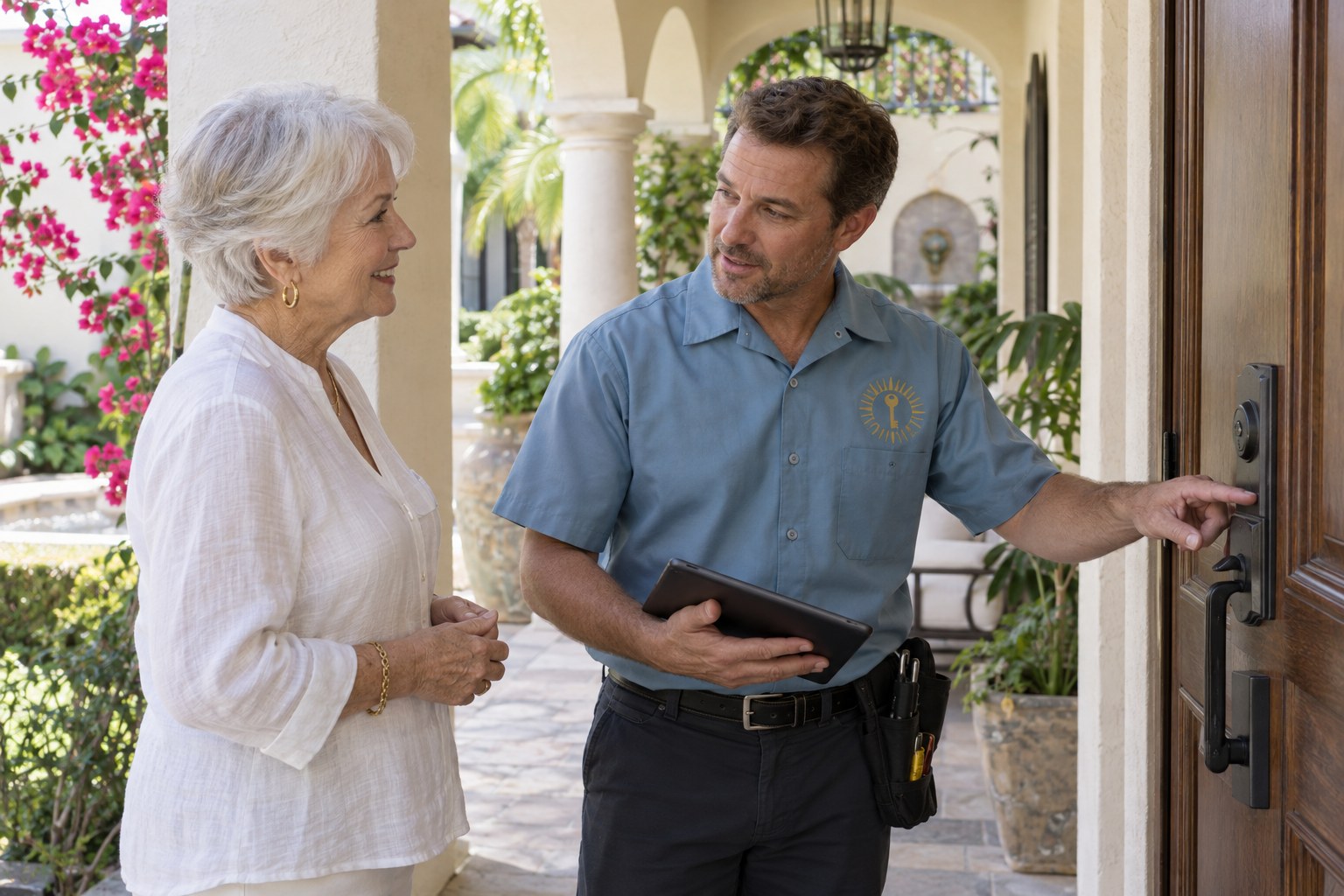
On arrival, the technician confirms that you own the properties or have authority to make changes, such as a property manager acting for the owner. This check applies to every residential job. Changing locks on a rental without it is not something a responsible locksmith does, and it protects tenants and owners alike.
The technician surveys the doors and locks, explains the options in plain terms and recommends a structure. You decide how to proceed. The work may include rekeying, replacing cylinders, and producing the keys, all with a written key chart at the end so you know exactly what you have.
If the project is complicated, a technician visits and the service call charge is explained before dispatch. Large systems can be phased, with the first units done now and others added later, as long as the plan was made at the start. Good planning turns a collection of doors into a system you can manage.
Frequently asked questions
What is the difference between keyed alike and master keyed?
Keyed alike means several locks open with the same key. Master keyed means each lock has its own key while one master key opens them all. Master keying keeps tenants private from each other, while keyed alike suits owners and staff who need the same access.
Is a master key system less secure?
It concentrates access in the master key, so that key needs careful handling, and the pin design adds some complexity. For typical rentals the risk is modest when you use quality cylinders and a restricted keyway where possible, and keep good records.
Can my existing locks be added to a system?
Often, yes. Many existing cylinders can be rekeyed or replaced with compatible ones. A technician looks at what you have and tells you which can be used and which should be replaced for a reliable system.
Do you verify I own or manage the properties?
Yes. The locksmith checks ownership or authority before rekeying, replacing or programming locks on homes and rentals. A deed, a management agreement or the owner's approval usually serves. It is a normal step for every residential and rental job.
How do I get a quote for a larger project?
Call us and describe the properties, the number of units and your goals. Quotes are given by phone. If the job is complicated, a technician visits and the service call charge is explained before dispatch. Please call to confirm availability.