
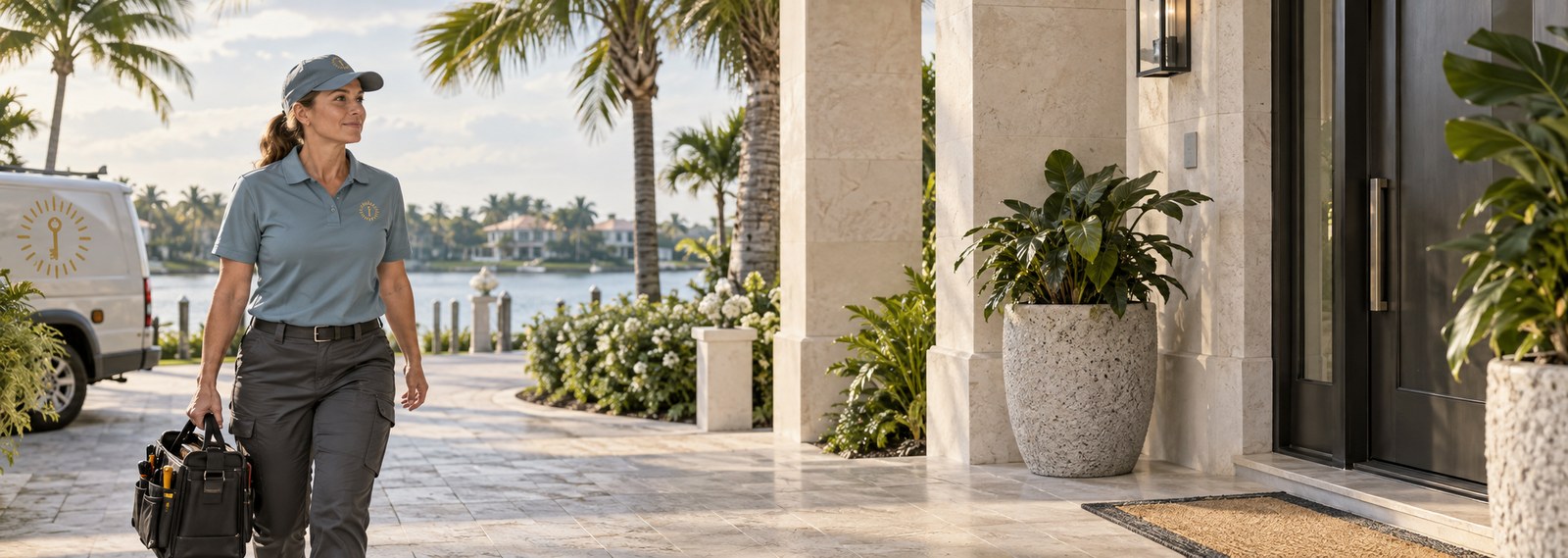
A new house feels clean in every sense, and that is exactly why the keys are easy to overlook. During construction, many people need to get inside: crews, inspectors, delivery drivers, cleaners and sales staff. This page explains who may still hold a copy, why rekeying before move-in makes sense, and how builder hardware compares with upgrades.
A new house has already had many visitors
Between the slab and the final walkthrough, a new home sees a long parade of people. Framers, electricians, plumbers, drywall crews, painters, flooring installers, appliance delivery teams, landscapers and inspectors all need to enter at various points. Someone has to let them in, and that usually means keys, lockboxes or a temporary setup.
Construction sites often use a single keyed-alike arrangement while the house is open, then switch to the permanent lock set near the end. The permanent set is installed so the finished doors are ready, and the builder cuts keys for the buyer at closing. What is harder to know is how many other copies exist beyond the ones handed to you.
That uncertainty is the real issue. It is not that anyone intends harm. It is that nobody can tell you with certainty how many keys were cut, who received them, and where they are now. A key in a former subcontractor's truck, a spare in a sales office drawer or a copy given to a decorator all remain possible.
Rekeying removes the question. Instead of trusting that every copy has been collected, you change the lock so none of the earlier keys work, and you start with a set that you know. For a house you plan to live in for years, this is a small step that closes a large gap.
If you bought the house from a builder in a development with many similar homes, remember that the same crews and the same sales team served all of them. A key cut for one house sits in a similar drawer to keys for the houses beside it, and mix-ups happen. Rekeying your locks takes you out of that shared pool entirely and leaves you with keys that belong only to you.
How builder lock sets are usually chosen
Builders buy hardware by the hundreds, and they choose it with cost, availability and appearance in mind. The result is a lock set that looks good at the front door and does the basic job of keeping the door closed. It is not designed to be the most secure option on the market, and a builder is not trying to hide that fact.
Typical builder hardware includes a standard deadbolt, a keyed entry knob or lever, and light-duty strike plates secured with short screws. The metal tends to be thinner than the better grades, and the finish may be a plated surface that wears or corrodes faster in coastal air. None of this is a defect, but it is a baseline.
Builder locks often share a common keyway across many houses in a development. If the same model and keyway appear in neighboring homes, a key that fits one may be closer to fitting another than you would like. Rekeying to a different pin pattern, or replacing the cylinder with a different keyway, breaks that similarity.
Knowing what you have is the first step to deciding what to improve. A technician can identify the brand and grade of the installed hardware, explain what it offers, and tell you honestly where an upgrade matters and where the builder set is perfectly adequate for your needs.
It helps to know what a pin tumbler cylinder is doing when you turn a key. Small spring-loaded pins of different lengths inside the lock line up at exactly the right height when the correct key is inserted. Builder cylinders often use a common pinning style and a widely available key blank, which means a copy is easy to get. A different keyway narrows who can make one.
What rekeying does and why it fits a new build
Rekeying changes the internal pins of a lock so that a new key works and the old keys do not. The lock body, handle and finish stay as they are. A technician removes the cylinder, replaces the pins to match a fresh key and reassembles it. A set of doors can often be done in a single visit.
For a new build this suits well, because the hardware is new and the only thing that needs changing is who can open it. You are not paying for new locks, only for the new key code. Homeowners can also have all exterior doors set to the same key, so one key opens the front door, the garage entry and the back slider.
Timing is helpful. If possible, rekey after the final walkthrough and before you move furniture in. By then the builder's crews are finished, and any punch-list work has been scheduled. If workers need to return for follow-up repairs, you can arrange access with a temporary method instead of handing over your keys.
A technician also checks that each lock works smoothly after rekeying. New hardware can have alignment issues from settling or from the doors not being fully adjusted. Testing each bolt and adjusting the strikes means you start living in the house with doors that lock firmly, not doors that need a shove.
Ask for the original keys back from the builder at closing, if you were given a bundle, and count them. Compare the count against what the paperwork says. Whatever the number, rekeying makes it irrelevant, but the count tells you how many were in circulation. Keep a few of the old keys if you like, as a reference for the technician, and discard or destroy the rest.
- Old keys cut for the builder stop working
- All exterior doors can share one key
- Hardware and finish stay in place
- Alignment issues are caught and adjusted at the same visit
Garage doors, openers and the entry from the garage
Garage openers are an often overlooked source of access. The remote or keypad code programmed during construction may still be active, and a builder or contractor may hold a remote. Reset the opener codes and clear any old remotes, so the only devices that work are the ones you control.
The door from the garage into the house is another point of concern. It is often a plain interior-style door with a basic knob lock, which was fine to the builder because the garage was assumed to be secure. If a garage door is opened by any means, that interior door becomes the only barrier. Installing a proper deadbolt is sensible.
Check the emergency release cord on the overhead door. In some designs, a thin tool slipped through the top gap can pull the release. Many owners protect this by trimming the cord, adding a shield or using a lock on the release. A technician can show you the options and how they work.
Do not leave a remote clipped in a parked car in the driveway. Vehicle break-ins in residential areas often start with a remote in the visor. Take it inside, or use a code keypad on the wall instead. Small habits guard against the most common route into a garage.
Smart locks and keypads on a new home
Many buyers of new homes want a keypad or smart lock, and the new house is a good time to install one. The door is fresh, the bore is clean and the alignment is often good. A technician can fit a keypad deadbolt in place of the builder set and make sure the strike matches properly.
Choose with care. A smart lock should offer a physical key backup, a power source that you can monitor and a way to manage codes without depending on a single device. Humid coastal air shortens the life of cheap electronics, so a sturdy model with a sealed keypad makes sense in this climate.
Think about the human side. Codes should be unique for each person who needs one, such as family, a cleaner or a pet sitter, and deleted when no longer needed. Avoid reusing the code from the builder, the garage keypad or the alarm. Mixing them makes it harder to track who knows what.
If you prefer traditional keys, that is a perfectly good choice. A mechanical deadbolt with a quality cylinder is reliable and does not need batteries. The point is not that one type is superior, but that the choice is yours, and that you make it with a clear picture of how you actually live.
Network connection is worth a thought as well. A smart lock that links to wifi or a hub brings convenience and a second thing to maintain. Software updates, account passwords and shared access all become part of the home's security. Pick a model from a maker with a reliable track record, and set a strong password that you do not use elsewhere.
Builder hardware compared with upgrades
Upgrading is optional, and the right amount of it depends on the house and your comfort. The most valuable improvements are often invisible: longer screws in the strike plate and hinges, a reinforced strike, and a deadbolt with a solid one-inch throw. These change how the door resists force without changing its look.
Next come the cylinders. A higher-grade cylinder with a more complex keyway resists picking and key copying better than a basic one. Some keyways are restricted, meaning blanks are controlled and copies need authorization. This adds a layer against casual duplication, which can matter for a house with many visitors.
Finish and style come last. Matching the handle sets across the house, choosing a finish that handles coastal conditions and making sure the new hardware suits the door are all matters of taste and durability. A technician can recommend options and show samples, so you choose with real choices in front of you.
Be wary of upgrades that cost much and change little. A fancy handle on a door with a weak frame is not an improvement. Ask the technician what each change adds in practice, and prioritize the items that deliver real security and reliability. A modest plan done well beats an elaborate one done unevenly.
There is a quieter benefit to upgrading at the start. Everything is new and clean, the doors have not yet been scratched, and the technician can work without disturbing furniture or decorations. The job goes faster and the results are neat. If you plan changes at all, doing them before move-in is typically easier than doing them after the house is full.
Community rules, gated neighborhoods and builder paperwork
Many new neighborhoods in the Bonita Springs area are planned communities with design guidelines. Visible changes to the front of the house, such as the color or style of the front door hardware, may need approval. Check the guidelines before replacing anything that shows from the street, and keep a copy of any approval you receive.
Gated communities add their own access systems. Gate transponders, visitor codes and entry procedures are managed by the association or its management company. A locksmith works on the lock of your home, not on community gates, so contact the association about anything related to the community access.
It is also wise to read your builder's documents before modifying door hardware. Some builders ask that homeowners keep certain components original during an initial period, or that modifications be done in a particular way. If you are unsure, ask the builder which changes are acceptable, and keep a record of the answer.
Changing lock cylinders and rekeying is a routine task that generally does not alter the door itself. Even so, ask first if you have any concern. A short conversation with the builder or the association avoids misunderstandings, and a technician can describe exactly what will be done so you can relay it accurately.
Homeowner associations sometimes ask for a spare key to be kept on file for emergencies such as water leaks or fire. If yours does, keep it separate from the rest and ask how it is stored and who may use it. When you rekey, tell the association so they can update their records and avoid holding a key that no longer opens your door.
How the visit works
When you contact us, describe the house, the number of exterior doors, the lock brand if you know it, and whether you want rekeying only or upgrades as well. Quotes are given by phone. Please call to confirm availability, because new communities are often far from one another and scheduling depends on the day.
On arrival, the technician checks that you own the home or have authority to approve work. For a new purchase, a closing document or a builder handover record usually serves. Rekeying or changing locks on a home without that confirmation is not something a responsible locksmith does.
The work starts with an inspection of each door and lock. The technician explains what is installed, what can be rekeyed and what, if anything, would be better replaced. You decide what to do, and the technician carries it out and tests every door, leaving you with new keys and a clear explanation of what was done.
If the plan grows into a larger project, such as a number of upgrades or door adjustments, a technician visits and the service call charge is explained before dispatch. That way you know the scope and the process before work starts. You also receive tips on how to store spare keys and how to manage access going forward.
Moving in with a clear key plan
Before the movers arrive, decide who gets a key. Family members, a cleaner, a pet sitter and a trusted neighbor all might need one. Write the list down, keep it with your records and cut only as many copies as you need. A short list is easier to manage than a long one.
Store the spare somewhere that is not hidden outside the home. A small safe, a trusted relative or a locked drawer inside the house is better than a rock in the garden. If you must use a lockbox, mount it securely and change its code from time to time.
Keep the original builder documents, including any hardware information. If you later need a replacement part or a matching key, those papers help a technician identify what you have. A folder with the lock brand, key code and rekey date takes minutes to prepare and can save hours later.
Finally, treat the first few weeks as a settling-in period. Doors may shift slightly as the house cures and the humidity changes, so a lock that fit perfectly on day one might need a small adjustment on day thirty. A follow-up call is perfectly reasonable, and a good technician expects it.
Keep your plan simple and your records neat. Know what locks you have, who has keys and when you last rekeyed. If you ever sell, a tidy record of the hardware and a note of what has been changed is a pleasant thing to hand to the next owner, who will have the same questions you have now.
Frequently asked questions
Do I really need to rekey a brand new house?
It is a sensible precaution. During construction, many people may have held keys, and it is hard to know who still has a copy. Rekeying makes all earlier keys stop working and gives you a set you know, without replacing the hardware itself.
Is builder hardware poor quality?
Not necessarily, but it is usually a basic grade chosen for cost and appearance. Many owners keep it and improve the invisible parts, such as longer screws and reinforced strikes. A technician can tell you what you have and where upgrades are worthwhile.
Can all my exterior doors use the same key?
Yes. Locks can be rekeyed so one key opens the front door, the garage entry and the back door. Some homeowners prefer separate keys for some doors, and a technician can set up whatever grouping suits your household.
Will you need proof that I own the home?
Yes. The locksmith checks ownership or authority before rekeying or changing locks. A closing document or builder handover record is usually enough for a new purchase. This is a standard step for every residential job.
How do I get a quote?
Call us and describe the house, the number of doors and whether you want rekeying or upgrades. Quotes are given by phone. If the job is complicated, a technician visits and the service call charge is explained before dispatch. Please call to confirm availability.