
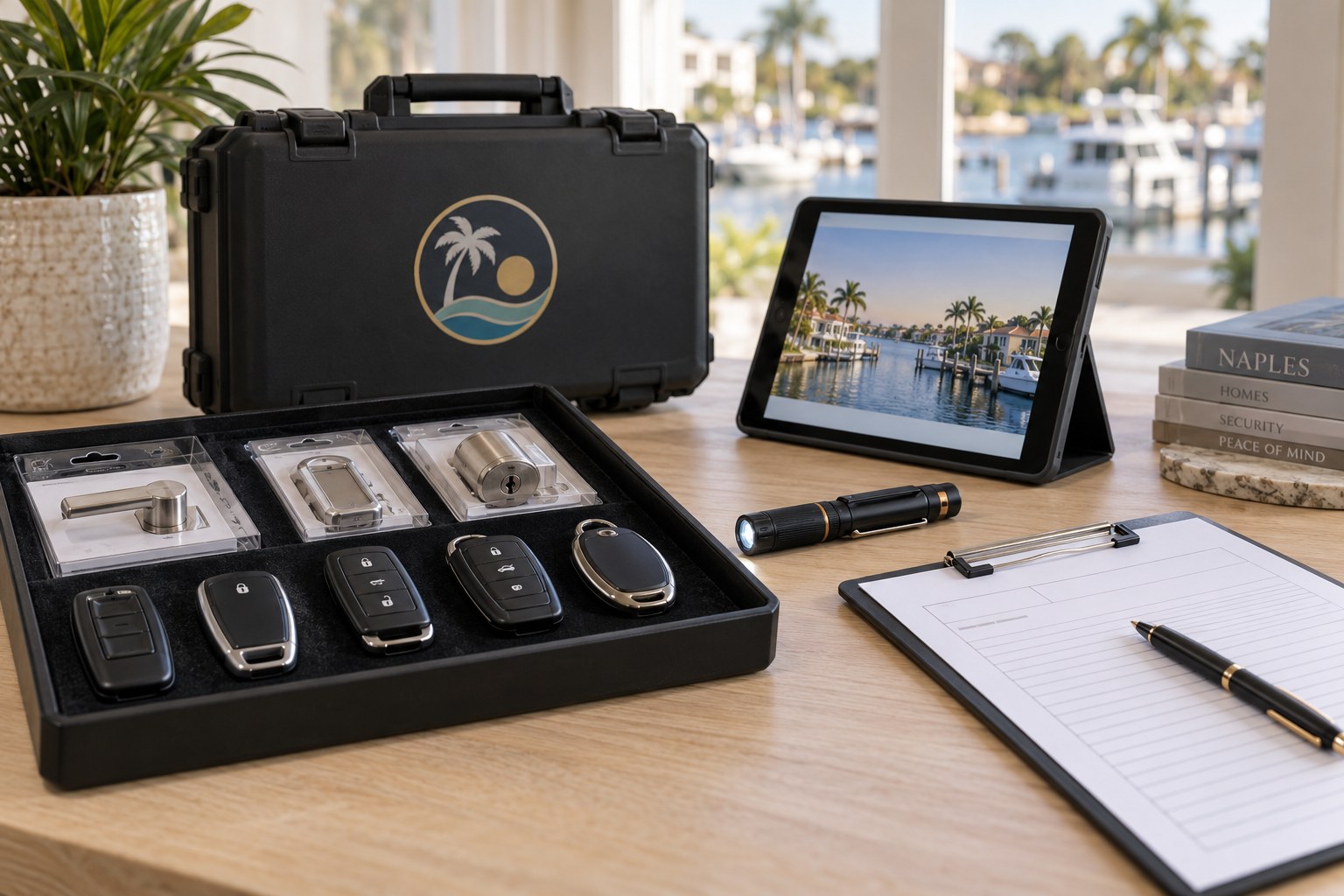
Living on acreage east of the city means a long driveway, a gate at the road, a house set back among the trees and perhaps a shed or two out behind it. Each of those needs a lock, and together they can bury you in keys. This page covers gate hardware, house doors, outbuildings and a sensible way to organize it all.
What is different about locking rural property
A lot in the city has a front door and a back door, and the neighbors are close enough to hear a shout. A rural lot in Golden Gate Estates is a different arrangement. The house may sit a long way from the road, the nearest neighbor may be out of sight, and the property has several entry points that all need to be thought about together.
Distance changes the way security works. On a small lot, a visible deterrent and a nosy neighbor do a lot of the work. On acreage, the lock has to do more by itself, and the layers matter: a gate that slows a visitor, a house door that resists force, and outbuildings that do not offer an easy prize.
It also changes the practical side. When the gate lock fails, you may be a long walk from the house. When a key goes missing, the number of places it might open is large. Planning the locks as one system, rather than as a pile of separate purchases, saves effort and makes later repairs much easier.
The advice below suits owners of working land, hobby farms, horse properties and quiet homes on large lots alike. Every situation differs, and a technician will look at your actual layout before suggesting anything, but the principles carry across most of the rural lots in the area.
A final difference is time. Help on a large rural lot takes longer to arrive, whether from a neighbor, a service provider or anyone else, which is why prevention matters more than reaction. Spending an afternoon getting the locks right is far easier than dealing with the aftermath of a loss that nobody noticed for days.
Gates, chains and the padlocks that hold them
The driveway gate is usually the first lock a visitor meets, and it is often the weakest. A bright shiny padlock on a thin chain looks reassuring, but a pair of bolt cutters ends the conversation in seconds. The strength of a gate lock is the strength of its weakest link, which is usually the chain or the hasp, not the padlock body.
A better setup uses a heavy chain with hardened links, a padlock with a shackle that is guarded or shielded so cutters cannot reach it, and a gate post or latch that cannot be unbolted. Where the chain loops around a post, it should be snug so there is little slack to leverage. Small details such as these decide how long the lock resists.
Weather matters as well. Constant sun, humidity and sandy dust work into a padlock and make it stiff or seized. Choose a model designed for outdoor use with a weather cover or drain holes, and spray it with a suitable lubricant at intervals. A padlock that is hard to open tends to be left open, which is no protection at all.
Some owners prefer an electric gate with a keypad or remote. These have their own locks and manual overrides, and the override is worth checking. If the power fails or the opener jams, you need a way to open the gate by hand. A technician can look at the override lock, make sure it works, and advise on how to keep it protected.
- Chain: hardened links, snug fit, no long slack
- Padlock: guarded shackle, outdoor rated, lubricated
- Hasp and post: bolted through, not screwed into soft wood
- Electric gate: working manual override and a known key location
The house doors at the end of the drive
Once someone is past the gate, the house doors are the next barrier. Farmhouse-style homes often have older or more decorative doors, which look wonderful and sometimes hide weak hardware. A single cylinder deadbolt with a short bolt and a thin strike plate can be defeated by a strong kick, no matter how handsome the door is.
The remedy is a good deadbolt with a bolt that extends a full inch, set into a reinforced strike that is anchored to the framing with long screws. Hinges get the same treatment, with at least one longer screw per hinge reaching the stud. These upgrades are mostly invisible, so the house keeps its character while the entry gets noticeably tougher.
Sliding doors and French doors leading to a porch or lanai also matter. They face the yard rather than the road, which can make them feel safe, but a person on foot in the back acreage has all the privacy they need. Check the latches, add a track bar for sliders and consider a keyed lock on the secondary leaf of any pair.
Do not forget the garage, which is often attached to the house and may have a door leading inside. That interior door should have a deadbolt, because the overhead door may be opened from outside by someone who knows the emergency release trick. A solid lock on the interior door keeps a garage breach from becoming a house breach.
If the house has a covered entry or a screened porch, check the lock on the porch door too. Many people treat a porch as a decorative space, but a screen door with a flimsy latch can be opened with a pocketknife, and it gives anyone working at the main door cover from view. A simple deadbolt or a stronger latch makes the porch part of the security layer.
Barns, sheds and outbuildings
Equipment on rural land is valuable and portable. A tractor attachment, a generator, a chainsaw, a pressure washer and a collection of hand tools represent real money, and they sit in buildings that may be out of sight of the house. A thief with a pickup truck and a quiet hour can empty a shed.
Lock the buildings with hardware that matches the value of what is inside. A thin hasp attached with short screws is a weak point; a heavy hasp through-bolted with the nuts on the inside is far stronger. Doors should close tightly against the frame so there is no gap for a pry bar. A good padlock completes the picture.
Consider how often you need access. A shed used daily needs a lock that is easy to work with gloves on. A building used a few times a year can take a more robust, harder-to-operate lock. Matching convenience to use keeps you from the temptation to leave things unlocked just because the lock is a nuisance.
Interior storage helps too. Keep the most valuable and easily carried tools in a lockable cabinet or box inside the building, so that even if the outer door is defeated, the best items still require extra effort. Record serial numbers somewhere other than the shed, because that makes recovery more likely if something is taken.
Trailers, boats and equipment parked outside are a separate matter. A hitch lock, a wheel lock or a chain through the frame can discourage opportunists, and the same key group can cover them. Tractor and utility vehicle ignitions are often generic, so a spare key from the same model may start yours, and a hidden kill switch or a locked shed matters more than the ignition.
Cutting the key ring down to size
Ask a rural owner how many keys they carry and the answer is often startling. Gate, house, garage, shed, barn, tractor, generator, tool chest, mailbox. Each lock arrived with its own key, and the ring has grown until it is heavy, noisy and impossible to sort by feel. Fewer keys is more convenient and, oddly, more secure.
The way to fewer keys is to key locks alike. A locksmith can rekey many padlocks and cylinders to open with one key, so a single key opens the gate, the sheds and the barn while the house stays on its own key. You decide the groups, and a short list on paper keeps them straight.
It works because padlocks and many deadbolts use standard pin tumbler cylinders that can be changed. Matching brands help, because a technician can combine them more easily, but mixed sets can often be handled as well. The key point is to plan before you buy, so everything you add later fits the plan.
Think about which doors should share and which should not. A caretaker who needs the gate and barn may not need the house, and a contractor who fixes the shed should not get the gate for the rest of the year. Separate groups make that easy. You get the benefit of fewer keys without giving anyone more access than they need.
Record keeping sounds dull and proves invaluable. Write the key codes or stamp numbers on a sheet and store it with your important papers, away from the keys. With the code, a locksmith can cut a replacement without the original, and you can verify that nobody copied a key you did not authorize. A sheet like that also helps you notice drift over the years.
Humidity, dust and the wear on rural hardware
Rural hardware lives outdoors, in humidity, sun, sand and the occasional downpour. Padlocks, hasps and gate latches see more punishment than any lock on a house. Rust forms on exposed steel, dust packs into keyways, and insects sometimes build nests inside lock bodies. Left alone, even good hardware stiffens and fails.
A little routine care goes a long way. Clean and lubricate padlocks twice a year with a dry lubricant made for locks, since oil attracts dust. Check hasps and hinges for rust and replace any that show deep pitting. If a key is hard to turn, deal with it now, before the day you need to get in quickly.
Keys wear too. A copy of a copy of a copy can be so inexact that it barely works, and it can break off inside a lock. When you cut spares, use the original or a good key made from the code, and test each one. A locksmith can do that on site, with the equipment to cut and check keys accurately.
Where a lock is damaged or seized and the key will not turn, avoid forcing it. Applying heavy force can snap the key or damage the cylinder. A technician can usually extract the broken piece, release the mechanism and replace what has failed, often without any need to destroy the hardware around it.
Sandy soil and fine dust get into places you would not expect. A padlock that sits on a shed door facing the wind can fill with grit within a season. Cover plates, rubber boots and shackle shields reduce how much gets in, and a quick blast of compressed air before lubricating clears the keyway. These small habits extend the life of the hardware by years.
Access for workers, deliveries and emergencies
A rural property has more people passing through than you might expect. Delivery drivers, landscapers, a fence crew, a propane supplier, a pest control visit. Each may need to get past the gate. Handing out keys is one answer, but it multiplies the number of copies in the world and gets harder to track.
A better method might be a coded padlock or a keypad on the gate that you can change, or a lockbox near the entrance with a key to a single temporary lock. Whatever you choose, treat access as something that expires. When the job is done, change the code or rekey the padlock, and the previous visitor loses entry.
Emergency access deserves special thought. If an ambulance or fire truck must reach the house, a locked gate should not stand in their way. Many owners use a lock arrangement that responders can cut, or leave information with the local services. Think about how someone would reach you if you were hurt and could not open the gate.
Make sure someone you trust knows how things work. A relative or neighbor who can open the gate and the house in an emergency is worth far more than a key hidden in a flowerpot. Give them what they need, tell them what they should not touch, and keep the written plan updated whenever locks change.
Delivery companies sometimes ask for gate codes, and it is worth deciding in advance what you will share. A code for the day, or one that is changed each month, limits how long a stranger holds it. If a company asks for permanent access, consider whether a drop box at the road would serve the purpose without opening the gate at all.
What a visit to acreage looks like
Because rural property is spread out, a visit takes some planning. When you contact us, describe the layout: the gate type, the number of buildings, the kinds of locks involved and what you want to achieve. Quotes are given by phone. Please call to confirm availability for your location, since travel to outlying areas affects scheduling.
On arrival, the technician confirms that you own the property or have the owner's authority before rekeying or changing any lock. Then comes a walk around the lot, looking at each gate, door and hasp. This walk shapes the plan and lets the technician spot problems you may have stopped noticing.
The work is explained as it goes. Padlocks may be rekeyed to match, cylinders changed, hasps replaced and a key chart provided. If the scope grows beyond what was discussed, such as a damaged gate post or extensive hardware replacement, the technician stops and explains. A complicated job means a visit, and the service call charge is explained before dispatch.
Afterward, you should have a short record of what opens what, the number of keys cut, and who holds them. That sheet is the real product of the visit. It turns a pile of keys into a system, and it makes any future changes much simpler for you and for whoever you call next.
Putting a rural lock plan together
Start with a sketch of the property. Mark the gate, the house, every outbuilding and any other locked item. Beside each, note the type of lock, who needs access and how often. The picture that emerges usually shows redundancy and gaps that were never obvious from inside any one building.
Then decide on groups. Which locks should open with the same key, which should be separate, and who gets which key. Keep the number of groups small. Two or three groups cover most properties, and it is easier to remember what each key does when there are only a few kinds.
Finally, schedule the work and the follow-up. Replace the weakest items first, rekey to match, and set a reminder to review the plan once a year. Locks wear, people come and go, and the plan stays useful only if it is maintained. A little attention each year keeps a large property manageable.
The reward is simple: a ring with a handful of keys, locks that work in the weather, and a property that is harder to enter without being a bother to live in. That balance is what good rural security looks like, and it does not depend on expensive equipment, just on careful planning and honest upkeep.
Frequently asked questions
Can one key open my gate, shed and barn?
Yes, in many cases. Padlocks and standard cylinders can be rekeyed or replaced so that several locks share a single key. You choose the groups, such as one key for outbuildings and a separate one for the house, and a technician sets them up to match.
Is a heavy chain enough to protect a gate?
A chain is only as strong as its weakest part. Hardened links, a guarded padlock shackle and a secure hasp or post all matter. A tight fit with little slack also helps. A technician can look at the whole arrangement and suggest improvements.
Do you service outlying properties?
Please call and tell us where the property is. Availability depends on location and schedule, so call to confirm whether we can come to you. Quotes are given by phone, and a technician can then plan the visit around the layout you describe.
Will you check that I own the property?
Yes. Before rekeying, replacing or installing locks on a home, farm building or gate, the locksmith checks ownership or authority. That might include a deed, a lease with the owner's approval or a property manager acting for the owner.
What if the job turns out to be bigger than expected?
The technician stops and explains before going further. A complicated job means a visit, and the service call charge is explained before dispatch. You decide whether to proceed once you understand the scope, and nothing is done without your agreement.