
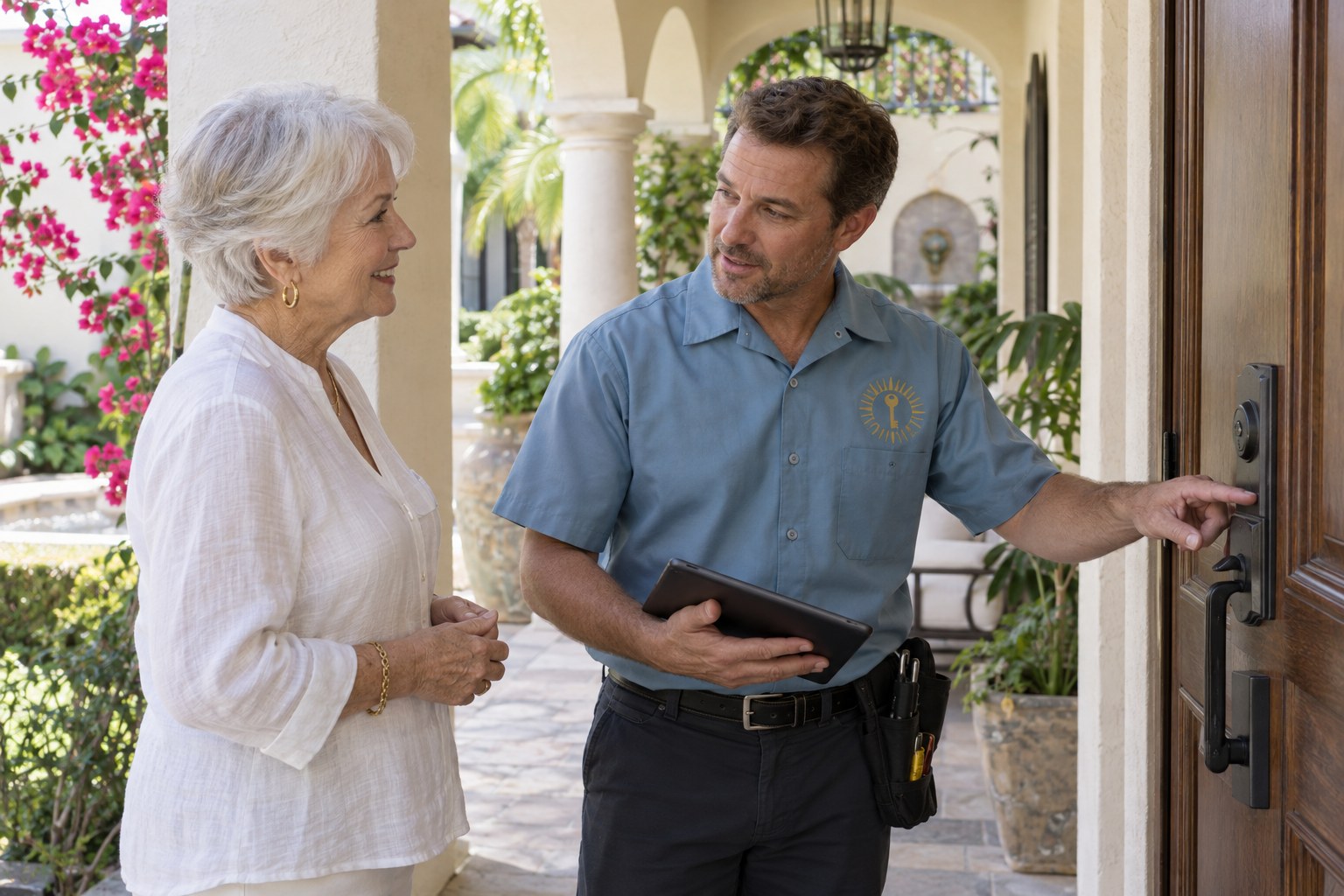
Hosting a rental on an island means guests who arrive after a long drive or flight, owners who may be hours away, and a steady turnover of people holding access to your door. This page compares keypad entry, key lockers and in-person handoff, and explains how to plan a rekey for the day a key goes missing.
The handoff problem on an island
A vacation rental changes hands every few days, sometimes every few hours. Each arrival repeats the same question: how does this guest get inside, and how do you make sure they cannot get back in after they leave? On Marco Island the question carries extra weight, because many owners live elsewhere and guests often arrive tired, late and unfamiliar with the layout.
A good handoff method is easy for the guest, simple for the host and hard to abuse. Those three goals pull in different directions, and no single method wins on every count. Understanding the tradeoffs lets you pick the approach that fits your property, your guests and the amount of attention you can give.
Whatever method you choose, remember that every guest is a short-term holder of access. The lock system should assume that sooner or later a key will be copied, a code will be shared or a device will be left behind. Planning for that from the start is much easier than reacting after the fact.
The rest of this page walks through the common options, how each works in practice, and how to keep control of access over the life of the rental. The advice applies to single-family homes, villas, condo units and townhomes, though building rules may add requirements of their own.
Keypad entry and smart locks
A keypad deadbolt lets each guest enter a code, so no physical key changes hands. Codes can be changed between stays, set to expire, or issued individually. For a remote host this is the most convenient option, since a guest can arrive at any hour without meeting anyone and the host can change the code from a phone.
The weaknesses are practical. Keypads depend on batteries, which must be checked and replaced before they die. Humid, salty air can shorten the life of electronics, so a model suited to coastal conditions is worth the thought. A power or battery failure leaves guests at the door, which is why a backup physical key or a second entry method matters.
Codes also leak. A guest may share a code with friends, or a cleaner may keep using an old one. Good systems let you issue unique codes per person and see when they were used. Whatever the model, remember to delete codes after checkout, and avoid reusing simple patterns such as the last four digits of a phone number.
A locksmith can install and set up keypad locks, check that the deadbolt is properly aligned so the motor does not strain, and make sure the mechanical key still works. Alignment is the most common hidden cause of unreliable keypad locks, and a short adjustment at the strike often fixes what a new battery cannot.
If you are installing a keypad lock yourself, test it with the door open and closed before guests arrive. Many failures come from a door that has swollen slightly and binds the bolt, and a motorized lock that struggles will drain batteries quickly. Fixing the alignment first extends battery life and reduces the number of frustrating calls on a busy weekend.
Key lockers and lockboxes
A lockbox holds a key near the door and opens with a code. The guest enters the code, takes the key, and returns it at the end of the stay. It costs little, needs no power and works with the lock you already have. For many hosts it is the first step in remote handoff.
The weakness is that the key itself is the vulnerability. A guest can copy it at a hardware store in minutes, and nothing in the box warns you. A lockbox also advertises the presence of a rental, and a cheap model can be forced open by someone with a few tools. Choose a sturdy one, mount it to something solid and change the code between guests.
Placement matters. A box on a railing, hung from a doorknob or fixed with short screws can be pulled off. Mount it to masonry or a structural post, in a place that is visible enough to discourage tampering yet not shouting to the street that nobody is home. In a condo, check the building rules, because many do not allow exterior lockboxes.
If you use a lockbox, plan to rekey on a schedule. A key that has been through many hands is a key that may exist in copies you do not know about. Rekeying the lock between seasons, or whenever a key is reported missing, resets the system and makes every old copy useless.
For a lockbox to be useful in the long run, think about who sees it. A box in plain view at the front steps tells a passerby that a rental sits here and the key may be inside. A box tucked at a side entrance, or one that uses a deliberately plain finish, draws less attention. No box is invisible, but a little thought about placement lowers the odds.
Meeting guests in person
Handing a key to a guest face to face gives you control no device can match. You see who they are, you can show them how the door works, and you can collect the key at the end. For higher-value properties or longer stays, this personal approach is still the most reliable.
The cost is time. Someone has to be at the property when the guest arrives, and flights and traffic do not respect schedules. Many hosts use a local property manager or caretaker for this, which keeps the human touch without requiring the owner to be present. Make sure the person understands their responsibility for the keys.
A hybrid approach is common: meet the guest for the first handoff, show the lock, and set up a backup method for lockouts. Guests lose keys, lock themselves out and forget codes. Having a plan for those moments, with a clear instruction for who to call, prevents a night on the doorstep.
Whichever method you use, hand over only what is needed. A guest does not need keys to the storage closet, the owner's room or a boat house. Keep those on separate locks that stay with the host, so the stay-level key opens only the spaces the guest is meant to use.
Arrival instructions deserve as much thought as the lock itself. A clear message with the door location, the code or lockbox position and a number to call when something goes wrong prevents most late-night problems. Photographs of the entry help a guest who is tired and in the dark. Keep the message short, and avoid putting the code in a place that remains visible after the stay.
Comparing the three methods side by side
Each method trades convenience, cost and control differently. Keypads are convenient and controllable but need maintenance and a backup. Lockboxes are cheap and simple but rely on a key that can be copied. In-person handoff is the most controlled but demands time and coordination.
Many hosts mix methods. A keypad on the front door with a lockbox holding a backup key for emergencies gives two ways in without duplication risk on the main entry. A physical key for the owner's closet and a code for the guest door keeps the spaces separate.
Think about the type of guests, too. Families arriving at midnight value a code they can enter without help. Corporate guests may prefer to meet someone. Owners staying part of the year can use a different setup from one who never visits. Fit the method to the actual pattern of use, not to the latest product.
Do the rekey on a day when the unit is empty, so a guest is not caught between an old key and a new one. Plan it between stays, and let your cleaner and any manager know that new keys are coming. Cutting enough copies for the owner, the manager and a spare held somewhere secure, and no more, keeps the new set under control from the first day.
- Keypad: easy for guests, needs battery care and a backup
- Lockbox: low cost, depends on a key that can be copied
- In person: strongest control, needs someone on site
- Mixed: a code for guests plus a hidden-from-view backup key held by a person
When a key goes missing
Sooner or later a guest will leave with a key, or a spare will disappear from a drawer. The right response is calm and quick. You do not need to panic, but you should not shrug it off either. A missing key on a rental means someone holds access who is no longer supposed to, and that access should end.
Rekeying is the usual answer. A technician changes the internal pins of the lock so the old key no longer works and issues a new set. It is faster and typically more economical than replacing the whole lock, and it keeps the hardware you already have. If the lock is damaged or worn, replacement may be sensible instead.
For keypad locks, the equivalent is to change every code and, if a physical key was lost, to rekey the cylinder. Do not assume that the code reset alone protects you if a mechanical key is out there. The two systems are separate, and a key keeps working unless the cylinder is changed.
Keep a record of every key, who holds it and when it was issued. When one goes missing, you know exactly what you are dealing with. Without a record, you are guessing, and the safe course becomes rekeying everything. A simple log saves money and avoids the sense of insecurity that follows a lost key.
Consider cleaners and maintenance staff when you design access. They often need to come and go on their own schedule, and giving them the same code as guests creates confusion about who entered when. A separate code or key for staff makes it easy to see activity and to remove access when someone leaves the job, without disturbing any guest.
Humidity, salt air and island wear
A rental near the water faces constant moisture. Salt in the air settles on metal, and tourists tug at doors and sliders with little care. The result is that rental locks wear faster than those in a private home. Keys bind, bolts stiffen and finishes pit.
Choosing hardware suited to the environment makes a difference. Solid brass, stainless steel and sealed keypad models handle the conditions better than lightweight plated products. Even so, regular care helps: wipe down exposed hardware, apply a suitable dry lubricant to the key cylinder, and replace anything that starts to corrode.
Guests tend to report problems late, if at all. A stiff lock may be forced and broken before the host hears about it. A quick inspection between stays, with each door opened and locked from both sides, catches issues early. A technician can set up a maintenance routine that fits your turnover schedule.
Sliding doors to lanais and balconies deserve special attention in a beach setting, since sand in the track is common. A latch that does not engage and a bar that guests forget to place leave the unit open to the breeze and to strangers. A simple pin lock or a track bar, with a note explaining its use, helps.
Storm season is a reminder that islands can be cut off or evacuated, and a rental should have a plan for it. Decide who closes the unit, who checks the locks afterward and how guests are told to leave when asked. Door hardware that has been knocked out of line by wind should be checked and corrected before the next guests arrive, and a technician can do that quickly.
Rules, owners and shared access
Many Marco Island properties sit in condo buildings or communities with rules about access. Some require that the association hold a key, some restrict exterior devices, and some limit rental terms. Before you install or change anything, check what is allowed, and ask the association what they need.
If you rent through a manager, agree on who controls the locks. A manager who holds keys needs to know when you change them, and you need to know who has copies. Poor coordination leads to guests locked out and keys no one can account for. Put the arrangement in writing.
When ownership or management changes, rekey. New owners and new managers should not inherit unknown keys. A locksmith can confirm ownership or authority before changing a lock, and that is a step that applies to every property regardless of who is asking. It protects the people who have a right to the home.
For units used by the owner part of the year, make sure personal belongings are secured separately. A locked closet or cabinet for the owner's items means guests have access to the rental space and no more. This simple measure prevents many disputes and gives the host peace of mind.
Keep the paperwork tidy. A one page summary listing each lock, its type, the key group and the date of the last rekey is all you need. Store a copy with your property records and give a second copy to your manager. When a question arises months later, the answer is already written down.
Planning the lock setup with a technician
When you contact us, describe the property, the current locks, how guests arrive and what problems you have faced. Quotes are given by phone. Please call to confirm availability, since arrivals and seasonal demand on the island can affect scheduling, and it is easier to plan ahead than to scramble.
On site, the technician confirms ownership or authority before changing anything. Then comes a survey of every exterior door, the condition of the cylinders and strikes, and a conversation about how guests and staff move through the property. The goal is a setup that suits the way you operate.
If the plan involves several locks, new keypads or a full rekey, the technician explains the scope and what each step involves. A complicated job means a visit, and the service call charge is explained before dispatch. You get a clear understanding before work begins, and a record of the keys and codes afterward.
Follow-up matters. Set a reminder to review the setup each season, change codes between guests, and rekey when keys go missing or after long periods of heavy use. A little regular attention keeps an island rental secure and keeps guests happy.
Frequently asked questions
Is a keypad lock better than a lockbox for a rental?
It depends on how you operate. Keypads let you change codes and avoid physical keys, but need batteries and a backup. Lockboxes are simple and inexpensive, but the key inside can be copied. Many hosts combine the two. A technician can help you choose.
What should I do if a guest keeps a key?
Treat it as lost and rekey the lock, so the old key stops working. Change any keypad codes too, since the codes and the mechanical key are separate. Keep a log of who holds each key so you always know what you are dealing with.
Can you rekey a lock without replacing it?
Usually yes. A technician changes the internal pins so the old key no longer works and a new key does. This keeps the existing hardware. If the lock is worn or damaged, replacement may make more sense, and the technician will tell you which applies.
Do you check that I own the rental?
Yes. Before rekeying or changing locks, the locksmith checks ownership or authority, such as a deed, a lease with the owner's approval or a property manager acting on the owner's behalf. This is routine for homes, condos and rentals alike.
How do I get a quote?
Call us and describe the property, the doors and what you want to change. Quotes are given by phone. If the job is complicated, a technician visits and the service call charge is explained before dispatch. Please call to confirm availability for your location.