
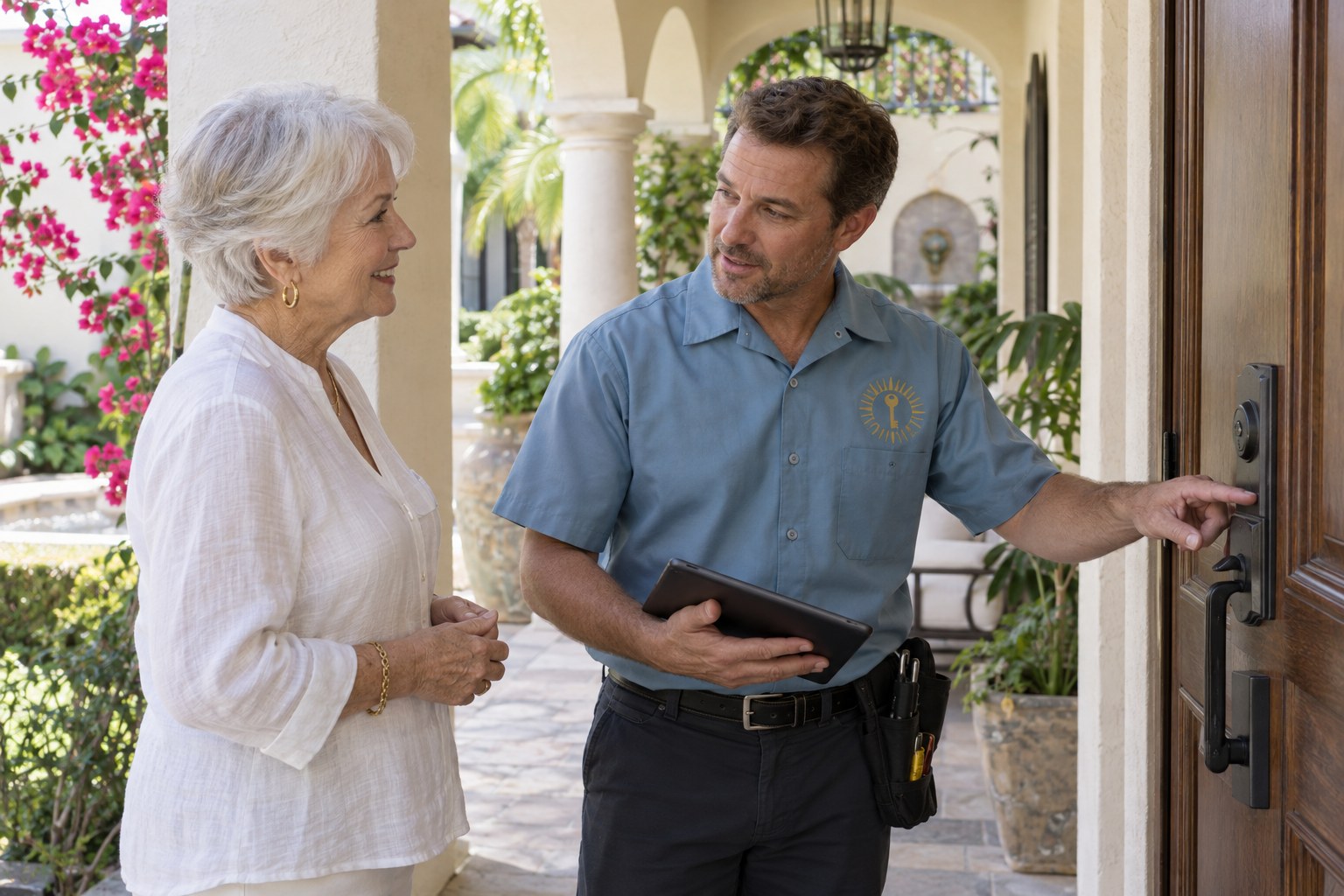
You walk up from the sand with damp towels, sandy feet and a cooler, pull the door shut behind you, and realize the key is on the kitchen counter. A beach condo lockout has its own wrinkles: building desks, shared hallways, heavy doors and guests who are not owners. This page explains how the call works and how to avoid repeating it.
The moment it happens, and what to do first
Nobody plans for this. You step into the hallway to take the elevator down to the pool or the beach, the door swings shut, and the click you hear is not reassuring. Stay calm and take stock before you do anything else. Check your pockets, your beach bag, the cooler lid and your swim cover up, because keys have a talent for hiding in the one pocket you did not check.
Next, think about who else might help. A travel companion with a key, the front desk, a building manager or a rental agent may all be able to do something before a locksmith is needed. Many condo buildings keep a spare for emergencies, and some offices will let you borrow it after confirming who you are. It is worth a short walk to ask.
If none of that works, call us. Tell us the name of the building if you are comfortable, the floor, and whether you are an owner, a long term tenant or a guest staying a few days. That last point matters, because it determines how we confirm that you may be let in. We ask the questions kindly, and the answers shape how the visit unfolds.
How a technician confirms you belong in the unit
A beach condo can be an owner's home, a seasonal retreat, a long term rental or a short stay booking, and the person locked out may be any of them. For every case, a technician must confirm that the person asking has the right to enter. We do not skip this, because the same step that protects the unit protects you.
If you are the owner, bring photo identification and anything that links you to the unit: a deed, a tax bill, an association letter, or mail with the unit number. If you are a renter, a lease or booking confirmation and the owner's or manager's approval may be needed. Guests on short stays can ask the host or property manager to call us and confirm.
The building itself can help. A front desk or management office often knows who lives in each unit and can verify an owner's identity. Some associations give permission directly to a locksmith by phone or email. If you are a guest and cannot reach the owner, we may not be able to proceed, and we will explain that clearly rather than leave you guessing.
Working with the front desk and building rules
Condo towers have their own routines. Many require visitors and vendors to sign in, show identification and sometimes wait while a staff member calls the unit. Parking can be tight, and service elevators may be reserved for certain hours. These rules are not meant to slow you down. They exist to keep residents secure and the building running calmly.
When you call us, tell us what the building asks of contractors. Some places want a notice in advance, or a certificate of insurance, or a particular parking location. If you can ask the front desk what they require, you save time. A technician cannot enter a secured lobby without arrangements, so a quick word from you at the desk makes things smoother.
A few buildings have rules about what work may be done on unit doors, particularly fire rated entry doors. A locksmith can open a locked door without altering it, but replacing or rekeying hardware may require approval. We keep the work within what the association allows and ask you to tell us if there are restrictions. Rules differ, so we do not assume.
Heavy doors, fire ratings and what that means for entry
Condo unit doors are often steel or heavy core fire rated doors, with a deadbolt and sometimes an additional latch or peephole. They close firmly, often with a self-closing hinge or closer, which is why lockouts happen so easily: the door shuts itself even when you meant to prop it open. That same weight and construction make careful technique necessary.
A technician approaches the lock first with picking or a bypass, since these leave the door intact. Fire rated doors must stay in compliance, and drilling or cutting can compromise the rating. If a lock is damaged or resists picking, we discuss options before any destructive step is taken, and we confirm with you what the building allows.
Many condo doors also have a pass-through or auxiliary lock inside, such as a chain or a security bar. If you flipped one before leaving, a technician may not be able to reach it from outside. Tell us what you did on your way out. Knowing how the door was secured helps us decide the best way in and set honest expectations.
The balcony question
A common thought when locked out of a beach condo is the balcony. If you are on an upper floor, the balcony is not a safe route, and you should never climb from one balcony to another or from a neighbor's balcony. That is a serious fall risk, and no lockout is worth it. A technician will not ask you to do it and will not do it either.
If you are on the ground floor or the balcony is reachable from a safe, legal route, the slider door is a possible way in. Sliding glass doors have simple latches, often a hook or a pin, and may be left unlocked by guests who feel safe at height. A technician can sometimes open a slider without damage, but only after confirming you are entitled to enter.
Neighbors may offer help, and many are kind. Still, we ask that you do not let someone enter through their unit unless they are certain it is safe and the building allows it. The legal and practical route is the front door, opened by a technician. Where the balcony is the only option, the building management usually needs to be involved.
Sand, salt and why condo locks stick
A beach condo is a rough environment for hardware. Salt air drifts through open balcony doors, sand blows into keyways, and damp towels and swimsuits pass through the door daily. Even inside a high-rise, the breeze carries salt, and the locks on balcony doors and entry doors see the worst of it.
A key that has been sandy or wet will carry grit into the lock. If the cylinder has become stiff over the season, the technician may find the lock needs cleaning or replacement soon. A quick conversation after the door is open helps you decide whether to act now or watch it. We never push work you do not need.
A simple habit helps: shake sand off keys and bags before inserting a key, and wipe the key with a dry cloth. Avoid soaking the lock with oil, which collects sand. A dry lubricant used a couple of times a year is plenty. We can show you the routine when we visit, and it takes about a minute.
Guests, rentals and the owner not answering the phone
Many beach condos are vacation rentals, and a guest locked out at night while the owner is traveling is a classic problem. The guest is not the owner, and we cannot take their word. We will ask them to contact the host or the property manager, who can confirm authority by phone or message.
If the unit is managed by an agency, the agency can usually approve the work quickly, because it handles such requests regularly. If the owner is self-managing, the guest should keep trying their contact, perhaps by messaging through the booking platform. We will wait for confirmation before opening the door, and we explain why when it feels like an obstacle.
As a host, you can avoid the whole situation. Provide a clear instruction sheet, a lockbox with a code, or a keypad lock so guests are never stranded. Tell them whom to call and what to expect. A calm guest with a plan is far less stressed than one who has to improvise on a hot afternoon.
Staying comfortable while you wait
If you are locked out, your first priority is comfort and safety. Wet swimwear and a cooled-down hallway can make you chilly, while the afternoon sun can make a waiting area uncomfortable. Find a shaded spot, drink water, and use a towel for warmth if needed. The pool deck, the lobby or a lounge may be better places to wait than the hallway.
If children or older relatives are with you, make sure they are in the shade and have access to water and a restroom. Ask the front desk whether you can wait in the lobby. Most buildings are understanding about a situation like this, and staff are often happy to help you get comfortable while the locksmith is on the way.
Keep your phone charged and available. A technician may call as they approach to ask about the entrance or parking. If you step away, leave a note with the front desk about where you will be. We do not promise arrival times, but we do keep you informed and ask you to call to confirm availability when you reach us.
After the door opens: checking the lock and the door closer
Once you are back inside, the technician checks the lock that caused trouble. Does the bolt move easily? Does the key turn smoothly? Does the door close fully on its own and latch? A door closer that slams too hard, or a latch that catches halfway, can contribute to lockouts, and small adjustments can help.
We also check whether the lock has seen better days. Condo locks in beach buildings take a beating from salt and sand. If the cylinder is gritty or the bolt drags, we explain whether cleaning and lubrication will do, or whether a new lock should be considered. The decision is yours, and we help you weigh the options without hurry.
If keys were lost rather than left inside, we talk about rekeying. A key lost at the beach could be picked up by anyone, and it may be tied to your unit number or a tag with your name. Rekeying makes the lost key useless and costs little in time. We always confirm ownership or authority before starting.
A spare plan for beach days
The best fix is a plan that makes lockouts rare. Leave a spare key with someone you trust, such as a neighbor, a friend in the building or a property manager, rather than hiding it near the door. If your building allows it, a small lockbox with a combination that you control can be a safe backup.
For beach days, consider a waterproof key pouch that clips to your bag or swimsuit. It keeps the key dry and in a place you can see. Some people prefer a keypad lock for the unit, which lets them use a code with no key needed. If your association permits it, a technician can talk through options that suit your door.
Build a habit at the door: before closing it, touch your pocket or bag and say to yourself that the key is with you. It sounds simple, and it works. Teach everyone in your group the same habit, especially children, who often close doors without noticing who has a key. A thirty second ritual can save a long wait in the heat.
Quotes, service calls and next steps
A condo lockout depends on the door, the lock and the building, so we do not post fixed amounts. Call us, describe where you are and what the door looks like, and we will give you a quote by phone. If the job is complicated, a technician visits and the service call charge is explained before dispatch.
We do not promise arrival times. Traffic near the beach, seasonal crowds and building access all affect timing, and we would rather give you an honest answer. Call us to confirm availability, and we will tell you what to expect and update you if anything changes along the way.
When you call, have the building name, your floor or unit number, your role as owner, tenant or guest, and a way to reach the person who can confirm authority. That preparation shortens the process and helps us get you back inside, dry and comfortable, as smoothly as possible.
Storm season, shutters and hallway doors in a tower
Beach buildings take hurricane season seriously, and that shapes how a lockout plays out at certain times of year. Before a storm, associations may close off parts of the property, restrict elevator use, require residents to secure balconies and limit who can enter the building. If a lockout happens during these periods, the front desk may have rules that differ from a calm summer afternoon.
Call ahead if you know a storm is approaching and you are away from your unit. Tell the building which day you plan to return, and ask whether any entry limits apply. A locksmith cannot override a building closure, and it is better to know about it in advance than to learn it at the lobby door. We ask you to call to confirm availability, particularly when weather is a factor.
Inside a tower, shared hallways are often narrow, carpeted and monitored. A technician working there should be tidy and quiet, since neighbors live behind every door. We keep tools off the carpet, take care with elevators and clean up fully. If a neighbor looks curious, we answer politely without sharing your business, and we respect the privacy that building living depends on.
After a storm, doors sometimes swell or shift, and a lock that worked before may start to stick. If you return to a unit and the key will not turn, do not force it. A bent or broken key can turn a small annoyance into a larger repair. Call us, describe what you tried, and we will walk you through the next sensible step.
It also helps to keep an eye on small signals during the season. A door that closes with a bang, a latch that needs a push, or a peephole cover that has loosened are all minor things on their own. Together they tell you how the door is aging in the salt air. Mentioning them to the technician while we are already there often leads to a quick adjustment that prevents the next surprise.
Frequently asked questions
Can a guest in a vacation rental call you directly?
A guest can call, but we need the owner or property manager to confirm authority before opening the door. Ask your host to contact us, or share their contact information so we can verify. This protects the unit and everyone staying in it, even if it feels like an extra step.
Will you damage my condo door?
Our approach is to open the lock with picking or a bypass, which leaves the door intact. Fire rated doors must stay in compliance, so we avoid drilling or cutting unless it is the only option, and we explain it to you and check building rules first. You choose before any such step.
Should I climb over the balcony to get in?
No. Climbing between balconies on an upper floor is a serious fall risk, and no lockout is worth it. A technician opens the front door safely. If a ground floor slider is the only route, we still confirm that you are entitled to enter before attempting it.
What does the building need to approve?
Requirements vary. Some buildings want vendors to sign in, show identification or give notice, and some restrict work on fire rated doors. Ask the front desk or management what they need, and tell us when you call so we can plan for access and parking.
How soon can someone come out?
We do not promise arrival times, because conditions near the beach and in the building change. Please call to confirm availability, and we will give you an honest picture of what to expect and keep you updated if anything shifts before the technician reaches you.