
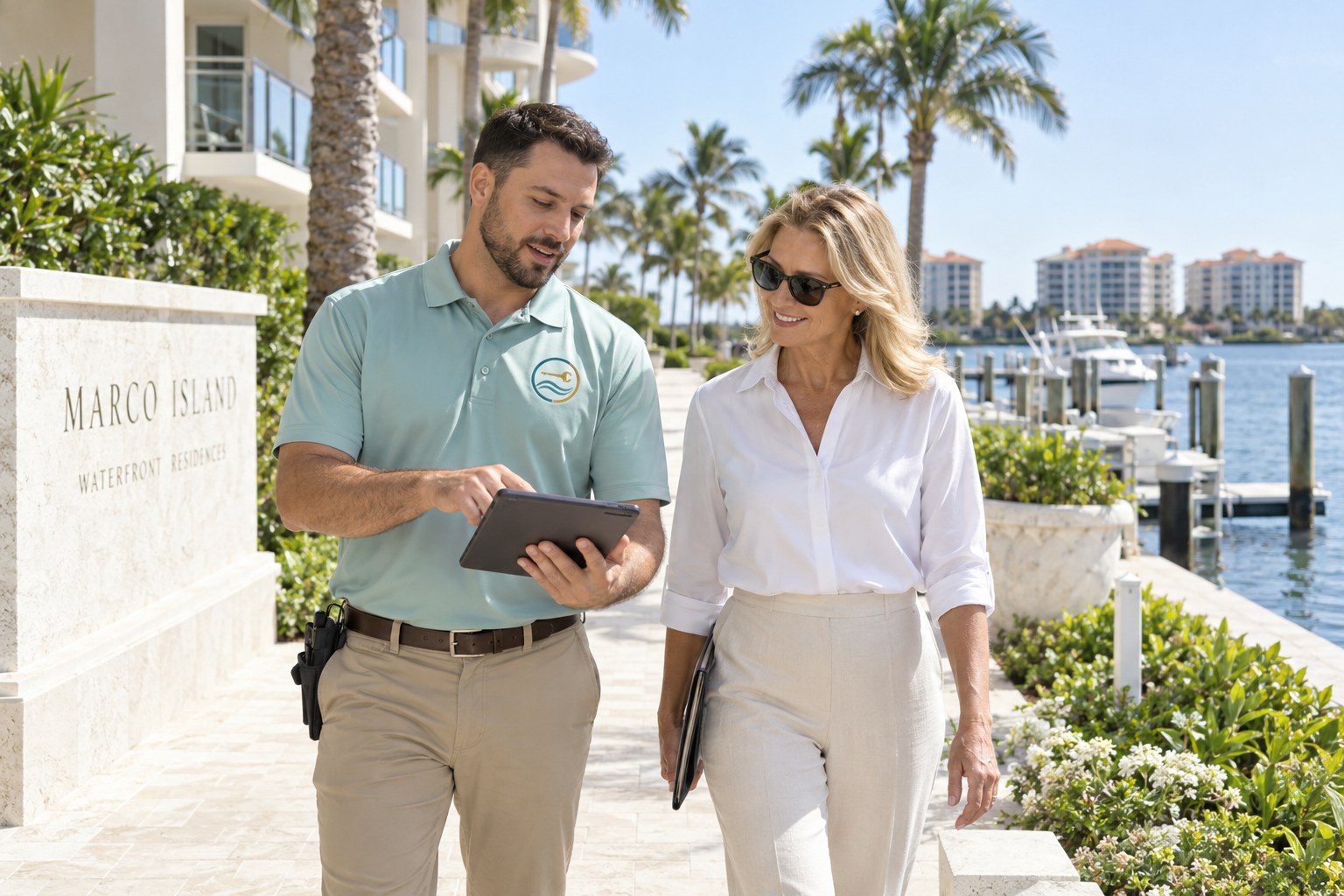
Life in a gate-guarded community has its own etiquette. Visitors are announced, vendors are logged and residents expect calm streets. A locksmith visit works best when it fits that rhythm. This page explains how to arrange access with the gate, what the technician needs from you, and how locks and keys are handled in single-family homes, villas and tower residences. Call us to confirm availability.
How a guarded gate changes a service call
At a guarded community entrance, nobody simply drives in. A guard checks a list, calls a resident, records a plate or issues a pass. For a locksmith, the gate is the first step of every job. If the guard has no record of the visit, the technician waits at the gatehouse while someone sorts it out. That wait is nobody's fault, but it is avoidable with a little advance planning on the part of the resident.
The solution is simple. When you book a visit, tell us you live behind a guarded gate and ask what the guard needs. Many communities want the visitor's name, company, vehicle description and the unit or address. Some ask for a phone call from the resident at arrival. Others accept a standing vendor list. Give the guard everything in advance, and the visit starts smoothly. If the community requires a vendor pass, arrange it before the technician leaves.
A locksmith also has to think about emergencies. If you are locked out and standing in your driveway, the guard may not know that a technician is on the way until you call. Tell the gate as soon as you book. If you are locked out of the community itself, because your remote or decal has failed, the guard can usually help verify you and let you in. We work with the gate, not around it, and we respect each community's rules.
Guest lists, vendor lists and what to give the guard
Gate procedures vary by community, but a few details usually matter. The guard needs the visitor's name or company, the date, the address being visited and sometimes a vehicle description. A resident may need to approve the visit by phone or through an app. Some communities limit vendor hours or restrict certain days. Ask your management office for the current rules, since they change, and share anything unusual with us when you book.
When you give the guard our information, be clear about what to expect. A technician arrives in a service vehicle carrying tools and hardware. The guard might ask to inspect the vehicle, which is normal. Allow time for check-in at the gate, and do not be surprised if the guard calls you. Answer the phone, even if the number looks unfamiliar. A missed call at the gate is the most common reason vendors are delayed or turned away.
If you are a property manager or caretaker arranging a visit for an owner who is away, tell the guard in advance and be ready to prove your authority. The gate may require written permission from the owner. We also confirm ownership or authority ourselves before opening, rekeying or programming anything, so have documentation ready. Between the gate check and our own, your home gets two layers of care, which is exactly what residents want.
- Tell the gate the vendor name, date and your address
- Answer calls from the gatehouse promptly
- Ask management about vendor hours and pass rules
- Arrange written owner permission if you are a caretaker
Single-family homes and villas behind the gate
Inside a guarded community, security can feel like someone else's job. The gate and patrol create a sense of safety, and residents sometimes relax about their own doors. That is understandable, but the gate protects the neighborhood, not the individual house. Service people, delivery drivers, guests and contractors all pass through legitimately, and a door left weak is still weak. The best approach is a layered one, where the gate is one layer and your locks are another.
A solid front door, a quality deadbolt with a reinforced strike, a secure garage entry and sliders with secondary locks form the next layer. These are the same improvements we recommend anywhere, and they matter just as much behind a gate. We check hardware condition, door fit and strike installation, then suggest sensible upgrades. We also talk about habits, such as locking doors when you are in the backyard or by the pool, since opportunistic entry is the most common issue.
Villas and attached homes add shared walls and common areas. The exterior of a villa, including doors and entry hardware, may be governed by the association. Before replacing a lockset or changing a finish, check the rules. Rekeying is rarely an issue. A change in style or color might be. We recommend hardware that matches what is already there, so the home continues to look consistent with the community while its security improves.
Seasonal residents deserve a word here. A home that sits empty for months behind a gate still needs its locks checked before departure and on return. Humidity affects a closed house, and a deadbolt that turned easily in March may stick in November. A pre-season visit, arranged with the gate in advance, lets us clean, adjust and test everything while you are still deciding what to pack, instead of in a rush on the day you arrive.
Tower residences and what they require
Pelican Bay includes tower residences where several layers of access meet. A resident passes the community gate, then the tower's own entry, then perhaps a floor-level door, and finally the unit. Each layer has a different authority. The community controls the gate, the tower association controls the lobby and common areas, and the owner controls the unit door. Knowing who controls what prevents delays and wasted calls.
For work on a unit door, we follow the usual high-rise approach. We ask about fire-rated assemblies, approved hardware, vendor registration, elevator reservations and permitted hours. We confirm ownership or authority, keep noise low and protect hallways. If the building keeps an emergency key on file, we respect it and remind you to supply a new one after any rekey. Compliance protects you and your neighbors and avoids disputes that outlast the lock change.
Electronic access is common. Fobs, cards and codes for lobbies, garages and amenities are managed by the building or community. We do not program those systems, which belong to the access control vendor and management. We handle the mechanical side of unit doors and, with authorization, common doors. Dividing responsibilities this way ensures that each part is handled by the right party and that records are accurate.
Lockouts when you live behind a gate
A lockout is stressful enough without a gate to negotiate. The practical sequence is: first, tell the guard you have called a locksmith so there is no confusion at the entrance. Second, give us the exact address and any directions inside the community. Third, prepare identification and proof of residence. If you are standing outside in the heat, move to shade, and if someone inside needs help, call emergency services first.
Many communities have curving streets, cul-de-sacs and similar-looking homes, and a technician can lose time circling. Provide a landmark such as the street name, a nearby clubhouse or the color of your door. If the gate gives us a map or pass with directions, we follow it. Clear information lets us arrive prepared and avoids a second trip that neither of us wants.
Before opening any door, we confirm ownership or authority. That means identification showing the address, a lease, a bill or a call to the owner. In a community where residents trust one another, this still matters, perhaps even more. It protects the household and the neighborhood. After entry, we test the lock, look at why it failed and suggest a spare key plan, such as a trusted neighbor or relative who can help next time.
Keys, fobs and remotes that go missing
Residents in a gated community carry more devices than keys: a gate remote or decal, a garage remote, a car fob, a house key and perhaps a tower fob. Losing one is common, and it triggers a small chain of tasks. Report a lost gate remote or decal to management right away so it can be deactivated. Keep a note of which devices belong to which system, since each has a different path to replacement.
As a locksmith, we deal with the physical keys: house keys, mailbox keys where permitted, padlocks and car keys. For vehicles, we describe options in general terms, such as metal keys, chip keys, remote head keys and proximity fobs. Programming depends on equipment and the vehicle category. We confirm ownership with registration and identification before cutting or programming anything. A vehicle key is a key to everything inside, so we ask first.
If you lose a house key and suspect it could be in the wrong hands, rekeying is the sensible response. It makes the old key useless while leaving your hardware in place. It takes little time and gives peace of mind. If you only misplaced it at home, wait a few days before acting. If it was lost in public or with an address attached, do not wait. We explain our recommendation honestly and let you decide.
Garage doors, entries and golf cart storage
Garages in gated communities often hold more than cars: golf carts, bikes, tools, wine and boxes of seasonal belongings. The walk-in door from garage to house is a weak point in many homes, often with a basic latch and a thin strike. A proper deadbolt, a reinforced strike and a solid door change it. The overhead door's springs and openers are outside our work, but the entry points around it are not.
A garage remote left in a parked car is an open invitation, because anyone who opens the car can open the garage. Habits matter as much as hardware. Take the remote with you or use a keypad on the wall. If your opener has a keyed override, make sure the lock works and that spare keys exist. We can check and service these locks, and we can set up a keyed-alike arrangement with other doors on your property.
Golf carts and utility vehicles have simple ignition locks that are often identical across a whole manufacturer line, which means one key can start many carts. Consider replacing the ignition cylinder with a unique one, particularly if you store the cart outside. We can discuss options and note limits. Ownership checks apply, and we ask for proof before changing anything. A little attention here protects a valuable machine that residents use daily.
Deliveries, contractors and managing who has keys
Gated communities see constant traffic from contractors, cleaners, landscapers, pool crews and delivery services. Many have standing arrangements with residents, and some hold keys. Over time, those keys multiply. A resident who cannot say who has a copy has a security gap no gate can close. The remedy is a simple key audit. List everyone with access, collect keys that are no longer needed and rekey if there is any doubt.
Lockboxes and keypad locks reduce the number of physical keys. A code can be issued to a cleaner and canceled when the relationship ends. Many residents prefer a keypad on a side door for service people and keep the front door on a separate key. This segmentation limits exposure. We help set up and explain these arrangements, and we recommend keeping a mechanical backup so a failed battery never leaves anyone stranded.
During renovations, key control matters even more. Contractors often need unrestricted access for weeks. Plan to rekey at the end of the project so that every key issued to the crew stops working. Doing so once, with a clear record, is simpler than chasing individual keys. We schedule it around your timeline, confirm that we are speaking with the owner, and leave you with a clean set of keys.
Hurricane season and the community response
Gated communities usually coordinate their hurricane response through management and the guard force. Residents receive notices about preparations, evacuations and re-entry. Door hardware is part of your personal preparation. Before the season, check that doors latch, deadbolts reach their strike plates and sliders seat properly. Replace worn weatherstripping and tighten loose screws. A few small repairs reduce storm stress on your doors and make post-storm recovery easier.
After a storm, access may be restricted until it is safe to enter. Management will announce when vendors can return. We do not enter until clearance is given, and we ask residents to be patient. When we do come, we help with stuck doors, damaged locks and gates that no longer latch. We follow community rules for check-in and keep our work orderly. Call us to confirm availability once conditions allow.
Residents who leave for the season should make a plan for key access in an emergency. Give a trusted person a key or code, and tell management who that is. Avoid leaving keys under mats or planters, where they are easy to find. If you need to hide one, use a proper lockbox out of sight. We can help choose a location and a model that suits your home and your community's rules.
Arranging a visit that fits your community
Start by gathering your gate information: what the guard needs, any vendor pass rules and permitted hours. Then call us with your address, the nature of the job and any details about the lock or door. We will explain the likely approach, tell you whether a quote can be given by phone and confirm availability. Share the visit time with the gate so there is no confusion on arrival.
If the job is complicated, a technician visits and the service call charge is explained before dispatch. For straightforward work, a quote is given by phone. We confirm ownership or authority before opening, rekeying or changing hardware, using identification and documents or a call with the owner. Tower residents should also notify their building. A well-prepared visit takes less time and disturbs fewer people. If there is a reservation for a service elevator or loading area, include the time so we do not arrive early and block a neighbor.
Our aim is to be a courteous guest in your community. We park where permitted, work quietly and clean up after ourselves. If we see something that might concern you, such as a weak strike plate or a worn deadbolt, we mention it plainly and leave the decision to you. Contact us with questions about your doors, and we will help you plan sensible steps without pressure.
Frequently asked questions
What should I tell the gate before a locksmith arrives?
Give the guard our name, the date, your address and a description of the service vehicle if asked. Ask your management office about vendor passes and permitted hours. Answer any call from the gatehouse promptly, since a missed call is the most common reason visitors are delayed.
Do locks matter if my community has a guarded gate?
Yes. The gate protects the neighborhood, but contractors, guests and deliveries all pass through legitimately. A solid door, reinforced strike, quality deadbolt and secure garage entry still matter, and good key habits close the gaps a gate cannot.
Can you program my community gate remote or tower fob?
No. Those are controlled by management and the access vendor, so lost devices must be reported to them. We handle the mechanical side of doors and, with authorization, common doors. We can also cut or program house and vehicle keys after confirming ownership.
What if my keys were lost and I am worried about security?
Rekeying makes the lost key useless while keeping your existing hardware, and it is usually the sensible response if the key was lost in public or with an address attached. If you only misplaced it at home, you may wait a few days. We explain our view and you decide.
How are complicated jobs handled in a gated community?
A technician visits first, and the service call charge is explained before dispatch. Quotes for straightforward work are given by phone. Tell the gate the visit time in advance, and call us to confirm availability so check-in goes smoothly.