
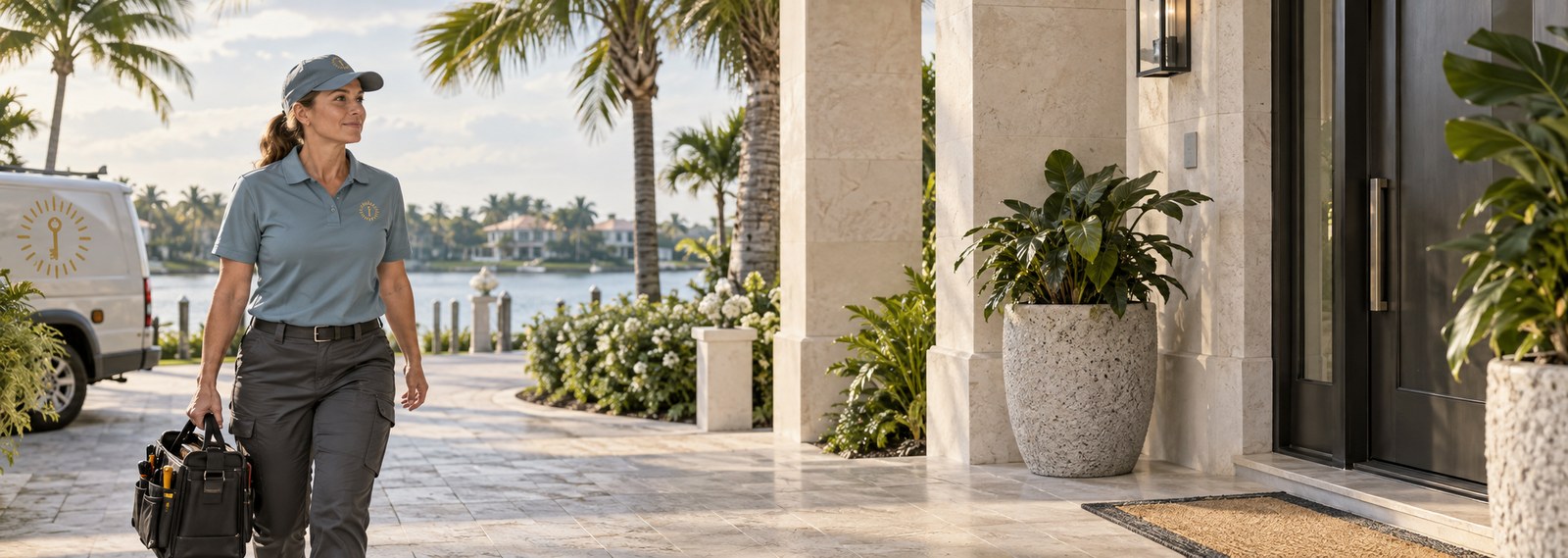
Storm preparation usually focuses on shutters, water and supplies, but doors and locks carry real load when wind pushes against them. A door that holds its latch in a gale protects everything behind it. This checklist walks through each entry point of a Gulf Coast home, explains what to look at and why, and notes when a locksmith visit is worth arranging before the weather turns.
Why locks matter when the wind rises
People tend to think of a lock as protection against intruders, but in a storm it has a second job: keeping a door shut against pressure. Strong wind pushes on a door and tries to flex it away from the frame. The bolt, the strike plate and the screws holding them in place are what keep the door closed. If any of those parts is weak, the door can pop open even though it was locked.
Southwest Florida homes face this in particular ways. Many have large glass sliders onto a lanai, double front doors with decorative glass, and garage doors that are the widest openings on the house. Salt air and humidity wear on hardware all year, so a lock that looked fine in winter may be corroded or loose by the time hurricane season opens in early summer.
A good checklist is a calm way to find weak points before there is any pressure. Do it on a clear day, with a screwdriver and a flashlight, and take notes. Most of what you find will be small fixes you can handle yourself. For the rest, you will know exactly what to describe when you call us and ask about availability.
Start with the front door and its deadbolt
Open the front door and look at the bolt when it is extended. A good deadbolt should project a full inch or close to it into the frame, and it should slide in and out smoothly without grinding. Turn the thumb turn and the key several times. If the action is stiff or gritty, corrosion or debris is probably inside, and the lock may be nearing the end of its life.
Now check how the door sits in the frame. Close it and look at the gap around the edges. An even gap is good. A gap that is wide at the top and narrow at the bottom, or a door that rubs, tells you the hinges have loosened or the door has swollen in the humidity. A door that is out of square makes the bolt hit the edge of its hole, which weakens the whole arrangement.
Wiggle the handle and the deadbolt body. Nothing should rattle or shift. Loose lock hardware means loose screws, and loose screws tend to get worse. Tighten what you can reach. If the wood around a screw has stripped out, that needs a better fix than a tighter screw, and this is a good moment to think about a technician adjusting or replacing the hardware.
Strike plates and the screws behind them
The strike plate is the metal piece on the door frame that receives the bolt, and it is the most overlooked part of door security. Most homes arrive with short screws, often about three quarters of an inch, that bite only into the thin trim of the frame. In a strong gust, or a hard shove, those screws can pull out and the frame can split.
A simple upgrade is to replace those short screws with longer ones, around three inches, that pass through the frame and into the solid framing stud beyond. This anchors the strike plate to the structure of the house, not just the trim. The same goes for the screws in the hinge plates, at least one in each hinge, which should reach the stud as well.
Check whether the strike plate is cracked, bent or loosely mounted, and whether the hole behind it is clean and deep enough for the bolt. Many older homes have shallow, rough holes. A reinforced strike plate, with a longer and wider body, spreads the load across more of the frame. A technician can fit one in a short visit, and it is among the most useful pre-season upgrades.
- Replace short strike plate screws with long ones that reach the stud
- Fasten at least one screw per hinge into the framing
- Check for cracks in the frame around the latch and bolt hole
- Consider a reinforced strike plate on exterior doors
Sliding glass doors and lanai entries
Sliders are a common weak point in storms. The standard latch is a small hook that catches a keeper on the frame, and the door itself rides on rollers in a track. Wind can lift a slider slightly off its track, and a weak latch lets it slide open. Check that the latch engages fully and that the keeper is firmly screwed to the frame.
Clean the tracks and look at the rollers. Sand and grit from the Gulf wear them down, and a slider that is loose in its track rattles and shifts under pressure. Many sliders also benefit from a secondary lock, such as a pin through the frame, a bar in the track or a keyed auxiliary lock. These add resistance when the main latch is stressed.
Impact-rated glass and storm shutters protect the glass, but they do not replace a solid lock. If your slider has a cracked frame, a bent latch or a track that cannot be cleaned to run smoothly, mention it to a technician. Some sliders can be repaired with new rollers and a stronger latch, while others are better replaced, and a visit will clarify which applies.
Garage doors and the service door inside
The garage door is usually the largest opening in the house, and in a storm it takes the heaviest wind. Look at the tracks, the brackets and the door panels for signs of loosening or rust. A door that has bent or been dented over the years is weaker than one in good shape. Garage door structure is separate from locking, but the two work together.
Test the manual release and the lock, if your door has one. Make sure you know how to disconnect the opener, because a power cut during a storm leaves you with a heavy door and no way to raise it. A garage door that cannot be opened by hand in an emergency is a safety problem, not just an inconvenience.
Do not forget the door between the garage and the house. It is often a lighter door with a basic lock, because people assume the garage door is the barrier. Treat it like an exterior door: check the deadbolt, the strike plate and the hinge screws. A technician can upgrade that hardware so the interior entry matches the strength of your front door.
Shutters, shutter hardware and padlocks
If you use roll-down, accordion or panel shutters, their locking hardware needs the same attention as your door locks. Many shutters are secured by pins, slide bolts or small padlocks. Salt air makes quick work of cheap hardware, and a stuck pin on a storm shutter is the last problem you want while the sky darkens.
Test every shutter now. Close it, lock it and open it again. Lubricate moving parts with a product made for outdoor hardware, and wipe off excess. Replace rusty pins and seized padlocks. Label keys and keep a spare set in a known place, since a shutter key lost in a rush is a real hazard when time is short.
For panel shutters stored in a garage, check that all the hardware is present and that you know which panels belong to which openings. Practicing the installation once, on a calm day, reveals missing bolts and tricky fits. If any shutter lock refuses to turn or any key has gone missing, call us before the pre-storm rush, because many households have the same idea at the same time.
Keys, codes and who can get in
Storm preparation is a good moment to review who holds keys and codes. If you are leaving the area, a neighbor, a property manager or a caretaker may need access to check the house afterward. Decide who that is, and make sure they have a working key or code. A lockout during a post-storm inspection wastes valuable time.
If you use a smart lock or keypad, check the batteries and think about what happens in a power outage. Most battery-powered locks keep working without house power, but they need fresh batteries and a physical key backup. Know where the physical key is, and confirm that the override cylinder works. Test the backup rather than assuming it does.
Think about spare keys as well. Make sure each household member has a key to every door they need, and that a spare is in a safe place you can reach. Avoid leaving keys in obvious hiding spots, since those are the first places anyone looks. A small lockbox with a code, mounted discreetly, is a better option for some homes, though it needs care too.
Condos, high-rises and rental properties
If you live in a condo tower or managed building, much of the exterior hardware belongs to the association, but your unit entry door and its lock are usually yours to maintain. Check the deadbolt, the strike plate and the peephole, and confirm that your door closes and latches smoothly. Ask the management office what their storm procedures are and who holds master keys.
Balcony and terrace doors on upper floors face strong, gusty winds. Make sure the locks and latches on those sliders work well, and that any storm panels or shutters your building allows are ready. Associations often have rules about what can be changed on exterior openings, so ask before arranging hardware work.
Owners of vacation rentals and investment properties should plan for a storm in absentia. Confirm that a manager or caretaker can enter, that locks are in good order and that key records are up to date. Consider a quick pre-season inspection by a technician if the property has had heavy use. A short visit beats discovering a failed lock by phone from another state.
Interior doors, safes and valuables
Inside the house, think about where you would put documents, medications, small valuables and important keys if you evacuated. A lockable safe or file box that can be carried out, or a fixed safe in a closet, protects papers from both theft and water. Check that you can open it, that you know the combination or have the key, and that spare keys are not stored inside it.
Interior bedroom or office doors with locks matter if you shelter in place with children or guests. Privacy locks are meant to be opened from the outside in an emergency, and a small pin or key often does it. Know where those emergency tools are kept. A door that cannot be opened quickly can become a safety problem.
If you have a gun safe, a medicine cabinet lock or a lockable storage room, confirm that the keys and combinations are accessible to the right adults and not to everyone. A storm brings hours of waiting at home, and unlocked hazards are best secured before the weather forces everyone indoors. A locksmith can service or replace safe and cabinet locks that have gone stiff.
When to call a locksmith before the season
Some items on this checklist are easy to do yourself, such as tightening screws, cleaning tracks and testing keys. Others benefit from a technician: replacing a worn deadbolt, installing a reinforced strike plate, rekeying after a lost key, repairing a slider latch or adding a secondary lock. If you find several issues, a single visit can handle them together.
The best time to call is early in the season, long before a storm is forecast. Once a system is approaching, demand rises and availability is uncertain. Call us to confirm availability and explain what you found. For simple items, a quote can be given by phone. For complicated jobs, a technician visits and the service call charge is explained plainly before dispatch.
As always, the technician checks ownership or authority before opening, rekeying or replacing locks, so have identification and a document connecting you to the property ready. A short, planned visit in spring is calm and unhurried. It leaves you with doors that latch firmly, keys you trust and a clear mind when the forecast starts to change.
Doing the walk-through step by step
It helps to have a routine so nothing gets skipped. Begin at the front door, then move clockwise around the house. At each entry, do the same four things: open and close the door, throw the deadbolt, wiggle the hardware and look at the frame. Write down anything that sticks, rattles or looks worn. A short list in your phone is enough, and you can sort it into easy fixes and technician jobs afterward.
Carry a few basic items with you: a screwdriver set, longer screws, a small brush, a dry lubricant made for locks and a flashlight. Resist the urge to spray heavy oil into everything. Oil attracts dust and salt crystals, and in a coastal environment it can make a lock worse within a season. A light touch with the right product is far better.
Take a few photos as you go, particularly of any door that looks out of square or any lock that seems loose. If you later call us, those photos let the dispatcher understand the issue before the visit. They also create a record of the condition of your hardware before the season began, which can be useful if you ever need to explain what changed.
Mistakes that weaken a door without anyone noticing
Some common habits quietly weaken entries. Leaving a deadbolt unlocked while the door is closed means the bolt is not helping to hold the door against wind. Locking only the knob latch gives far less resistance than throwing the deadbolt as well. In a storm, every door in the house should be fully locked, including the interior garage door and any lanai entries.
Another mistake is relying on decorative hardware. A handle set chosen for looks may use thin metal and short screws. A glass-paneled door may have a lock that sits close to the glass, which is a weak point if the glass breaks. Strong hardware, solid mounting and a reinforced frame matter more than appearance when the weather turns hard.
A third mistake is waiting until the last minute. Once a storm is named and moving toward us, stores run low on hardware and service providers are stretched thin. Handling the list in spring or early summer means you can choose parts calmly, schedule a visit that suits you and test the result. Preparation is much easier when nobody is in a hurry.
Frequently asked questions
Do locks really matter in a hurricane?
Yes. Wind pushes on doors, and the bolt, strike plate and screws are what hold them closed. A weak latch or short screws can let a locked door pop open. Checking these parts before the season is a simple way to strengthen the entry points of your home, especially sliders and the garage service door.
What is the easiest upgrade I can do myself?
Replacing the short screws in the strike plate and hinges with long screws that reach the framing stud is simple and useful. Use a screwdriver, take your time and check the result by closing the door firmly. If the frame is cracked or the wood is stripped, a technician can repair it properly.
Should I worry about my slider lock?
Sliders are a common weak point because the standard latch is small and the door rides in a track. Clean the track, check the rollers and test the latch. A secondary pin, bar or keyed lock adds strength. If the frame or latch is damaged, ask a technician whether repair or replacement makes more sense.
Can you visit before a storm is forecast?
That is the best time. Call us early in the season to confirm availability and describe what you found. Simple items can be quoted by phone. For complicated jobs a technician visits and the service call charge is explained plainly before dispatch. Demand rises quickly when a storm approaches, so early is calmer.
What if I rent or live in a condo?
Your unit door lock is often yours to maintain, but the association or landlord may control exterior hardware and rules. Ask before changing anything on shared or exterior openings. A technician checks ownership or authority before working on any lock, so have your lease, deed or a manager's confirmation ready.