
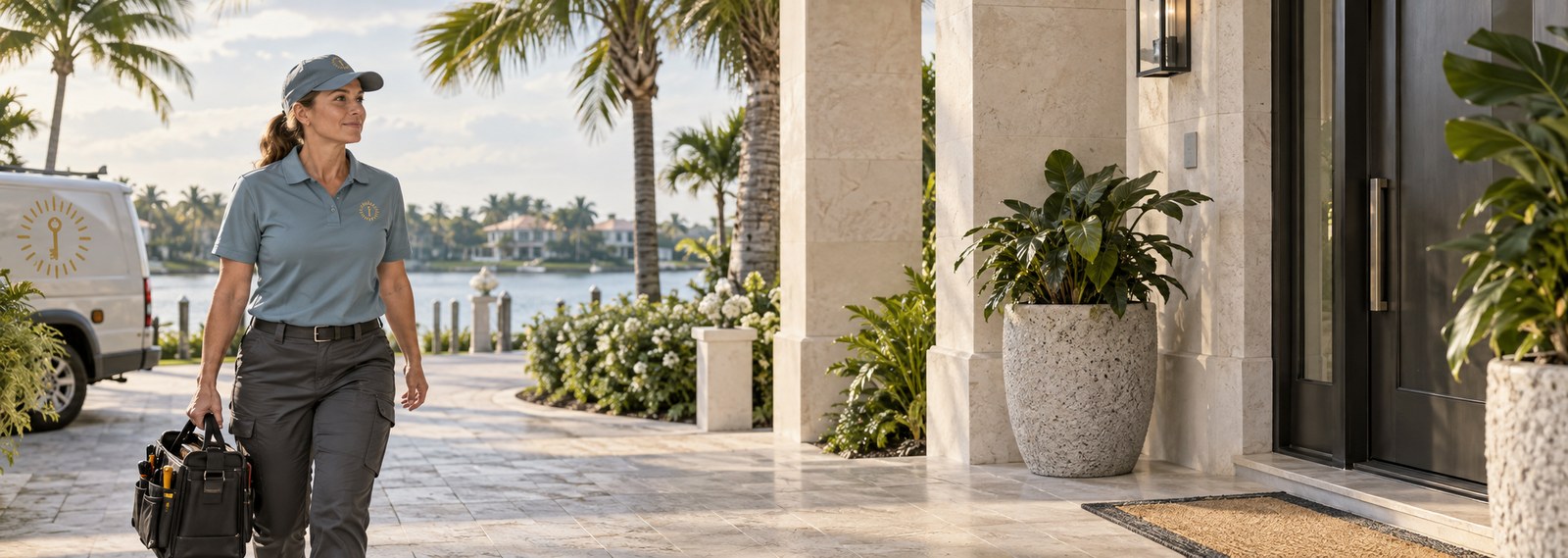
Everglades City sits at the remote southern edge of Collier County, where older buildings, fishing lodges and waterfront properties meet a long drive from the rest of Naples. Locks here face humidity, salt and age, and a service visit takes planning. This guide explains how we approach old hardware, outbuildings and long-distance calls, and how you can prepare.
A long way out, and why that shapes the job
Reaching the southern edge of Collier County from Naples means a long drive through quiet country. The road runs past farmland and wetlands, and the sense of distance is real. For a technician, that distance is part of every job. It means planning tools and parts carefully, asking more questions up front and being clear with the customer about what a visit involves before anyone sets out.
This is why detail matters so much on a phone call. Tell us what type of lock, what type of door, what the building is and what has happened. If you are not sure of the lock brand, a photo can help. The more we understand before leaving, the better our chances of completing the work in a single trip rather than returning later with something we forgot.
We are honest about the limits. We ask you to call and confirm availability, we do not promise arrival times, and we explain in advance that a complicated job may require a technician to visit first, with the service call charge explained before dispatch. Straightforward work is quoted by phone. Plain talk beats surprises, especially when the road is long.
Older buildings and the hardware they carry
Many structures near the edge of the Glades are older, and some have been modified several times. Doors may be solid wood that has swelled and shrunk over decades. Frames may be out of square. Hardware may include a mix of original mortise locks, later add-on deadbolts and a few modern replacements. Each layer tells a story, and each calls for a different approach.
Old mortise locks are sturdy pieces of engineering. They sit inside a pocket cut into the door edge and contain a latch, a deadbolt and a cylinder in one body. Many can be rebuilt, and many can be rekeyed by changing the cylinder. Replacing them with modern bored hardware means cutting the door, which is sometimes the wrong answer. A technician can often restore the original lock and keep the door's character.
When hardware is truly past saving, we explain the options. Modern mortise-style sets exist that fit the same pocket, and surface-mounted deadbolts can add security without cutting anything. We talk through what suits the building, whether it matters to preserve its appearance and how much work you want to do. There is rarely one right answer, and we lay out the tradeoffs openly.
- Rebuilding or rekeying an original mortise lock
- Adding a surface-mounted deadbolt without cutting the door
- Reinforcing worn strike plates and door edges
- Replacing tired knobs with sturdier lever sets
Fishing lodges, guest rooms and shared keys
Fishing lodges and small guest properties have a special problem: many people, many doors and many keys. Guest rooms need locks that work reliably for visitors who may be unfamiliar with them. Keys disappear into pockets and tackle bags and end up hundreds of miles away. A lodge with traditional keys needs a process for tracking, replacing and rekeying them.
A simple structure helps. Number the keys, keep a master set locked away and have a plan for what happens when a guest departs with a key. Rekeying a room costs far less effort than replacing hardware, and it restores security at once. For larger properties, a master key system lets staff open every room with one key while guests carry only their own.
If you run a lodge or a rental, keypad locks can reduce key loss, because codes can be changed between guests. Choose models that stand up to humidity and salt, and keep a mechanical backup. We can install, program and test them, and explain how to manage codes. We confirm authority with the owner or manager before changing any lock on the property.
Humidity, salt and the endless damp
This corner of Collier County is humid and close to salt water. Moisture is a fact of life, and metal pays the price. Doors swell in summer and shrink in winter. Padlocks rust shut. Screws holding strike plates loosen as the wood moves. The cumulative effect is a steady decline in how well a lock works, often unnoticed until it fails completely.
Regular care slows the process. Wipe hardware with a damp cloth to remove salt deposits, dry it, and apply a dry lubricant sparingly into the keyway. Avoid thick oils that attract dust and form a paste. Tighten screws on hinges and strikes at least once a year. These steps take minutes and extend the life of hardware considerably.
When replacement is needed, favor materials made for coastal conditions: stainless steel, coated brass and sealed cylinders. They cost more up front but last longer and reduce repeat visits, which matters when the technician has a long drive. We discuss the options by phone and let you decide how much to invest in each door.
Boat docks, storage and waterfront gear
Waterfront properties often have docks, boat lifts and storage boxes, with all the corrosion issues that come with them. A dock gate that stays unlocked invites trouble, and a storage box without a decent lock is an open shelf. Choose weather-resistant padlocks with covered shackles and sealed bodies, and replace them before they seize. We can supply and install these, and key them alike.
Boat keys and trailer hitches are another category. Marine ignition keys vary, and we cannot promise to cut every type. Call and describe yours, and we will say honestly whether we can handle it. Hitch locks and coupler locks are sensible protection for trailers parked at home, and we can recommend styles that handle the wet environment.
We do not repair boat engines, lift motors or electronics. That work belongs to marine specialists. Our part is the lock, latch and key. If a gate is damaged and a lock will not hold, we repair what we can and suggest who to contact for the rest. Being clear about our scope saves you time and wasted effort.
Lockouts when help is far away
A lockout anywhere is unpleasant, and in a remote location it feels worse. If you are locked out, first stay safe. Check whether another door or window you control is open. Ask a neighbor if they have a spare. If you must wait, make sure you have shade, water and a charged phone. Call us and tell us your location, the type of lock and what happened.
When we arrive, we check identification and some link to the property, such as mail, a lease or a utility bill. This is routine for every building. Then we open the lock using picks or bypass tools, aiming to leave the door undamaged. Older locks sometimes need more care, since worn parts can bind, and we work patiently so we do not cause more harm.
If a lock is too worn or corroded to open without drilling, we explain the choice and proceed only with your agreement. We then replace the cylinder so the door is secure when we leave. A quick fix that leaves you with a damaged lock is not helpful when the next visit is a long drive away.
Vehicle keys on remote roads
Out here, a vehicle is a lifeline. A lost key or a lockout can leave you stranded far from help. Many vehicles in the area are trucks, SUVs and older cars with a range of key types, from simple blades to transponder keys and push-button fobs. Tell us the type of key and the general kind of vehicle, and we can tell you what is possible.
We help with many lockouts and key replacements after confirming ownership or authority. We ask for identification and registration or another proof. This is a standard step. Some keys require special programming equipment, and some vehicles must go to a dealer. We say so honestly and do not make promises we cannot keep.
Prepare for the possibility of a lost key by keeping a spare in a safe place at home, not in the vehicle. A magnetic box under the bumper is a poor idea because it is easy to find and prone to rust. A trusted friend or family member can keep a copy. If your fob is worn or damaged by humidity, replace it before it fails completely.
Storms, flooding and what to do with locks
Low-lying coastal places feel storms keenly. Wind, rain and rising water can all affect a building. Locks may corrode quickly after exposure to flood water, and door frames can warp. After any flooding or heavy storm, check every lock. If a key does not turn smoothly, do not force it. Clean it, dry it and call us if the problem persists.
We do not install shutters or give storm ratings, and we make no promises about any storm outcome. What we offer is practical help with locks and keys. After a storm, we can ease swollen latches by adjusting strikes, replace cylinders damaged by water and rekey if keys were lost. We also help you reopen a building safely and calmly.
Before the season, gather your keys, label them and store copies in a waterproof container. Give a copy to someone who lives away from the coast if you plan to evacuate. Think about the order in which you will secure the property. A written checklist helps, and it makes the process more bearable when time is tight.
Seasonal visitors and empty buildings
Some properties near the edge of the Glades sit empty for part of the year. An empty building needs hardware that works without daily care. Test every lock before you leave, lubricate lightly and make sure someone nearby knows how to access the building in an emergency. Locks that sit unused tend to stiffen, and the first use after months of rest is often the hardest.
Rotate access carefully. Give each person who needs entry the key or code they require, and remove them when the job is done. A caretaker, a cleaner and a repair person do not all need permanent access. Keep a simple list of who holds what, and review it at least twice a year. When a key goes missing, rekeying is the cleanest reset.
We confirm ownership or authority before any rekeying or reprogramming. If you manage a property for an absent owner, bring a note or agreement. If you are the owner, bring paperwork showing ownership. This is routine, and it protects owners from changes made without their knowledge. We keep the process courteous and efficient.
Windows, shutters and louvered doors on older structures
Older buildings in the area often have features that are rare in new construction: jalousie windows with crank latches, wooden shutters that close from the inside, louvered doors on porches and wide plank doors with strap hinges. These are part of the character of the place, and they come with their own security quirks. A crank window cannot be locked in the way a modern sash can, and louvers admit tools as easily as breezes.
There are sensible options that respect the building. Keyed sash locks can be fitted to many wooden windows. Interior bolts and slide latches on shutters add strength without altering the exterior. A louvered door can be backed with a solid inner door or a security grille, depending on what the owner wants. We talk through what is practical, and we do not push changes that would spoil the building.
Remember that safety from the inside matters too. In a fire or storm, everyone must be able to leave quickly. Any bolt or lock we add must be easy to operate from inside without a key, unless the building has a specific reason otherwise. We balance security and escape routes carefully, and we explain the thinking behind each recommendation.
Keeping records of keys on an old property
Properties with long histories often have a drawer or jar of unlabeled keys. Nobody remembers which opens what. Some belong to locks long replaced, some to padlocks on buildings that no longer stand, and a few to something important that nobody can now identify. Sorting this out is a satisfying afternoon project, and it makes future service calls much easier.
Start by testing every key in every lock you can find. Tag the ones that work with a short code, and set aside the ones that do not. Do not throw away unknown keys at once, because one may belong to a lock you have not found yet. Photograph the tagged set, and keep the list somewhere safe. A technician can help identify what is left.
When a lock has no known key and the owner has authority, we can open it and make a new key, or rekey it so it fits a key you already carry. This reduces the number of keys and brings order to a collection that has grown by accident. Bring any paperwork showing ownership or authority, and we will take care of the rest. Along the way we label the finished set, so the next person who inherits the property knows exactly which key opens which door, shed or gate, and no one has to guess again or carry a heavy ring of mysteries.
Getting a quote and preparing for a long visit
Start with a phone call. Describe the building, the lock, the door and the problem. If you have several jobs, list them all, so we can plan one trip instead of several. Quotes for straightforward jobs are given by phone before anyone is dispatched. If the situation is complicated, a technician visits first, and the service call charge is explained before dispatch.
Prepare for the visit by clearing a path to the lock and securing pets. Have identification ready and, if you are not the owner, a letter or agreement. Give clear directions, mention gates or landmarks and let us know about parking. Remote addresses can be hard to find, and good directions save time and frustration for everyone.
We always ask you to call and confirm availability. After the work, we test every key and lock, explain what we did and offer simple care tips for the climate. If something else looks worn, we point it out and let you choose whether to deal with it. Our goal is to leave your building secure and your mind at ease.
Frequently asked questions
Can you restore an old mortise lock instead of replacing it?
Often, yes. Many original mortise locks can be rebuilt, cleaned and rekeyed by changing the cylinder. This preserves the door and its character. If the lock is beyond saving, we explain options such as a modern mortise set that fits the same pocket or a surface-mounted deadbolt.
How do you handle a lodge with many guest rooms?
We can rekey individual rooms, set up master key systems or install keypad locks that allow codes to change between guests. We recommend a written key log and a locked master set. We confirm authority with the owner or manager before changing any lock.
Do you come this far out?
Please call and confirm availability. Distance means more planning, so we ask for details about the lock and building. We do not promise arrival times. Straightforward jobs are quoted by phone, and for complicated ones, a technician visits first and the service call charge is explained before dispatch.
Humidity makes my doors stick. Is it the lock?
Often the wood is swelling and the strike is out of line. We can adjust or reposition the strike and tighten hinge screws. If the door needs planing, that is carpentry, and we will say so. Avoid forcing the bolt or spraying heavy oil into the lock.
Can you help with my truck if I lose the key?
Often, after we confirm ownership or authority. Tell us the vehicle type and key style. Some keys need special programming or dealer support, and we say so honestly. Keep a spare in a safe place at home, not hidden on the vehicle.