
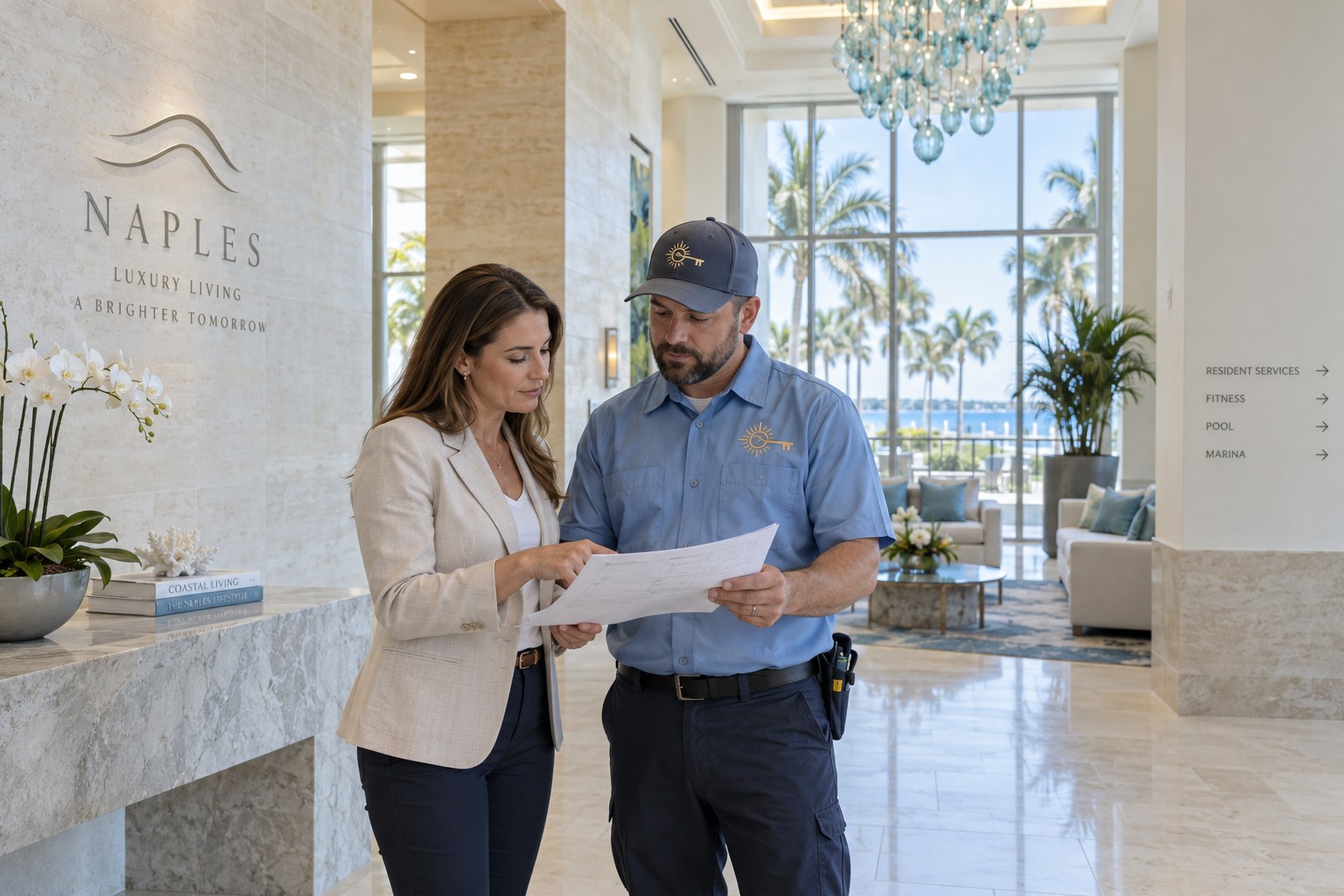
Condos and vacation units along the Bonita Springs shoreline live in some of the harshest conditions a lock can face: salt air, constant moisture, sand and a steady rotation of guests. This page explains how a mobile locksmith handles turnover lockouts, corroded hardware, key control between stays and the practical details of reaching a unit inside a building with its own access rules.
Why beachfront doors wear out faster
A door a few steps from the water gets a daily dose of salt. The air carries fine particles that settle on every metal surface, and humidity keeps them damp so corrosion never pauses. Cylinders swell with rust, springs weaken, screws seize in their holes and plated finishes bubble and flake. A lock that would last many years inland may need attention far sooner on the shoreline.
The signs are easy to recognize once you know them. A key that turns stiffly, a deadbolt that drags before it throws, a handle that feels gritty and a faint green or white crust around the keyway are all warnings. Ignoring them usually ends with a key snapping in the lock or a bolt that will not retract, often at the worst moment, such as late on arrival day.
A locksmith visiting a beachfront unit looks at the whole door, not only the lock. Hinges rust, strike plates corrode and frames swell, and any of them can cause the lock to fail. Replacing a single part rarely solves the problem if the rest of the hardware is tired, so the technician often recommends replacing the worn components together with suitable materials.
Choosing hardware that survives salt air
Material matters more than style by the water. Solid brass, stainless steel and hardware with a durable marine-grade coating resist corrosion far better than plain steel or thin plating. A lock that looks identical on the shelf can behave very differently after two summers by the Gulf, so it is worth asking what a lock is made of rather than judging it by its finish.
Sealed and shielded cylinders help as well. A design that keeps moisture and sand out of the pin chamber lasts longer than an open one, and a cover over the keyway protects it between uses. Keypad and smart locks with weather-rated housings are also sold, but they still need gaskets and batteries checked regularly, as moisture can find any gap.
No hardware is immune. A light application of a lubricant suited to locks, a wipe of the exterior with a damp cloth to remove salt and a periodic check of screws and hinges extend the life of any door. A locksmith can show you what to use and how often, so your maintenance matches the realities of a beachfront unit.
- Prefer solid brass or stainless over plated steel
- Choose sealed cylinders that keep out sand and moisture
- Rinse and wipe exterior hardware to remove salt deposits
- Replace rusted hinges and screws together with the lock
The turnover lockout
In a vacation unit, the busiest hours are the changeover hours. A guest departs, a cleaner arrives, a new guest turns up with luggage, and any one of them may find the door will not open. The most common story is a guest who steps out to the hallway, lets the door close and discovers the key card or key is inside.
Another frequent cause is a lock that behaves unpredictably. A keypad that rejects a valid code, a battery that dies between stays or a deadbolt that jams halfway can leave a tired family on the walkway with their bags. These are solvable problems, but they are better solved by a technician than by repeated attempts that may lock the system or damage the door.
If you are a guest, contact the owner or manager first, as they may be able to provide a code or a spare key. If that does not work, a locksmith can be called, though authority must be confirmed. The technician will ask for the owner's or manager's approval before opening the unit, since the guest does not control the property.
Owner and manager authority
Vacation units raise a question that regular homes do not: who is allowed to authorize a lock change or an opening? A guest staying in a unit has permission to use it, not to alter it. The owner or an authorized property manager controls the lock, and a locksmith will check with them before doing anything beyond a simple lockout.
For an owner, the process is straightforward. You explain that you own the unit, show identification or a document connecting you to it, and the work proceeds. For a manager, the technician may ask for a way to confirm authority, such as the owner's phone number or written permission. This protects the owner from someone claiming control they do not have.
In a condo building, the association adds another layer. The front door of a unit often belongs to the owner, but the building may have rules about hardware, finishes and the keys held by management. Checking those rules before a change prevents a conflict, and a locksmith can advise on what is typically allowed without making assumptions about your building.
Rekeying between guests and between seasons
Every guest who leaves with a key is a key that may not come back. Hosts who rely on physical keys face the real chance that a former guest still has one. Rekeying the lock between seasons, or after a lost key, removes that risk by making all earlier keys useless. It can be done on site, without replacing the lock.
For hosts who turn over units often, rekeying after each stay may not be practical, which is why many switch to keypad or smart locks. A code can be unique for each guest, set to expire at checkout and deleted from the system afterward. This avoids the problem of keys leaving with guests and simplifies the arrival process.
Whichever approach is used, keep a record. Note when each lock was rekeyed or each code changed, and who has access. A cleaner, a maintenance person and a property manager all need access at times, and tracking it prevents confusion. A locksmith can help set up a system that balances convenience with control.
Keypads and smart locks in a damp environment
Keypad locks are popular in vacation units because they remove the need to hand over keys. In a beachfront setting, though, they face challenges. Moisture can creep into the housing, salt can corrode contacts and sand can clog buttons. A lock that works well in a dry climate may become unreliable within a season on the shoreline.
Choosing a unit with a solid sealed housing, and installing it carefully so the gaskets seat properly, makes a big difference. The technician also checks that the bolt throws freely, since a sticky deadbolt drains batteries and strains the motor. Replacing batteries on a regular schedule, before they run low, prevents many lockouts.
Always keep a mechanical backup. Many keypad locks include a hidden keyway, and having a key stored securely, not in an obvious spot, gives you a way in if the electronics fail. The locksmith can explain how the lock behaves when power runs out and how to reset the codes if the system loses its memory.
Getting a technician into the building
Condo buildings often have a front desk, a keypad entry or a gate that requires a resident to let visitors in. A locksmith arriving for a unit needs to get through the lobby, up the elevator and along the hallway. Arranging that in advance saves time and prevents the technician standing at a door that nobody opens.
When you call, mention the building name, the address, the unit number and the floor. Tell the front desk or security that a locksmith is expected, and give the company name. If the building has a visitor system, add the technician in advance or arrange for someone to meet them in the lobby.
Parking can also be limited near the beach. Mention if there is a visitor lot or a loading area, and whether a code is needed. Beach areas can be crowded during peak season, and a technician who knows where to park arrives with less delay. A clear plan makes the visit smoother for everyone.
Balcony doors, sliders and storm shutters
Beachfront units usually include a sliding glass door onto a balcony or lanai, and these doors face the full force of salt and wind. The tracks collect sand, the rollers corrode and the latch becomes stiff. A slider that does not close and latch easily is both a security problem and a comfort problem, and it should be addressed early.
A locksmith can clean and lubricate the track, replace worn latches and add a secondary lock or pin to prevent the door from being lifted or forced. For units on higher floors, the slider is a less likely entry point, but it still matters, especially if the balcony is reachable from a neighbor's or a service area.
Storm shutters and protective panels add another layer. Their hardware also corrodes, and a shutter that jams when you need it is worse than none at all. Checking that all hardware moves freely before hurricane season, and that any locks or pins work, is a sensible habit for owners who spend time away from the unit.
Mailboxes, storage lockers and shared areas
A condo is not just a unit. Residents may have a mailbox, a storage locker, a bike rack, a beach gear room or a parking space with a lock. These small items are easy to forget until a key goes missing or a lock seizes. They also fall under different authority, as some belong to the owner and others to the association.
A locksmith can often help with personal storage lockers and private locks, after checking that the owner is requesting the work. For common mailbox banks or building-controlled rooms, the association or the postal service typically controls the locks, and a locksmith will direct you to the right place.
For items you control, keeping them on the same key as the unit reduces clutter, though some owners prefer separate keys for security. A technician can rekey locks to match or keep them different, depending on your preference. Rust-resistant padlocks suit outdoor lockers, and sealing the keyway lightly helps against moisture.
Hurricane season and leaving the unit empty
Many owners leave their units during the summer and the stormy months. Before leaving, it is worth checking the locks, the slider and the entry door. A door that sticks, a latch that barely engages or a deadbolt that needs force will become worse during a long absence, and a problem found on return is more annoying than one fixed before leaving.
Owners should also leave a key or code with a trusted person who can enter in an emergency, such as a leak or a storm warning. The arrangement should be recorded, and the access should be removed or changed when it is no longer needed. A locksmith can help set this up cleanly.
After a storm, hardware is worth checking again. Wind-driven rain, shifting frames and debris can affect locks and tracks. If a door no longer closes properly, do not force it. Call and describe what you see, and the technician can tell you what is likely and what can be done on a visit.
Making the call and what to expect
When you call, give the building or complex name, the unit number, and what has happened. Say whether you are the owner, a manager or a guest, and whether anyone has the key. If a keypad is involved, mention the brand if you know it, and say whether it shows any light or sound when you try the code.
Standard jobs such as a lockout or rekey are quoted by phone before dispatch. If the work is complicated, such as a corroded lock that has seized or a door with several failing parts, a technician visits to assess it, and the service call charge is explained before anyone is sent. Call to confirm availability.
On site, the technician confirms authority, inspects the door and carries out the work. You should leave with a lock that operates smoothly, keys or codes that work and advice on keeping the hardware in good shape. For owners of vacation units, a short maintenance routine can save many future calls.
Cleaning crews, maintenance staff and temporary access
A vacation unit is visited by more people than a normal home. Housekeepers, maintenance technicians, pool or pest services, inspectors and the owner all need to enter at various times, often without anyone else present. Each of these visitors creates a question about how they get in and whether they should keep a key afterward.
The cleanest answer is to avoid handing out permanent keys wherever possible. A keypad lock with a unique code for each person allows access to be granted and removed precisely. Where physical keys are used, a lockbox with a changeable combination keeps the key out of circulation, and the combination can be updated regularly.
When a cleaner or contractor stops working with the property, the access they held should end the same day. Rekeying the lock or deleting the code takes little time, and it removes any lingering uncertainty. A locksmith can set up a system that makes this routine, so changing access is a simple task rather than a chore.
Walkways, stairwells and exterior doors of low-rise buildings
Not every shoreline building is a tower. Many are low-rise complexes with exterior walkways, outdoor stairs and unit doors that face open air. These doors are exposed to wind-driven rain, sun and salt, and are often painted metal or fiberglass with hardware that takes constant punishment.
A locksmith visiting such a unit looks closely at the threshold and the weatherstripping, since water that seeps in can rust the bottom of the door and the lock. Paint that has peeled around the strike or hinge is a sign of trouble. Treating the metal and replacing worn parts early extends the life of the entire door.
Handles and deadbolts on exposed doors benefit from a protective coating or a better material. Replacing a rusted handle with stainless or solid brass makes a visible improvement and a practical one. For owners who rent out the unit, a door that looks well cared for also sets a good first impression for arriving guests.
Owners can also help the locksmith by noting when problems occur. A lock that fails after heavy rain, a door that sticks only in the humid months or a handle that gets worse near the end of each season gives useful clues. Sharing those patterns on the phone helps the technician bring the right parts.
Frequently asked questions
Why does my beachfront lock stick so often?
Salt and moisture corrode the metal inside the cylinder and the bolt, and sand can clog the keyway. A technician can clean, lubricate or replace the worn parts, and suggest materials such as brass or stainless that resist the coastal air. Regular wiping and light lubrication also help.
I am a guest and locked out of a vacation unit. Can a locksmith open it?
Only with the permission of the owner or authorized manager. A guest has permission to use the unit, not to control its locks. The locksmith checks ownership or authority before opening, so contact the owner or manager first and have them confirm by phone.
Should I rekey my unit between guests?
It depends on how often guests turn over. Rekeying removes the risk of former guests holding keys, but many hosts prefer keypad or smart locks with codes that expire at checkout. A locksmith can explain both approaches and set up whichever suits your rental.
Are keypad locks reliable near the beach?
They can be, if you choose a sealed, weather-rated model and install it carefully. Check batteries regularly and keep a mechanical backup key stored securely. Moisture, salt and sand can affect any electronic lock, so occasional inspection is wise.
How will I know the cost before the technician comes?
For simple jobs a quote is given by phone before dispatch. If the job is complicated, a technician visits to assess it, and the service call charge is explained before anyone is sent. Call us with the building name, unit number and the problem to confirm availability.