
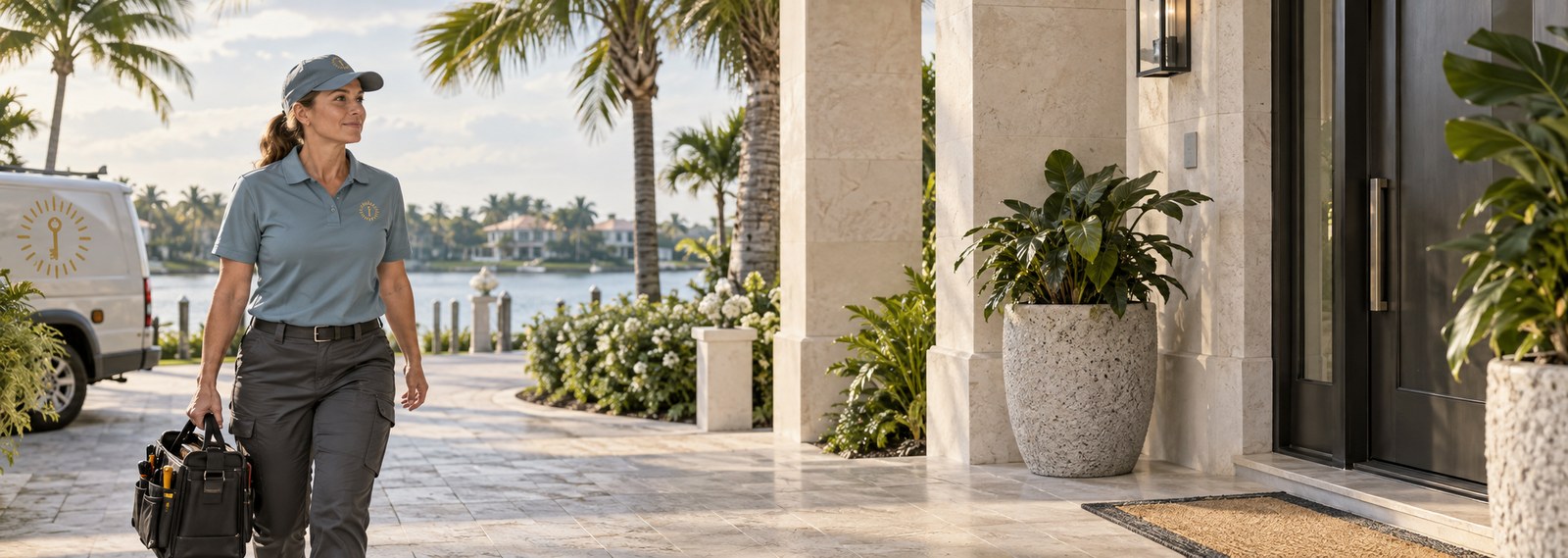
A large gated community with several neighborhoods, long internal roads and detached guest casitas asks more of a locksmith visit than a typical street. Distances are bigger, entry points are many, and no two sections look alike. This page explains how we plan a call across a sprawling community, and how to manage keys for a main house and its extra buildings.
Why a big community needs extra planning
In a community with multiple neighborhoods, the address alone may not tell a visitor where to go. Internal roads wind around lakes and fairways, sections may have their own gates, and some streets look nearly identical from one village to the next. A technician who arrives at the main entrance still has a drive ahead, and a wrong turn can take a long time to correct.
To avoid that, give us the neighborhood name, the street, the house number and any landmark that helps, such as a clubhouse, a pond or a model unit sign. If your section has a secondary gate, mention it and tell us what the gate needs. A second or third gate means a second or third call, so planning ahead saves frustration for you and for the technician.
Please also tell the main gate that a service visitor is expected, and pass along the details we give you. Rules differ between communities, so follow what your gate prefers. Call to confirm availability, and we will go over the route and the entry steps before anyone starts driving. A few minutes of preparation often shapes how smoothly the whole visit goes.
- Neighborhood name, street and house number
- Any secondary gate and what it requires
- A nearby landmark if streets look similar
- A phone number where you can be reached at the gate
Main houses and the casitas beside them
Many larger homes in golf communities include a guest casita, a detached or semi detached suite with its own door, bath and sometimes kitchen. Guests, family and rental visitors use it, and it is often left empty for weeks. A casita has its own locks, and those locks are commonly forgotten in the rest of the household security plan, even though they open into a furnished living space.
Treat the casita as a separate home when you plan keys. Decide who needs access, whether the casita should share a key with the main house, and whether guests should receive a code or a physical key. Many owners prefer a keypad lock on the casita so a code can be given and removed without cutting keys. A mechanical backup remains wise in case batteries fail.
We can rekey the casita on its own, key it alike with the main house, or build a small system in which the owner has one key that opens everything while guests have a key for the casita alone. That second approach is called a master key plan, and it takes thought. If the plan involves several doors, a technician visits first and the service call charge is explained before dispatch.
Lockouts across long distances
In a spread out community, a lockout can happen far from the door you need. You may be at the pool or the clubhouse, the car may be in a garage across the property, or the guests may be waiting by the casita. When you call us, describe where you are and where the locked door is. That prevents us from heading to the wrong spot and helps you stay comfortable while you wait.
A technician can open most standard house doors, casita doors and garage side doors with minimal marking. The first step is identifying the lock. Smart locks, mortise locks and lever handles each need a particular approach. If a deadbolt was thrown from the inside, the method differs from a simple latch. We explain what we are doing as we go, and we stop if anything suggests damage might result.
Authority is always confirmed. For a main house, identification matching the address works. For a casita used by a guest or a renter, the owner needs to authorize the opening, and we may ask to speak to the owner. If you are a guest locked out of a casita, contact the owner or manager and ask them to call us. This is how we protect homes that people are only visiting.
Master key plans and keyed alike sets
A master key plan is a system in which one key opens many locks, while each lock also has its own key that opens only that one. In a home with a main house, casita, garage, pool house and storage, it can bring order to a heap of keys. The owner carries a single master, a caretaker holds a key for specific buildings, and guests receive a key for only their space.
Setting this up requires compatible lock cylinders. Many standard cylinders can be keyed into a master system, though some hardware cannot. The technician checks each lock and tells you which ones can be included and which should be replaced. Planning on paper first avoids mistakes. A simple chart of doors, keys and holders makes the system easy to maintain years later.
A simpler alternative is keyed alike, where several locks open with the very same key. This works well for a main house with a garage and a lanai, where everyone with access should enter all doors. It is less flexible than a master system but easier to set up. We discuss both, explain the tradeoffs, and let you pick the structure that suits how your household and guests really behave.
Garage doors, golf carts and extra storage
Homes with golf course frontage commonly have garages that hold cars, carts, bikes and gear. The overhead door and its keypad carry the main burden, and the interior door to the house receives constant use. In larger homes there may be several bays, with a separate door for each, and sometimes an extra storage room attached to the garage. Each opening needs consideration in your key and code plan.
Resetting garage keypad codes is an easy habit that closes a common gap. When landscapers, contractors and house cleaners come and go, codes spread. Change them periodically, and certainly after any large project. Interior doors from the garage should lock every time you leave. If you have a pattern of leaving them open for convenience, a keypad deadbolt can make locking effortless.
Storage rooms and utility closets may have simple privacy latches. If they contain tools, chemicals, bicycles or valuable equipment, a real keyed lock is worth the modest effort. We can fit a deadbolt or a sturdy keyed lever and set it to match your other keys. Where a door is metal or hollow, we check the frame as well, since a strong lock in a weak frame offers little protection.
Seasonal homes and returning owners
Plenty of homes here are occupied for part of the year. The house stands quiet through the summer and wakes up in the winter. A locksmith can help at both ends of that cycle. Before you leave, check every lock, confirm that spare keys are accounted for, and decide who will have access while you are away. When you return, do a quick walk through of every door.
Absence is a good moment to reconsider access. If a caretaker, a cleaner or a property manager has keys, make sure you know who has what. If a contractor finished a project during the off season, ask for the keys back or rekey. A clean reset takes little time and removes doubt. Many owners schedule rekeying at the start of each season as part of their routine.
Electronic locks need special attention in long absences. Batteries drain even when a lock is not used much. Replace them before you leave, and keep a mechanical key where a trusted person can reach it. Test the keypad when you return and review the code list. If you prefer to manage access from afar, we can describe the options, keeping in mind that every connected device needs maintenance.
Rental guests and short stays
Some owners host guests, family or short term renters in a main house or casita. Guest access creates a repeated key problem: keys are handed out, lost, copied and never returned. The result is a home with many unknown copies. For hosts, the cleanest approach is a keypad lock with individual or rotating codes, or a lockbox that is rekeyed or reset between stays.
If you use a physical key, track each set and ask guests to return them. Rekeying between long stays is a reasonable precaution, especially after a guest reports losing a key. A rekey is quick and leaves the hardware untouched, so the next guest finds a perfectly ordinary door. We can work out a routine that suits how often the property changes hands.
Local rules on short term rentals vary, and we do not give legal advice. We simply help with the lock side of the arrangement. As ever, we confirm that you own or manage the property before changing any lock. If a manager acts for the owner, we ask for a clear statement of that authority. These checks keep legitimate work moving while protecting everyone's homes from misuse.
Entry doors, pivot doors and heavy hardware
Larger golf homes often feature tall entry doors made of wood, glass or iron, sometimes hung on pivot hinges. These doors weigh a great deal, and the hardware is built accordingly. When they sag or bind, the latch no longer meets the strike, and the door either cannot be locked or locks only with pressure. Treating the door and the lock as one system leads to better repairs.
A technician checks the hinges or pivot, measures the gap around the door, and looks at the strike. A small adjustment can restore smooth operation. If wear is serious, a heavier hinge or a rebuilt strike may be needed. We always explain what we see and what the fix involves. Specialized hardware can have a lead time for parts, so we advise calling early about changes you notice.
When fitting new locks on a grand entry, the decision between a lever and a knob, a mortise lock and a bored lock, and a standard cylinder and a high security cylinder is partly aesthetic. Choose hardware that suits the door and your habits. We can show examples and talk through how each behaves in a humid coastal environment, including the finish options that stand up best.
Vehicles, fobs and larger households
Larger households often keep several vehicles, each with its own key type and its own pattern of loss. A teenager forgets a fob, a spouse drops a key in the course, and a guest uses a borrowed vehicle. We help with lockouts, spare keys and programming at your location. A technician can usually cut and program keys on site for many vehicle types without towing.
Before we begin, we check ownership or authority, looking at identification and a registration, title or rental agreement. For a vehicle owned by a business or a family member, the person who owns it may need to approve by phone. This is part of the routine and does not signal distrust. It simply stops a vehicle from being opened or programmed for the wrong person.
Keep a spare for every vehicle, stored where you can reach it. If your only key is the one in your hand, consider adding a second before you need it. Mention the make and key style when you call, and tell us if the buttons have been unreliable or the case has cracked. Fobs wear out like anything else, and replacing a worn one early avoids a difficult day.
Humid air, golf course irrigation and exterior hardware
Homes next to fairways deal with sprinkler overspray, humidity and frequent summer storms. Water on door hardware leaves mineral deposits that dull finishes and creep into lock cylinders. Exterior locks near irrigation heads may need to be rinsed and wiped more often. If you notice crust on a handle or a rough turn, the cylinder may need cleaning before it fails.
Choose hardware rated for outdoor exposure where you can. Solid brass, stainless steel and coated finishes resist corrosion better than basic plating. Replace worn weatherstripping so that water does not run into the lock area. A technician can check these small points during any visit, and can recommend whether a lock deserves a cleaning, a lubrication or a full replacement.
After heavy rain or storm conditions, inspect the doors. Check that nothing is swollen, that latches catch cleanly and that sliders move easily in their tracks. Clear sand and debris. If a door has shifted, call before the issue grows. Small adjustments are simpler than repairs after a failure, and a few minutes each season keep your entries secure and pleasant to use.
Keeping a written record of keys and codes
A property with a main house, a casita, a garage and several outdoor gates quickly outgrows anyone's memory. Who has a key to the casita? When was the garage keypad code last changed? Which key opens the pool equipment room? A single sheet of paper, kept somewhere private, answers all of these and takes less than an hour to create. It also helps any technician who visits to understand your setup.
A good record lists each door or gate, the type of lock, the key number or code, the people who hold access and the date of the last change. Update it whenever something changes. If you use a master key plan, the chart is essential, because the structure is otherwise invisible. Keep a copy with a trusted family member or in a secure document folder.
We are happy to help you build this record during a visit. Walking the property with a technician usually reveals forgotten doors and locks that nobody has rekeyed in years. The exercise often leads to a short and sensible plan: rekey a few locks, replace one or two that are worn, and set up a clear system going forward. You remain in charge of every decision.
What to expect when we arrive
After you call, we confirm the details and give a quote by phone for straightforward work. If the job is complicated, such as several buildings or a master key plan, a technician visits first and the service call charge is explained before dispatch. You then decide whether to proceed. We do not start work without your clear agreement, and we welcome questions.
When the technician arrives, identification and authority are checked, the lock or vehicle is examined, and the plan is described in plain language. Work proceeds carefully, protecting finishes and glass. You are welcome to watch and ask questions. If something unexpected appears, such as a damaged frame, we pause and talk it through with you before changing the plan.
At the end, you test every lock, try each key, and review any codes. We suggest keeping a simple record of keys and holders, especially for a property with several buildings. If anything feels wrong, say so before the technician leaves. We would rather make a quick adjustment on the spot than have you discover a problem later at an inconvenient moment.
Frequently asked questions
Can you work on a guest casita separate from the main house?
Yes. A casita has its own locks, and we can open, rekey, repair or replace them, and key them to match the main house if you like. We confirm ownership or authority first, so if you are a guest, we will need the owner to authorize the work.
What is a master key system and do I need one?
A master key system lets one key open many locks while each lock also has its own key. It can suit a property with several buildings and different people needing different access. For a simple home, keyed alike locks or ordinary rekeying may be enough. A technician can explain which suits you.
How do you find the right house in a big community?
Give us the neighborhood name, street, house number and any landmark. Mention any secondary gate and what it requires. Let the main gate know a service visitor is expected. A little detail up front prevents wrong turns and saves time for everyone involved.
Can you help with a keypad or smart lock on the casita?
Yes. We install and set up keypad locks, help you create and remove codes, and explain battery care. We suggest a mechanical key backup in case the batteries run out. A technician checks the door first to be sure the lock you choose fits it properly.
How are larger jobs quoted?
Simple jobs are quoted by phone. For complicated ones, a technician visits and the service call charge is explained before dispatch. You get a clear plan before any work begins. Please call to confirm availability for the time that suits you, and we will talk through the details.