
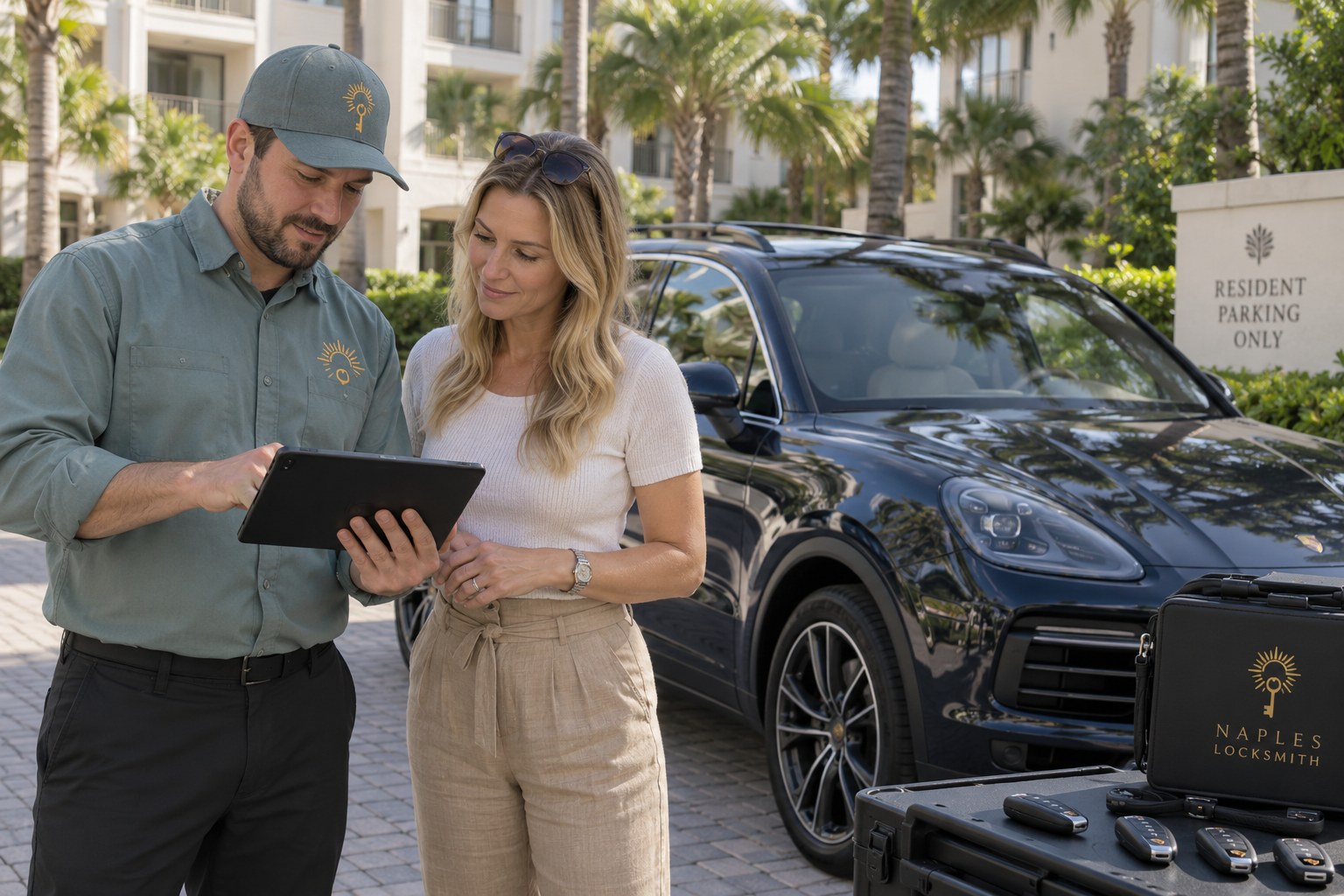
Plenty of owners in Collier County keep a car, a truck or a golf cart at a seasonal home, ready for the next arrival. Guests, cleaners, property managers and family all want access at different times. This page covers how to plan spare keys, hand them off safely, use lockboxes sensibly, and keep track of who holds what.
Why a vehicle at a rental needs its own plan
A vehicle left at a second home faces a different life than one in daily use. It may sit for weeks, then suddenly be needed by someone who has never driven it. The key may be in a drawer in another state, in the pocket of a cleaner, or in a lockbox no one remembers the code to. Each of those is a problem waiting for the wrong moment.
Owners who rent out their property add another layer. Guests may be allowed to use a vehicle, or the car may simply be parked in the garage where visitors pass by. Every extra person who knows the car exists is a person who might look for the key. Planning ahead keeps the situation tidy.
The goal is straightforward: enough keys to cover the people who legitimately need access, a method of passing them along that you control, and a record that tells you where each key is. That is a modest system, and it is easier to build before something goes wrong than after.
This page walks through the pieces in a sensible order, starting with how many keys you really need.
Deciding how many spares make sense
Count the people who need to drive the vehicle. That might be you, a spouse, a property manager, a caretaker and an occasional family member. For each, ask whether they need their own key or can borrow one when needed. Giving everyone their own key is convenient but multiplies the number of copies in circulation.
A reasonable starting point is three: one with you, one at the property in a secure place and one with a trusted person nearby. Anything beyond that should have a purpose. Each extra key is another item to track and another possible loss.
Think also about key types. Some vehicles come with a full key and a limited valet key that opens the door and starts the engine but not the trunk or glove box. A valet key can be a good option for a caretaker or guest, as it limits what they can access.
If the vehicle is a golf cart or a utility vehicle, the key is usually simple, but the same logic applies. Carts are easy to start with a copy, and a lost cart key can be as inconvenient as a lost car key.
Making spares from a working key
The easiest time to make copies is when you have a working key. A technician cuts new blades, programs transponder chips and pairs remote buttons, all while the original is on hand. Plan this for a visit when you are at the property, not by mail from far away.
If you are away, a trusted caretaker can meet the technician, provided the owner authorizes the work. The locksmith checks ownership or authority before cutting or programming, so be ready to confirm by phone with the person who is present. A short call is usually enough, and you can speak to the technician directly.
Bring the existing key and tell us the make of the vehicle. For a transponder car, expect a visit of about an hour for programming. For a simple metal key without a chip, copies are quick. A cart with a basic ignition may take only a few minutes.
Test each key before the technician leaves. Start the engine, run it, lock and unlock the doors, and operate the trunk. Do not accept a key that has not been tested in every way you plan to use it.
- Confirm how many keys exist now and where each one is
- Decide how many spares you truly need
- Have the owner or an authorized person present or reachable
- Test every function of every new key before the visit ends
Lockboxes: useful, but not magic
A lockbox is a small box with a code that holds a key. Mounted at a property, it allows a guest, cleaner or manager to retrieve a key without meeting anyone. For vacation rentals, that convenience is the main appeal, and a good lockbox is better than hiding a key under a flowerpot.
Choose a sturdy model made for outdoor use. Coastal air is rough on cheap boxes, and a unit that corrodes can jam with the key inside. Mount it where it is not obvious to passersby but is easy for authorized people to find. Avoid placing it on the vehicle itself.
Change the code regularly. Many owners change it after each guest or each season. A code that never changes is a key that never stops working for anyone who has ever known it. Keep a list of who knows the code at any time.
Remember that a lockbox protects a key, not a vehicle. If the vehicle is valuable, consider whether a lockbox at the property is appropriate, or whether the key should be handed over in person.
Handing off keys in person
Face to face handoffs are slower but safer. When you give a key to a manager, a cleaner or a family member, you can explain how the vehicle works, where it should be parked and what to do if something goes wrong. You also see who receives it, which adds a human check.
Write down the date, the person and the key. A simple notebook or a note on your phone works. If you have several keys, label them with a small tag that does not reveal the address or the vehicle. A tag that says which key is which is useful, but a tag with a street address is dangerous if lost.
When a person finishes their role, collect the key back and cross it off your list. Do not rely on memory. A manager who leaves, a cleaner who changes jobs or a guest who departs can all take a key out of circulation by accident.
If getting a key back is not possible, consider whether the vehicle's system can be updated so that key no longer starts the engine. That is often an option on transponder vehicles, and the technician can explain it.
Tracking who has access
A short log solves most problems. List each key by number, note who has it, the date they received it and the date it returned. Keep the log somewhere you can reach from anywhere, such as a shared note or a spreadsheet. Update it each time a key changes hands.
If you work with a property manager, ask for a copy of their key records. Professional managers usually keep tidy logs, and comparing yours with theirs shows gaps early. If they use their own lockboxes, ask how the codes are handled and how often they are changed.
Consider adding a tracker to a spare key, a small device that can be located by phone. It will not open a door, but if a key goes missing, you know roughly where it is. For keys that move between several people, that extra information can save a lot of stress.
Review your records every season. Keys drift, people change and codes become stale. A quick check at the start of each season keeps the system honest and flags anything that needs replacing.
Ownership and authority at a second home
When you ask a locksmith to make keys, they check that you own the vehicle or are authorized by the owner. This is true whether you are at home or at a vacation property. A registration, a title or a bill of sale together with photo identification usually does the job.
If the vehicle is registered in another state, that is fine. Out-of-state registrations are common in Southwest Florida, and a locksmith can work with them. If the vehicle belongs to a company, a trust or a family member, bring documents or be ready to put them on the phone.
If you are not present and a caretaker meets the technician, the caretaker needs authority. A clear phone call from the owner, with the technician speaking directly to them, often resolves it. Some owners prefer to send a written note, but the call is usually more reliable.
If the paperwork is not available, the work waits. This can be inconvenient when you have flown in for a short stay, so check your documents before you travel. A digital copy on your phone is a good backup.
Salt, sun and storage at a coastal property
A vehicle stored near the water faces extra hazards. Salt air corrodes keys, locks and electrical contacts. Heat inside a closed garage can warp plastic and drain batteries. A key left in a drawer for months in humid air can develop green corrosion on its contacts.
Store spare keys in a dry, cool place, ideally in a small sealed bag with a silica packet. Avoid leaving them in a hot car or on a windowsill. For fobs, take out the battery if the vehicle will sit unused for a long season, and label the battery so it does not get lost.
Test the keys at the start of each season. Start the vehicle, use the remote and check that everything works. A fob that has been sitting may need a fresh battery, and a lock that has been closed up may stick.
If you are heading north for the summer, consider leaving the vehicle's battery on a maintainer and keys in a secure place. A little preparation at the end of the season prevents trouble at the start of the next.
If a key goes missing at the property
A lost key in a rental setting raises a security question. Someone may have it who should not. The sensible response is to find out when it was last seen, who had access since and whether the vehicle shows any sign of use. Check mileage, fuel and fittings against your last visit.
If you cannot be sure the key is safe, ask about reprogramming. On many vehicles, a technician can remove old keys from the car's memory and program new ones, so a missing key no longer starts the engine. The physical door lock may also be rekeyed on some vehicles.
Tell your manager and anyone else involved. If a guest or a cleaner had access, ask politely whether they have seen the key. Most losses are innocent, but being open about it helps recover keys sooner.
A technician may need to visit to assess a complicated situation, and the service call charge is explained before dispatch. Quotes for standard work are given by phone, so call us with the details.
Building a simple routine
Pick a date at the start of each season and run through a short checklist. Count your keys, test each one, change the lockbox code, update the log and replace weak batteries. The whole routine takes an hour or two, and it removes most surprises.
Keep a printed card at the property with the vehicle information, a contact for your manager and a note about where spares live. Do not put anything on the card that identifies the key locations to strangers. Share the card only with the people who need it.
If you ever sell the vehicle, collect every key first. Note how many exist and make sure all are returned. If a key is missing, consider reprogramming before handing the car to a new owner.
A tidy, boring system is what you want. Nothing interesting should happen with your keys. When your system works, the only evidence is that nobody ever has a problem.
Golf carts, low-speed vehicles and other things with keys
In Collier County many second homes come with a golf cart or a low-speed neighborhood vehicle, and owners sometimes forget these when they count keys. A cart key is small, easy to lose and often identical to dozens of others made by the same manufacturer, which means a stranger's key may start your cart. That is both a convenience and a weakness.
If your cart or utility vehicle uses a common key pattern, a locksmith can cut copies quickly, or replace the ignition switch so that a unique key is needed. The second option is more involved but gives you real control, particularly if the cart is parked in a shared area or left outdoors overnight.
Also think about boat trailers, storage lockers and gate remotes tied to the same property. They are not vehicles, but they often live on the same key ring. Sorting them into separate rings, each with its own record, makes handoffs cleaner and reduces the chance that a guest leaves with more access than intended.
Guests who borrow the car
Some owners let guests use a vehicle as part of the stay. If that is your plan, think through the details. Who is allowed to drive, what insurance applies, and how will the key be handed over? Insurance questions belong with your insurer, not a locksmith, but the key side is simple enough to plan in advance.
A dedicated guest key, separate from your own, is the sensible approach. Label it clearly, put it in a lockbox or hand it over at check-in, and collect it at departure. If the guest loses it, you know exactly which key is missing, and you can decide whether to reprogram the vehicle to cancel it.
Walk guests through the basics: how the doors lock, how the engine starts, whether the car locks itself and where the spare is not. A short printed note in the car or the kitchen prevents the most common lockouts and saves a stressful call during someone's holiday.
Preparing for a visit from the locksmith
Before the technician arrives, gather everything in one place: the working key, the registration or title information, your identification and, if you have it, the owner's manual. Clear a little room around the vehicle so doors can open fully, and make sure the garage or driveway is accessible. If the property is in a gated community or a condominium, arrange entry with the guard or management ahead of time.
Write down any odd behavior the vehicle has shown, such as a slow start, a flickering dashboard light or a door that sticks. The technician can address related issues while on site, and some problems, like a weak car battery, can interfere with programming. Mentioning them early avoids surprises.
Finally, decide how many keys you want and what types. Ask about a spare fob, a valet key and a plain emergency blade. The technician can explain what your vehicle supports and what each option involves, so you leave with a set that fits your actual plans.
Frequently asked questions
How many spare keys should I keep for a vehicle at a rental property?
A common starting point is three: one with you, one stored securely at the property and one with a trusted person nearby. Add more only if there is a clear reason. Each extra key is another item to track and another chance for loss. A limited valet key can suit caretakers who only need basic access.
Are lockboxes safe for vehicle keys?
They can be, if you choose a sturdy outdoor model, mount it out of obvious sight and change the code regularly. Coastal air can corrode cheap units. A lockbox protects a key, not the vehicle, so for a valuable car you may prefer to hand the key over in person and log who has it.
Can a caretaker meet the locksmith if I am out of town?
Yes, as long as you authorize it. The locksmith checks ownership or authority before cutting or programming, and the owner can confirm by phone with the technician. Have your registration or title information ready. Call us to confirm availability and talk through who will be present.
What if a spare key goes missing at the property?
Find out when it was last seen and who had access. On many vehicles, a technician can reprogram the system so the missing key no longer starts the engine. The physical lock can sometimes be rekeyed as well. Call to discuss what your specific vehicle allows.
How do I get a price for making spares?
Quotes for standard key work are given by phone after you describe the vehicle. If the job is complicated and a technician needs to visit in person to assess, the service call charge is explained before dispatch. If the actual vehicle differs from the description, any change is explained before work begins.