
It happens on the best days. You wade in for a swim, a wave knocks you sideways, and when you walk back to the car the key is gone from your pocket. This page covers what to do next: a sensible search along the shoreline, what salt water does to modern keys, and how a replacement is made on site at the beach.
That sinking feeling at the car door
You come up the boardwalk with sandy feet, a damp towel and a cooler, reach into your pocket for the key and find nothing. Maybe it was in your swim shorts, maybe in a small zipped pouch, maybe in a beach bag that tipped. The sun is high, the car is hot and the phone, if it survived, is the only tool you have. Take a breath before you do anything else.
Start with the simple possibilities. Check every pocket, bag and towel fold. Look inside the cooler, under the chairs and in the cup holder of the umbrella. Retrace your path from the water to the car, scanning the sand. Ask your companions whether anyone saw it fall. A fob has a bright plastic shell that often shows when it sits on the surface.
If it truly is gone, you are facing two tasks: finding out whether the key can be recovered, and arranging a replacement. These can happen together. While one person searches, another can call for help. Staying calm and organized will save time, and it keeps a bad moment from turning into a ruined day at one of the area's loveliest places.
Searching the shoreline sensibly
A methodical search beats a frantic one. Begin where you last remember having the key and fan outward. In shallow water, move slowly in lines, feeling with your feet and watching the bottom through clear water. Currents and waves shift small objects, so the key may be a short distance away from where it dropped. Ask other beachgoers if they have seen a key, and mention it to a lifeguard or a beach attendant if one is nearby.
Some people have luck with a hand scoop or a sand sifter, the sort used for shells. Dragging fingers through the sand in the area where you were standing can also reveal a key buried just under the surface. Be careful around shells, broken glass and marine life. Wear protective footwear if you can, and do not wade into water that looks unsafe, rough or crowded with boats.
Set a limit. Searching for a half hour is reasonable, and after that the odds fall. The Gulf tends to move sand and small items daily. If the key was lost in deeper water or in a strong current, recovery is unlikely. At that point, put your energy into replacement. Take a note of the time and place, in case someone turns the key in later.
What salt water does to a modern key
If you do find the key, do not assume it works. Salt water is far more damaging than fresh. It conducts electricity, corrodes metal, and leaves crystals when it dries. A modern key with a transponder chip or a remote circuit can short out, corrode or lose its battery connection in a short time. The key may look fine, then fail the next day.
A basic metal blade is more forgiving. Brass and nickel silver resist corrosion better than steel, though salt can still leave marks. A blade that has been in the water can usually be rinsed, dried and used. But a key with electronics inside needs more care. Rinse it gently in fresh water, remove the battery if the case opens, and let it dry thoroughly in a ventilated place.
Do not put a wet fob in rice or in a hot oven, and do not use compressed air at high pressure. Heat can damage the plastic and warp the board. Even after careful drying, a fob that has been submerged in the Gulf may fail later. If you recover it, treat it as a temporary key and ask a technician about a fresh spare as soon as possible.
- Rinse recovered keys in fresh water, not salt
- Open the case and remove the battery if possible
- Dry slowly in open air, away from direct heat
- Plan on a spare, since submerged electronics often fail later
Why the car may not open or start
Without the key, you cannot unlock the door with a remote and you cannot start the engine. Some vehicles have a keyhole on the door, which can sometimes be used with a spare blade, but that does not help if you have no key at all. Push-button vehicles will not start without the fob close by, and there is no way around that without a replacement.
Modern vehicles carry immobilizers, security systems that recognize your specific key. This protects the car from theft, but it also means a new key must be programmed before it works. A plain cut blade will turn the lock but will not start the engine on most vehicles. That is why a trained technician with the right equipment is needed.
Do not try to force your way in or hot-wire the car. Doing so can set off alarms, trigger an engine lockout, damage wiring or break the window. Anything that harms the vehicle will add cost and delay. The cleanest path is to wait for a technician who can open the car without damage, check ownership and create a new key right where you are.
Getting a replacement made on site at the beach
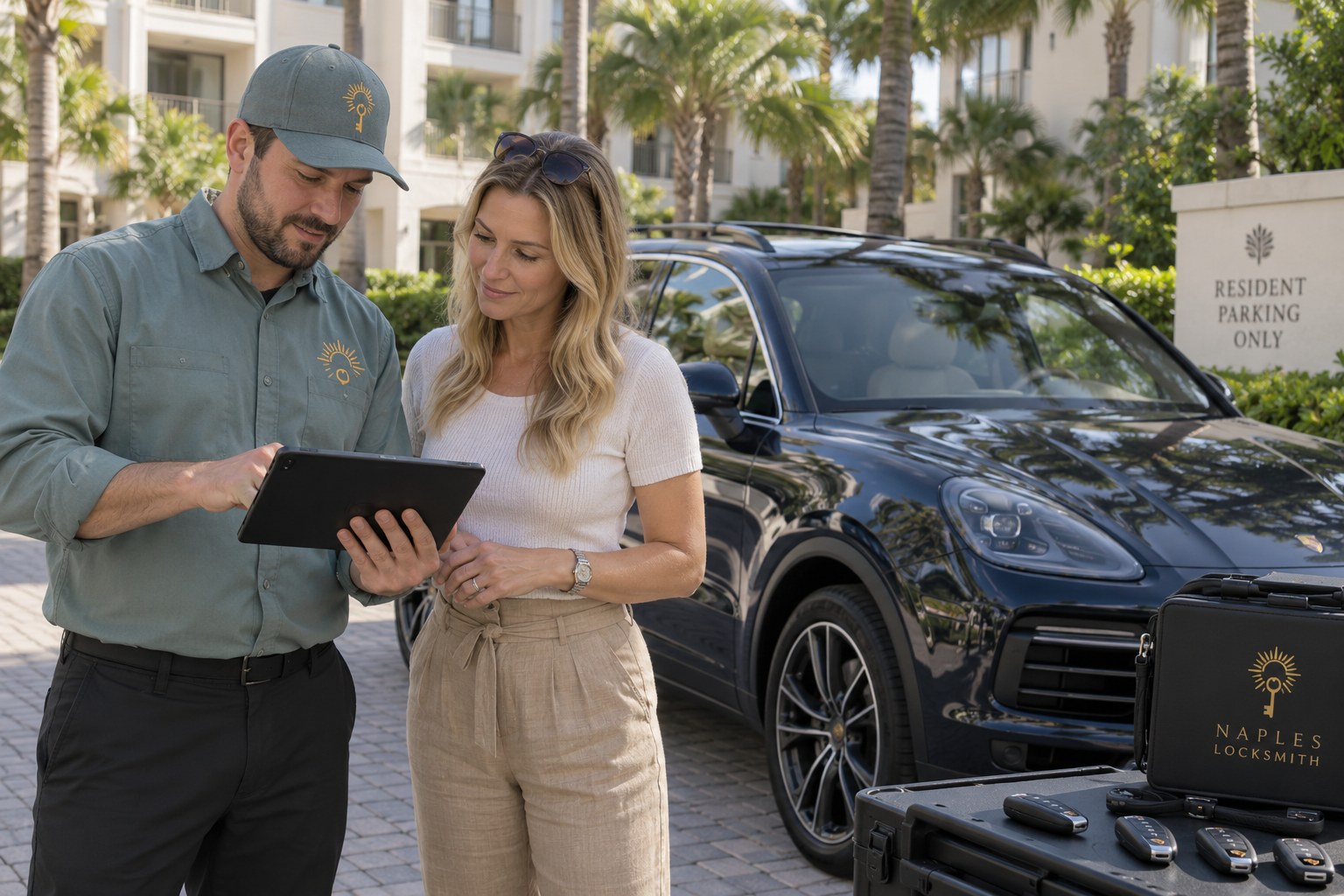
A mobile locksmith comes to you, whether you are at a public beach lot, a parking area near a pier, a condo beach club or a driveway near the water. The technician carries portable key cutting machines and programming tools. After confirming ownership, they open the car if needed, cut a new key by code or from the lock, and program the electronics so the engine will start.
The process takes patience, and conditions on the coast add small challenges. Wind blows sand into equipment. Bright sun makes screens hard to read. Heat can affect batteries and tools. A technician will often set up in the shade of the vehicle or a shelter to protect the machine, and may ask if you can wait nearby in a cooler spot.
Tell us which beach or lot you are in, and describe how to reach you. Parking fees, time limits and access gates can all matter. If the lot has a guard or a toll booth, let them know a locksmith is coming. Please call us to confirm availability and to discuss the plan. We will explain what is likely to happen once we know your vehicle.
Proving the car is yours when everything is in the water
Ownership has to be confirmed before any key is made, and a beach day makes that harder, because wallets and papers may be in the car or lost with the key. A technician will ask for photo identification and proof the vehicle is yours. A driver license in a dry bag or phone case is ideal. Registration may be in the glovebox, which is locked.
If your documents are in the car, tell us. A photo of the registration on your phone, an insurance app, a rental agreement email or a lease document may be acceptable. The name on the identification should match the registered owner. If the car belongs to someone else, such as a friend, a family member or a rental company, we may need that person's confirmation.
Seasonal visitors and tourists sometimes arrive with out-of-state registration, a rental car, or a borrowed vehicle. These are all workable if the paperwork is clear. If you are in a rental, contact the rental company, since they may have their own procedure for key replacement. We can tell you what we need to see when you call, so you can gather it while you wait.
Waiting in the heat: comfort and safety
A beach lot in the middle of the day is hot, with little shade and hot asphalt underfoot. Find a shaded spot, drink water and cover up. Sunburn, heat exhaustion and dehydration are real risks, especially after a morning of sun and swimming. If anyone in your group feels dizzy, nauseous or unwell, move them to shade and seek help.
If children or pets are with you, keep them out of the hot car and out of direct sun. Never leave anyone in a closed vehicle, even briefly. Many beaches have public restrooms, shaded pavilions or nearby shops where you can wait in comfort. Let the technician know where you are, with a landmark that is easy to find.
Afternoon thunderstorms are common in the summer. If lightning threatens, get off the beach and into a building or a hard-topped vehicle if you can safely do so. If your car is locked and you cannot get in, a nearby shop, a pavilion or a restroom is the best shelter. Tell the technician if conditions change, so they can plan the visit accordingly.
Keeping the next key safe at the beach
There are better ways to carry a key near water. A small waterproof pouch worn around the neck or clipped to a swimsuit keeps it dry and attached to you. Floating key rings are inexpensive and fit most keys. Another approach is to leave the key in a locked bag with a companion who stays on the sand, or to use a lockbox mounted on the car, if you have one and it is suitable.
Consider how your key is built. A key with a large electronic head is more vulnerable than a plain metal key. Some drivers keep a basic metal key for beach days, but only if their car supports one. A technician can tell you what is possible with your vehicle. In some cases a valet key or a simple blade can open the door and start the engine on certain cars.
Whatever you choose, a spare helps. Having a second key at home or with a trusted person means a lost key is an inconvenience rather than an emergency. If you are a seasonal resident, ask a neighbor to hold a spare. And consider getting a spare made now, before your next trip to the shore.
Marking the spot and thinking about who else might find it
A key lost in the sand or surf may be found by someone else. If the key is a smart fob with a logo, a finder may be able to tell the make of your car. If you left a parking pass, a tag or an address on the key ring, a stranger could connect it to you. It is worth considering this when deciding how much to do after a loss.
A technician can sometimes remove the lost key from the car's memory when programming a new one, so the missing key will no longer start the engine. Not every vehicle allows this, but many do. It is a sensible step if the key is in the water and cannot be recovered. Ask the technician what your car allows.
If your house keys were on the same ring, treat that as a separate problem. A house key lost with an address clue is worth addressing with a rekey of the home. A locksmith can discuss that too. The safest approach is to treat the loss as potentially permanent, and to make decisions on that basis rather than hoping the key will turn up.
What to expect when you call
Call us from the beach, if your phone is dry. Tell us the lot or beach access you are in, the vehicle, and what has happened. Mention whether you can reach your documents and whether you have any key, even a broken one. We will explain the process and give you a quote by phone. Please call to confirm availability.
The technician arrives, confirms ownership and opens the car if needed. They cut the key and program it to the vehicle, then test the doors, the ignition and the remote functions. If you want a spare, it is easiest to add one during the same visit. Everything is explained as it happens.
If the vehicle is complicated, or the location makes the work difficult, we will say so early. If the job is complicated, a technician visits and the service call charge is explained before dispatch. Then you can put the keys somewhere safe, rinse the sand from your feet and drive home from what was, after all, a good day at the beach.
Getting home and dealing with the rest of the day
Once a technician has made your key, there are a few loose ends. Rinse sand and salt from your feet and your belongings before you get into the car, since salt left on a leather seat or a pedal area can leave marks. Keep the new key separate from damp items, and put it somewhere dry. A pouch in a cup holder is better than a wet pocket.
If your phone, wallet or house keys were lost along with the car key, make a short list of what else needs attention. House keys on the same ring may call for a rekey of the home. Credit cards can be frozen by phone. Rinse a phone in fresh water only if it is rated for it, and otherwise keep it powered off and dry until you can have it checked.
Take a moment to think about the other people in your group. A beach day with children or older relatives can wear thin when the car will not open. Find shade, share water and keep everyone calm. Often the memory of the afternoon becomes a small story rather than a ruined outing, particularly if the sunset on the drive home is a good one.
One last practical note: when a technician programs the new key, ask for a spare in the same visit. A second key made now costs far less effort than a repeat of this afternoon, and you can leave it at home or with a trusted friend so the next beach day carries less worry, whatever the surf decides to do with your pockets.
If the beach lot is busy, tell us which section you parked in and describe your car by color and type. In a crowded lot, a clear description helps the technician find you quickly without wandering among rows of sandy vehicles in the sun.
Frequently asked questions
If I find the key in the water, will it still work?
It might, but do not count on it. Salt water corrodes electronics and drains batteries. Rinse the key in fresh water, open the case if possible, and let it dry slowly. Even if it works at first, it may fail later, so plan on a spare. A plain metal blade usually recovers better than a fob.
Can a new key be made right at the beach lot?
Often yes. A mobile technician brings portable cutting and programming equipment to the location, confirms ownership, opens the car if needed and creates a working key. The details depend on the vehicle. Tell us which lot or access you are at, and please call to confirm availability.
What if my wallet and registration are in the locked car?
Tell the technician. A photo of the registration on your phone, an insurance app or a rental agreement can sometimes serve. Photo identification is expected. If the vehicle belongs to someone else, we may need their confirmation. We explain what is acceptable when you call so you can prepare.
Will the lost key still start my car after a new one is made?
On many vehicles the technician can remove the lost key from the car's memory so it no longer starts the engine. Not every vehicle supports this. If you are worried about a key in the water or sand, ask the technician what your car allows.
How is a price given for a beach lot visit?
Quotes are given by phone once we know the vehicle and the situation. If the job is complicated, a technician visits and the service call charge is explained before dispatch. Ownership is confirmed before any key is made. Call us with your location and vehicle details.