
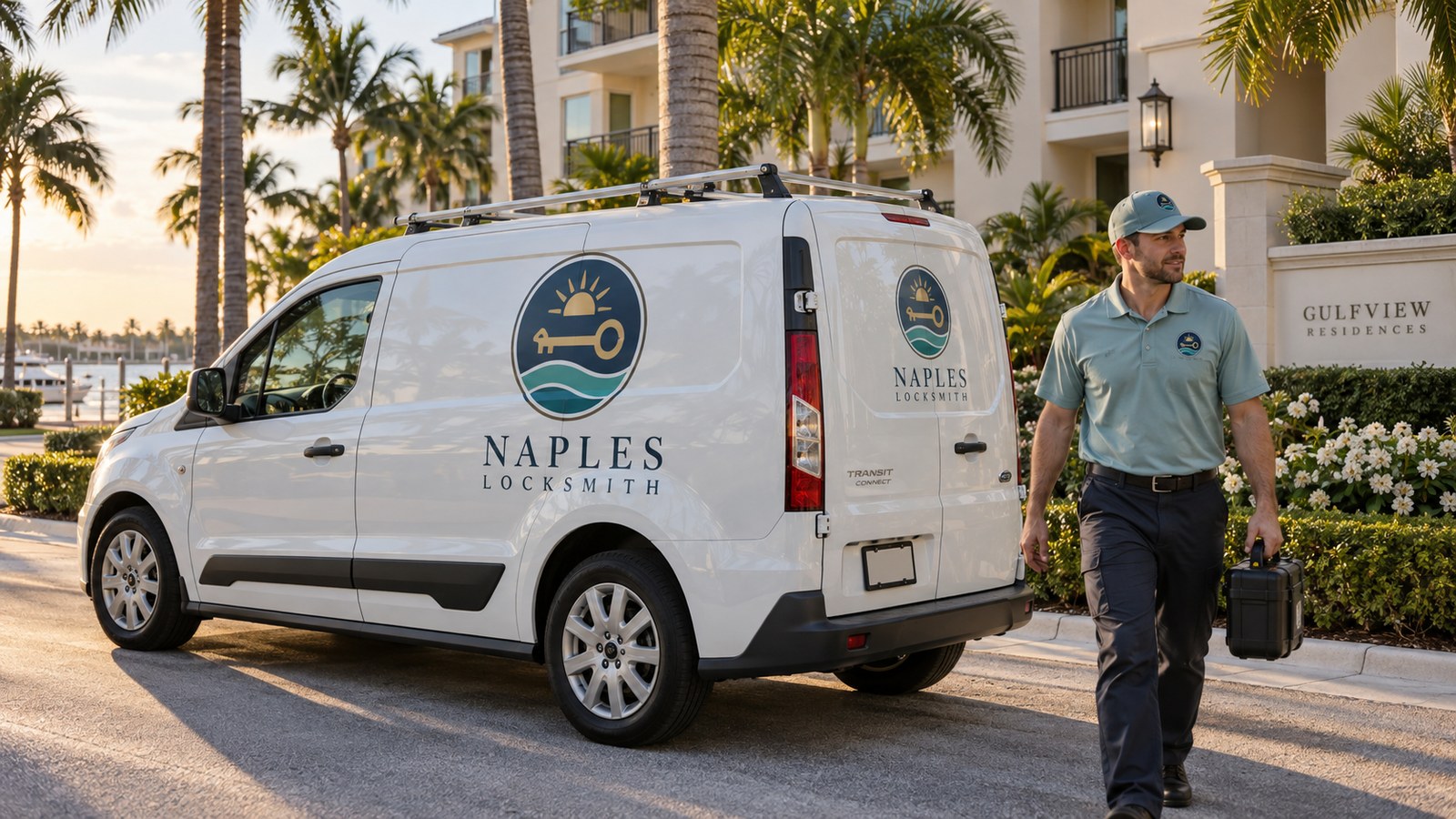
You loaded the groceries, shut the door, and heard the lock click with the keys still on the seat. A busy shopping center parking lot is one of the most common places for a lockout, and one of the more awkward. This page explains how a locksmith works safely around moving cars, what to do while you wait, and how ownership is confirmed in a public place.
The anatomy of a parking lot lockout
Most shopping center lockouts follow the same pattern. Your hands are full, a child needs attention or a phone rings, and the door closes behind you with the key somewhere inside. Cars that lock automatically after a short time make it worse, since the lock engages before you realize the key is gone. By the time you reach for your pocket, the moment has passed.
Shopping lots add pressure that a driveway does not. Traffic circles past, people wait for your space, and there is a sense that everyone is watching. It helps to remember that lockouts are routine and nobody thinks less of you. Locksmiths open locked cars every day, and bystanders have usually been there themselves.
The practical issue is the environment. A parking lot is not a quiet workshop. There are vehicles, carts, pedestrians and heat radiating off asphalt. A technician has to think about where to stand, where to park, and how to keep both you and the work area safe.
Knowing this in advance lets you help. A few simple actions can make the visit calmer and faster, starting with where you decide to wait.
First steps while you stand beside the car
Take a deep breath and check the obvious. Try every door handle, the hatch and the trunk release. Occasionally a rear door was never locked. Look through the glass to see exactly where the key is, since that tells the technician what to expect. If the key is visible on the seat, the job is usually straightforward.
Move your groceries and belongings out of the sun. Frozen items, medication and anything that melts should be handled first. If you can, take perishables into a store with air conditioning and ask a clerk to hold them behind the counter. Most stores are understanding about this.
Consider whether anyone else can help. A family member with a spare key might be a short drive away. A roadside assistance plan or a car app might offer a remote unlock. Using these may be faster, but if they are not practical, calling a locksmith is a reasonable next step.
Be honest on the phone about what you have already tried. If you used a coat hanger or a wedge, mention it. Forced attempts can damage weatherstripping or wiring, and the technician will adjust their approach to protect the car.
Working safely among traffic
Safety is the first rule of any parking lot job. Technicians position their service vehicle to create a buffer, usually parking so the work area is shielded from passing cars. They may use cones or warning lights when the lot is busy. If the car is near a lane, they may ask you to stand on the sidewalk side while they work.
Please keep children and pets well clear of the work area. Parking lots feel casual, but cars are moving, and the technician needs space and focus. If you have kids with you, a bench or a shaded spot near a store entrance is a safer place to wait than beside the car.
If the car is in a poor location, such as the end of an aisle with heavy turning traffic, tell the technician when they arrive. Sometimes the best approach is to wait until the traffic thins, or to open the car from the side farthest from the lane. The aim is a calm, unhurried process.
Never try to direct traffic yourself. If a driver is impatient, let the technician manage it. A short delay is better than any risk to people.
Shade, heat and the wait
Anyone who has lived in Southwest Florida knows how hot a parked car gets. Interiors can reach dangerous temperatures within minutes. If anyone or anything alive is inside, call emergency services immediately and do not wait for a locksmith. This applies to children, pets and anyone who is unwell.
If the car is empty, the heat still matters for comfort and for your belongings. Electronics, medication, candles and chocolate all suffer. Find shade, ideally inside a store where it is cool. Carry water if you have it, and avoid standing on hot asphalt for long periods.
For the technician, heat also affects the work. Plastic tools and rubber wedges behave differently in high temperatures, and metal parts can burn bare hands. Mid-afternoon sun is a challenge. If shade is available near the car, let us know and consider whether the car can be positioned there, though it will be locked.
In summer, afternoon thunderstorms can roll in quickly. Lightning makes outdoor work unsafe, and the visit may pause until the storm passes. Staying in a store until conditions improve is the sensible choice.
Verifying ownership in a public place
Someone opening a car in a parking lot invites questions, and rightly so. The locksmith checks ownership or authority before touching the door, and does so in the open. This protects you and everyone else whose car might be the next target. Think of it the same way a bank asks for ID.
Bring photo identification and, if you can, something connecting you to the vehicle. A registration card, an insurance card or an app showing the car details can work. If these are inside the locked car, tell the technician. They may accept a photo on your phone, a matching name on your license and the car's record, or a call to the registered owner.
If the car is not yours, such as a borrowed vehicle or a rental, the owner or company must be reachable and willing to confirm. A locksmith will not open a vehicle without that confirmation, even when the situation seems obvious. It is a firm rule, and it applies equally to every customer.
If store security or a passerby asks what is happening, the technician can explain and show their credentials. The process is calm and professional, and the car is opened only after authority is established.
How the door actually gets opened
Most modern cars can be opened without damage using a specialized approach. The technician places a protective wedge at the top of the door frame to create a tiny gap, then slides a long, thin rod through to press the unlock button or pull the interior handle. The wedge protects paint and the rod is padded to avoid scratching.
Some vehicles require different methods. Doors with certain airbag layouts, electronic locks or frameless windows call for special care. The technician assesses the car and chooses accordingly. If the safe option is slower, they will explain why, and take the time needed.
The key is to avoid hurry. Rushing causes bent frames, torn seals and scratched paint. A skilled locksmith works quietly and deliberately, which can look slow to impatient onlookers, but it protects your car. Expect a few minutes of focus instead of a dramatic reveal.
When the door opens, check that nothing was disturbed. Test the lock, the windows and the alarm. If the alarm sounds, the technician helps you silence it, and you can retrieve your key and head home.
Keyless cars and the fob left inside
Cars with push-button start create a particular kind of lockout. The fob sits in a bag on the seat, you walk away, and the car locks. Some vehicles prevent this by refusing to lock when a fob is inside, but not all do. If yours is one that locks regardless, you may want to practice a mental check before closing the door.
In most cases, the car can be opened and the fob is retrieved. No programming is required. If the fob is lost entirely, a new one must be made, which takes longer and requires proof of ownership. A technician can do this in the parking lot, though a lot is not the most comfortable workspace.
If your fob battery is weak, the car may not respond as expected and may even lock itself unexpectedly. A fresh battery is an inexpensive fix. Mention it to the technician while they are there, and they can check the fob.
Learning your car's habits is worth a few minutes. Test what happens when you step away with the fob in your pocket, and what happens if it is on the seat. Do it at home, not in a busy lot.
When the key is gone instead of locked inside
Sometimes the key is not in the car at all. It may have fallen out of a bag, been left in a store or dropped between the cart return and the door. Before assuming it is lost, retrace your steps. Check with customer service desks, restrooms and the store where you shopped.
If the key cannot be found, the car still needs to be opened, and a replacement must be made. For a basic metal key, a locksmith can cut one from the lock. For a transponder or fob, a new key must be programmed to the car, a job that needs diagnostic equipment and proof of ownership.
A lost key in a busy public place raises a security question. If someone finds it and knows which car it fits, they could use it. Many vehicles let a technician program new keys so that the old ones are removed from the car's memory, which is worth discussing if you think the key could be misused.
Complicated jobs may require a technician visit to assess, and the service call charge is explained before dispatch. Quotes for standard work are given by phone.
Etiquette and practicalities in the lot
Parking lots have their own etiquette. If your car is taking up a space during peak shopping hours, a polite note on the dashboard or a quick word with a store manager can ease tension. You might also tell nearby drivers that help is on the way. Most people are patient when they understand the reason.
If the center has security staff, let them know. They may offer to direct traffic or give guidance on where the service vehicle can park. Cooperation avoids confusion, and sometimes a security guard will watch the area while the work proceeds.
Keep your phone charged and stay in a place where the technician can find you. If you move, tell us. A quick text or call saves wandering. Note landmarks such as the store name, the nearest entrance and the row, and update them if anything changes.
Be patient with the process. The first minutes feel long, but once the technician arrives, the actual opening usually goes quickly. Having your identification ready and your belongings sorted makes everything move more smoothly.
Habits that stop the next lockout
Create a single place for your key whenever you step out of the car. A pocket, a clip on a bag strap or a lanyard worn around the wrist all work. Choose one and use it every time. Habit is far stronger than memory when your mind is on groceries, kids or a phone call.
Before closing the door, glance at the seat and the cup holders. A two-second check is enough. Teach every driver in the household to do the same, including teenagers who may be less careful. A short family conversation prevents repeated mistakes.
Keep a spare key somewhere safe and reachable, such as with a trusted neighbor or in a secure lockbox at home. Avoid magnetic boxes on the car, since thieves know to look for them. A spare in your wallet that is not a full key, such as a simple valet key, is another option on some vehicles.
If you tend to lock yourself out often, ask about alternatives such as a key with a tracker or a fob with a convenience feature. A technician can describe what suits your vehicle and your routine.
What to have in your hands when the technician arrives
A little preparation shortens the visit. Have your photo identification out and ready, along with any paperwork or phone screens that show the vehicle. If you remember the make and approximate age of the car, that helps too. Stand where the technician can see you easily, near the car but away from moving vehicles, and keep your phone on in case the lot layout leads to a wrong turn.
Gather your belongings that are not locked in the car. Grocery bags, a purse, a child's backpack and anything fragile should be in a shady spot before work begins. That lets the technician focus and keeps your things from being kicked, rolled over or soaked by a sudden rain shower.
Finally, decide ahead of time what you want to do after the door opens. If you want a spare key made, say so right away. If the car has been acting oddly, mention that too. The technician is already on site with tools, and sometimes a second task can be handled during the same visit, saving you from another trip.
Bonita Springs traffic, seasons and the shopping rush
Shopping centers in this part of Collier and Lee counties get very busy in winter, when seasonal residents fill the roads and parking lots overflow. A lockout during a crowded afternoon takes a little more planning than one on a quiet summer morning. Give a precise location, and mention nearby stores or entrances so the technician can find you among hundreds of cars.
Rain is the other seasonal factor. Summer storms arrive fast and can drench a lot within minutes. If you are standing beside a locked car when a downpour starts, take shelter inside a store and call to update your location. The technician can adjust the plan, and the work can resume safely when the weather clears.
On weekends and holidays, expect heavier traffic around the center and on the roads leading to it. We do not promise a particular arrival time, and we will tell you plainly what the day looks like when you call to confirm availability. A realistic picture beats a hopeful guess, and you can use the wait to finish errands nearby.
Frequently asked questions
Is it safe to open a car in a busy parking lot?
Yes, when the technician plans for it. They park to shield the work area, use cones or lights when needed, and ask you to wait away from moving traffic. Children and pets should stay well clear. If the car is in a poor spot, the technician may adapt the approach or wait for traffic to ease.
What if a child or pet is locked inside the car?
Call emergency services first, because a closed car in Florida heat becomes dangerous quickly. Then call us. Responders are trained and authorized to act at once. We ask about this on every lockout call because it changes the plan completely. Do not wait for a locksmith while the situation gets worse.
How do you confirm the car is mine when I am in public?
The locksmith checks ownership or authority before opening, right at the car. Photo identification and a registration, insurance card or phone record usually work. If documents are locked inside, tell the technician and they will explain other ways to confirm, such as a call to the registered owner.
Can you open the car without damaging it?
In most cases, yes. Technicians use protective wedges and padded tools to reach the lock or handle without marks. Some vehicles need extra care because of airbags or electronics. If a door cannot be opened safely, the technician tells you before continuing. Mention any earlier attempts with tools or force.
How do I get a price for a lockout in Bonita Springs?
Quotes for standard lockouts are given by phone after you describe the car and where you are parked. If the job is complicated and a technician needs to visit to assess, the service call charge is explained before dispatch. Call us to confirm availability and ask about anything specific to your location.