
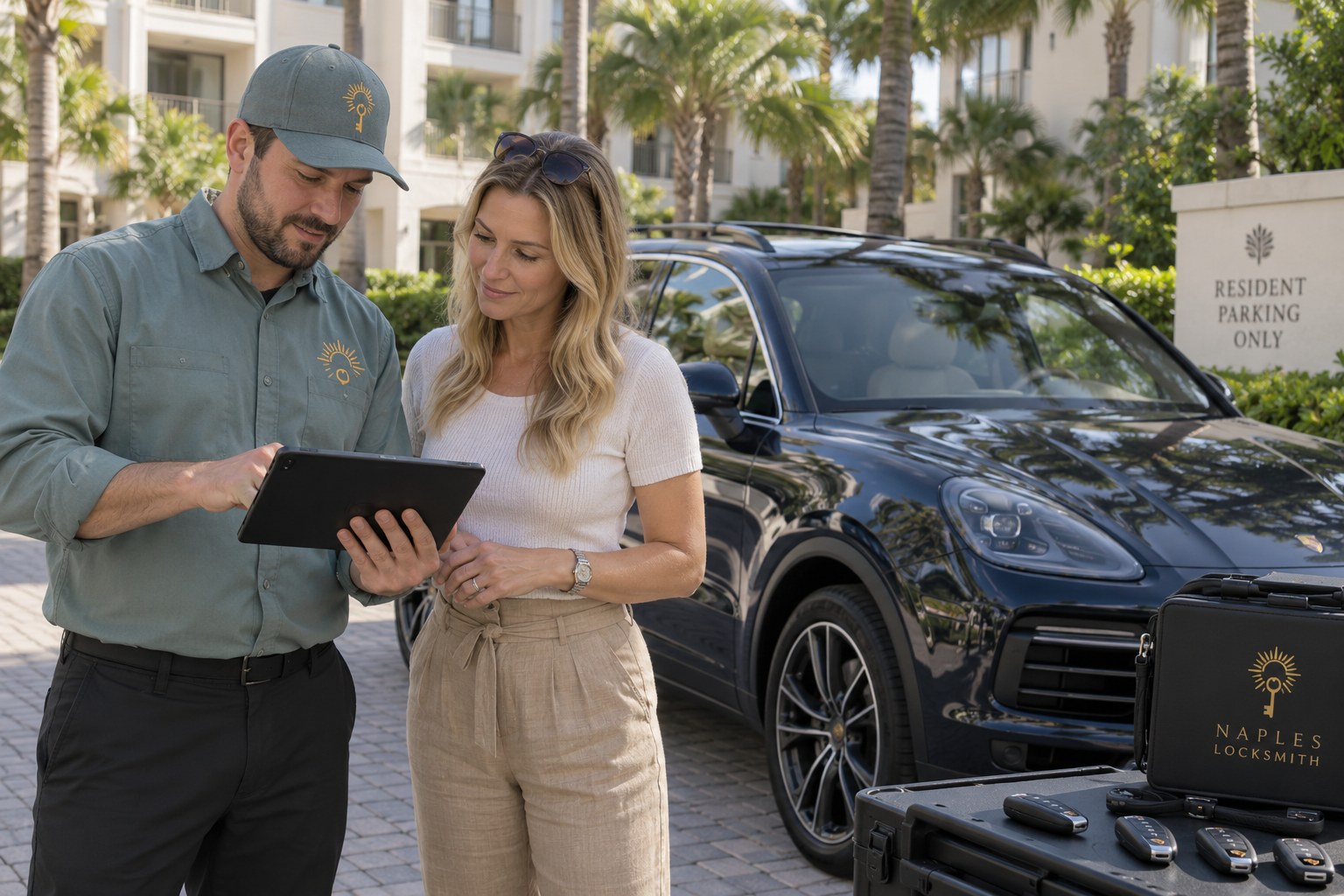
It takes half a second: you step from the dock to the hull, your pocket tips, and the ring disappears between the boards and the water. Now the car is parked in the lot, the boat may be unlocked or locked, and nobody can say what is recoverable. This page walks through the car side of the problem and how to sort out which keys matter.
First, take a breath and look at what actually fell
Before anyone starts wading, work out what was on that ring. Many boaters carry a car key or fob, a house key, a boat ignition key, a dock box padlock key, maybe a gate card for the marina and a small float. Each of these has a different fix, and the car key is only one piece of the loss. Writing the list down helps you decide what to replace first.
Next, decide whether recovery is realistic. Shallow water beside a dock with a visible bottom sometimes lets someone reach the ring with a magnet on a line or a net. Deep, murky or tidal water is another matter, and nobody should dive or lean dangerously over a hull for a set of keys. Safety comes before any key, and keys can be made again.
If the ring does come up, treat it as wet electronics. A fob that has been submerged in salt or brackish water should have its battery removed promptly and be dried in a shaded place. Rinsing a fob in fresh water before drying can help remove salt, but the circuit board should never be powered up while damp. When in doubt, have a technician test it.
Why the car matters more than it first seems
A car in a marina lot often has more riding on it than a car in a driveway. Your phone charger, your tackle, a cooler and sometimes the boat registration or a ramp pass sit inside it. If the car is locked and you have no key, you may be separated from all of that, and also from the ride home. That makes the car the practical priority.
Modern car keys are not simple pieces of metal. Most contain a transponder chip that the car reads before the engine will start, and many are remote fobs or proximity keys that handle locking and unlocking by radio. Losing one means more than cutting a blade. The replacement has to be introduced to the car's computer, which is a separate step from making it physically fit the lock.
Because of that, the first useful question is what kind of key you had. A basic metal key with a rubber head, a flip key with remote buttons, and a push button start proximity key are three different jobs. Tell us what you remember about the key and the car, and we will outline what making a replacement involves before any visit is scheduled.
What a mobile locksmith can do when no key exists
When every key to a car is gone, the process is called all keys lost. A technician comes to the car, confirms who you are and that the car is yours, and then works from the vehicle itself rather than from an existing key. The lock can often be read or decoded, a blade cut to match, and a new chip or fob programmed to the car's computer.
The exact method depends on the car. Some vehicles allow a new key to be added through the diagnostic port using specialized equipment. Others need extra steps, such as a security waiting period, a code obtained through the proper channels, or in rare cases the work of a dealership. We explain what your car is likely to need when you call, and we are honest when a job is not simple.
Because the work happens at the car, a marina lot is a perfectly workable place. The technician needs access to the driver door and the diagnostic area, a bit of room, and a stable power supply for the equipment, which is usually handled from the service vehicle. You do not need to tow the car anywhere for the basic work.
Proving the car is yours when everything is in the water
People worry about this part because their wallet, registration and phone were often in the same bag as the keys. Ownership proof does not need to be elaborate. A registration, a title, an insurance card paired with photo identification, or a record that can be matched against the vehicle identification number all help. A photo of the registration on your phone is fine.
If your identification also fell in the water, tell us on the phone. There are reasonable alternatives, such as another government photo card, a copy sent from home by someone you trust, or a signed document that the locksmith can verify. What the technician will not do is open or program a car for someone who cannot show authority, and that firmness protects you too.
For business vehicles and company cars, the person calling may not be the owner. A manager, owner or fleet contact can authorize the work by phone or in writing. Rental cars follow the rental agreement. In every case, the check happens before the car is opened or any key is made, and it is the same check whether you are a visitor or a long-time resident.
Boat keys are a separate job
It is easy to blur the car and the boat together when both keys went into the water. They are separate problems with separate solutions. A boat ignition key is typically a simple key with a floating tag, and many marine ignition switches use common key patterns. A locksmith can often cut a replacement from the switch or from a code, depending on the make.
There is also a safety angle. Many outboards use a lanyard or kill switch that is separate from the ignition key, and it is worth checking that it is stored where you can find it. If the boat is stored dry or in a slip, make sure it is secure while you sort out the keys, because an unlocked helm or cabin with no key can be an invitation to trouble.
Marine hardware lives in salt air and tends to corrode, so replacement keys on a corroded switch can bind. Sometimes the right fix is replacing the ignition switch, not only the key. We handle the car side of things, and for the boat we can talk through what is possible for the ignition or storage locks, while being clear about what depends on the specific equipment.
Padlocks, dock boxes and gate access
Dock boxes, lockers and storage cabinets near the water are usually secured with padlocks, and those keys were probably on the same ring. Marine padlocks are built to resist corrosion but still seize over time. If you cannot open one, a technician can often open it without destroying it, though a rusted lock is sometimes better replaced.
Marina gates and dock access may use cards, codes or keys managed by the marina itself. Those belong to the marina, not to a locksmith, so contact the office about replacing them. It is a good moment to confirm what the marina requires, such as whether lost access items must be reported for security reasons before a new one is issued.
If you want to rekey your own locks after losing a ring, that is reasonable. Rekeying changes the internal pins of a lock so the old key no longer works, without replacing the lock itself. It makes particular sense for a house or storage lock whose keys sit at the bottom of a canal and might be found by someone else.
Should you worry that someone could use the lost keys?
It is a fair question, and the honest answer is that the risk is usually low but not zero. Keys underwater are hard to find and hard to attribute to a car or a house. Nothing on a typical key ring says where you live, and a fob does not announce which vehicle it belongs to. Still, you are the best judge of how comfortable you are.
For a car, programming a new key can be paired with removing the old one from the vehicle's memory, so the lost key stops working. This is worth asking about if the ring may be recovered by a stranger. Not every car supports it the same way, but where it does, it turns a missing key into a harmless piece of metal.
For your home, think about whether the ring included an address tag or anything that would point to it. If there is any doubt, rekeying the exterior locks is a measured response. It is not dramatic, and it settles the question permanently. We can discuss which doors matter most when you call, and we keep the discussion practical instead of alarming.
Getting home while the work is arranged
Practical comfort counts. If the car is locked and you are stuck at the marina, consider whether someone can pick you up while we handle the key work. Many people simply leave the car and return later for it, since there is no rush to move a car that is safely parked. A technician can start the work when the owner is present and ready.
If the car is open and the key is missing, avoid the temptation to hotwire or force the ignition. Modern vehicles resist this, and forced attempts tend to damage the steering column and switch, which makes the eventual key job more complex. It is better to leave the car as it is and call.
While you wait, check for a spare. A spare key sitting at home is a much simpler, faster path than programming a new one from scratch. Ask someone to bring it to you, or have them hold it for the technician. If there is no spare, we will talk through the replacement and what the job will involve, so there are no surprises when someone arrives.
What happens during the visit
A technician arrives, checks authority and identification, and looks at the car. They confirm the vehicle details and the key type needed, and explain the steps in plain language before starting. If the visit turns out to be more complicated than the phone call suggested, they tell you why and what the next step is before any extra work begins.
The work itself is usually a mix of cutting a blade, preparing a new chip or fob and programming it to the vehicle. You will be asked to test the new key in the door, the ignition or the start button, and to try the remote functions. A key that opens the door but fails to start the car is not finished, and a good technician checks both.
Afterward, you should leave with at least one working key and a clear idea of whether a spare is worth making. Spares are cheaper and simpler to make while a working key exists, so it is wise to have a second one cut at once. We can explain how that works when you call and help you decide whether it fits your situation.
Salt, humidity and why marina vehicles wear faster
A car that spends its weekends in a marina lot lives in a harsher environment than most. Salt mist drifts across the lot, the air stays humid, and door locks and ignition cylinders collect a thin film of corrosion. Keys that turn stiffly, door locks that stick and remotes that work only some of the time are common signs.
These symptoms matter when a replacement key is cut. A fresh key in a worn or gummy lock can feel different from the old one, and a technician may suggest cleaning or servicing the cylinder so the new key works smoothly. It is better to deal with a sticky lock now than to snap a new key in it later.
Ask the technician about a light cleaning of the door and trunk locks while they are there. A graphite based lubricant suited to locks, not a heavy oil that attracts grit, keeps the pins moving. It takes only a few minutes, and it is a sensible bit of upkeep for any vehicle that lives beside salt water.
Habits that keep keys out of the water
The best protection is a floating key ring. Foam or buoyant tags cost little and turn a disaster into an irritation, since the ring bobs to the surface instead of sinking. Attach one to every key you carry near water, including the car fob, though keep the fob in a dry pouch, because floating does not protect electronics from soaking.
Keep car keys away from the boat. Leaving the car key in a zip pocket of a bag stowed in the boat, or locked in the car's own console where possible, separates it from the dock. A small lockbox or a trusted person at home holding a spare key reduces the stress of an accident to something manageable.
Finally, treat the first near miss as a signal. If you have already dropped keys once, or had a close call at the dock, make the spare now. Spares made before a loss are the simplest route, and a quick call to us can set up the plan for your vehicle before an emergency makes it urgent.
Seasonal residents and visiting boaters
Naples and Marco Island fill with seasonal boaters who arrive from out of state, and their cars often sit in marina lots for days at a time. If you are visiting and your only key ends up in the water, your home locksmith is far away, and the car may be registered in another state. That does not stop the work, but it does mean ownership proof needs a bit more care.
Out-of-state registration is perfectly acceptable. Bring or send a photo of the registration, a photo identification and, if the car is financed or leased, any documents showing your right to use it. For vacation rentals or loaned vehicles, the person who owns the vehicle can authorize the work by phone, and we will talk to them if necessary.
If you are staying only a short while, think about whether a full replacement key is worth it. Some visitors prefer a single key to get through the trip and a more complete plan when they are home. Others want a spare for the rest of the season. Call us, describe your plans, and we will lay out the options plainly.
Frequently asked questions
Can you make a new car key if every key fell in the water?
In most cases yes. A technician visits the car, verifies ownership, and cuts and programs a new key from the vehicle itself. The method depends on the car and the type of key. Call us with the vehicle details and we will explain what the job involves and how a quote is given by phone.
Is it worth trying to recover a fob that fell in salt water?
Only if it can be done safely. If you retrieve it, remove the battery quickly and let it dry in a shaded place without heat. Salt water does lasting damage to circuit boards, so have a technician test whether it still works before relying on it. A new fob may be the better route.
Will the lost key still work if someone finds it?
Possibly, unless the car is told to forget it. Where the vehicle allows it, programming a new key can also erase the old one from the car's memory, so the lost one stops working. Ask about this when you call, since support varies by car.
Do you handle boat ignition keys too?
We focus on cars, homes and businesses, and we can talk through boat ignition and storage locks when you call. Many marine switches are simple, but corrosion can complicate things, and sometimes the switch needs replacing. We will be straightforward about what is and is not possible for your equipment.
What if my wallet and registration went into the water too?
Tell us on the phone. There are reasonable ways to show authority, such as another photo identification, a registration copy sent by someone at home, or confirmation from the registered owner. We will not open or program a vehicle without a check, but we will work with you to complete it.