
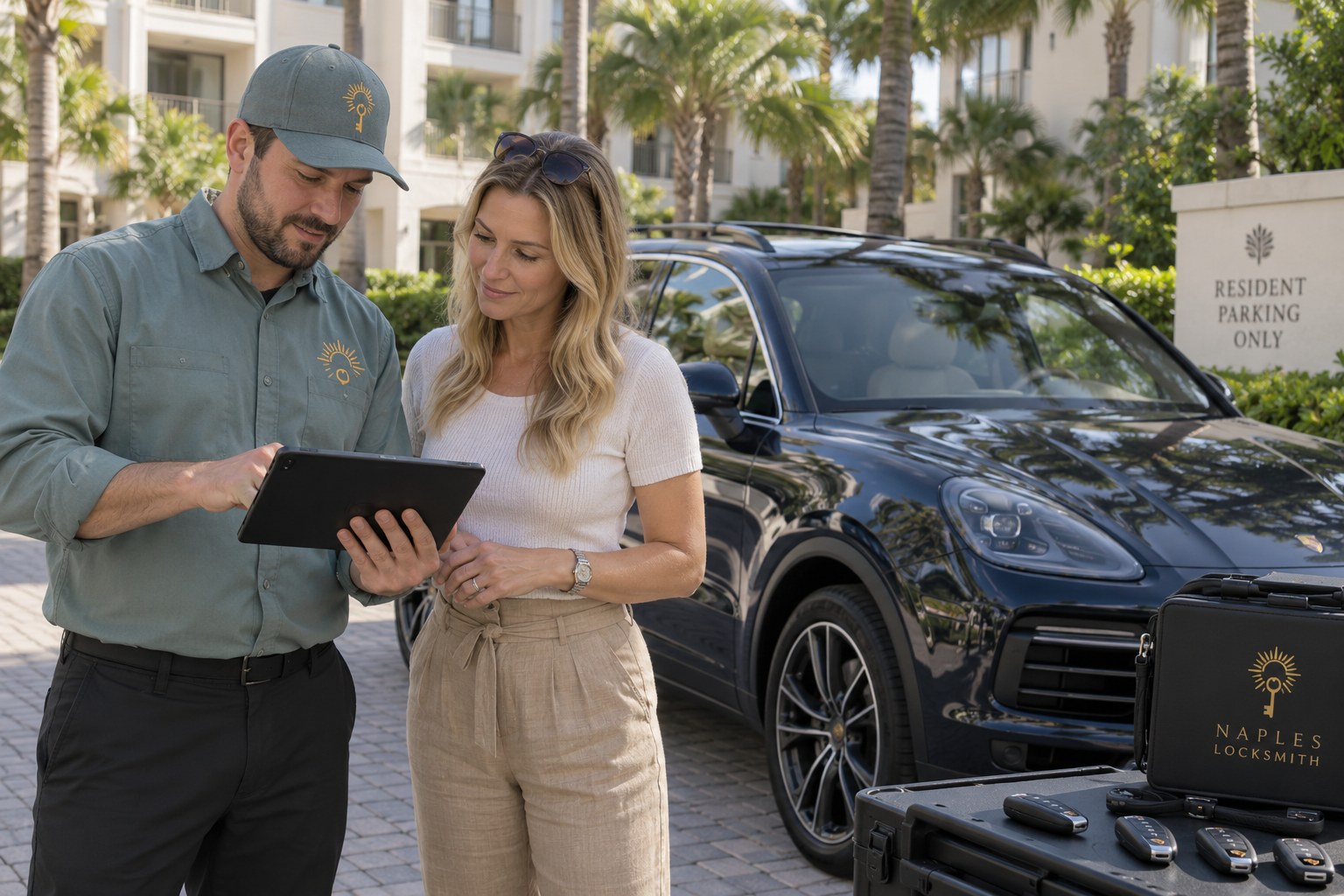
You spent the afternoon on the sand, walked back to the parking area with a towel over your shoulder, and the car does not react when you press the button. A day of sun, heat, sand and salt air is hard on a small electronic key. This page explains what usually went wrong, what you can safely try yourself, and what a mobile technician does when the fob needs real help.
What a day at the beach does to a key fob
A key fob is a small radio transmitter with a coin battery, a circuit board and a plastic shell that is not sealed the way a watch is. When it spends hours in a beach bag, a cup holder or a back pocket, it meets three enemies at once: heat, moisture and fine grit. None of these usually kills a fob outright, but together they can make one stop responding for a while, or for good.
Heat is the quiet one. A bag left on a towel in direct Gulf sunshine, or a fob left on a dashboard, can reach temperatures well above what the battery and solder joints like. Coin batteries lose strength faster when they are hot, and a battery that was already tired may cross the line from working to not working during a single afternoon.
Moisture and salt are the slow one. Humid Gulf Coast air carries salt, and a damp swimsuit or a splash from a cooler can put a thin film on the contacts inside the fob. That film can block the little spring contacts from touching the battery properly. The fob looks fine on the outside while the inside quietly stops conducting.
There is also the simple matter of where the fob ends up. Beach bags collect sunscreen, wet towels, phones and bottles, and a fob pressed against other items can send a signal by accident, or have its buttons pushed over and over in the bag. A fob that has been transmitting all afternoon runs its battery down far sooner than one resting quietly in a pocket.
Start with the simple checks before you assume the worst
Before anything else, try the physical key. Most fobs hide a mechanical key blade inside the shell, released by a small slider or button. Using it on the driver door will open the car even when the fob is completely dead. Some newer cars hide the keyhole under a small cap on the door handle, so look for a plastic cover you can pry gently with a fingernail.
Next, notice what the fob is doing. A small indicator light that blinks when you press a button usually means the battery has some life and the problem is elsewhere. No light at all points toward a dead battery or a broken connection inside. Hold the fob close to the car and press the button a few times, because a weak battery sometimes works at arm's length but not from across the lot.
Also try the car's other ways of recognizing a key. Many cars with push button start let you hold the fob against the start button, or against a marked spot on the steering column or center console, and the car reads a passive chip even when the battery is empty. Your owner manual shows the exact spot, and it is worth looking up before you start guessing.
- Use the hidden mechanical key on the driver door
- Look for a small cap over the door handle keyhole
- Hold the fob against the start button or marked spot
- Check whether the fob light blinks at all
Replacing the coin battery the right way
If the fob has a battery that you can reach, replacing it is often the whole fix. The battery type is printed on the old cell, usually a flat coin battery with a code stamped across its face. You can pick up the same code at a pharmacy or hardware store. Open the shell gently with a small flat tool along the seam, noting which side of the battery faces up before you lift it out.
Cleanliness matters more than people expect. If you see white or green powder on the contacts, or a faint grey film, wipe it away with a dry cotton swab and let everything dry fully before closing the shell. Do not use water on the circuit board. A small amount of isopropyl alcohol on a swab can help, but give it time to evaporate completely.
A fresh battery sometimes makes the fob work immediately, and sometimes the car needs a moment to relearn it. If the buttons work but the car still ignores the fob, the issue may be the transponder chip or the circuit board rather than the battery. At that point, more guessing wastes time, and a technician who can test the fob electronically is the better next step.
When the fob has been wet or sandy
If the fob went into the water, or sat in a wet bag, treat it gently. Remove the battery as soon as you safely can, because power running through a wet board is what causes the damage. Open the shell, let the parts air out in a dry shaded place, and do not use a hair dryer or leave it on a hot dashboard. Heat can warp the plastic and crack the board.
Sand is a different problem. Fine grit works into the button pads and under the rubber membranes. A fob that feels gritty when you press a button may stop registering presses even though the electronics are fine. A soft brush and a gentle blow of air can clear it, but do not push grit deeper by pressing hard on the buttons.
Be honest about what you can recover. A fob that has been fully submerged and left powered may work again after drying, or may be done. A technician can test whether the chip inside still talks to the car. If it does, the shell and battery may be all that needs attention. If it does not, a replacement fob is the straightforward answer.
What a technician does in the parking lot
A mobile locksmith comes to where the car is parked, whether that is a public beach lot, a garage near the shore or a driveway. The first step is not to open anything. The technician confirms that you are the owner or someone with authority over the vehicle, which usually means a registration, a title or a rental agreement paired with identification. This protects you as much as anyone else.
With that settled, the technician looks at the situation. If the mechanical key works, the car may already be open and the discussion turns to the fob itself. If the car is locked and you do not have a working blade, the technician uses non-damaging methods suited to the car, since door seals, paint and wiring in the door are things nobody wants disturbed.
Then comes the diagnosis. A handheld programming tool reads whether the car recognizes the fob, whether the chip responds and what the key slots look like in the vehicle computer. That information decides everything that follows. Call us to describe the car and the situation, and we will tell you whether a visit makes sense, how a quote works, and when to expect a service call charge explanation.
When a replacement fob is the real answer
Some fobs are finished. A cracked board, corroded contacts that no longer clean up, a chip that does not respond, or a shell that has come apart from repeated drops all point toward replacing the fob rather than repairing it. Trying to nurse a damaged fob through another season often costs more in frustration than the replacement itself would.
A new fob has two parts: the physical unit and the programming that introduces it to your car. The unit must match the car's category, whether that is a simple remote, a remote with a flip key, or a proximity key. The programming ties it to the vehicle computer so the car accepts it as a legitimate key. Both parts need to be correct for the key to work.
In many cars, a technician can cut a new blade and program the fob on site. In others, the car needs a different process, and a complicated job may need a technician visit before the work begins. We explain what the job involves by phone first, and if a visit is needed, the service call charge is explained before dispatch.
Keeping a fob safe on beach days
Prevention is mostly about where the fob rides. A zip pouch or a small waterproof pocket costs little and keeps sand and splashes away from the shell. Leaving the fob in a dry bag inside a cooler lid compartment, or locked in a glove box when you can, is better than a back pocket that goes into the water with you.
Heat control matters too. Do not leave a fob on a dashboard, on a car seat in direct sun or in a bag resting on hot sand. Put it in the shade, under a towel, inside the center console. A fob that stays cooler keeps its battery healthier for longer, and it is less likely to surprise you at the end of the day.
A spare is the real safety net. A second key kept at home, with a trusted family member or in a secure spot, means a lost or damaged fob becomes an inconvenience rather than an emergency. If you only have one working key, it is worth having a second made before the next beach season, and we can explain how that works when you call.
Visitors, vacation renters and unfamiliar cars
Naples fills with visitors who drive rental cars to the beach, and the same fob trouble applies to them. A rental fob is the property of the rental company, so the situation involves more than your own convenience. Before anything is opened or programmed, the technician needs proof that you are the authorized renter, and the rental desk may need to be told what happened.
If you are renting and the fob dies, check your rental agreement for roadside instructions first. Many agreements include a support line that handles lockouts and dead keys, and following it can keep you from being charged for work the rental company did not approve. A locksmith can still help when that route is slow or unavailable, but authorization comes first.
Vacation home guests face a version of this too. A car borrowed from a host, or a vehicle kept at a rental property, belongs to someone else. We check ownership or authority before opening or programming anything, which means the owner may need to confirm by phone or provide documents. That check is a normal part of the job, not an obstacle.
What to have ready when you call
A short, clear description speeds everything up. Tell us the make and general type of vehicle, whether it has a push button start or a turn key ignition, what the fob does or does not do when you press it, and where the car is parked. If you can see a small blinking light, mention it. If the fob got wet or sandy, mention that as well.
Have your proof of ownership or authority within reach. A registration card in the glove box counts, but if the car is locked, a photo of it on your phone works well, along with a photo identification. If you are the renter, keep your rental agreement handy. If the car belongs to a relative or employer, have their contact information in case we need to confirm.
Finally, be ready for a plain conversation about the job. We give quotes by phone for straightforward work, and we explain what a complicated job involves before sending anyone. Call us to confirm availability in your part of Collier County, and we will talk through your options without pressure so you can decide what is best for your day.
Hurricane season, storage and long gaps between trips
Naples residents who leave town for part of the year, or who store a second car through hurricane season, run into a related problem. A fob that sits unused for months in a hot garage can lose battery strength even while it does nothing. When you come back and the car does not respond, the cause is usually the battery in the key or the battery in the car, not a mystery fault.
Humidity inside a closed garage matters too. Salt air finds its way through door seals, and a fob left in a drawer near a window can pick up the same corrosion as one carried to the beach. Keeping spare fobs in a small sealed container with a dry packet helps a great deal, and it costs very little to set up before you go.
If you return to a car that will not accept its key, do not keep pressing buttons for twenty minutes. Try the blade, try the passive start spot, and then call us. A short phone conversation often tells us whether the battery, the fob or the car is the likely cause, and what kind of visit would actually be needed.
Looking after the key you already have
Once the immediate problem is solved, a few habits protect the next fob. Replace the coin battery when the car starts showing a low key battery message, or at the first sign that the range has shrunk, instead of waiting for a total failure in a parking lot. A fresh battery is a small task compared with a dead fob at the end of a long day.
Look at the shell now and then. Cracks near the seam let humidity in, and a loose shell lets the battery shift. If the plastic is worn or split, a replacement shell can transfer the electronics into a sound housing. It is worth doing that before the board is exposed, because moisture damage is far harder to reverse than a cracked case.
Finally, keep the mechanical blade accessible. Many people forget the blade exists until the day they need it, and then discover it has been lost, or never cut for the car at all. Knowing where it is and how to release it gives you a dependable way into the car, whatever the fob decides to do on a hot afternoon.
Frequently asked questions
Can sand and salt air really make a fob stop working?
Yes, indirectly. Sand can clog the button pads so presses do not register, and salt in humid air leaves a film on the battery contacts that interrupts power. Heat also weakens coin batteries quickly. Cleaning the contacts and replacing the battery solves many of these cases, though a fob that was soaked may need testing by a technician.
Will the car start if the fob battery is dead?
Often it will. Many cars with push button start can read a passive chip when the fob is held against the start button or a marked spot near the steering column. Your owner manual shows where. If your car does not offer this, the battery needs replacing, or the fob needs to be tested.
Can you replace the fob and program it on site?
In many cases yes, and a mobile technician comes to the car. Whether it can be done on site depends on the vehicle and the type of key. Call us with the car details and we will explain the process. If the job is complicated, a technician visit comes first and the service call charge is explained before dispatch.
Do I need proof that the car is mine?
Yes. Before opening a vehicle or programming a key, the locksmith checks ownership or authority, usually with a registration or title and identification. Renters can use a rental agreement. This check protects you and the vehicle owner, and it is a normal part of every vehicle job we do.
What if I dropped the fob in the water?
Remove the battery as soon as it is safe to do so and let the parts air dry in a shaded spot. Do not use heat to speed it up. Once it is dry, a technician can test whether the chip still talks to the car. If it does not, a replacement fob and programming is the clear answer.