
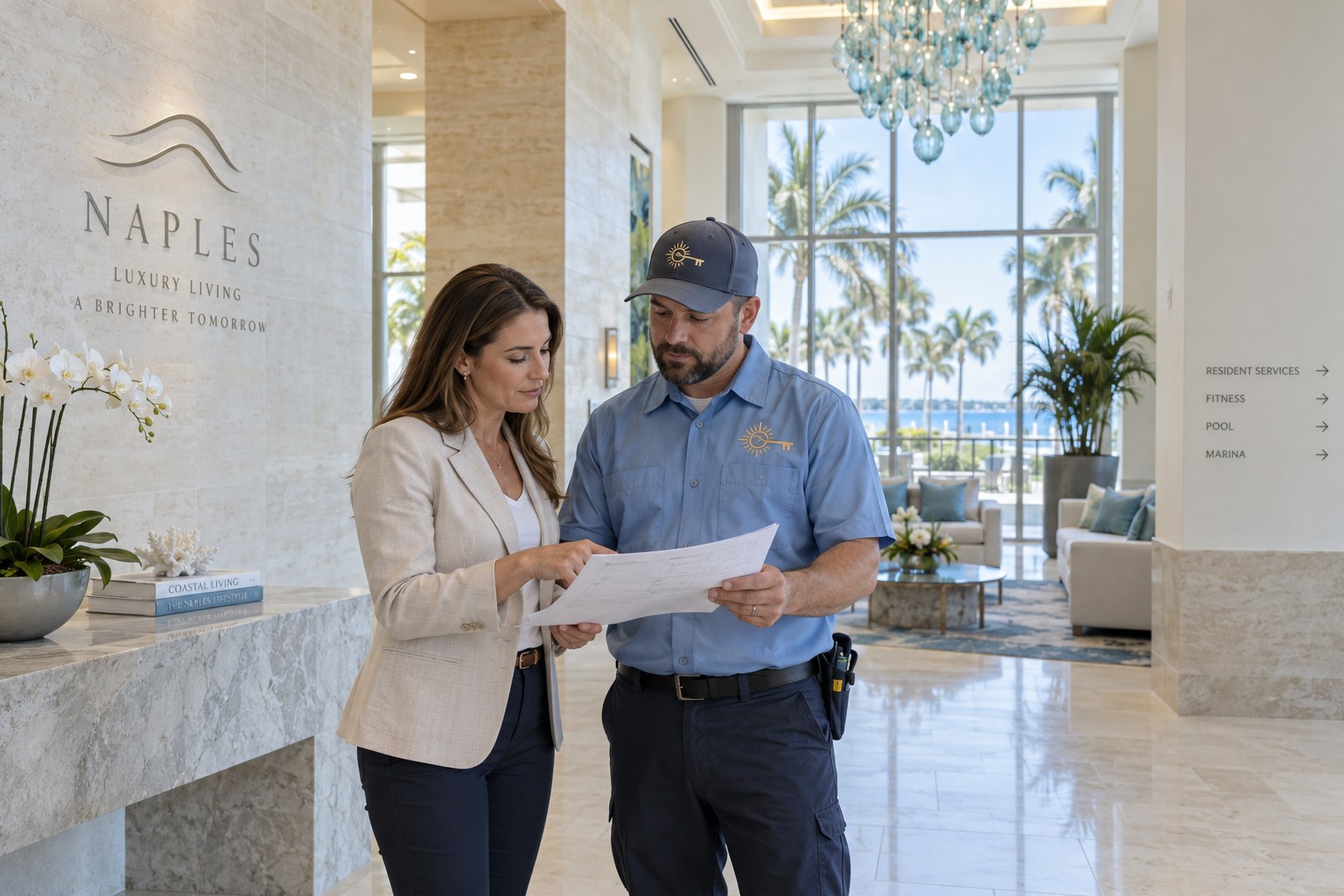
Once you have called and a technician is on the way, a few minutes of preparation can shorten the visit and keep it smooth. This guide walks through what to do while you wait: clearing the entry, gathering identification, noting what you know about the lock, keeping pets safe and staying safe yourself. None of it is complicated, and most of it takes only a moment.
Start with where you are standing
Before anything else, think about where you will wait. If you are locked out of your home, find a safe, shaded spot close to the door but out of the way of traffic. Naples heat and humidity can wear you down quickly in summer, and a sudden afternoon storm can arrive with little warning. A covered porch, a neighbor's lanai or a shaded bench is better than a hot driveway.
If you are in a car, move to a safe spot if you can, away from moving traffic, and keep your hazard lights on if you are on a roadside. A parking lot with shade and good lighting is better than a dark corner. Let someone know where you are and what is happening. A short call or message to a friend or family member is worth making.
If a child or pet is locked inside a vehicle or home, tell the dispatcher immediately and consider calling emergency services first. A locked car in Florida heat becomes dangerous in minutes. Preparing for the visit is secondary in that situation. Safety comes first, and the dispatcher can help you decide on the right order of calls.
Clear the entry so the technician can work
A technician needs room to kneel, set down tools and see the lock clearly. Move planters, doormats, shoes, umbrellas and anything else cluttering the entry. If the door is on a lanai or in a narrow breezeway, make sure the path is open. Even a small change like sliding a chair away can save a few awkward minutes.
Think about lighting too. Porch lights, entry lights and gate lights help the technician see keyways and small screws. If it is dark, switch on whatever outdoor lighting you can reach, or keep a flashlight handy. If you are locked out and cannot reach a switch, a phone flashlight held steadily is a good substitute.
At a gated community or condo building, you may also need to clear the way into the property. Let the front gate or building desk know that a locksmith is expected, and give them the technician's first name if you have it. A technician who is stopped at a gate with nobody to approve entry loses time, and so do you.
Find your identification and proof of connection
Every responsible locksmith checks ownership or authority before opening, rekeying or programming a lock. Prepare for that now. Gather photo identification, such as a driver license or state identification card. If you are locked out of your own home, you may not be able to retrieve it from inside, so think about alternatives and tell the dispatcher what you do have.
For a home, helpful items include a lease, a utility bill or piece of mail with your name and the address, a property manager letter, or a phone photo of a deed or closing document. For a vehicle, a registration, title or insurance card matching your identification is the usual proof. For a business, a letter or call from the owner or manager authorizing the work.
If you cannot get any of these, say so on the phone rather than hoping it will not come up. The technician may be able to suggest another way to establish authority, such as calling a property manager or the condo association office. It is far better to find out on the phone than to learn on the doorstep that the job cannot proceed.
- Photo identification for the person who will meet the technician
- A lease, bill, letter or title connecting you to the property or vehicle
- A phone number for the owner or manager if you are not the owner
- A photo of the lock or key, if you have one on your phone
Note what you know about the lock
The more the technician knows before arriving, the better prepared the truck will be. Look at the lock and notice what you can. Is it a knob, a lever handle, a deadbolt or a keypad? Is the finish brass, black, nickel or bronze? Is there a brand name on the faceplate or the edge of the door? Even a rough description helps.
Mention how the lock has been acting lately. Did the key stick for weeks before failing? Did the bolt feel loose or catch partway? Did the door start to swell and drag during the humid months? Those clues help narrow down whether the problem is the lock, the door, the strike plate or the frame. Humidity, salt air and house settling all affect doors on the Gulf Coast.
If you have any keys at all, even a broken one, keep them in your hand. A key or a piece of one can help the technician decode the cuts. If you have a spare key at a neighbor or relative, mention it, though the technician may still need to proceed with the work if getting it would take too long. Being specific helps the dispatcher decide what to bring.
Secure pets and think about children
Pets often react to a stranger arriving, especially one carrying tools. If your dog is inside, the barking from behind a closed door can be loud and stressful, and an anxious dog can bolt when the door finally opens. If you can, ask a neighbor to hold the dog or keep it in a room away from the entry, though if you are locked out that may not be possible.
Tell the dispatcher about animals up front. Mention if a dog is inside, if one is in a yard behind a gate and if a cat tends to slip out. Technicians would much rather know before they open a door than meet a startled animal on the other side. It also helps them decide how to approach the work with minimal fuss.
Children should be kept at a safe distance from tools and open doors. Younger children can become upset by a stranger working on their front door, and little ones may wander into the technician's workspace. A calm adult, a seat in the shade and a short explanation about what is happening usually settles things. Keep the entry area clear for the work.
Condos, gates and communities with rules
Naples has many gated and golf communities, condo towers and managed buildings with their own rules. Some require advance notice for contractors. Some limit working hours. Some require the technician to sign in with the office or a guard. Some need a unit owner to be present. Find out what yours require and call ahead if you can.
For a condo or apartment, the association may need to approve a lock change or rekey, especially if the lock is on a shared door or fire-rated entry. Technicians can work within these rules, but they cannot override them. Ask the management office what they need and share that with the dispatcher so the visit is not wasted.
If you rent, check your lease before authorizing a lock change. Landlords usually control what hardware is installed, and some require a copy of the key. A locksmith can often rekey a rental lock after you have written permission, but the owner or manager should be part of the conversation. A phone call or text from them confirming consent is often enough for the technician.
Think about what you want done
A lockout might seem like a simple matter of getting the door open, but the visit is also an opportunity to decide on follow-up work. If you have lost keys, you may want the lock rekeyed so that missing keys no longer work. If the lock is old or worn, you may want to replace it. If it is damaged, replacement may be necessary.
Decide ahead of time how many keys you want, whether you would like all your exterior locks keyed alike and whether you want to upgrade the deadbolt while the technician is there. These choices are easier to make calmly before the visit than in the middle of it. The technician can explain the options, but it helps to know your preferences.
It is also worth thinking about who else needs access. Family members, a cleaner, a dog walker, a property manager or a seasonal caretaker might need keys or codes. Make a short list. The technician can help you decide how to handle access in a way that is secure, and a quick list saves you from forgetting someone and facing another visit.
What to expect when the technician arrives
A technician will typically introduce themselves, confirm the work to be done and ask for identification and proof of connection to the property. They will examine the lock and explain what they plan to do. If the job turns out to be more complicated than described, they will tell you what changed and what the options are before going further.
The service call charge and the work involved should match what was explained on the phone. If there are differences, ask about them. A good technician welcomes the question. Complicated jobs may call for a technician visit first, with the service call charge explained plainly before dispatch, and the visit itself is where the plan for the actual work comes together.
Be prepared to watch the work. You are welcome to stand nearby, ask what each step is, and see the result. When the lock is opened, the technician may test it with you, show you any damage or wear, and explain what to watch for. Keep the conversation open, and do not be afraid to say if something is unclear.
After the work: tests and next steps
When the technician finishes, test everything before they leave. Lock and unlock the door from both sides several times. Try every key that is supposed to work, and confirm that old keys no longer work if a rekey was done. Close the door and check that it latches properly without slamming or forcing.
Ask how to look after the new or repaired lock. Simple habits such as keeping the keyway clean, avoiding heavy oil, and checking the strike plate screws every few months help locks last in coastal conditions. Ask what to do if you notice sticking or looseness, and whether there are warning signs you should watch for.
Finally, store spare keys sensibly. Give one to a trusted person, keep one in a secure place at home and avoid hiding keys under mats or planters where anyone can find them. If you need more keys or a follow-up visit, call us. A short conversation at the end of a visit often prevents another lockout in the future.
Sliders, lanais and garage entries
Many Southwest Florida homes are entered through places other than a front door. Sliding glass doors onto a lanai, side doors off a garage, and the garage door itself are all common entry points, and each has its own lock. Sliders often use a small hook latch or a keyed handle, and their tracks collect sand and debris that make the lock stiff or misaligned.
If your lockout involves a slider, mention that to the dispatcher. Slider locks are opened differently from deadbolts, and a technician wants to bring the right approach and avoid damaging the glass or the frame. Clear the area around the slider so the technician can reach the latch, and move furniture, curtains or blinds that block access.
For garage entries, find out whether the door from the garage into the house is locked, and whether the garage door has a keypad or remote. Sometimes the garage offers a legitimate way in. Do not force anything yourself. A quick conversation with the dispatcher about which entry is best often saves time and avoids a repair you did not need.
Keeping the visit short and the work clear
A visit goes quickest when the technician can begin as soon as they arrive. Have the person who will approve the work standing by, with identification in hand. Have the description of the problem ready, including what you tried and what the lock was doing before it failed. Be ready to say what you would like done afterward.
During the work, stay close enough to answer questions but far enough away to give the technician room. If you are unsure about a choice, say so and ask for a plain explanation. A good technician is happy to explain why one option is sturdier, simpler or better suited to your door than another, and will not rush you into a decision you are not comfortable with.
When the work is complete, walk through the checks together. Test the lock, try the keys, confirm the door closes smoothly and ask about care. Keep any paperwork you are given. If a question comes up the next day, call us and describe what you are seeing. Being prepared at the start makes this final stage feel organized instead of hurried.
If you are waiting in a car or on the road
A vehicle lockout changes the preparation in a few useful ways. Note the make and general type of your key, whether it is a metal key, a key with a chip in the head or a push-button fob. Find the registration or title on your phone if you can, and have photo identification ready. If your keys are inside the car, say so, and mention whether the engine is running.
Choose where to wait with care. A well-lit parking lot with other people nearby is better than a quiet roadside. If you are on a busy road or a bridge approach, stay away from traffic and keep your hazard lights on if the car allows it. In summer, shade and water matter more than most people expect, especially if you have been standing for a while.
If a child or animal is inside the locked vehicle, do not wait for a locksmith. Call emergency services immediately, then tell the dispatcher. Heat inside a closed car rises faster than it feels from outside. Everything else in this guide can wait. The safest order of calls is emergency help first, then the locksmith, and the dispatcher will understand.
Frequently asked questions
Do I need to be present when the technician arrives?
Yes, or you need a trusted person with authority who can approve the work and show proof of connection to the property. The technician checks ownership or authority before opening, rekeying or programming anything. If you cannot be there, arrange a clear way for the dispatcher to reach the owner or manager by phone.
What if I do not have identification with me?
Tell the dispatcher when you call. Alternatives might include other documents, a call to a property manager or association office, or a person who can vouch for you with proper papers. The technician cannot open a lock without establishing authority, so it is worth working out how before the visit rather than on the doorstep.
Should I try to open the lock myself first?
Gentle attempts such as checking other doors and windows you can legitimately use are fine. Avoid forcing the lock, using tools in the keyway or breaking anything, because damage can turn a simple opening into a replacement. Tell the dispatcher what you tried so the technician knows the lock's condition.
Can I choose how the lock is opened?
You can ask for a non-destructive method first, and a technician usually tries that anyway. If a lock cannot be opened gently, the technician explains the alternatives and what each would leave you with. You make the decision before any damaging step is taken, and you can ask questions at any point.
What should I do about the service call charge?
Ask about it during the call. It covers sending a technician and a stocked vehicle to you, and it is separate from labor and parts. On complicated jobs a technician visits and the charge is explained plainly before dispatch. Having the explanation in hand before the visit means there are no surprises at the door.