
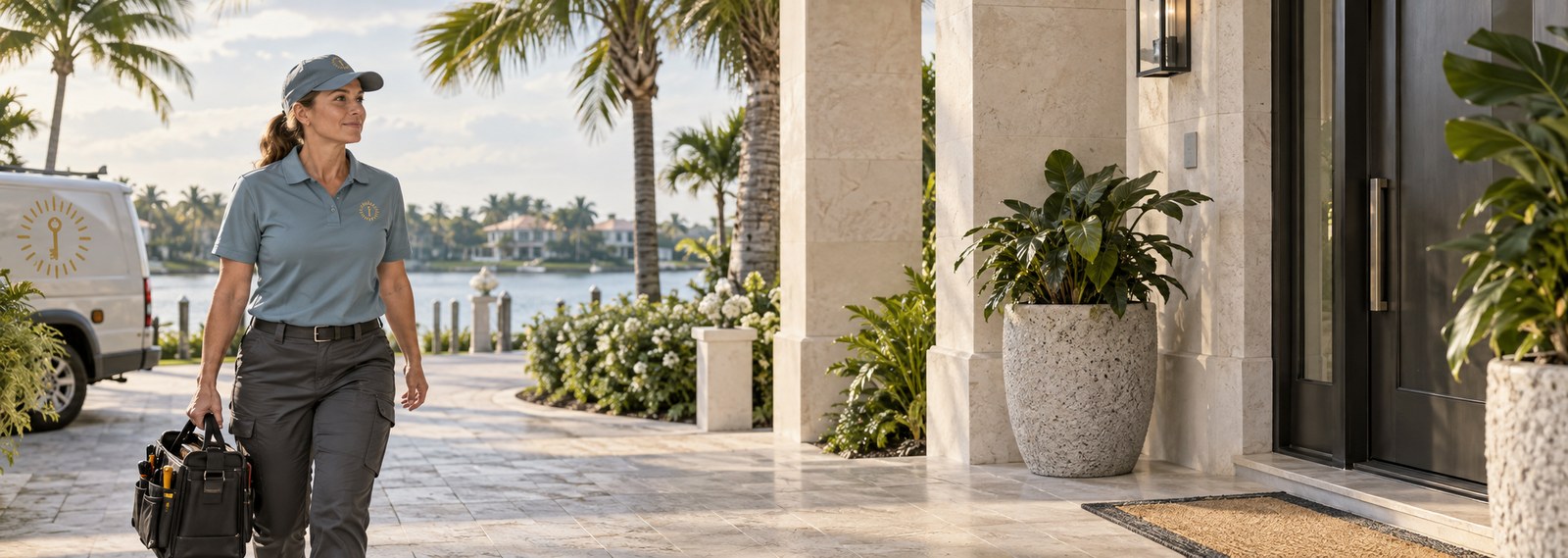
Homes on a canal street live with two fronts: a street side where cars and visitors arrive, and a water side with a dock, a walkway and a lot of moist air. Locks on both sides face different problems. This guide covers how a mobile locksmith handles lockouts, corroded hardware, rear gates and sliding doors for canal-front properties, and how to prepare for a call.
Living with two fronts: the street and the water
A canal-front home has a split personality when it comes to security. The street side looks like any other residential entry, with a front door, a garage and perhaps a side gate. The water side is entirely different: a lanai or sliding wall of glass, a patio, a seawall or dock, and often a gate or latch where the yard meets the walkway. Each side needs its own thinking, because the risks and the weather exposure are not the same.
Most people spend their attention on the front door and forget that the back of the house is the part open to long sightlines from boats, neighboring docks and shared walkways. At the same time, the back is where spray, humidity and sun hit hardest. Locks there corrode sooner, latches stick sooner, and handles loosen sooner. A thoughtful plan treats the water side as its own project rather than an afterthought to the front entry.
When you call us about a canal property, it helps to mention which side is giving trouble and what kind of door or gate it is. We ask whether the entry is a hinged door, a sliding panel, a pocket slider or a dock gate, because the hardware and the approach for each are quite different. A clear description lets the technician bring suitable parts on the first visit.
What salt air and humidity do to hardware
Moist, salty air is patient and thorough. It settles on metal surfaces, works into the tiny gaps inside a lock, and starts a slow process of corrosion that you cannot see until something stops working. Brass and stainless components tend to hold up better than plated steel, but even good hardware needs attention over time. Finishes pit, springs weaken, and the internal pins can become sluggish and sticky.
The signs are easy to learn. A key that suddenly feels gritty, a deadbolt that needs two attempts, a handle that looks cloudy or flaky, and a latch that does not spring back crisply are all early warnings. Catching them early usually means a cleaning, a dry lubricant and a small adjustment. Ignoring them often means a lock that seizes on a day when you most need it to turn.
We recommend that canal-side owners inspect exterior hardware a few times a year, especially before and after storm season. Wipe down visible metal with a damp cloth to remove salt film, and avoid heavy oils that trap grit. If a lock shows rust, green crust or a rough feel, have it looked at. A replacement in a corrosion-resistant finish is often a wiser long-term choice than repeated repairs on a failing unit.
Sliding glass doors and lanai entries
Sliding glass doors are the main way people reach the lanai and the water view, and they are also one of the most common weak points in a home. The factory latch on many sliders is a small hook that catches a keeper in the frame. Over time the track fills with sand and moisture, the rollers wear, and the door sits slightly out of line, which means the hook only partly engages.
A technician can inspect the latch, clean the track, adjust the rollers and replace a worn hook or keeper. For extra security, a secondary device such as a bar in the track, a pin through the frame or a surface mounted auxiliary lock gives a second line of defense without altering the glass. Because the door faces the water, choose parts with marine friendly finishes where possible.
If you ever find a slider stuck shut or open, avoid forcing it. Pulling hard on a misaligned door can crack tracks or pop the panel out of its frame. Call us, and describe how it moves and what you hear. We open it carefully, protect the glass and the frame, and then fix the underlying alignment so it works smoothly again. Ownership or authority is confirmed before we begin any work on the property.
Dock gates, seawall latches and shared walkways
Where a yard meets a dock, there is often a gate, and that gate faces the harshest conditions on the property. It sits in constant contact with moisture, sun and sometimes salt spray, and it may be touched by landscapers, boat guests and dock cleaners. A simple gate latch can corrode in a single season, and a padlock can seize so tightly that the key will not turn at all.
Replacement latches in stainless steel or heavy duty coated finishes last much longer than basic ones. Keyed gate locks designed for outdoor use handle moisture better than standard indoor cylinders. We can install a new gate lock, rekey an existing one so old keys no longer work, or cut a fresh key for a latch that has gone sticky. Cutting a key is quick if the lock is still healthy.
Shared walkways add a social side to the question. If a path crosses neighboring lots or serves several properties, you want locks that can be rekeyed easily when access arrangements change. A keyed alike set can open several gates with a single key, or each gate can be rekeyed differently. We help you plan the system so that you always know who holds a working key to what.
Lockouts when you are on the dock or in the yard
A particular and frustrating kind of lockout happens on canal properties: you step out the back door to deal with a boat line or rinse a hull, the door swings shut behind you, and your keys are inside. You may be barefoot, wet, and holding a hose. Nothing about the situation is dangerous, but it is uncomfortable, and the first instinct is often to try something clever with the door.
Our advice is to stay calm and avoid prying at the door or prying a window. A prybar can bend the frame or crack glass and turn a simple lockout into a repair bill. A technician can usually open a standard door with a tool that leaves no marks. For sliders, the approach differs but is just as gentle when done by someone who knows the hardware.
When you call, tell us whether anyone is inside, whether pets are locked in, and whether there is any urgency such as a stove left on. We will ask for identification and a way to confirm you live at the property. Once inside, we can suggest small habit changes, such as a hide-a-key arrangement that is not obvious, a keypad lock on the lanai door, or a spare given to a trusted neighbor.
Front doors, garages and the street side
The street side of a canal home deserves just as much care. Many of these houses have broad entry doors, sometimes double doors with a decorative finish, and attached garages that function as the daily entrance. The hardware on these entries sees constant use. Deadbolts, handle sets and strike plates take a beating, and the finish on the exterior often fades in strong sun.
A technician can check that the deadbolt throws fully into the frame, that the strike plate is anchored with long screws into the stud, and that the hinges are tight. These small points are what actually resist force. A pretty lock on a weak frame is a weak lock. If your doors have shifted from the heat or from storm movement, minor alignment work can make them close cleanly and lock firmly again.
If you want a different look or feature, we can fit new handle sets, smart locks or keypad deadbolts on the front door. Keep in mind that electronic models depend on batteries, and a plan for what happens if one fails is worth having. We explain how each type works in a coastal setting, including how often to change batteries, so you can pick something you will enjoy rather than something you will resent.
Vehicle keys at the house and the dock
Vehicle trouble shows up in canal neighborhoods in particular ways. Keys and fobs get exposed to moisture, dropped on dock boards, or left in a pocket during a swim. Water damage to a fob can cause erratic behavior or total failure, and a key left in salt air develops corrosion on the blade and the chip housing. The result is a vehicle that will not unlock or will not start.
We handle vehicle lockouts, spare keys and programming at your location, whether that is the driveway, a marina parking area or a quiet street along the canal. The first step is to identify the key type: a basic cut key, a chip key, a remote head key or a smart fob. Then we decide whether we can cut and program on site, which is common.
As with any vehicle, we check ownership or authority before opening or programming. A registration or title that matches the vehicle, together with your identification, is what we look for. If you recently bought a vehicle and only have one key, we recommend adding a spare before the original is lost or damaged. A spare is far simpler to create while a working key exists than after all keys are gone.
Hurricane season preparation for locks and doors
Hurricane season is a fact of life along the Gulf, and preparation is partly about doors. Before a storm, many owners install shutters or panels over glass, and they need to be able to lock or secure those panels in place. After a storm, doors can swell, shift or take on moisture, and locks that worked fine may suddenly bind or refuse to latch.
Before the season begins, test every exterior lock. Try each key, check that each deadbolt turns freely, and see whether any door drags on the floor or the frame. Fix small issues now, because during the days before a storm, everyone is busy and parts can be harder to find. Make sure every household member knows where spare keys are kept and how to secure each entry.
After a storm, inspect hardware for moisture, debris and bent parts. Wipe down locks, clear sand from tracks, and test the action. If a door has been damaged and cannot be locked, a temporary measure may be needed until a permanent repair is made. We can help with securing an entry, replacing damaged hardware and rekeying if a key or a door was affected. We advise calling early if you suspect trouble.
Rekeying a home with many keys in circulation
Waterfront homes often attract many helpers over time: dock builders, pool crews, cleaners, landscapers, boat captains, house sitters and guests. Each may have received a key or a code at some point, and few of those keys ever come back. The result is a property where nobody can say with confidence how many working copies exist.
Rekeying is the cleanest solution. The locks stay in place, but their internals are changed so that old keys stop working. A single new key then opens the front door, the garage entry, the lanai and the dock gate if you choose. The process is quick, the visible hardware does not change, and the cost compared with replacing every lock is much smaller. A quote is given by phone first.
Before we rekey, we confirm that you own the property or hold legal authority over it, since a locksmith should never change locks for someone without a right to do so. Seasonal owners especially benefit from rekeying when they return for the winter, as it resets the access list. You can then issue new keys deliberately and keep a simple record of who holds each one.
Boat storage, dock boxes and small outbuildings
Many canal properties include small storage points that need their own locks: a dock box for lines and fenders, a shed for pool supplies and tools, a boat lift control cabinet, or a utility closet beside the garage. These are modest items, yet they often hold things worth protecting and things that could cause harm if the wrong person reached them, such as fuel, cleaning chemicals or electrical controls.
Padlocks on exposed storage take the worst of the weather, and a common failure is a lock body that fills with corrosion until the shackle will not release. Look for padlocks with weather covers or sealed bodies, and consider a keyed hasp in a coated finish. If a padlock has already seized, do not strike it repeatedly. Call us, and we can remove it with minimal damage to the hasp so a replacement can go on.
Matching the keys across these small locks keeps life simple. Instead of carrying six different keys on a ring that is already crowded, you can have several padlocks keyed to open with one key. We can set this up for new locks, or rekey compatible ones. As always, we ask that you show you control the property before we alter any lock, and we explain what each choice will do for your daily routine.
How a visit works from first call to finished lock
The visit begins with a phone call in which we ask about the address, the type of door or gate, the problem, and whether anyone is inside. We also ask for details that help us plan, such as whether the entry is on the water side. We give a quote by phone for straightforward jobs. If the job is complicated, a technician visits first and the service call charge is explained before dispatch.
On arrival, the technician confirms your identity and your authority over the property, looks at the problem, and explains the plan. Work is done carefully, with attention to protecting finishes and glass. For lockouts, the goal is a clean opening. For repair or replacement, expect the technician to explain which parts are being used and why, including finish choices suited to a waterfront setting.
At the end you test everything yourself. Operate each lock several times, try each key, and ask any questions you have about care. We encourage a short maintenance routine of rinsing salt from exterior hardware and using the right lubricant. With reasonable care, the hardware on your canal home can serve you well through many seasons of sun, spray and storm.
Frequently asked questions
Can you work on dock gates and seawall latches?
Yes. We can repair, rekey or replace gate latches and keyed gate locks on residential properties, including those exposed to spray and humidity. We recommend corrosion resistant finishes for anything near the water. Describe the gate when you call, and call to confirm availability, so the technician can bring suitable parts.
Why does my lock keep sticking near the water?
Moist, salty air gets into the lock and builds corrosion and grit around the internal pins. The result is a rough key action or a deadbolt that resists turning. A cleaning and the right dry lubricant often helps, but a badly worn lock may need to be replaced with a more suitable finish.
I am locked out on my lanai. What should I avoid doing?
Avoid prying the door, forcing the slider or breaking a window. Those steps usually cost far more than a lockout call. Call us, tell us whether anyone or any pet is inside, and be ready to show identification that connects you to the property so we can open it safely.
Do you check ownership before rekeying a house?
Yes. Before rekeying, opening or changing locks, we confirm that you own the home or have the authority to act for the owner. This might be an identification matching the address, a lease with permission, or a management document. It protects owners and keeps the work clearly legitimate.
How is a quote given for a complicated job?
Simple jobs are quoted by phone after you describe the lock and the problem. For more complicated work, such as several doors or unusual hardware, a technician visits and the service call charge is explained before dispatch. You then decide whether to go ahead, and nothing is started without your agreement.