
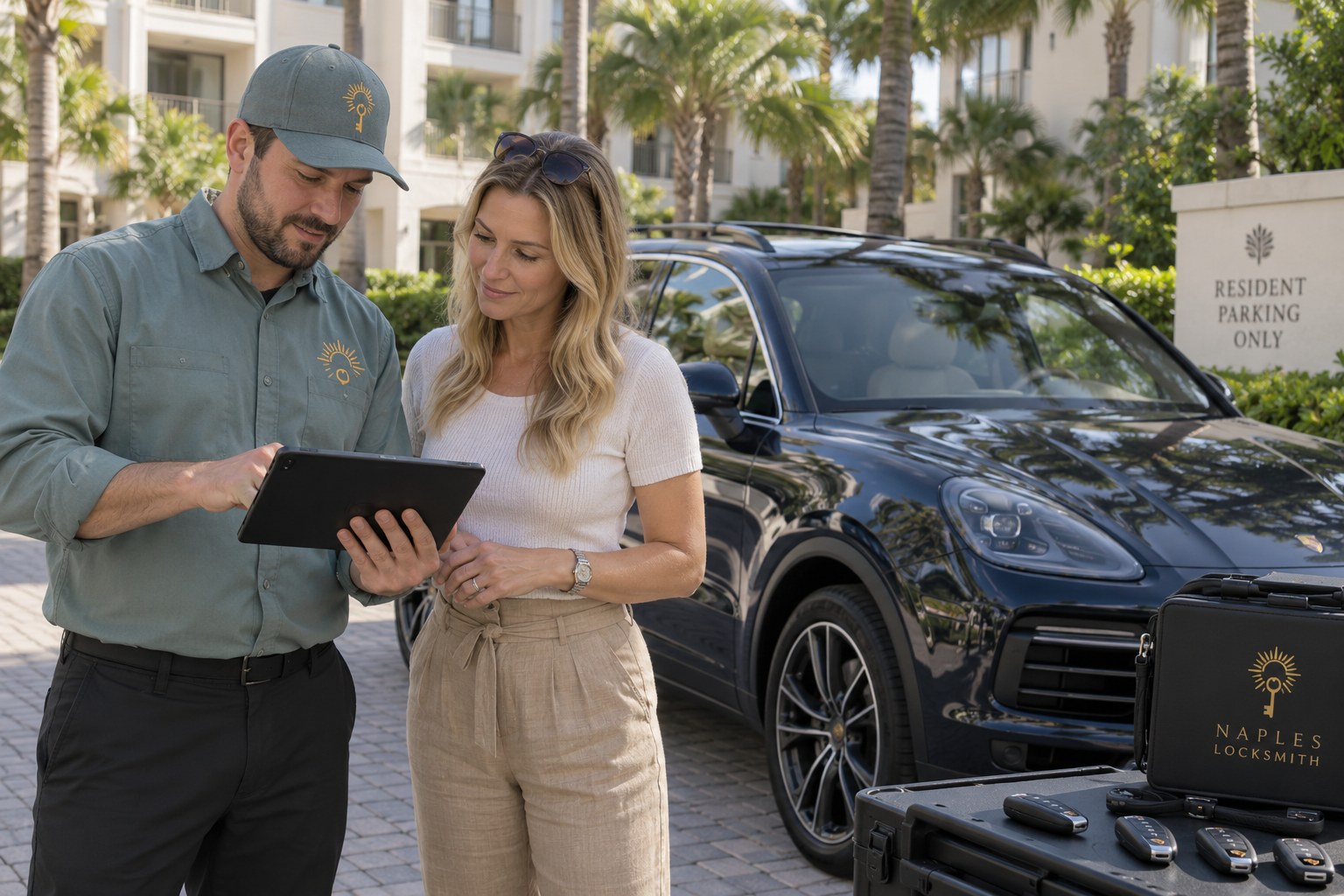
You loaded the cart, walked back to the car, pressed the button, and nothing happened. A dead fob battery is one of the most ordinary problems a driver in Naples can have, and it almost never means the key itself is ruined. This page explains what is really going on inside the fob, what you can try right there in the lot, and when calling a locksmith is the sensible next step.
What a dying fob battery actually looks like
Fob batteries rarely fail all at once. Most of the time the remote gets slowly weaker over several weeks, and you only notice because you have started standing closer to the car before pressing the button. You may find yourself pressing twice, pointing the fob at the windshield, or holding it against your chin, an old habit that sometimes helps the signal. Those are all quiet signs that the small coin cell inside is near the end of its useful life, and that a replacement is overdue rather than urgent.
Many vehicles also give a hint on the dashboard. Some display a short message about the key battery when you start the engine, and others simply blink a small key symbol. If your car has push button start, you might see a warning that the key was not detected, even though the fob is sitting in your pocket. That message is easy to dismiss in a hurry, but it is the car telling you the fob is running low and that the proximity link is getting unreliable.
A true dead battery looks different from a sudden break. If the fob worked this morning and the little indicator light on it no longer blinks when you press a button, a depleted cell is the most likely cause. If the light still blinks but the car ignores it, the problem may be on the vehicle side or in the fob programming instead, which is a separate conversation. Knowing which of these two situations you are in saves a lot of guessing in the parking lot.
The mechanical key hidden inside most fobs
Almost every modern remote or smart fob carries a small metal key tucked inside the plastic. It is easy to forget because it hides in the case, and many drivers go years without ever touching it. Look along the edge of the fob for a small slider or button. Slide it, and the thin blade usually pulls out of the case. Hold the fob in your palm while you do this, because the blade can spring out faster than expected and land under the car, which is a miserable thing to chase across hot pavement. That blade is built for exactly this moment, when electronics have failed but the door lock itself still turns mechanically with an ordinary cut.
On many vehicles the driver door handle has a cover over the keyhole to keep the exterior clean. If you do not see a visible lock, look near the end of the handle for a small notch or seam. The blade can often be used to lift that cover gently, revealing the cylinder underneath. Work slowly and avoid prying hard, since painted trim scratches easily and the cover is usually held by a simple clip. If you are unsure, it is better to ask than to force it.
Opening the door with the blade may trigger the alarm on some vehicles, because the car did not hear a recognized electronic command first. That is normal and not a sign that anything is broken. Often the alarm stops once the car detects the fob nearby or once you place the key in the ignition. If it keeps sounding, pressing the unlock button on the fob while holding it near the start button or steering column can help the car read the chip even when the battery is weak.
Starting the car when the remote battery is flat
Getting inside is only half of the problem. A car with push button start needs to read the chip in the fob before it will run, and a weak battery may leave that chip unreadable from a distance. Fortunately, manufacturers plan for this. Most vehicles include a backup reading position, often a marked pocket in the console, a spot beside the steering column, or a recess near the start button, where you can hold the fob so the car reads it at very close range.
The passive chip inside a fob does not actually need the battery to be read at close range. It works more like a tag that gets powered by the car's own antenna for a fraction of a second. That is why holding the fob directly against the start button or inside the marked slot often brings the dashboard back to life. Your owner manual will show the exact location, and it is worth taking a quick photo of that page now so you have it on your phone.
If the engine still refuses to start with the fob in the backup position, do not keep trying many times in a row. Repeated attempts can drain the car battery and make the situation harder. Check that the brake pedal is pressed firmly, that the shifter is in park, and that the fob is truly touching the target spot. If none of that helps, the issue may be more than the cell, and a technician can check the chip and the programming rather than guessing.
Replacing the coin cell yourself
Changing a fob battery is a small job when you know what to expect. The common cell is a flat lithium coin, and the type number is printed right on its face. Open the fob using the small notch on the case, with a thin flat tool or even a coin used carefully. Photograph the cell before you remove it so you remember which side faces up. Placing the new cell upside down is the most common mistake, and it simply leaves the remote silent.
Handle the new cell by its edges. Oils from your fingers can slightly reduce contact on some designs, and a dirty contact is a hidden reason a new battery seems not to work. If the small metal contacts look dull or have a faint green or white crust, which can happen in our humid Gulf air, wipe them gently with a dry cotton swab. Avoid scraping them, because bent contacts are harder to fix than a dirty one.
Keep coin cells away from small children and pets. A swallowed lithium cell is a genuine medical emergency, so store spares high up and dispose of old ones promptly. When snapping the case closed, press evenly all the way around so the seal seats correctly. A case that sits slightly open lets moisture in, which is the usual reason a freshly replaced battery fails again within a few months, especially for people who live near the water.
Do you need to re-pair the fob afterward?
This is the question most people worry about, and the honest answer is that in most cases the answer is no. The programming of a fob lives in a small memory inside it, not in the battery, so a quick swap that keeps the fob powered down for a short time normally leaves everything intact. Many people finish the swap in under a minute and find the buttons work immediately, with no pairing step at all.
There are exceptions. Some fobs lose their link to the car if the cell is out for a long time, or if the replacement battery is weak or the wrong type. A few vehicles ask you to run a short resynchronization routine, such as pressing the lock button several times or turning the ignition on and off in a set pattern. That routine is usually printed in the owner manual, and it takes only a few minutes when it is needed at all.
If the buttons stay dead after a fresh, correctly placed cell, there are a few likely explanations. The fob may have been dropped or damaged, the transmitter inside may have failed, or the key may need to be programmed again. A locksmith can read what the car expects, test the transmitter, and tell you whether the old fob is worth saving. Ownership is confirmed before any programming begins, which protects you as well as the vehicle.
Why the heat and salt air shorten battery life
Naples summers are hard on small electronics. A fob that rides on a dashboard, in a cup holder, or in a pocket on a hot day sees temperatures far above what the cell was designed for. Heat speeds up the chemical aging inside a lithium battery, so a fob left in a parked car through August can age a lot faster than the same fob kept in a cool purse or bag. Where you carry it matters more than most people think.
Humidity matters too. Warm, moist Gulf air slips into any case that does not seal tightly, and salt carried on the breeze after a beach day can leave a thin residue on the contacts. That residue draws moisture, and a damp contact can drain a battery slowly even when you are not pressing anything. People who spend time on the water, at the pool, or fishing from a dock often find their fobs fail earlier than they expected.
A few simple habits help. Keep the fob out of direct sun, rinse off salty hands before handling it, and dry it if it gets splashed. Consider a thin silicone cover, which cushions drops and adds a little protection against moisture. If you are a seasonal resident who leaves a vehicle parked for months, remove the spare fob from the vehicle and store it indoors, since a car sitting through the summer is the hardest environment of all.
When calling a locksmith makes sense
Most dead battery problems you can handle yourself, but there are honest reasons to call. You may not be able to open the fob without damaging it, the blade may be missing, or the door lock may refuse to turn because the cylinder is stiff from salt air. You may also be somewhere unsafe or inconvenient, with perishable groceries in the back and a long hot walk to anywhere with shade. In those moments, getting help is a reasonable decision and not a failure of preparation.
When you call, have a few details ready. Tell us the make and general type of vehicle, where you are parked, and whether the keys are inside or with you. Quotes are given by phone, and we ask you to call to confirm availability. If the job turns out to be more involved than a simple cell and a door, a technician comes to you and the service call charge is explained before anyone is dispatched, so there are no surprises on arrival.
Before we open or program anything, we confirm that the vehicle is yours or that you have the authority to act for the owner. That usually means a registration or title and a photo identification that match the car. It may feel like an extra step when you are standing in a hot lot with ice cream melting, but it is the same step that protects your own car if someone else ever claims it. It only takes a minute or two.
What a technician checks on the spot
When a technician reaches a stranded driver, the first thing checked is the cell itself. A small tester shows whether the battery has any life left, and that single reading often answers the whole question. If the cell reads low, a fresh one is fitted in the right orientation and the buttons are tested at several distances, so you know the range is back and not just working an inch away from the car.
Next, the technician looks at the fob body. Cracked cases, loose contacts, worn buttons, and signs of moisture are all noted. A fob that rattles or has a gap along the seam may no longer protect the circuit board, and in that case a replacement shell is a sensible suggestion. The board and chip can often be moved into a new shell, which keeps your programming while giving you a solid, sealed case again.
Finally, the car is tested alongside the fob. The technician checks that the doors lock and unlock, that the trunk release responds, and that the vehicle recognizes the key and starts normally. If something does not respond, the next step is explained plainly: either a quick resynchronization, a repair, or a new fob. You decide what to do, and the explanation comes before the work. Nobody should be rushed into a decision in a parking lot. If you would rather think it over and handle the rest at home, that is a perfectly reasonable choice, and the technician can simply get the car open and running for the evening.
Keeping a spare ready so this stays a minor event
The easiest way to turn a dead fob into a small inconvenience is to carry a spare battery or a second key. A single spare coin cell costs very little room in a glove box or wallet, and it makes the swap a two minute job rather than a stranded afternoon. Write the cell type on a small label so you do not have to guess later, and keep it in a spot you will remember.
A second, working key matters even more. If you only have one fob, a failed battery combined with a lost or damaged key leaves you with no easy fallback. Having a spare cut and programmed while everything still works is far simpler than creating one from nothing after the original is lost. Ask about adding a spare the next time a technician is already working on your car.
Finally, make it a habit to replace the battery on a schedule rather than waiting for failure. Many people choose a date, such as the start of hurricane season, and swap the cell then. Combined with a quick test of both fobs, that single routine catches almost every battery problem before it strands you. It is a small piece of preparation that fits well with the other storm season checks most of us already do.
Frequently asked questions
Can I start my car if the fob battery is completely dead?
Usually yes. Most cars read the chip inside the fob at very close range without needing the battery. Hold the fob against the start button or place it in the marked pocket or slot your owner manual describes, press the brake firmly, and try again. If that does not work, a technician can check the chip and the programming.
Will I lose the programming if I change the battery myself?
In most cases you will not, because the programming is stored in the fob and not in the cell. Make a quick swap with the correct type and the right orientation. If the buttons stay silent afterward, the fob may need a short resynchronization or have another issue, and a locksmith can diagnose which.
How do I find the right battery type for my fob?
The number is usually printed on the face of the old cell, so open the fob and read it before removing anything. You can also check the owner manual. Photograph the cell in place first so you remember which side faces up. If the markings are unreadable, call us and describe the vehicle.
Is it safe to pry the fob open with a coin or a screwdriver?
It can be, if you are gentle. Use the small notch on the case and a thin flat tool, and work slowly so the plastic does not crack. A cracked case lets moisture reach the circuit board. If the fob seems glued shut or tight, it is better to ask for help than to force it.
What does it cost to have a locksmith replace a fob battery?
Quotes are given by phone, so call us with the vehicle details and where you are. If the job is more involved than a simple battery and door, a technician visits and the service call charge is explained before dispatch. Please call to confirm availability, and have your ownership documents ready.