
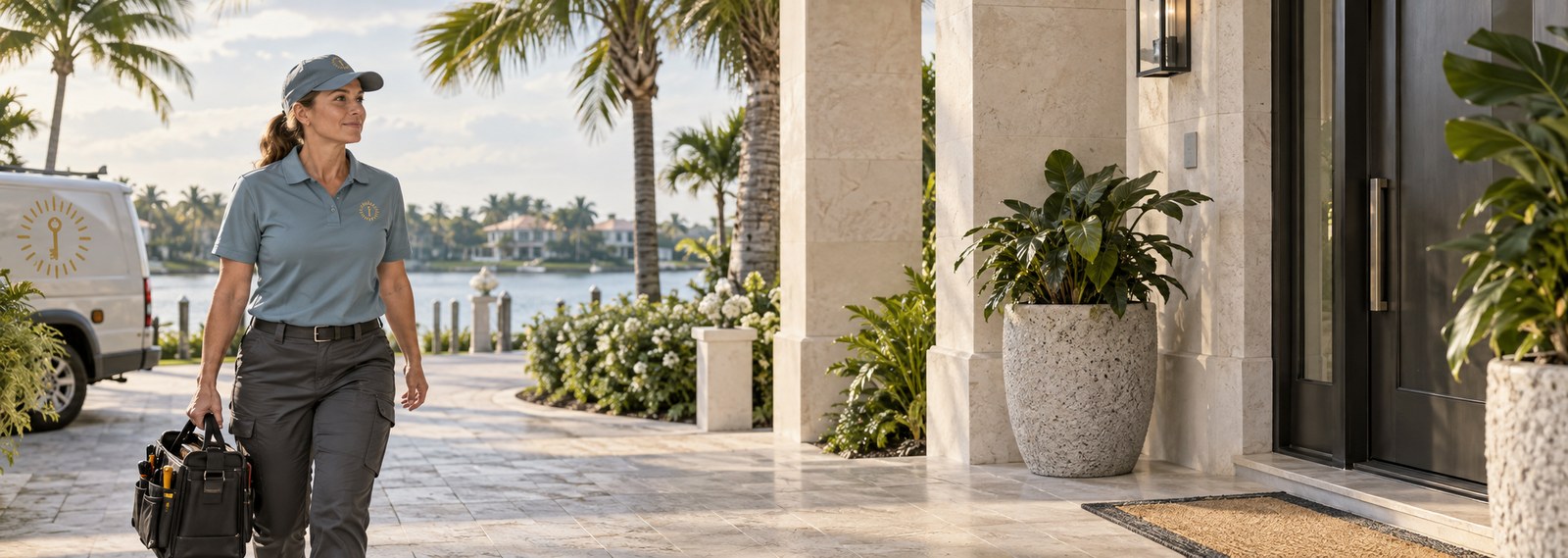
Selling or buying a home around Naples means keys move through many hands: agents, stagers, photographers, inspectors, appraisers and buyers. This guide walks through how lockbox access works, what can go wrong with it, why rekeying after closing is a sound habit, and how to handle the unknown key problem that nearly every resale home has.
How showing access normally works
When a home goes on the market, the listing agent usually places a lockbox on the door handle, a railing or a gas meter bracket. Inside the box is a key to the home. Agents who are cleared to show the property open the box with a code or an electronic credential, retrieve the key, show the home and return it. The system is designed to be convenient for the many people who need brief, legitimate access to a home they do not own.
That convenience is also the weak point. A lockbox opens for a lot of people, and the home key inside is the same key every time. It is the owner's real, working key, not a special showing key. If one visitor makes a copy, takes a photo of the key blade or leaves the door unlatched, the consequences land on the seller. Nothing about the lockbox itself is careless. The risk comes from how many people interact with it over weeks or months.
In the Naples area, there are extra wrinkles. Many sales involve seasonal owners who live elsewhere, so nobody is physically in the house to notice an unlatched door. Gated and condo communities may add a layer of gate access, front desk procedures or key fobs on top of the lockbox. Understanding exactly which layers apply to your property before the sign goes up avoids confusion once showings begin.
Choosing where the lockbox goes
Placement is more important than it looks. A lockbox on a front door handle in full view of the street advertises that the home is vacant or for sale, which is already obvious from the sign, but it also places the key just inches from the lock for anyone with the tools to attack the box. A box on a sturdy fixed object, attached with the shackle seated fully and checked for play, is harder to pry off than one clipped loosely on a lever handle.
Think about the door itself as well. A heavy impact-rated entry door with a deadbolt and a latch assembly that is in good repair stands up to constant use. A sticky or sagging door that needs a shoulder push to latch is a problem during showings, because visitors may leave it improperly closed. Before listing, have the door, strike plate and latch checked so the home locks smoothly every time the last visitor leaves.
Condo towers and communities with rules need a conversation first. Some associations forbid lockboxes on common railings or doors, and many prefer that access be arranged through the front office or a gate system. Ask the association or property manager what is allowed before ordering anything. If the building handles access differently, the lockbox may live in a controlled spot or not be used at all, and the listing agent can explain how showings will work.
What a listing agent and a locksmith each handle
It helps to know who does what. The listing agent manages the sale, controls who is allowed to schedule showings and decides how the lockbox is set up. The locksmith handles the lock hardware: the cylinders, the deadbolts, the latch, the strike plate and the keys themselves. The two roles overlap only at the door. If you need new keys made, a stuck lock repaired or a cylinder changed, that is locksmith work, and it should be done with the owner's knowledge.
A locksmith will not open, rekey or alter a lock without checking that the person asking has the right to do so. During a sale, that might be the seller, a property manager, an estate representative or a buyer after closing. If the request comes from someone else, such as an interested party who wants to see inside, we politely decline. This is not obstruction. It protects the owner and keeps the process orderly and lawful.
Good communication prevents most headaches. If you plan to change locks before listing, tell the listing agent so the keys in the lockbox match what actually works. If a lock fails mid-listing, call us rather than improvising, and let the agent know the access plan has changed. A locksmith can often advise the best order of operations by phone, including whether a repair can wait until a convenient window or should be handled before the next scheduled showing.
The unknown key problem
Nearly every home that has been owned for a while has keys nobody can account for. Previous owners, former tenants, relatives, contractors, cleaners, pool services and neighbors who once fed a cat may all have received a key at some point. Some were returned, some were copied, and some simply went into drawers and never came back. When you sell, you cannot honestly say how many working keys exist, and the buyer inherits that uncertainty.
This is why rekeying at the point of ownership change is such a common recommendation. A rekey replaces the internal pin arrangement of the existing cylinders so that old keys stop working and a new set of keys takes over. The door hardware stays, the look stays, but the list of people who can enter resets to zero. It is a modest piece of work compared with the peace of mind it provides, and it can be done on all the exterior locks in one visit.
Sellers can help by gathering what they know. Make a short list of everyone who has had a key and, if possible, collect the ones you can. Be honest with the listing agent about any ambiguity, such as a landscaper who has a code or a relative who lives out of state. You do not need a perfect inventory. You just need enough information to decide whether the keys that remain in circulation are acceptable, or whether it is time to reset them all.
Rekeying after closing, step by step
After the sale closes, the buyer becomes the person with authority to change the locks. A typical rekey visit begins with the technician confirming that the buyer owns or controls the home, usually from closing documents or identification. Then the technician inspects each exterior lock: the front deadbolt, handle set, garage entry, patio and side doors, and any keyed windows, storage or gate locks the buyer wants included.
For each cylinder, the technician removes it, replaces the pins with a new combination matched to a fresh key, tests it repeatedly, and reinstalls it. Because all the cylinders can be keyed alike, one key can operate the whole house, which many families prefer. If the existing hardware is worn, corroded or loose from years of salt air, the technician will point that out and explain whether replacement makes more sense than rekeying. Simple jobs are quoted by phone; complicated jobs involve a technician visit with the service call charge explained before dispatch.
Buyers often ask whether they should replace everything instead. In many cases, rekeying is enough, because the hardware is sound and only the keys need to change. Replacement becomes sensible when a lock is damaged, outdated, mismatched across doors, or when the buyer wants a different security level or a smart feature. A short conversation on the phone about the age and condition of the hardware usually clarifies which path fits, and we can discuss it before anyone arrives.
Smart locks and access codes during a sale
Some sellers use keypad or smart locks during listing, which can reduce the number of physical keys in circulation. A temporary code issued to each visiting agent can be tracked and deleted afterward. This approach has real advantages, especially for vacant seasonal homes. It also has pitfalls. Batteries die, firmware misbehaves, and codes shared casually spread faster than anyone expects. A smart lock is only as secure as the habits around its codes.
If the home has a smart lock when it is sold, the seller should remove their own codes and account access, and the buyer should reset the device and create a new administrator account. Failing to do this leaves a quiet door open for the previous owner's phone or cloud account, which is rarely malicious but is still a gap. The same goes for garage keypads, gate transmitters and any alarm codes tied to the property.
Smart locks do not replace the need to check the mechanical side. A keypad deadbolt still has a keyed override on many models, and that key is subject to the same unknown-copy problem as any other. When you rekey or replace a smart lock, ask the technician to handle the physical cylinder and confirm that the bolt, strike plate and door alignment are correct. A well-aligned door extends battery life and prevents the stalling that frustrates visitors.
Seasonal owners and absentee sellers
Plenty of homes in Naples and the surrounding communities are owned by people who live elsewhere for much of the year. Selling from a distance adds logistics. You cannot meet the locksmith at the door, hand over keys or check the result in person. Plan the process so that a trusted representative, such as a property manager, a family member or an agent with written authority, can be present when work is done.
Before the visit, confirm in writing who is authorized, what doors are included and how the keys will be handled afterward. The locksmith will want to verify authority at the property, so the representative should have documentation to show. If the home sits inside a gated community, notify the gate office that a service technician is expected, since entry procedures vary and delays at the gate are easy to prevent with a short heads-up.
Hurricane season adds its own planning. Shutters, storm doors and impact glazing change how a house is accessed, and a sale in the middle of storm preparations can complicate everything. Keep spare keys for shutter locks, garage doors and any secondary entrances in one labeled place, and tell your representative where it is. After closing, the buyer should receive a complete, tested set of working keys, with each one verified on the door it is meant to open.
Condos, associations and shared doors
Condo and townhome sales layer association rules over the normal lock questions. Some buildings control the front door key and require owners to use approved cylinders or a master key arrangement so that emergency access remains possible. Changing a lock without checking the rules can create disputes, so confirm what your documents and the association allow before any rekey is scheduled. Many associations are happy to answer in a short call or email.
Mailbox keys, storage cage keys, amenity fobs, garage remotes and parking tags are often forgotten during a sale. They belong to the unit, not the seller, and a buyer who does not receive them may face weeks of inconvenience. Make a checklist that covers every item, and hand the whole set to the buyer or their agent at closing. Where tags or fobs are registered in the seller's name, ask the association how to transfer or deactivate them.
If the unit has a shared or building-owned lock, the locksmith may be limited to the part that belongs to the owner. That might be the cylinder in the unit entry door, not the lobby door or the stairwell. Knowing the boundary prevents wasted effort. Call us with a description of what you want done, and we will tell you plainly what falls within an owner's authority and what the association needs to handle on its own.
A practical checklist for sellers and buyers
Sellers can reduce trouble with a few steps before the lockbox goes up. Test every lock and every key, repair anything sticky, and make sure the door latches without a push. Collect extra keys from relatives, cleaners and service providers where possible. Write down who has codes. Ask your agent how the lockbox is configured and who can open it. Then remove personal documents, spare keys and valuables that do not belong in a house full of visitors.
Buyers should plan to rekey or replace key locks soon after closing, ideally before the first night in the home or before movers arrive. Gather every key the seller provides, test each one, and ask about garage remotes, gate transmitters, mailbox keys and alarm codes. Reset smart devices and create new accounts. If any lock shows damage or corrosion, ask the technician to assess it, since coastal air can hide wear until a part finally fails.
Both sides benefit from a clean handoff. A written list of every key, code and fob, who has it and what it opens, is the single most useful document in the entire process. It takes a few minutes to prepare and prevents arguments months later. When you are ready to schedule, call us to describe the property and discuss the work. Please call to confirm availability for your preferred timing, and remember that ownership or authority is checked before any lock work begins.
What to do when a lockbox or showing key goes wrong
Problems with showing access are usually small and fixable. A key sticks in the deadbolt because humidity has swollen the door. A lockbox shackle will not release. An agent reports that the door did not latch after a showing, and the seller finds it ajar days later. Each of these has a cause worth tracing instead of simply living with it, because a lock that misbehaves during a listing will misbehave again for the next owner.
If a visitor reports that the key does not work, do not assume the visitor made a mistake. Have a technician look at the cylinder, the bolt alignment and the strike. A cylinder that has been used many times a week by strangers wears faster than one used by a single family, and tired pins show up first as a key that needs a jiggle. Early service costs less trouble than a lockout in front of a waiting buyer.
Keep a short incident note during the listing: what happened, when, and who was told. If a key goes missing from a lockbox or someone reports a lost showing credential, tell the listing agent right away and consider rekeying immediately instead of waiting for closing. Call us to talk it through, and we will explain whether a quick repair or a rekey fits, with the ownership check completed before any work starts.
Frequently asked questions
Is the key in a lockbox a special showing key?
Usually it is your real house key, the same one that opens the door every day. That is why the number of people who can open the box matters, and why many owners rekey after a sale. If you want a separate key for showings, a locksmith can set up a keyed arrangement, but most listings simply use the working key.
Should I rekey before listing or after closing?
Both can make sense. Rekeying before listing resets old keys and gives you a controlled set for the sale period. Rekeying after closing is the buyer's choice and is strongly recommended, since the buyer cannot know who holds old keys. Many sellers choose to make sure the locks work well and leave the rekey to the new owner.
Can a buyer change the locks before closing?
Generally no, because the buyer does not yet own the home and has no authority to alter it. After closing, the buyer has that authority and can schedule a rekey. A locksmith will ask for proof of ownership or authority before starting, which protects both the buyer and the previous owner during the transition.
What if I cannot find all the keys to my home?
That is very common. The usual answer is to rekey the exterior locks so every old key stops working, and then have a fresh set cut. You do not need to track down every missing key. Call us, describe the doors, and we will explain the work and quote simple jobs by phone.
Do smart locks remove the need for rekeying?
Not entirely. Many smart locks still have a keyed override, and that cylinder can have unknown copies like any other. You should also reset the device, remove old user codes and create a new administrator account. A technician can handle the physical cylinder and check the door alignment so the lock operates reliably.