
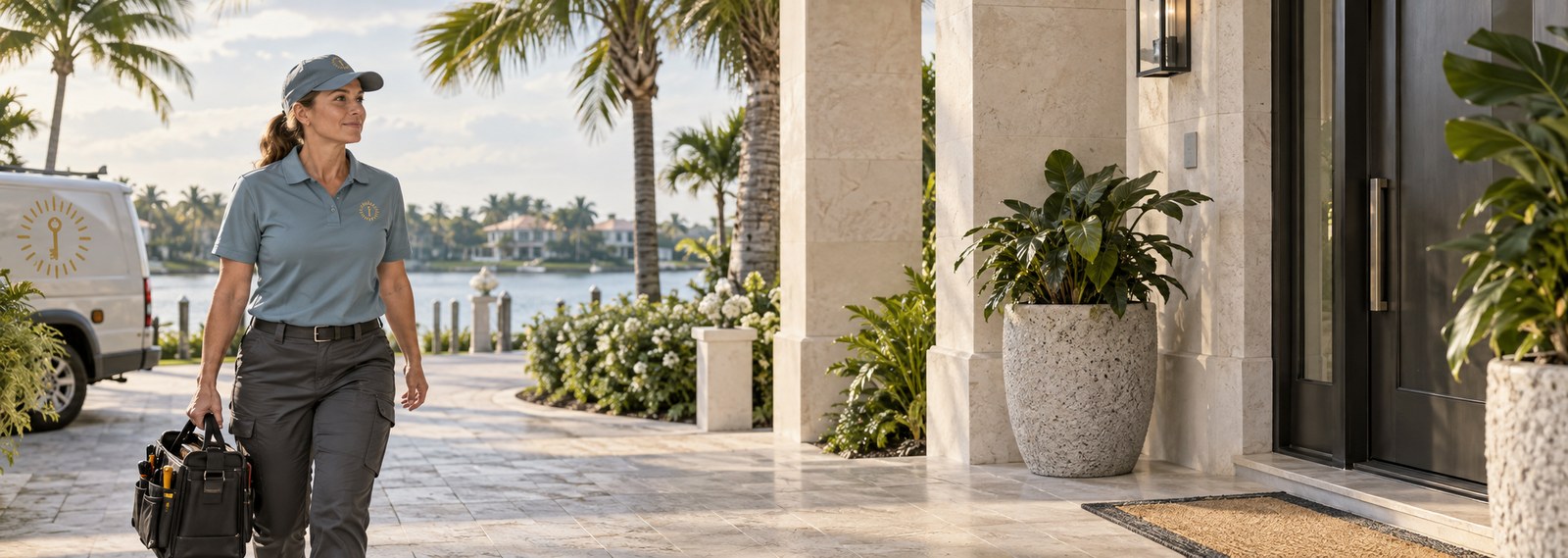
Many of the communities that branch off a long residential road are behind gates, guard houses or code-controlled entries. That changes how a locksmith call works, from how the technician gets in to how a home is secured once inside. This page explains what to arrange before calling, how gate access affects the visit and which door, garage and lock issues come up most often in planned neighborhoods.
How a gated entry changes a service call
A locksmith visit to a home behind a gate begins before the technician reaches the door. The vehicle must be allowed in, which means the resident, or the person calling, has to put the technician on a visitor list, provide a code or tell the guard what company is arriving. Without that step, even a short visit can be held at the entrance while the guard tries to reach the resident.
This matters most when someone is locked out and the phone is their only tool. If your phone is in your pocket but your keys are inside, call the gate directly or ask a neighbor to help, and tell the locksmith the community name, the street and the house number so the visit can be arranged. Communities have different procedures, and knowing yours saves time.
Some neighborhoods require the guard to see an identification or log the vehicle plate. A reputable technician is happy to cooperate, and a calm approach from the resident helps. Mentioning at the start of your call that the community is gated allows the dispatcher to prepare the technician for any check at the entrance.
What to arrange before the technician arrives
A few minutes of preparation make a gated visit smooth. Tell the guard house or the gate system that a locksmith is coming, ideally with the company name and a description of the vehicle. If the community uses a resident app or a call box code, add the visit in advance so the gate opens when the technician arrives.
Next, make sure the technician can find the house. Large communities have winding streets, similar-looking homes and cul-de-sacs, and a missed turn costs time. Giving the street name, house number and a landmark, such as the nearest clubhouse or pool, helps. If the house number is hard to see from the road, say so.
Finally, prepare your proof of authority. For a home, the locksmith confirms you live there or have the owner's permission before opening anything. A utility bill, a driver's license with a matching address or a lease can be enough, and for a guest or relative, the owner can confirm by phone. It is a simple step that protects every resident.
- Add the locksmith to the visitor list or tell the guard house
- Give the community name, street and house number clearly
- Describe a landmark if the house is hard to find
- Have identification or proof of residence ready
Lockouts in planned communities
Lockouts in a planned neighborhood often follow familiar patterns. A garage door closes behind someone taking out the trash, a front door latches while a resident checks the mail, or a key is left inside while the family unloads from a car. These are usually quick to resolve when the lock is in good condition, and the key is to avoid forcing anything.
A locksmith will assess the door and choose the least invasive method. Many standard deadbolts and knobsets can be opened without any damage to the lock or the finish. If the door is deadbolted from inside with no outside key access, or if the lock is damaged, the method may differ, and the technician will explain what is planned.
If you are locked out and a family member or neighbor has a spare key, ask them first. Planned communities often have a close-knit feeling where neighbors keep an eye out for each other. If no key is available, call and explain your situation, and confirm availability. The technician checks your authority at the door before opening.
Garage doors, keypads and the entry from the garage
Homes in planned communities often use the garage as the main entry. Residents drive in, close the garage door and walk through an interior door, so the front door may be used rarely. That interior garage door is an important lock, and it is often an ordinary knobset that was never meant to be a primary barrier.
A locksmith can check the garage entry door, strengthen the strike, and replace a weak knob with a proper deadbolt if desired. Many owners also like a keypad on the exterior of the garage so family members can enter without a key. These work on a separate system from the garage door opener, and the technician can explain the difference.
Lockouts happen here too. A remote that stops working, a battery that dies, or an entry door that locks automatically can leave someone stuck outside. Keeping a secure spare key and knowing the manual release for the garage door are useful habits. The locksmith can talk through the layout of your garage and propose a sensible plan.
Rekeying a home you have just bought or moved into
When a family moves into a home in a planned neighborhood, they receive keys from the previous owner, the real estate agent, the builder or a property manager. It is impossible to know how many copies exist. Rekeying is the straightforward solution, and it is usually the first thing a locksmith suggests to a new owner.
The process is done on the spot. The technician removes each cylinder, changes the pins and tests the new key in each lock. Because planned communities often have uniform door hardware, the work goes smoothly, and most exterior doors can be keyed alike. The garage entry, front door, patio door and any side gate can share a key if you prefer.
Many owners also add a keypad deadbolt during this visit, particularly if there are teenagers or a pet sitter in the household. The technician explains how to set codes, how to change them and how to keep a mechanical backup. Authority is checked, so be ready to show a closing document or similar proof of ownership.
Patio doors, sliders and lanai access
Homes in this part of Florida often feature a sliding glass door onto a lanai or pool area. These doors are large, convenient and a bit of a weak spot if not maintained. The latch is usually a simple hook, and the sliding panel can lift out of its track if the anti-lift hardware is missing or worn.
A locksmith can improve slider security with a secondary lock, a bar or a pin that stops the door from being lifted or forced. Many owners also like a keyed lock on the slider so family members can lock the door from outside when they leave the lanai. These additions are inexpensive in effort and do not change the look of the door.
Humidity and salt air affect slider tracks and latches. Sand and debris collect in the track, and the latch may become stiff. Cleaning the track and lubricating the latch lightly prevents many problems. If the slider does not close and latch easily, it is worth getting it looked at before it fails entirely.
Seasonal residents and homes left empty
Many homes in these neighborhoods are occupied only part of the year. Seasonal residents return in the cooler months and leave in the summer, which means the house sits empty through heat, storms and humidity. During that time, a locked door is the main defense, so its condition matters more than usual.
Before leaving, an owner can ask a locksmith to check every exterior lock, strengthen strike plates and make sure windows and sliders latch properly. They can also set up a simple key plan for the person who looks after the property, such as a property manager or a trusted neighbor, with a key that can be changed later if needed.
When the owner returns, a lock that sat unused may have stiffened. A quick cleaning and lubrication usually fixes it, but a worn cylinder may need replacing. Calling before the first lockout rather than after saves stress, and the locksmith can confirm availability and describe what the visit involves.
Vehicles, guests and parking in the community
Residents are not the only people who get locked out inside a gated neighborhood. Guests, family members and service providers sometimes lock keys in cars parked in driveways or on the street. A vehicle lockout in a community has its own considerations, since the car may be parked where the technician can reach it, but the visit still needs to pass the gate.
Before opening any vehicle, the locksmith confirms ownership or authority. The driver may show a registration, identification or other documents connecting them to the car. If the car belongs to a relative or friend, the owner can confirm by phone. It is a short step that protects the vehicle and its owner from misuse.
Modern vehicles have a variety of key types, from traditional metal keys to proximity fobs. The technician describes the situation in general terms, and the approach depends on the vehicle. Having the make and the type of key ready when you call helps the dispatcher understand what is needed, and a quote is given by phone before dispatch.
Community rules and what a locksmith can change
Planned communities often have an association with rules about exterior appearance. That can include door color, hardware finish and visible additions. Before changing a front door handle set, a resident should check whether approval is required. A locksmith can suggest hardware that matches current finishes so changes are subtle and compliant.
Interior locks and hardware are generally the owner's choice, and rekeying does not change the outside appearance at all. For this reason, rekeying is often the simplest first step in a community with strict rules. It strengthens security without changing anything visible, and it can be done in a single visit.
If the association controls common gates, pedestrian doors or amenity buildings, those fall outside the resident's authority. The locksmith can advise, but the board or property manager must approve work on shared hardware. Knowing the line between private and common saves time and prevents conflict later.
Calling a locksmith for a gated community
When you call, state the community name, the street, the house number and the nature of the problem. Mention how the gate works and whether you have arranged access for the technician. These details help the dispatcher plan the visit and tell the technician what to expect at the entrance.
For simple jobs such as a lockout or a rekey, the quote is given by phone before dispatch. If the job is complicated, a technician visits to assess it, and the service call charge is explained before anyone is sent. This approach keeps the visit transparent and allows you to decide whether to proceed.
At the door, the technician confirms your authority, explains what will be done and carries out the work. You should leave with working keys, a lock that behaves properly and a clear sense of anything else to watch. Call to confirm availability, especially if you need a time that suits a guard house schedule or an association rule.
Golf and club communities: clubhouse doors and cart sheds
Some neighborhoods are built around a golf course or club, and with that come doors that homes do not have. There may be a pool house, a cart shed, a storage room for the association or a gate to a maintenance area. These are common property, which means the association or management company decides who can change the locks and who may call a locksmith.
A resident who finds a problem with a common door, such as a pool gate that will not latch or a fitness room door that sticks, should report it to management rather than calling a locksmith directly. Management then authorizes the work. This keeps the community's key system intact and prevents a well-meaning repair from locking others out.
Inside the home, golf club residents often have a golf cart garage or storage area with its own door. These get used daily and take wear. A worn lock, a bent latch or a door that hangs badly can be repaired quickly, and a locksmith can keep the key matched to the rest of the house to avoid carrying yet another key.
Gate codes, remotes and what happens when they change
Access systems evolve. A community may change its gate codes regularly, replace resident remotes or move to an app-based system. When that happens, residents sometimes find that the code that worked last month no longer opens the pedestrian gate, which can lead to being locked out of the community entirely.
Locksmith work does not usually include programming community gate systems, which belong to the association and its vendors. What a locksmith can do is help with the physical doors and locks at the home itself. If you are stuck at a gate, contact management first, then call the locksmith once you can arrange entry for the visit.
For your own home, consider whether a keypad or smart lock gives your family a simple way to enter without carrying a key. Codes can be given to guests and cancelled afterward, which suits a household that hosts visitors. The technician explains how the lock works, what happens with low batteries and how to keep a mechanical backup.
Cul-de-sacs, shared drives and finding the right house
Planned neighborhoods often include cul-de-sacs, shared driveways and streets with repeating house styles. For a technician arriving for the first time, finding the right door can be harder than opening it. A wrong turn in a loop of identical streets wastes time and may leave you waiting longer than necessary.
Help the technician by describing the house in plain terms. Mention the door color, a distinctive tree, a mailbox style or a neighbor's landmark. If the house number is small or hidden, say so. If you can, stand outside where you can be seen, or turn on a porch light so the technician can spot the house as they approach.
For shared drives, tell the dispatcher which side or which house you are. Neighbors sometimes share an access lane, and a technician who knocks on the wrong door causes needless confusion. A clear description at the start of the call keeps the visit smooth and respectful to everyone on the street.
Frequently asked questions
Do I need to tell my community's gate that a locksmith is coming?
Yes, it is a good idea. Add the locksmith to the visitor list, give the guard the company name or send a gate code if your community uses one. Without that step, the technician may be held at the entrance while the guard tries to reach you. Call us with the community name and street.
What proof of residence will the locksmith ask for?
The technician checks ownership or authority before opening, rekeying or changing a lock. A driver's license with a matching address, a utility bill, a lease or a closing document can be enough. If you are a guest or relative, the owner can confirm by phone.
Is rekeying a good first step after buying a home in a planned neighborhood?
Yes. Previous owners, agents and builders may hold keys, and you cannot know how many copies exist. Rekeying changes the internal pins so old keys stop working, without changing visible hardware. That also helps in communities with strict exterior rules, since nothing looks different afterward.
Can my sliding patio door be made more secure?
Usually, yes. A locksmith can add a secondary lock, a pin or a bar that prevents the panel from being lifted or forced, and can suggest a keyed lock for the lanai side. Cleaning and lubricating the track also helps the latch engage properly in humid air.
How is the price handled for a visit inside a gated community?
Simple jobs are quoted by phone before dispatch. If the work is complicated, a technician visits to assess it, and the service call charge is explained before anyone is sent. Tell us at the start of the call that your community is gated so the visit can be planned.